International Research Journal of Engineering and Technology (IRJET)
e-ISSN: 2395-0056
Volume: 09 Issue: 04 | Apr 2022
p-ISSN: 2395-0072
www.irjet.net
Risk Management in Retrofitting Projects Shrikant Pawar Student, Construction Management, D.Y. Patil College, Akurdi, Maharashtra, India ---------------------------------------------------------------------***--------------------------------------------------------------------Abstract – Risk management is now an important management technique in any project because of the possible negative impact of a risk on project objectives. The goal of risk management in retrofitting projects is to make informed judgments, avoid unexpected cost overruns, schedule overruns, poor quality, and incidents, and make the appropriate decisions to meet the retrofitting objectives. To prevent such risks in retrofitting projects, we must first identify them and then manage them. The goal of this study is to identify and understand the risks associated with retrofitting projects, as well as what steps may be taken to mitigate those risks. A good risk management strategy can assist in not just preventing but also resolving risk. The risks are described in this article, together with their influence on the project and the solutions (recommendations) that can be implemented to reduce or mitigate the risk.
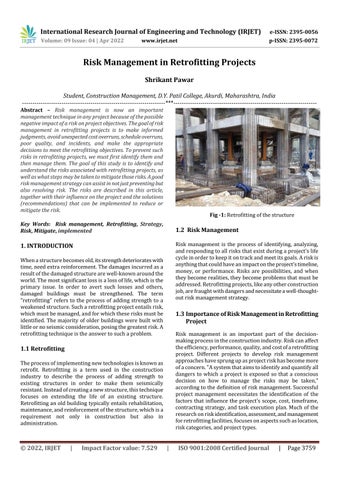
Fig -1: Retrofitting of the structure
Key Words: Risk management, Retrofitting, Strategy, Risk, Mitigate, implemented
1.2 Risk Management Risk management is the process of identifying, analyzing, and responding to all risks that exist during a project's life cycle in order to keep it on track and meet its goals. A risk is anything that could have an impact on the project's timeline, money, or performance. Risks are possibilities, and when they become realities, they become problems that must be addressed. Retrofitting projects, like any other construction job, are fraught with dangers and necessitate a well-thoughtout risk management strategy.
1. INTRODUCTION When a structure becomes old, its strength deteriorates with time, need extra reinforcement. The damages incurred as a result of the damaged structure are well-known around the world. The most significant loss is a loss of life, which is the primary issue. In order to avert such losses and others, damaged buildings must be strengthened. The term "retrofitting" refers to the process of adding strength to a weakened structure. Such a retrofitting project entails risk, which must be managed, and for which these risks must be identified. The majority of older buildings were built with little or no seismic consideration, posing the greatest risk. A retrofitting technique is the answer to such a problem.
1.3 Importance of Risk Management in Retrofitting Project Risk management is an important part of the decisionmaking process in the construction industry. Risk can affect the efficiency, performance, quality, and cost of a retrofitting project. Different projects to develop risk management approaches have sprung up as project risk has become more of a concern. "A system that aims to identify and quantify all dangers to which a project is exposed so that a conscious decision on how to manage the risks may be taken," according to the definition of risk management. Successful project management necessitates the identification of the factors that influence the project's scope, cost, timeframe, contracting strategy, and task execution plan. Much of the research on risk identification, assessment, and management for retrofitting facilities, focuses on aspects such as location, risk categories, and project types.
1.1 Retrofitting The process of implementing new technologies is known as retrofit. Retrofitting is a term used in the construction industry to describe the process of adding strength to existing structures in order to make them seismically resistant. Instead of creating a new structure, this technique focuses on extending the life of an existing structure. Retrofitting an old building typically entails rehabilitation, maintenance, and reinforcement of the structure, which is a requirement not only in construction but also in administration.
© 2022, IRJET
|
Impact Factor value: 7.529
|
ISO 9001:2008 Certified Journal
|
Page 3759