
Augmented Reality in Medical Education

Page 1

International Research Journal of Engineering and Technology (IRJET) Volume: 09 Issue: 04 | Apr 2022

www.irjet.net

e-ISSN: 2395-0056 p-ISSN: 2395-0072

Augmented Reality in Medical Education Pradeep Choudhary 1, Pooja Chopra2, Tushar Ravikant Dubey3, Prof. Rupali Satpute4 123Students,

Department of Electronics and Telecommunication Engineering, K.J. Somaiya Institute of Engineering and Information Technology, Mumbai, Maharashtra, India. 4 Assistant Professor, Department of Electronics and Telecommunication Engineering, K.J Somaiya Institute of Engineering and Information Technology, Mumbai, Maharashtra ,India. ---------------------------------------------------------------------***---------------------------------------------------------------------

Abstract - Education in the medical field involves

1. AR provides users with an authentic and situated experience, when connected with the surrounding realworld environment.

workplace training and knowledge of complex skills that require effective performance up to professional standards in the work environment. Augmented Reality (AR) uses computer vision, computer graphics techniques and image processing to integrate digital content into the real world. It allows real-time interaction between the real objects, virtual objects and the user. AR can be used to embed 3D graphics into a video in such a way as if the virtual elements were part of the real environment. The use of AR in industry is increasing with applications being developed for education, entertainment, retail and marketing, gaming, military, healthcare, travel and tourism, manufacturing, automotive industry, architecture and engineering. AR provides remote learning and interactive simulations; thus AR-based teaching programs are widely being adopted within medical schools across the world.

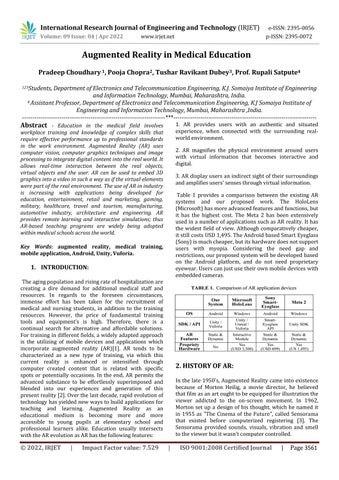
2. AR magnifies the physical environment around users with virtual information that becomes interactive and digital. 3. AR display users an indirect sight of their surroundings and amplifies users' senses through virtual information. Table 1 provides a comparison between the existing AR systems and our proposed work. The HoloLens (Microsoft) has more advanced features and functions, but it has the highest cost. The Meta 2 has been extensively used in a number of applications such as AR reality. It has the widest field of view. Although comparatively cheaper, it still costs USD 1,495. The Android based Smart Eyeglass (Sony) is much cheaper, but its hardware does not support users with myopia. Considering the need gap and restrictions, our proposed system will be developed based on the Android platform, and do not need proprietary eyewear. Users can just use their own mobile devices with embedded cameras.

Key Words: augmented reality, medical training, mobile application, Android, Unity, Vuforia.

1. INTRODUCTION: The aging population and rising rate of hospitalization are creating a dire demand for additional medical staff and resources. In regards to the foreseen circumstances, immense effort has been taken for the recruitment of medical and nursing students, in addition to the training resources. However, the price of fundamental training tools and equipment’s is high. Therefore, there is a continual search for alternative and affordable solutions. For training in different fields, a widely adapted approach is the utilizing of mobile devices and applications which incorporate augmented reality (AR)[1]. AR tends to be characterized as a new type of training, via which this current reality is enhanced or intensified through computer created content that is related with specific spots or potentially occasions. In the end, AR permits the advanced substance to be effortlessly superimposed and blended into our experiences and generation of this present reality [2]. Over the last decade, rapid evolution of technology has yielded new ways to build applications for teaching and learning. Augmented Reality as an educational medium is becoming more and more accessible to young pupils at elementary school and professional learners alike. Education usually intersects with the AR evolution as AR has the following features:

© 2022, IRJET

|

Impact Factor value: 7.529

2. HISTORY OF AR: In the late 1950’s, Augmented Reality came into existence because of Morton Heilig, a movie director, he believed that film as an art ought to be equipped for illustration the viewer addicted to the on-screen movement. In 1962, Morton set up a design of his thought, which he named it in 1955 as "The Cinema of the Future", called Sensorama that existed before computerized registering [3]. The Sensorama provided sounds, visuals, vibration and smell to the viewer but it wasn’t computer controlled.

|

ISO 9001:2008 Certified Journal

|

Page 3561


Turn static files into dynamic content formats.
Create a flipbook
Augmented Reality in Medical Education by IRJET Journal - Issuu