
ARIMA Based Weather Prediction Model using IoT and Open Source Data

Page 1

International Research Journal of Engineering and Technology (IRJET)

e-ISSN: 2395-0056

Volume: 09 Issue: 04 | Apr 2022

p-ISSN: 2395-0072

www.irjet.net

ARIMA Based Weather Prediction Model using IoT and Open Source Data Gunjan Rawat1, Dhruv Patel2, Prajwal Khapare3, Prof Sandhya Deshpande4 1Department

of Electronics and Telecommunication Engineering, KJ Somaiya Institute of Engineering and Information Technology(Autonomous), (Affiliated to University of Mumbai),Mumbai,India) 2Professor, Department of Electronics and Telecommunication Engineering, KJ Somaiya Institute of Engineering and Information Technology(Autonomous), (Affiliated to University of Mumbai),Mumbai,India) ---------------------------------------------------------------------***---------------------------------------------------------------------

Abstract -The main objective of our research is to

objects(sensors) embedded with software and other technologies. QGIS is a free and open source geographic information system which allows to analyze and edit spatial information. Machine learning allows applications to become more accurate at predicting outcomes. With our project we are hoping to create a system which will be able to monitor the weather conditions over controlled areas like house, industry, agricultural area. Capture weather parameters like temperature, humidity and rain using sensors and finally predict the rainfall, temperature and humidity by implementing Machine learning Algorithms on the data received from sensors and from IMD.

integrate weather parameters data collected from IMD(Indian Meteorological Department) and AccuWeather.com and combine it with our own data collected from sensors to create a database. This database is then used to predict and monitor the weather of our area. The prediction done in this manner will lead to a more accurate result of the area where the sensors are located and therefore results in better accuracy and is more suitable. As it is with respect to an area, it will be more precise than other Web applications which predict weather of a whole region compared to a specific area. This could find it’s application in a variety of fields such as it can be used by farmers for better prediction, schools, universities and industries/offices where exist extreme weather conditions. IMD data is extracted using Python and a python library created specifically for this purpose called imdlib. This data constitutes the whole of India so QGIS can be used for mapping it to a certain area and the resultant can be stored in the form of a CSV file. The second part of the database is gathered from sensors which are connected to a microcontroller which in turn transfers this data to a wifi module and stores it in the form of CSV file.The database can then be used to work with the ARIMA model to predict the data. ARIMA model is one of the most accurate and easy to implement linear regression model.

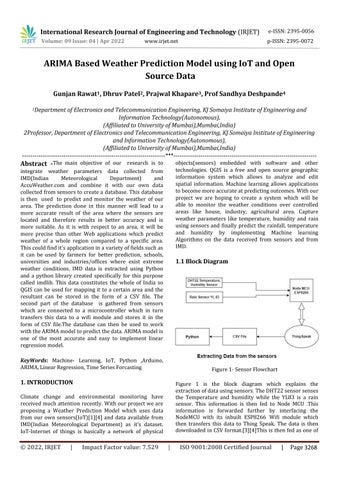
1.1 Block Diagram

KeyWords: Machine- Learning, IoT, Python ,Arduino, ARIMA, Linear Regression, Time Series Forcasting

Figure 1- Sensor Flowchart

1. INTRODUCTION

Figure 1 is the block diagram which explains the extraction of data using sensors. The DHT22 sensor senses the Temperature and humidity while the YL83 is a rain sensor. This information is then fed to Node MCU .This information is forwarded further by interfacing the NodeMCU with its inbuilt ESP8266 Wifi module which then transfers this data to Thing Speak. The data is then downloaded in CSV format.[3][4]This is then fed as one of

Climate change and environmental monitoring have received much attention recently. With our project we are proposing a Weather Prediction Model which uses data from our own sensors(IoT)[1][4] and data available from IMD(Indian Meteorological Department) as it’s dataset. IoT-Internet of things is basically a network of physical

© 2022, IRJET

|

Impact Factor value: 7.529

|

ISO 9001:2008 Certified Journal

|

Page 3268


Turn static files into dynamic content formats.
Create a flipbook
ARIMA Based Weather Prediction Model using IoT and Open Source Data by IRJET Journal - Issuu