International Research Journal of Engineering and Technology (IRJET) Volume: 09 Issue: 04 | Apr 2022
www.irjet.net
e-ISSN: 2395-0056 p-ISSN: 2395-0072
Automatic Pulmonary Nodule Detection in CT Scans using Xception, Resnet50 and Advanced Convolutional Neural Networks models. Dr. S. V. G. Reddy1 , V Bhuvaneshwari2, Aniket Kumar Tikariha2 , Yagna Sriram Amballa2 , Balumuri Sesha Sahith Raj2 1Associate
Professor, Department of Computer Science and Engineering, GITAM University, Visakhapatnam, Andhra Pradesh, 530045, India. 2Student, Department of Computer Science and Engineering, GITAM University, Visakhapatnam, Andhra Pradesh, 530045, India. ---------------------------------------------------------------------***---------------------------------------------------------------------
Abstract - Lung cancer is one of the most dreadliest
Key Words: Lung cancer, Lesion detection, Deep Learning, Advanced Convolutional neural network(CNN), Computed-Tomography (CT) scan, Resnet50, Xception.
diseases that is more probable to grow rapidly with the spread of metastasis. Metastasis is the formation of additional secondary malignant growths away from the primary cancer location. The ability to recognize and diagnose the malignant nodules and categorize them as benign, malignant, or indeterminate(normal) on chest computed-tomography (CT) scans is extremely crucial for early lung cancer diagnosis and treatment. For that purpose, with the increasing advancement of technology numerous machine learning and deep learning techniques have come into existence to diagnose lung cancer where the machines are taught to predict outcomes. By using such means to precisely detect the cancerous pulmonary lung nodules can aid in the timely manifestation of lung cancer. However, it’s not an easy task to develop a reliable lesion detection approach due to irregularity in the patterns of lung lesions, it’s shape, size and the complex nature of the surrounding conditions. In our proposed computer-aided design system we perform cancerous nodule detection by using advanced CNN model and pre-trained CNN models like Resnet50 and Xception. In our advanced CNN models, we integrated several approaches for improved image preprocessing and employed methods such as SMOTE and class weighted approach to account for the dataset's imbalance. By adjusting the imbalances in our dataset, we were able to considerably enhance our model's accuracy. For this project we use the lung cancer screening thoracic computed tomography (CT) images from the IQ-OTHNCCD lung cancer dataset which is collected from kaggle. The dataset contains 1190 images totally. These 1190 images are the CT scan slices of 110 cases. Each case approximately having 10 slices. These images are categorized into 3 classes: normal, benign, and malignant. Among them, there are 40 malignant instances, 15 benign cases, and 55 normal cases. In this project we try to build our own Convolutional Neural Networks to classify the images into one of the three classes and we also employ the pre-built architectures, namely RESNET50 and XCEPTION, trained on the image net dataset and compare their performances on certain metrics.
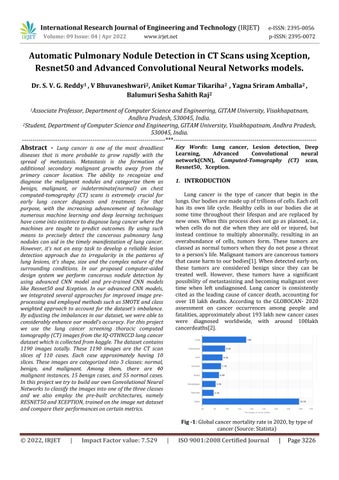
1. INTRODUCTION Lung cancer is the type of cancer that begin in the lungs. Our bodies are made up of trillions of cells. Each cell has its own life cycle. Healthy cells in our bodies die at some time throughout their lifespan and are replaced by new ones. When this process does not go as planned, i.e., when cells do not die when they are old or injured, but instead continue to multiply abnormally, resulting in an overabundance of cells, tumors form. These tumors are classed as normal tumors when they do not pose a threat to a person's life. Malignant tumors are cancerous tumors that cause harm to our bodies[1]. When detected early on, these tumors are considered benign since they can be treated well. However, these tumors have a significant possibility of metastasizing and becoming malignant over time when left undiagnosed. Lung cancer is consistently cited as the leading cause of cancer death, accounting for over 18 lakh deaths. According to the GLOBOCAN- 2020 assessment on cancer occurrences among people and fatalities, approximately about 193 lakh new cancer cases were diagnosed worldwide, with around 100lakh cancerdeaths[2].
Fig -1: Global cancer mortality rate in 2020, by type of cancer (Source: Statista)
© 2022, IRJET
|
Impact Factor value: 7.529
|
ISO 9001:2008 Certified Journal
|
Page 3226