Recommendation system for e-learning based on personality type and learning style

Abstract Current e learning management systems contain a large collection of data collected from multiple sources but the biggest challenge these systems face is providing quality related content to users and reducing thetimeusersspendsearchingforthiscontent.Also,with a difference in the reading ability, not many students can take the same learning track to understand a particular content. Personal Learning Environment (PLE) is an e learning concept that allows users to manage their learning environment both in terms of content and process. However, the main problems with the use of PLE in grade reading are the excessive knowledge and difficulty in finding appropriate reading content for students.
As users of the e commerce system, some students may feeloverwhelmedbythechoiceofavailablecontentthatis offered by the e commerce program there, not always in line with their reading style. This is important as a psychologist suggests that students need to learn according to their style of reading. Therefore, we can recommende learningmaterialstotheuserdependingon theuser'sstyleandlearningstyle.
Keywords (PLE) Personalized Learning Environment, recommendation system, e-learning, Myers-Briggs, Kolb’s learning style, knowledge-based recommendation.
I. INTRODUCTION
The whole e learning system is designed to help the student find his or her goals and help when needed. However,thelearningstyleofthestudentisdifferent,asa result, the continuity of learning and pattern varies betweenstudents.Learningstyleisanaspectoftheuser's mental and psychological functioning under the learning category.Therefore,agoode learningprogramisonethat notonlyrecommendsaknowledge basedconceptbutalso recommends a type of reading material that will help the learnertolearnoracquireaskillinthebestpossibleway.
E Learning systems provide a wide variety of educational content and learning materials such as video tutorials,
blogs, essays, e books, etc. Finding and searching for adequate resources and site related content is one of the keychallengesforE Systems.
Learning management systems provide users with an environmentthatallowsthemtomanageandsearchsmall content units to learn more collaboratively. Each learning resource has its features and characteristics, when it comestothewaythedataispresented,thedatastructure or the content format, etc. The biggest challenges in developing an e learning site are improving the profile creation and continuing to update the profile to suit user changesinpreferences,interests,andinterests.
II. PROBLEM STATEMENT
With the advent of technology and the ever increasing increase in student capacity and the number of departments in educational institutions, it is extremely difficult to change learning materials between students andfaculty.
The main purpose of E Learning is to help students move beyondthetraditionalwayoflearningandget usedtothe internetwheretheirstudynotesarereadilyavailable.
E Learning is an inexpensive, effective, and comfortable way for students to easily access notes and another easy way to study for tests. In our project, we try to give recommended e learning materials to the user based on their personalitytypeandtheirlearningstylesothatthey cansavetimeinaccessingresources.
E learning has become a part of each student, especially after the Covid 19 pandemic. It has forced students to adapttoonlinestudiesandcopewithonlinestudies.
III. REVIEW OF LITERATURE
Nowadays, it is a quite common technology used in e commerce systems to assist users in the retrieval of relevant items. Despite being very successful in the e commerce area, the implementation of the recommended
Anuj Hegishte
Aditya Nair
International Research Journal Of Engineering And Technology (IRJET)
Volume:09
system for education especially e learning is still unexplored. The use of recommending systems for e learning can be beneficial for both students and the instructors,aswellasfortheinstitutions.
There are four recommendation approaches
Collaborative filtering (CF) as explained in paper [4], Content based recommendation (CB), Hybrid recommendation system as explained in paper [5], and Knowledge basedrecommendationsystemasexplainedin papers[1,2,3]
Content based (CB): Content Based recommendation is based on identifying characteristics that are like those a user has preferred in the past and making recommendationsaccordingly.
Collaborative filtering (CF): Collaborative filtering recommendationisbasedonuserbehaviouroruserratings of recommended items. It recommends items liked by similar users and explores diverse possible content. By accessingalearnerprofile,RScanaccessinformationabout age, country, previous learning activities, educational background, etc. With the help of this information, RS can findlearnerswithsimilarlearningpreferencesandsuggest learning materials accordingly. The CF algorithm finds either prediction ratings or recommends a list of top N items.
Hybrid recommendation: Hybrid RS is the combination of CB and CF which combines characteristics of both approaches through mergers of individual predictionsinto one or by adding content information to a collaborative model or by a weighted average of content and collaborative recommendations or getting final recommendationsbasedonthecombinedrankings.
IV. PROPOSED METHODOLOGY
To collect student data we have created a website and conducted a small personality test (MBTI Test). After submittingthetest,theuserwillcometoknowaboutboth its personality type and also users’ learning style will be mentioned.
ISSN: 2395 0056
ISSN: 2395 0072
Fig1.ActivityDiagram
IdentifyingStudentPersonality
After the user submits the test, we analyze the data and identify the user’s personality type. To Identify Student Personality,weareusing theMyers BriggsTypeIndicator (MBTI). Myers Briggs evaluates personality types and classifies the personalities into four types. They are as follows:
Extroversion(E)orIntroversion(I)
Sensing(S)orIntuition(N)
Thinking(T)orFeeling(F)
Judging(J)orPerceiving(P)
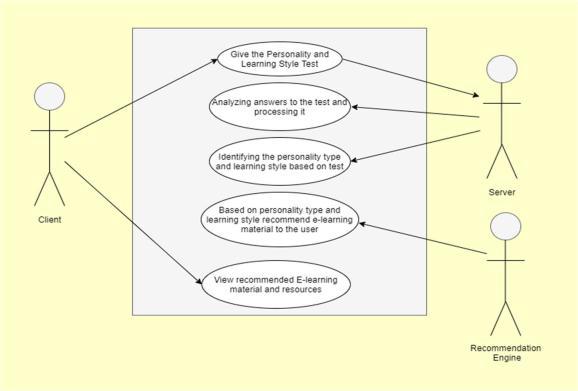
The functionality of the e learning system is illustrated in theuse casediagramshownbelow.
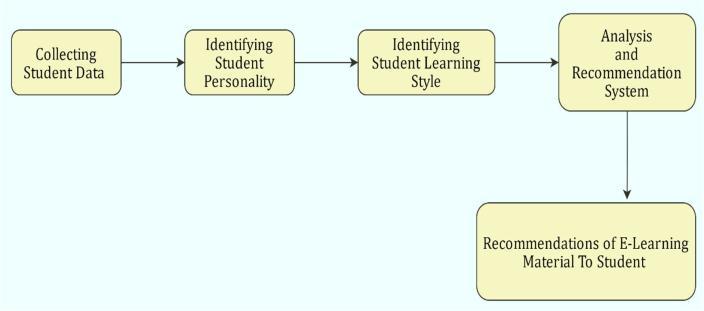
Fig2.UseCaseDiagram
Combined sets of these unique preferences offer 16 differentpersonalitiesandareusuallyrepresentedbyfour characters to represent human movement on four scales.
For example, ESTP stands for Extroversion, Sensing, Thinking,andPerceiving,highlightingfourpreferencesfor thisuser’ shighestperformance.
The MBTI test highlights the unique nature of each
Apart from the sixteen personality types, each type of person has one unique choice (governing process) used with great confidence. It guides our personality and revealsourmotivesandgoalsinthelongerphaseoflife.
IdentifyingStudentLearningStyle
Aftersubmittingthe
thesystemgivesboth
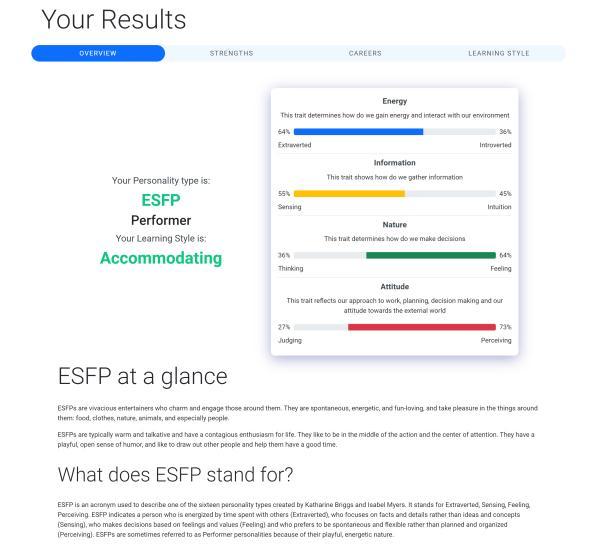
type as well as students learning style as output. Fig. 3 showsthepersonalitytypeandlearningstyleoutput.
AnalysisandRecommendationSystem:Aftersubmitting the test,wewouldanalyze theuser ’sdataandcangetthe personality type and learning style. Based on that our recommendation system will recommend e learning materialtotheuser.
TechnologiesUsed
FrontEnd
HTML5
CSS3
JavaScript
Bootstrap5
BackEnd
NodeJs
DB
ExpressJs
Fig3.Learningstyle
V. RESULTS AND DISCUSSION
To Identify Student
we are using Kolb's Experiential Learning Model. Kolb
by Professor David Kolb. There are four types in which Kolb’smodelis
MBTI test can provide a lot of help in building your personality, which is probably the reason that it has become so enormously popular. It can also be helpful for anindividual toidentifythe perfectlearningstylesuitable fortheuser.Evenwithouttakingtheformalquestionnaire, youcanrecognizesomeofthesequalitiesinyourself.
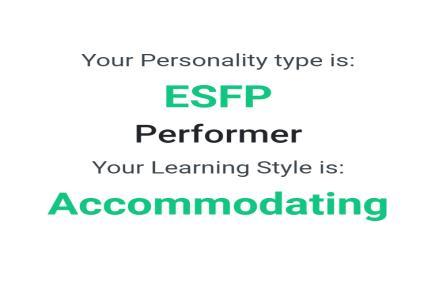
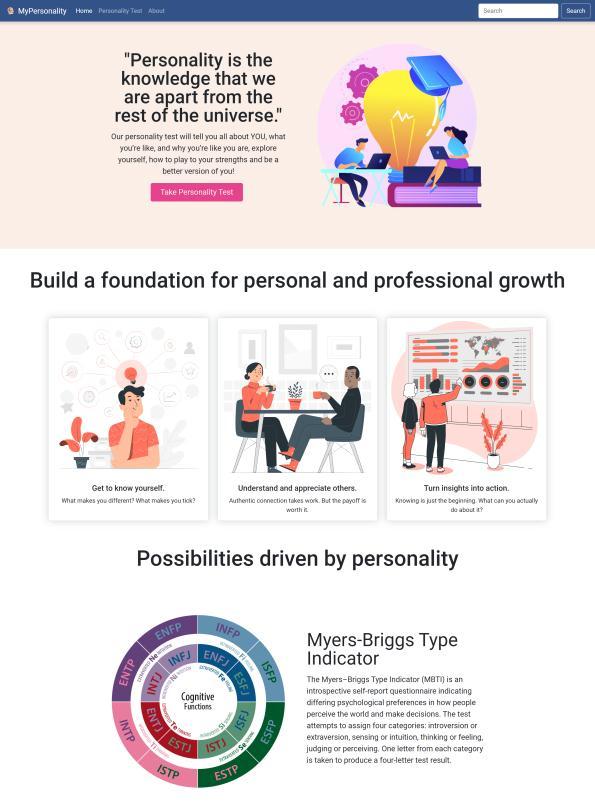
Fig 4. Represents the landing page of the website. It includes basic information about the MBTI test and what arethebenefitsoftakingthetest.
Fig4.Landing
Fig5.representsthepartoftheresultpagewheretheuser will be redirected after submitting the test. Here, the user will get detailed information about the personality type, learningstyle,preferablee learningstyle,strengths,career options,andmuchmoretoexploreaboutthepersonality.
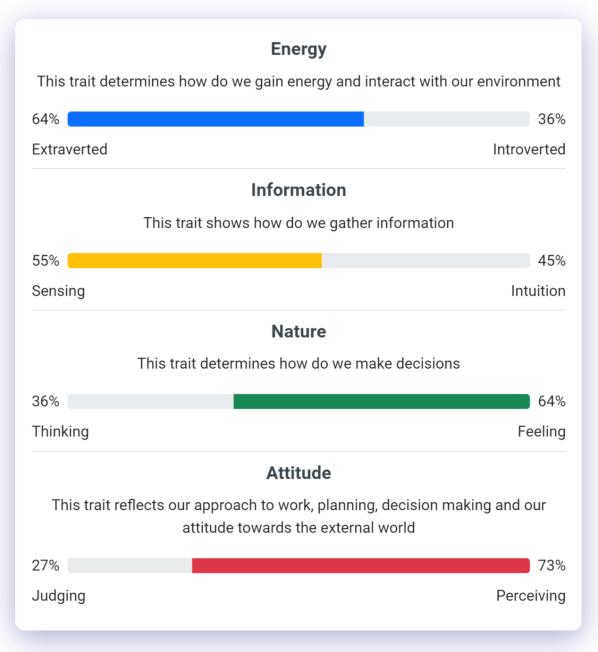
The sixteen personality types are further classified as per their dominant traits. These traits include their attitude towards thinking about a problem, their nature, their enthusiasm, and their knowledge. Fig 6. represents the dominant traits of the resultant personality type in the formofapercentagebargraph.
Fig6.PercentageBargraph
Thedominanttraitsandeachletterofthepersonalitytype arealsostoredinthebackend,usingMongoDb.Here,Each letter dominant trait is stored in the database, as per the option selected by the user while giving the test. Fig 7. shows the data stored in the database using Mongo Db Atlas.
Fig5.Result
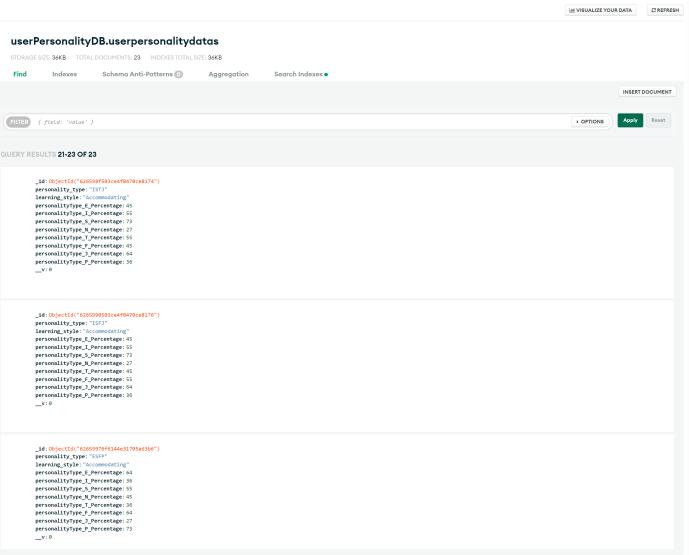
Fig7.Database
VI. CONCLUSION
The Myers & Briggs Foundation helps us to understand that, it is very important to remember that all personality types are equal, and unique in nature and that every type has equal value, and all have different abilities. It is the part where taking the test helps you to understand more aboutyourself.
The combination of the MBTI type indicator and Kolb’s LearningModelfulfillsthegoaloftheinstrument,whichis to simply offer further information about your unique personality. Identifying your strengths, weaknesses, and career opportunities better for your personality is quite helpful in shaping your career. When working in group situations in school or at work, for example, identifying your strengths, your passion, and understanding the strengths and weaknesses of others can be very helpful. When you are working toward completing a project with other members of a group, by giving this personality test, you might realize that certain members of the group are skilled and talented at performing particular actions. By recognizing these differences, the group can better assign tasksandworktogetheronachievingtheirgoals.
REFERENCES
[1] M. S. Halawa, E. M. Ramzy Hamed and M. E. Shehab, "Personalized E learning recommendation model based on psychological type and learning style models,"2015IEEESeventhInternationalConference on Intelligent Computing and Information Systems (ICICIS),2015,pp.578 584.
[2] Kamal, A., Radhakrishnan, S. “Individual learning preferences based on personality traits in an E learning scenario” 2019 Education and Information Technologies.24.1 29.
[3] K. Jetinai, "Rule based reasoning for resource recommendation in personalized e learning," 2018 International Conference on Information and ComputerTechnologies(ICICT),2018,pp.150 154.
[4] F. Hidayat, D. D. J. Suwawi and K. A. Laksitowening, "LearningContentRecommendationsonPersonalized Learning Environment Using Collaborative Filtering Method," 2020 8th International Conference on Information and Communication Technology (ICoICT),2020,pp.1 6.
[5] R. Turnip, D. Nurjanah and D. S. Kusumo, "Hybrid recommender system for learning material using content basedfilteringandcollaborativefilteringwith good learners' rating," 2017 IEEE Conference on e Learning,e Managementande Services(IC3e),2017, pp.61 66.