REVIEW ON COVID DETECTION USING X-RAY AND SYMPTOMS
Hirani
COVID 19 which is caused by SARS COV 2 Virus was declared as a pandemic by theWorldHealthOrganization in the year 2020. Since then, the virus has been imparted in over 44 million population and deceased over 5.6 million lives globally. It has affected peoplementally,physicallyandshaken the global economy as well. With the explosion of virus, there also arises the need to find an effective & feasible method to detect the virus.
Also, Artificial Intelligence and Deep Learning has grown exponentially in the last few years and the Data Science communities has also contributed against this pandemic globally, moreover it is prominently playing a key role in image classification which also includes medical imaging. Convolutional Neural Networks (CNN) have been effective in detecting many diseases already. Therefore, there is considerable prospect that it will detect COVID 19 infected patients with images of Chest X Rays and CT scans. With insight from different papers, our study in this project aims to propose a model for detecting COVID 19diseasethroughchest X Ray images. Publicly available datasets have been used for our project and the concept of CNN have been taken in use. Our model provides an accuracy of about 96.5 %. It can be enhanced by taking a larger number of datasets for training the model.
Key words: COVID-19, Coronavirus, X-Rays, Chest X-Ray images, Convolutional Neural Networks (CNN), Deep Learning, COVID-19 Detection.
1. INTRODUCTION
The COVID 19 outbreak has become a severe health issue which has been a middle of media attention since March 2020.AsofMarch2022,twoyearssincethecovidoutbreak, therehavebeenabout446,911,134confirmedcasesacross theglobe,including6,022,266deaths.Thedatawhichhave been collected during these times state that, USA has the highestnumberofcasesfollowedbyIndia,Brazil,France,UK andsoon.WiththeincreaseinthenumberofcasesofCOVID worldwide, the most common symptoms that have been observed in people are fever, cough, tiredness and loss of taste or smell, but there are also a large number of cases, wherecovidinfectedpeopleareasymptomatic.Forpeople with non young ages & elderly people who have chronic diseases, COVID 19 virus may progress to more serious infectionslikedifficultyinbreathing,chestpain,pneumonia andevendeathinmanycases.Themortalityrateishigherin
Shweta
Mumbai,
elderlypatientsastheviruscomesupovertheimmunityof thosepeopleeasily.Tostoporreducetherateofspreadof virus, many countries imposed strict lockdowns, social distancingnormsandparallellytheyperformeddiagnostic teststofrontlineworkersandgeneralpeopletodetectthe COVIDpositivecasesandisolateaffectedpeopleandtreat theminaprescribedmanner.
The diagnosis of this virus is done by RT PCR (reverse transcription polymerasechainreaction)testsacrossthe globeaftercollectingproperrespiratorytractspecimens,but itisalaboratory basedtest,istimeconsumingandalsonot cost effective. Therefore, there arises the need to develop newlow costrapiddiagnostictoolstodetectthevirus.On the other hand, the recent development of technology in DeepLearningandprocessingofmedicalimageshasoffered supportforthedevelopmentofdiagnostictoolsagainstthis virus.Severalstudieshaveconcludedthepotentialofusing X Ray&CTScanimagestodiagnoseCOVID 19patients.Both can yield similar results but as X Rays are less expensive thanCTscans,theyaremorefavouredandcanbeusedby many nations which have scarcity of resources. There are manyresearchesthathavestateddifferenttechniquesand modelstodifferentiateCOVIDpositivepatientsfromothers by using the concept of Convolutional Neural Networks (CNN).Likemanyotherimageclassificationtechniques,CNN hasbeenperformingextremelywellwithmedicalimaging. Alreadyithasbeenwidelyusedforthedetectionofdifferent diseasesoranomalydetection.

In this paper, we have proposed a CNN model to detect COVIDpositivepatientsfromchestX Rayimages.Withina shortdurationoftimeandresources,thismodelsuccessfully detectspeoplewhoareinfectedwithcoronaviruswithgood accuracy.ThismighthelptoimplementtestingofCOVID 19 even on a larger scale which would really save time and money.
2. LITERATURE SURVEY
CheXNetalgorithm[10]whichisusedtodiagnoseanddetect pneumonia from chest X rays. To achieve higher accuracy thantheexperiencedradiologistbymakingsomechangesto itmadeaConvolutionNeuralNetwork(CNN)algorithmto diagnose 14 pathological conditions in the chest X ray. Trainedthemodelusingadatasetof550chestx rayimages collected from the Kaggle website. Prediction accuracy of 89.7% was achieved which was closer to the CheXNet
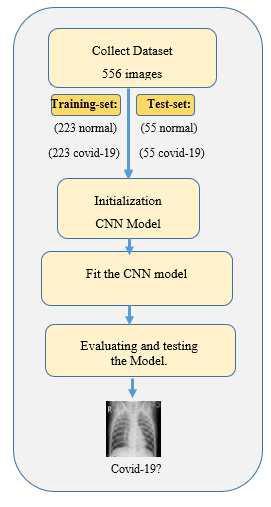
algorithm. The algorithm was trained multiple times to increasethemodelaccuracyondifferentsizesofdatasets. Also,thesamedatahastopassmultipletimestothesame NeuralNetworktoimprovethelearningprocess.Thelackof ahugedatasetactedasahugebarriertoachievinghigher accuracy.Throughexperiment,itisnotedthatanincreasein the training sample achieved more accuracy in the identificationofCovid 19inhumansamples.[1]
Fig.1.TheproposedCNNmodelforCovid 19detection.
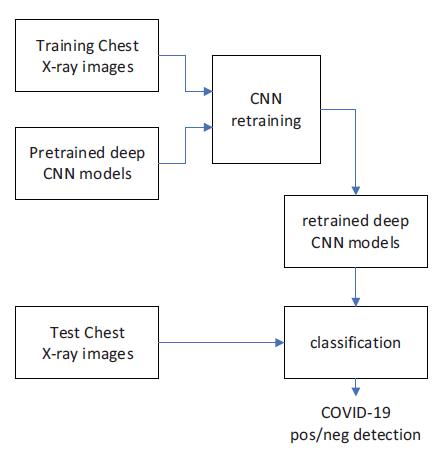
DataScienceandAIhavecontributedalotinthepast,tofind solutionstoproblems.Forglobalresponseagainstthenew coronavirus, Covid 19 special attention is given to developingrapiddiagnostictoolsusedforthedetectionof covid 19usingChestX raysusingthedeepCNNmodel.To train the model, transfer learning has been used. Two different sets of the dataset are used. In this paper, an evaluationofseveralpre traineddeepCNNmodelsonthe detectionofpositivecasesofthecovid 19.Afterevaluating thedifferenttypesofCNNmodels,bestperformingmodels amongtheevaluatedonesweretheDenseNet,ResNet,and Xception models having high accuracy in predicting the Covid 19usingthechestX ray.[2]
Fig.2.Blockdiagramoftheevaluatedarchitecturefor COVID 19detection.
Deeplearninghasbeenplayingagreatroleinthemedical field for the detection of several diseases like Coronary ArteryDisease,Malaria,Alzheimer’sdisease,differentdental diseases and many more. Since CNN plays a great role in image classification. It has been used for the detection of Covid 19usingchestX rays.Asforacovidpatient,everyday isimportantsotoeliminatethedayfortestingthespecimen taken from the patient, this method is very efficient as it gives the results with a very little amount of time and resourcesataverycheapcost.Thishelpsthepatienttotake treatmentearlyandalsohelpsthegovernmenttoimplement testing of Covid 19 on a much greater scale which is very essentialtostopthespreadofcovid 19.
Inthispaper,aCNNmodelisdevelopedanditsevaluationis donewithacomparativeanalysisoftwootherCNNmodels. A good accuracy model is achieved although a limited dataset is available, data augmentation is used such as randomhorizontalflippingandrandomcropping.[3]
SinceCovid 19isspreadingrapidlyintheworld,thereisa hugeshortageofmedicaltestingkitsallovertheworld.So, using the deep Neural Network model can overcome the problem of the shortage of testing kits. By using transfer learning,aResidualNetwork(ResNet)modelisdeveloped bychangingdifferenthyperparameterslikelearningrates and dropout values to achieve good accuracy. During the experiment, as there was a huge shortage of datasets, achievinghigheraccuracybecameverydifficult.Sinceitis illogical to develop a model from scratch with a small dataset, two models ResNet 34 and ResNet 50 which are pre trainedonthehugedatasetsaretrainedandachieved decentaccuracy.Alsoobservedthatbyincreasingthelayers andbychangingparameterstheaccuracyofthedeveloped modelwilldefinitelyincrease.[4]
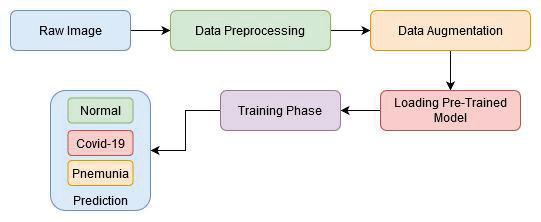
UsingRadiologyto diagnose thepatientsthathaveCOVID symptoms.Theydiscoveredthatthemostusedmethodto testthisdiseaseisRT PCRTest,whichisatime consuming process, also transporting of samples requires time. To reducethedurationoftheprocessandtomakeitlesshectic, he proposed a solution to use radiography images of the human chest like X Rays and CT scans. But X Ray image detectionispreferredovertheotherasitiscost effective. Here,they’veusedtheconceptofCNN(ConvolutionalNeural Networks)astheydemonstratehighaccuracyresultsinthe use case of image & object recognition. There are several modelsofCNNwhichhaveevolvedovertime,butthemost commonandmajorlyusedmodelsareResNetandDarkNet models.Theresearchersofthispaperhaveimplementeda unique 19 layered CNN structure which determines the detection of coronavirus and differentiates it from pneumonia.TheycreatedtheirdatasetbycollectingCOVID positivex rayimages,x raysofnormallungs,andimagesof lungs infected with pneumonia from publicly available repositories.Fortrainingtheirmodel,theyhad600images and they decided to select 100 images as corona positive, pneumonia each and the rest 400 as non infected images. Theycreateda model namedCovidAidmodel whichis as follows:
/Pneumonia/Nofindings.
ThearchitectureoftheirmodelwasinfluencedbyDarkNet’s modelarchitecture.Theymade19layersofconvolutionin which 7 were single layered and 4 as triple layered structures,alongwithmax poolinglayersandthentheyused severaloperationsintheirarchitecture.
Their model Covid Aid Model achieved 87% accuracy in multiclass classification of 3 classes namely: Covid/ Pneumonia/ No Findings. The limitation which they faced was the limited availability of high quality images for training their dataset. But they proposed that their model can be used effectively in remote areas which don’t have accesstotestingkitsormedicalexperts.[5]
TheauthorsofPapersmadethoroughresearchonseveral papersandstudiedabouttheoutbreakofCoronaviruswhich they concluded that first transmitted from live animals to humans and then human to human. They identified the problemsfacedbythecitizenswhowerestrandedforhours at the laboratories for taking RT PCR tests, like overcrowdingwhichcanleadtomorecross infectionsand spread the virus, also the lower number of radiologists available at the test centres; so, the authors proposed an approach of making use of AI and Machine Learning algorithmswithavisiontoeliminatethecost,timeandother resources. They have selected the best Deep Learning models to detect and diagnose the segment of lungs, and predict the infected patients using Deep Learning techniques.
They have presented the summary of their work on classification, segmentation & prediction in tables. They comparedtheperformanceofapprox.40modelsbyaltering thedatasets,modelKitslikeX RayImages/CTscanimages orboth.ManyDLmodelsout performedothermodelsbased onaccuracy,numberoftrainingcases,etc.Limitationwhich theyobservedwasthesmallernumberofdatasetsavailable fortrainingtheirmodel.[6]
TheresearcherhascreatedaConvolutionalNeuralNetwork model and pre trained on different architectures like MobileNet,DenseNet,forfeatureextractionofX Rayimages. TheoutputofCNNmodelisMatrixform,thisoutputisgiven to the Dense layer for training. Next procedure of Dense layer training was done on Machine learning algorithms Bayes,RF,MLP,SVM,kNN.Themethodofextract classifier pair combination, is resulting in achieving very good Accuracy. For one dataset combination of MobileNet architecture and SVM linear kernel classifier archives the accuracy and F1 score of 98.5% on the other hand for second dataset DenseNet201 as extractor and MLP as classifiergivesthebestaccuracyandF1 score0f95.6%.The solution in the paper has not undergone clinical study, though this system is fast, accurate and automatic. Only limitationofthepaperisthesmalldataset,whichconsistsof 388imagesoutofwhich194imagesarenormalchestXray and 194 images are COVID 19 positive X ray images. The limitationcanbeovercomedbymoredatasetimagesandby clinicalstudyofXray.[7]
The group of researchers from Iran and Hungary have proposed a solution on Rapid and accurate diagnosis of COVID 19fromComputerisedTomography(CT)scansusing Deeplearning.TheresearchershaveusedMachineLearning, ArtificialNeuralNetwork(ANN)andEnsemblelearning(EL) methods to find solutions.The single models include SVM,Naive Bayes,MLP and CNN on other hand ensemble models have AdaBoost and GBDT algorithm. Dataset includes 430 images of COVID 19 chest X ray while 550 images of normal chest X ray. The researchers have used 75%datafortrainingand25%datafortesting.Outofmany
Journal of Engineering and Technology
CNNhas97%accuracywhileSVMalgorithmhas 99%
Proposed a solution for early detection of lung detected COVID 19 using Chest X Ray. It was classified using the ConvolutionalNeuralNetworkarchitectureResNet50model. Thedatasetof1200imageswascollectedfromfourdifferent sources and has two different classes COVID 19 and non COVID19. Then authors applied image augmentation for improvingthetrainingprocess.Finalstagewastopretrained RestNet 50CNNmodetoextractdeepfeaturesofchest X Ray. The authors have achieved 99.5% classification excellentaccuracy.Smallsizeofthedatasetisalimitationof thepaper.[9]
3. PROPOSED SYSTEM
ChestX rayandsymptomsasinputdata:Thedatathatisto beprocessediscollected,chestX raycanbeinanyformsuch asaPNG,JPEG,JPG.Oncethedataiscollecteditissenttothe furtherstages.Thismodeliseasytoimplementbecauseof thefactthatitrequiresveryfewdevicesorsoftwareforitto work.X rayresizing:TheX rayimagegivenasinputcouldbe ofanysize.Asthemodelneedsaspecificsizeforpredictions itneedstoberesizedelseitresultsinanerror.AresizedX ray image is given to the further stages for predictions. Predictions:TheresizedchestX rayimageisdirectedtothe trained CNN model for predictions while the symptoms whicharegivenasinputareconvertedintotheNumPyarray andgiventothedecisiontreemachinelearningalgorithm forprediction.
Results integration: The predictions of the models get integratedtogivetheresults.Integrationofresultsisdonein thefollowingways: If both themodelsconclude the covid present,itisconfirmedthattheuserhascovid.Ifboththe modelsconcludethenormalasoutput,itisconfirmedthat theuserisconcludedassafe.Incaseofconflict,priorityis given to the X ray, and the user is informed to take medicationandfollowcovidprotocols.Outputofthesystem : The outcome of the system will have the domination of resultsgivenbytheCNNmodelastheresultwasgenerated usinganX raywhichisgeneratedbyscanningthelungs.A patient can be symptomatic or asymptomatic; it differs according to the immune system of one's body. However, prediction based on symptoms supports the predictions madebytheCNNmodel.
4. ADVANTAGES AND LIMITATIONS:
4.1. Advantage
1. Noneedforatestkitorhugeinfrastructure.
2. Patients can be tested by maintaining social distance andwithoutmuchinteractionwithdoctors.
3. Noneedforcollectinganyspecimensfromthepatient.
4. Highlycost effectiveandquickresultscanbeachieved, handywhenmasscovid 19testingisneeded.
5. Waiting time for the results of the patient will be avoided, the patient could get medical treatment on time.
6. Donotneedanextramedicalprofessional.
7. Thesystemwillprovideaccurateandunbiasedresults.
4.2. Limitation
1. A very huge dataset with proper authorization is neededtoachievehigheraccuracy.
2. Producewrongresultsifdataaugmentationisnotdone whileusedintherealworld.
3. Highaccuracyisneededsothatmodelisreliabletouse.
4. OnlyadigitalX rayisneededforthemodeltodetect.
5. APPLICATIONS
1. Atgovernmenthospitals,whereahugecrowdgathers fortesting.
2. Testing poor people as they can afford it since it is cheap.
3. Testing of the critical patients where time is very crucialforsavinglife.
ACKNOWLEDGEMENT
We sincerely acknowledge our Project guide and co ordinatorProfessorShwetaSharma,fortheirguidanceand co operation.WewouldliketomentionShrikantKalurkar, Principal Atharva College of Engineering and Dr.Suvarna Pansambal HOD Computer Engineering for giving us an opportunitytoworkonthisproject.
Intheend,wewouldliketomentionourparentsandfriends for their immense support and help. Without them, completingthisprojectwouldhavebeendifficult.
REFERENCES
[1]AreejA.WahabAhmedMusleh,AshrafYounisMaghari,” COVID 19DetectioninX RayImageusingCNNAlgorithm.” 2020 International Conference on Promising Electronic Technologies(ICPET)
[2] Iosif Mporas, Prasitthichai Naronglerdrit, “COVID 19 Identification from Chest X Rays” 2020 International Conference on Biomedical Innovations and Applications (BIA)
[3] Khandaker Foysal Haque, Fatin Farhan Haque, Lisa Gandy, Ahmed Abdelgawad “Automatic Detection of COVID 19 from Chest X ray Images with Convolutional
International Research Journal of Engineering and Technology (IRJET)
Volume: 09 Issue: 04 | Apr 2022 www.irjet.net
Neural Networks” .2020 International Conference on Computing, Electronics & Communications Engineering (iCCECE)
[4] Ravneet Punia, Lucky Kumar, Mohd. Mujahid, Rajesh Rohilla “Computer Vision, and Radiology for COVID 19 Detection” 2020 International Conference for Emerging Technology(INCET)
[5]ShrinjalSingh;PiyushSapra;AmanGarg;DineshKumar Vishwakarma “CNN based Covid aid: Covid 19 Detection using Chest X ray” 2021 5th International Conference on ComputingMethodologiesandCommunication
[6] Akshay Kumar Siddhu; Ashok Kumar; Shakti Kundu “Review Paper for Detection of COVID 19 from Medical Images and/ or Symptom s of Patient using Machine Learning Approaches” 2020 9th International Conference SystemModelingandAdvancementinResearchTrends:
[7]EleneFirmezaOhata,GabrielMaiaBezerra,JoãoVictor Souza das Chagas, Aloísio Vieira Lira Neto, Adriano Bessa Albuquerque, Victor Hugo C. de Albuquerque “Automatic DetectionofCOVID 19InfectionUsingChestX RayImages Through Transfer Learning” IEEE/CAA JOURNAL OF AUTOMATICASINICA,VOL.8,NO.1,JANUARY2021
[8] Hamed Tabrizchi, Amir Mosavi, Akos Szabo Gali, Imre Felde,LaszloNadai“RapidCOVID 19DiagnosisUsingDeep LearningoftheComputerizedTomographyScans”IEEE3rd International Conference and Workshop in Óbuda on ElectricalandPowerEngineering:
[9]ZehraKarhan,FuatAkal “Covid 19ClassificationUsing DeepLearninginChestX RayImages”
[10] Pranav Rajpurkar, Jeremy Irvin, Kaylie Zhu, Brandon Yang, Hershel Mehta, Tony Duan, Daisy Ding, Aarti Bagul, RobynL.Ball,CurtisLanglotz,KatieShpanskaya,MatthewP. Lungren, Andrew Y. Ng “CheXNet: Radiologist Level PneumoniaDetectiononChestX RayswithDeepLearning
© 2022, IRJET
ISSN: 2395 0056
ISSN: 2395 0072
Impact Factor value: 7.529 | ISO 9001:2008