International Research Journal of Engineering and Technology (IRJET)

International Research Journal of Engineering and Technology (IRJET)
(1) Graduate Student, Dept. of Electrical Engineering and Computing, RIT Dubai, UAE. (2) Professor of Electrical Engineering, Dept. of Electrical Engineering and Computing, RIT Dubai, UAE.
***
Abstract -. In the smartgrid, substations play a significant role in distributing quality power to customers. The intelligence of substations equipment has drawn expanding consideration in the smart grids. Smart Substations are expensive and are challenging to keep up with since they are dispersed in one unit. The functionality optimization and device integration are significant points to be considered in theadvancementofasmartsubstation.Thispaperreviewsthe proposed methods mainly based on IEC61850 Standard and communication technologies. The techniques to be assessed are like "three layer, "SCADA based substation "with ICS. These strategies manage applications, communication protocols, architecture, and information standards largely focusing on substation automation in transmission and distributionnetworks.Theanalysisshowsthatthereisagreat exertion from the Smart Grid key stakeholders to develop interoperabilityacrossthedifferentcomponentsmanagingan electrical grid, from field processes to market exchanges, allowing the information flow to be more accessible and received across applications and domains, and creating opportunity for new applications in multiple domains.
Key Words: Smart grids, substation automation, smart transmission and distribution, improved interoperability,standards,gridreliability.
The conventional electrical grid has undergone essential changes with the introductionof the Smart Grids. Installation of end consumer smart meters distributedrenewablepowergenerationdeployment, and interconnection of operation and information systems need new solutions that can intelligently monitorandadministertheinfrastructure.
Earlysubstationsincludemechanicalrelaysandmeters thatbarelysupportedrecordingandhadnomethodfor correspondence. The fault recorders primarily capturedtheinformationintheformofpapercharts, so reading andinspecting the informationwas nota distinct process. Lack of communication caused any maintenance or troubleshooting to be costly and lengthy due to personnel having to be forwarded to substationsthatwerefarawayandhardtoreach.
WiththeintroductionofHighspeed,microprocessor based Remote Terminals Units (RTUs) or Intelligent Electronic Devices (IEDs) are utilized for substation automationandprotection.IEC61850,introducedin 2003, establishes standard protocols for the communicationandinteroperabilityoftheequipment SASisbasedondecentralizedarchitectureandabay oriented and distributed intelligence concept, for securityandavailabilityreasons.
Substationautomationforpowerdistributionsystems isdesignedtomeettwocompetingdesignobjectives. On one hand, power distribution systems got to be robusttogetridofpoweroutageseveninthepresence of severe external disruptions, such as natural disasters, equipment breakdowns, or fluctuations in supply and demand. Accomplishing this goal needs redundanthardwareandadvancedcontrolalgorithms. Ontheotherhand,suchsystemsgottobeeconomically viable and supply effective power consumption in corresponding to the newest “green society” trends. Thisgoalrequireslessredundancy,butmoreflexibility, adaptability, and reusability of solutions as the electricalgridundergoamajormodificationwiththe introductionoftheSmartGrid.
Beyondaspecificdefinition,focusedonstakeholders (e.g.,TheSmartGridsEuropeanTechnologyPlatform), thesmartgridshouldcovertheentirepowergridfrom generation., to the transmission and distribution infrastructure all aside down to a wide array of electricityconsumers[1].Awell designedsmartgrid initiativebuildsonexistinginfrastructure,providesa higherlevelofintegrationattheenterpriselevel,and hasalong termfocus.It'snotaone offsolution,butit's a change in the way utilities look at different technologiesthatenablebothstrategicandoperational processes.Thedesign,development,anddeployment ofsmartgridsaremoreimportanttomeetingtheever increasingdemandforelectricity[1]
Thesmartgridisawaytoleveragethebenefitsofthe entire application and break down silos of organizationalthinkingbarriers.
International Research Journal of Engineering and Technology (IRJET) www.irjet.net
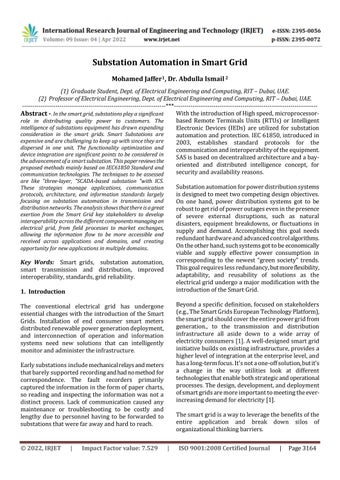
TheInternationalElectrotechnicalCommission(IEC) haspublishedtheIEC61850standard,whichenhances interoperability between substation equipment and enablestheabstractionofcommunicationsservices.It provides vertical and horizontal communication betweendevicesatthreelevels:
level,theIEDssupplyallbayleveloperationssuchas control (command outputs), monitoring (status indications, measured values), and protection. The IEDs connect directly to the switchgear without the need for additional interposing or transducers. Each baycontrolIEDisindependentoftheotherIEDsandits functionality is unaffected by failures that occur in otherbaycontrolunitsofthestation[19]
RedundantPC basedHMIenableslocalstationcontrol throughtheMicroSCADAProsoftwarepackage,which includesawiderangeofSCADAfeatures.Thestation levelincludesstation orientedfunctionsthatcannotbe implemented at the bay level [19]. For example, an alarm or eventlistrelatedtothe entiresubstation,a gateway for communication with the remote control centers.Apledgedmasterclockforthesynchronization ofallentitiesshallbeprovided[19].
Theprocesslevelconsistsofallsubstationdevicesthat are routed with copper cables and connect bay level IEDsusedforcontrolandprotectionusingfiberoptic cables[19]
Fromahigh levelsystemperspective,thesmartgrid can be considered to contain the following key componentsasillustratedinFig.2
(i)Amicroprocessor basedintelligentelectronicdevice (IED)thatprovidesinputsandoutputstothesystem while performing primary control or processing services. Typical IEDs are protection relays, load monitoringand/oroperatorindicatormeters,revenue meters, programmable logic controllers (PLCs), and powerdevicecontrollerssuchascircuitbreakersand transformers[1]
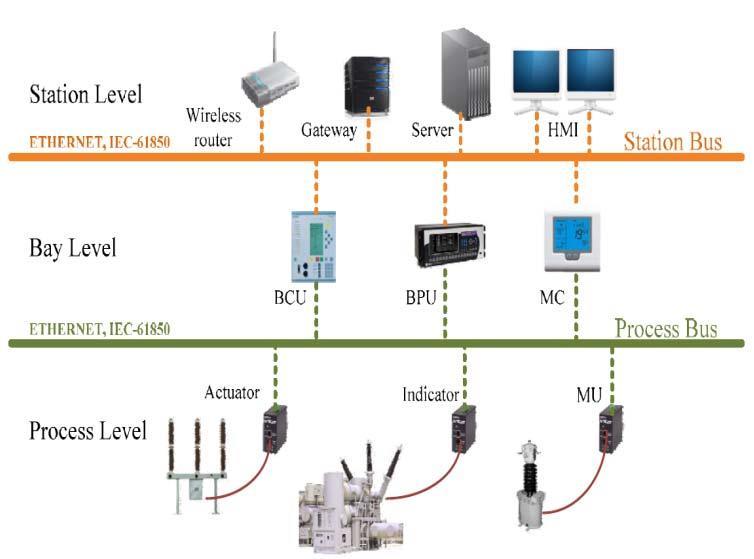
(ii) There may also be devices dedicated to specific functions of the SA system, such as transducers, position sensors, and clusters of interposing relays, whichmayadditionallybepresent[1]
(iii)AdedicatedEthernetswitchthatconnectswired devices such as computers, WiFi access points, PoE lights,andIoTdevicestoserversonanEthernetLAN sothattheycancommunicatewithoneanotherandto theinternet[1].
Fig -1:ThehierarchyofasubstationsystemwithIEC 61850inthreelevels[13]
Bay level comprises circuit breakers and isolators, earth switches, and instrument transformers. At bay
(iv)There may also be a substation display or user’ s station (local HMI) connected to or part of the substationhostcomputer(localserver)[1].
(v)Commoncommunicationlinkstotheoutsideworld suchasutilityoperationscenters,maintenanceoffices, and engineering centers. Most SA systems are connected to SCADA (supervisory control and data
International Research Journal of Engineering and Technology (IRJET) www.irjet.net
acquisition)systemmasterstationsthathandlereal timerequirements forrunningutilitynetworksfrom oneormoreOperationsCenters[1].
transmission and distribution domain of substation automation, and related protocols, applications, and regulationsrelatedtothecontrolcenter[1].
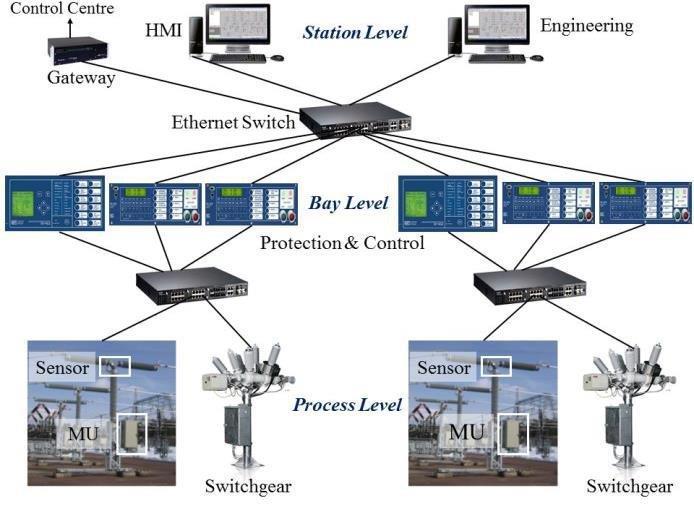
Fig 2: Substation automation system components[5]
Otherutilityusers/servicestypicallyconnecttothe systemthroughafirewall protectedDMZconnected totheSCADAsystem.
4. The Smart Grid Architectural Model (SGAM)
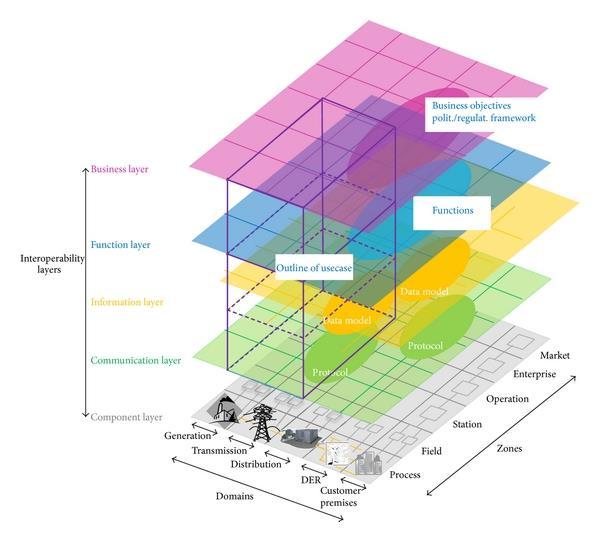
The Smart Grid Architectural Model (SGAM) FrameworkofFig.3aimsatofferingadvancethedesign ofsmartgridusecaseswithanarchitecturalapproach allowing for a representation of interoperability viewpoints in a technology neutral manner, both for thecurrentimplementationoftheelectricalgridand futureimplementationsofthesmartgrid[1] Thisisa 3D model that combines the dimensions of the five interoperabilitylayers(business,features,information, communications,components)andthetwodimensions ofthesmartgridlayer,thatis,Zones(representinga hierarchical level of power system management: process, fields, stations, operations, enterprises, and markets)anddomains(coveringtheentireelectrical energy conversion chain: mass generation, transmission, distribution, distributed power resources,andCustomerpremises)[1]
Thisworkprovidesastate of the artofrelevantparts of the smart grid, primarily focusing on the
Fig 3: CEN CENELEC ETSISmartGridplaneofdomains andhierarchicalzones[1]
All over the state of the art analysis, it can be concludedthatoverthereisanenormouseffortfrom the smart Grid key stakeholders to enhance interoperability across the dissimilar components administratinganelectricalgrid,fromfieldprocesses tomarketexchanges.Informationcannowflowmore freelybetweenapplicationsanddomains;potentially newapplicationshaveanopportunitythatisnolonger limitedtoasingledomain[1]
The Smart Grid applications, such as the Integrated Voltage and Var Control (IVVC), Distribution Automation (DA) on Fault Detection Isolation and Restoration (FDIR), and Advanced Metering Infrastructure (AMI), Demand Response (DR), offer increased operational functionality for distribution substationandfeeders[15].Totakefulladvantageof these new applications, a well designed substation automation architecture provides an enhanced approach to adding new automation functions,
9001:2008 Certified
Page3166
International Research Journal of Engineering and Technology (IRJET) www.irjet.net
providingacommoncommunicationinfrastructurefor feederautomationandAMIs,andofferingprovisionfor updatestothenetworkmodel[15].
the capability to support interoperability with the neighboringsubstations,becomingtherealchallenge tothedistributedDAsystemsinSA[15].
DAisnotonlyanimportantmoduleindistributiongrid operation,butalsoahubthatconnectsotherimportant modulesandapplicationsinthesmartgridsuchasthe Demand Response Management System (DRMS), AdvancedMeteringInfrastructure(AMI),andOutage Management System (OMS). In general, DA systems include a variety of advanced applications such as Topology Processor (TP), Distribution Power Flow (DPF), Fault Detection, Isolation and Restoration (FDIR),IntegratedVoltage/VarControl(IVVC),Optimal Feeder Reconfiguration (OFR), Distribution Contingency Analysis (DCA), Distribution State Estimation (DSE), Distribution Load Forecasting and Estimation (DLF/DLE), etc. Among them, FDIR and IVVC are the primary key applications for real time operations and are therefore considered typical DA applications for a distributed approach that is simultaneouslyintegratedintotheSAsolution[15].
Fig 4: The logic of IVVC operation with the distributed DA system [15]
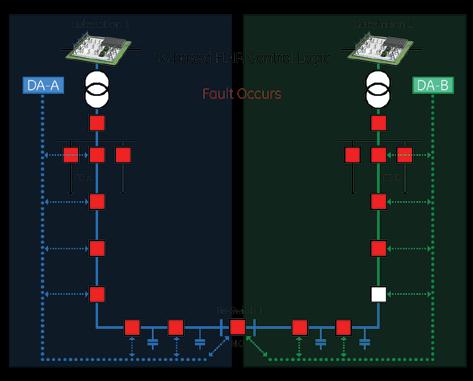
Fig4 shows the logic of IVVC operation with the distributedDAsystem.Ifpartofthesubstation2feeder circuitissuppliedfromsubstation1via atie switch, DA'sIVVClogiccanhandlethecasebyexchangingdata betweenthetwosubstations.WhentheDAsystemin substation1detectsafault,theFDIRlogicisolatesthe faultedsectionandimmediatelyrestorestheoperation oftheupstreamsection,thencalculatesthetotalload of the downstream section and limits the load and voltage requirements for substation 2 to pick up. If substation 2 cannot handle the load for recovery, alternative approaches are used for evaluation, includingusingmultiplesources,transferringtheload from one feeder in substation 2 to another in substation 2 to increase reserve capacity, or implementingpartialrestore.Alternativeapproaches are appreciated, such as restoring as much load as possibletotheoperation.
Thus, the service scope of SA is expanded to the distribution feedercircuits.Becausethefeedersmay haveopentiestootherfeedersthatareservedbyother substations,theDAsysteminasubstationhastohave
IVVCisdesignedtoimprovetheoperationalefficiency ofdistributionsystemsandservesthefollowingbasic objectives:
Reducefeederlossbyauto switchingON/OFF ofthefeedercapacitorbank[15].
Maintain a healthy voltage profile under normaloperatingconditions[15]
Reduce peak load by adjusting the output voltage by controlling the transformer tap settings in the substation and the voltage regulator in the feeder section, achieving automaticvoltageregulation[15].
DemandResponse(DR)isarelativelynewfeatureof thesmartgrid.Itisdesignedtodirectlymanageaload of individual customers through two way communication[15].Thepotentiallydispatchablepart oftheindividualloadscanbeaggregatedtotakepartin thesystem wideeconomicdispatchforreducedpeak demandandminimizeenergycosts.Ontheotherhand, the dispatched number of load management can be distributedtotheindividualloadsoverdisaggregation.
International Research Journal of Engineering and Technology (IRJET) www.irjet.net
Theprocessesofaggregationanddisaggregationneed efficientcoordinationwiththeDAsystemforoptimal gridoperationsubjecttotheconstraintsonvoltageand loadinglimits[15].Asimilarprocessisneededinthe recovery stage while returning to the normal operations for the individual customers. The DA functions in SA can also be designed to play an appropriaterole,similartoacentralizedDMSsystem [15]
AMI systems are getting more and more attention aboutsmartgrids.Inadditiontotheconventionalroles inaccountingandcustomerbilling,theAMIdatafrom theindividualcustomerscanalsobeutilizedtomake better the distribution entity in operation and management,containingthehistoricalloadprofilesfor moreexactloadforecastingandestimation,aswellas thereal timeinformationattheendpointsoffeedersto feedDAfunctions[15]
The SA operation in distribution substations can includethekeyDAfunctions,whichincludeIVVCand FDIR, and can incorporate the AMI and DR data in additiontoimprovingtheoperationperformance[15]. A general review of the conventional SA functionsis presented and the extended SA functions in distributionsubstations are discussed with AMI, DR, andDAfunctionsincorporatedinSmartGridoperation [15].
The latest SAS is smarter with software enabled devices,digitalsampling,andseamlesscommunication networks. These systemsprovide useful information for smart grid applications and components. This information includes measurements for metering, protection, and a wide range of control applications. Reliableconstructionanduseofthesesystemsrequire ensuringreliability,includingsafetyandsecurity[20].
Inaddition,smartsubstationsgotbuilt incontroland automation capabilities. This dual capability reduces the opportunity for communication failures and the effects of power outages and can decrease developmentandmaintenancecosts[20]
ThesmartgridcanuseSAS functionalitiestorapidly deploymultipleservicesandfunctionsintransmission and distribution networks and control centers. The functionismainlytoprotectthenetworkofconnected
renewableenergyresources.Therefore,thegridwillbe scalable with these new SAS features. The following pointshighlightthemainbenefitsoftheevolution of thesmartgrid.
Digital measurement and metering are available in modernSASsystemstoprovideaccurateinformation aboutthestateofthegridwhentheseparametersare collectedattheregional ornationallevel.Substation status data availability also helps to connect or disconnectanyenergysourceaccordingtoademand response scheme [20]. The SV (Sampled Values) service sends analog measurements values in digital format,andSVscansenddigitaldevicemeasurements suchascurrentsandvoltagesembeddedinmulticast EthernetframestoSASdevices.Agoodexampleofthis communication service is sending data at a specific samplingrate,forexample,80samples/cyclewitha50 or60Hzcycle.Accordingtothestandard,protection, automation,andcoordinationneedtoreverencetime critical constraints to make better reliability, e.g. accurate time synchronization of this sampling mechanismtoavoidsecurityissues[20]
Networkmaintenanceshouldbenefitfromup to date substation data, for example, the IEC 61850 object model provides records containing the status of devicesatmanylevelsofsubstations.GenericObject oriented Substation Events (GOOSE), defined in IEC61850 Part 7 1, is a high speed message for communicating status and event changes. GOOSE datasets are embedded in Ethernet frames with prioritytaggingcapabilitiestoimprovetime sensitive priorityrequests[20].Thesemessagescanberouted externally of the substation to supply helpful informationformaintenanceplanningandfollow ups. These datasets assist to schedule preventive maintenance policies and extending the life of grid assets(e.g.Switchgears,transformers,andcapacitors). Another important dataset is the communication network and interfaces status that can provide assistance to diagnose failures and differentiating between cyber and physical ones. Testing can be accomplishedwiththesedatasetsmoreoverautomatic diagnosticsshallaiddisclosehiddenfailures[20].
International Research Journal of Engineering and Technology (IRJET) www.irjet.net
Datacollectedlocallyfrommodernsmartsubstations viaroutedmessages(routedGOOSEand SV)helpsto managereal timeprotectionandcontrolstrategiesin largepowergrids[20].Therefore,theoverallstateof the grid can be estimated before the appearance of reliabilityissues,suchascascadedfailureorblackouts. Inaddition,gridexpansioncanbeplannedseamlessly utilizingthestatusinformationfromSAS[20].
The digital sampling related parts, of the IEC 61850 standard, provide recommended sampling rates to draw a useful shape of the grid [20]. These samples represent the amount of frequency, current, and voltagethatisusedtodeterminestatusandmetering values. With additional data from generators, power plants, renewable resources, and other DERs (DistributedEnergyResources),theControlCentercan automaticallyprovidedetailedinformationaboutthe grid.Therefore,thereliabilityoftheelectricalpower servicecanbemonitoredinreal time[20]
Security in Smart Grids is a critical factor as interruptionsinthesesystemscanleadnotonlytothe destruction of expensive equipment but also to interruption of serious operations that can include significantrisktothehealthandsafetyofhumanlives, thoughtfuldamagetotheenvironment,and financial issuessuchasproductionlossesandnegativeimpactto anation’seconomy[1].
ThevulnerabilitiesdisturbingtheSCADAsystem regardmainlythefollowingequipment[1].
1. IEDsandRTUsinthesubstations;
2. SubstationLANandfirewall;
3. Communicationnetworkbetween substationandcontrolcenter;
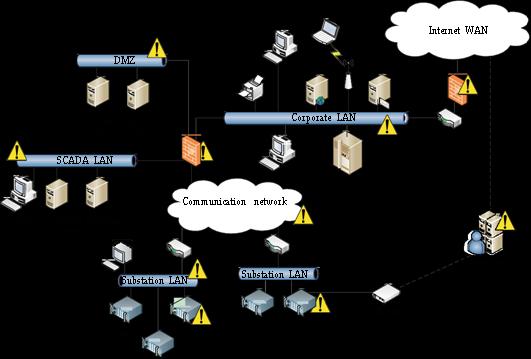
4. SCADALANandfirewall;
5. Corporate(office)LANandfirewall;
Differentregulatorymandatesexistorarearisingthat requireenergyutilitiestosecure,monitor,andmanage their critical sites and data networks by regulatory requirementsandstandards.Thesevaryingranularity
and rank, positioning from process oriented to technicalstandards[1]
Fig.5 represents an outline of potential targets for cyber attacks(indicatedbyyellowexclamationmarks) on the communication infrastructure of SCADA frameworks [1]. The primary issue in most of the existing systems derives from the fact that SCADA frameworkswerenotintendedtobeassociatedwith theexternalorganizationfoundationandthussecurity perspectives were not considered during the development phase [1]. The messages that IEDs exchangewiththeoutsideworldareoftentransmitted overcommunicationchannelsthatarepotentiallyopen toeavesdroppingoractiveintrusions[1].Anenormous possible threat to these frameworks is gotten from unauthorized users on the corporate channel or any othernetworkthathasanassociationwiththeSA[1].
The initial phase in securing substation assets is separation from the SA system network by utilizing suitablefirewallrulesandotherknowncyber security measures[1].Assumingremoteinnovationissentat thesubstation,itcanmakeanotherassaultvectorifno appropriatesafetyefforts,forexample,accesscontrol
International Research Journal of Engineering and Technology (IRJET) www.irjet.net
and encryption are in place[1].IEEE Standard 1402 2000recognizesandarrangesthesortsof“intrusions” into a substation and examines some security techniques to be taken on for moderating risks[1]. NERCin"SecurityGuidelinesfortheElectricitySector" has developed a comprehensive set of guidelines methods to be applied in safeguarding the electric infrastructuresystems[1].
Conventionally, SA has been focused on automation functioning for instance monitoring, controlling, and gatheringinformationinsidethesubstation.Thisisa narrow margin to allow effective control of the automatedequipmentinsidethesubstationfence,but the automated feeder devices cannot be used effectively.Thesmartgridcanextendthedistribution stations in the SA system to include the automated feeder devices distribution circuits supplied by the substation. The noticed improvements in the Smart Griddomainraiseseveralsecurityperspectiveswhich were discussed and most likely will acquire significanceinthefuture.
Inthispaper,anattemptwasmadetogiveanoverview of important smart grid related standards. These standardsdevelopedshouldbereviewedandrevised regularlybasedonlessonslearnedfromreal worlduse casesandfeedbackfromsmartgridimplementations. Asacontinuouslearningprocess,standardizationplays akeyroleinbuildingasecure,reliable,advanced,and smart electric power grid with bidirectional communication, interoperability between different devices,andcontrolcapabilities.
IwouldliketoextendmygratitudetomyProfessorDr. Abdulla Ismail, Professor of Electrical Engineering, Dept.ofElectricalEngineeringandComputing,RIT Dubai, UAE for his support and guidance with this paperwork
[1] A. Leonardi, A.Wiesmaier, K.Mathioudakis,andF.Zeiger, “Towards the Smart Grid: Substation Automation ArchitectureandTechnologies “ , Volume 2014, ArticleID 896296, doi.org/10.1155/2014/896296
[2] Vikas Shrivastava, Chris Salter, “Future Trends to smart gridautomation architecturebyIEC61850,”January2018/ Research Gate /325069210
[3] N. Anglani, F. Benzi, L. Frosini, and E. Bassi, “Electricity smart meters interfacing the households,”, no. 10 2011, IEEE Trans. Ind. Electron., vol. 58.
[4] T. Basso, J. Hambrick, and D. DeBlasio, “Update and review ofIEEEP2030smartgridinteroperabilityand IEEE 1547 interconnection standards,”Conf., pp. 1 7, Jan. 2012, Proc. IEEE PES Innovative Smart Grid Technol.
[5] G.A. Taylor,I. Pisica,andM. Golshani:“Simulationof Power System Substation Communications ArchitectureBased on IEC 61850 Standard”, Brunel Institute ofPowerSystems,London,UK.
[6] R.Bucher,“Smartgridfunctionalityforthehigh voltage transmission grid: On the market readiness of Digital Substation2.0technology,”December2017/Research Gate/325235618
[7] Debasis Tripathy, Manoj Pattnaik, and Amar Kumar Barik, “Monitoring and Mitigation of Power Quality Issues in Dispersed Generation & Smart Grids,” November2013/ResearchGate/336677091
[8] OmidAmeriSianaki,OmarHussain,TharamDillon,and AzadehRajabianTabesh,“IntelligentDecisionSupport System for Including Consumers' Preferences in ResidentialEnergyConsumptioninSmartGrid,”October 2010/ResearchGate/224215097
[9] Neetesh Saxena and Bong Jun Choi “State of the Art Authentication,AccessControl,andSecureIntegration in Smart Grid” Energies,8, 11883 11915; doi:10.3390/en81011883/October2015
[10] VijayendraVK,PavanMN,andNeethiM,“AnAccessof SmartgridStandardsanditschallenges,”(IJRTE)ISSN: 2277 3878,Volume 8,Issue 2S11,DOI:10.35940/ijrte. B1270.0982S1119/September2019
[11] OmarKhaled,AndrésMarín,FlorinaAlmenares,Patricia Arias, and Daniel Díaz, “Analysis of Secure TCP/IP Profilein61850BasedSubstationAutomationSystem for Smart Grids” International Journal of Distributed SensorNetworks, ArticleID5793183,11pages,Volume 2016,doi:10.1155/2016/5793183
International Research Journal of Engineering and Technology (IRJET) www.irjet.net
[12] MathiasUslarandRobertBleiker,“Automationforthe SmartGrid:IEC61850 SubstationAutomationandDER Communication” Standardization in Smart Grid, DOI:10.1007/978 3 642 34916 4_7,pp.115 128.
[13] HosseinZeynal,MostafaEidiani,DariushYazdanpanah, “IntelligentSubstationAutomationSystemsforRobust OperationofSmartGrids,”,August2014/ResearchGate /264700221
[14] JiyuanFan,XiaolingZhang,“FeederAutomationwithin theScopeofSubstation”,ProceedingsofPowerSystems ConferenceandExposition,2006PSCE’06.2006IEEE PES,Atlanta,GA,pp607 612,ISBN:1 4244 0177 1’,
[15] Paul Backscheider,Jiyuan Fan, and Willem du Toit, “DistributionSubstationAutomationinSmartGrid,”GE DigitalEnergy
[16] A. Altaher,H. Madi, &A.Khomsi. ReliabilityInvestigation of Digital Substation Networks Design Using FMEA Technique. InternationalConferenceonTechnicalSciences, Vol. 6. 2019. (ICST2019).
[17] A.Altaher,H.Madi,&A.Khashkusha.Real-Timesafety: Analyzing
1st International MaghrebMeetingof the Conference on Sciences and Techniques of Automatic Control and Computer Engineering MI-STA,IEEE.2021,pp.393-397.
[18] IEC TR 61850 1:2013 Communication networks and systems for power utilityautomation Part 1: Introduction and overview, 2013, IEC Geneva.
[19] Arun T V, Lathesh L, and Suhas A R’ “Substation Automation system” International Journal of Scientific & EngineeringResearch, Volume7,Issue5, ISSN2229 5518, May 2016

[20] “The Role of Modern Substation Automation Systems in Smart Grid Evolution IEEE Smart Grid,” smartgrid.ieee.org. https://smartgrid.ieee.org/bulletins/august 2021/the role of modern substation automation systems in smart grid evolution (accessed Apr. 23, 2022).
Er.MohamedJaffer1
Er. Mohamed Jaffer received his bachelor's degree in ElectricalEngineeringfromAnnaUniversity,Indiain2007 Currently, he is doing his Master of Science in Electrical EngineeringatRITUniversity,Dubai.Hehasover14yearsof experience in the operation, maintenance, and testing & commissioning of Power Transmission and Distribution substations. His education and research interests are in power transmission and network analysis, substation automation,smartenergyandgrids,and5Gtechnologies.
AbdallaIsmail
Dr.AbdallareceivedhisPh.D.inElectricalEngineeringfrom the University of Arizona, USA. He has over 35 years of experience in higher education, teaching, research, and management. HewastheAssociateDeanof theFacultyof Engineeringandamemberofthepresident’stechnicaloffice atUAEUniversity.Hiseducationandresearchinterestsare inintelligentcontrolsystems,smartenergyandgrids,and renewableenergy.Hepublishedoveronehundredandten technical papers and two co-authored books. He has participatedinseveralhighereducationqualityassurance andaccreditationprogramsboardsandcommitteesinthe UAEandotherGCCcountries.Hereceivedseveralprizesand awards including the Emirates Energy Award, IEEE Millenniumaward,andFulbrightscholarship.