
Smart Infirmary Trolley
1,2,3,4Student, Department of Mechatronics Engineering
New Horizon Institute of Technology and Management, Thane, University Of Mumbai, India 5Professor, Department of Mechatronics Engineering
New Horizon Institute of Technology and Management, Thane, University Of Mumbai, India

Abstract - In this paper we have proposed a system called “Smart Infirmary Trolley”, which focuses on solving the problem of frequent touch when delivering artifacts such as things ordered or food to be delivered. The project focuses on minimizing the spread by following one of the standard operating procedures maintaining distance. This is a autonomous line following robot which has Arduino UNO, 12V UPS battery, ultrasonic as well as IR sensors and UVC lights.
Keywords: infirmary trolley, covid19, contactless, delivery,automaticsanitization,sterilize
1. INTRODUCTION
Everyone throughout the globe is affected by COVID 19. The impact of the global pandemic has not only agitated our lifestyles as individuals but also its consequences haveperturbed our vulnerability to epidemics. Only by acting unanimously can we save lives and overcome the detrimental socio economic impacts of the virus. Since the outbreak of the novel corona virus, social distancing andquarantiningalongwithfrequentsanitizationisnow the “new normal”. Frontline medical workers are exposed to the contagion daily as countries around the worldgrapplewithCOVID 19;theseworkerscandeploy robots, and other technologies to help contain the pandemic. Furthermore, the advancement of technology plays a critical role in our lives and has brought major stridesinbringingemancipationtothedivergenthuman wants and gratifications. These advances in technology canenhanceourhealthcaresystemsbecausenotonlythe futureofhealthcaresystemsisshapingupnow,butalso digital technology could help transfigure unsustainable healthcare systems into sustainable ones, equate the relationshipbetweenmedical professionalsandpatients, and provide cheaper, brisk and more effective solutions fordiseases.Sincetheoutbreakofthenovelcoronavirus which has affected throughout the globe, social distancing and quarantining along with frequent sanitizationisnow the“newnormal”.
To tackle this perplexing yet a quandary situation, the proposed solution is to build a line/human following
robot sothat there is “no contact” (considering the fact that the covid 19 pandemic was a rapid widespread becauseofcominginclosecontactwithinfectedpeople) andsoitisanautonomousremotelycontrolledrobot.
2. OBJECTIVE
Mobile workstations are designed to enhance the daily routines and workflow of today’s healthcare providers. Autonomous carts that can carry food or other items without involving any physical contactortransfer ofthe viruswouldbeefficientandbeneficial.
Our project named “Smart Infirmary Trolley” is a remotely controlled autonomous robot with an automatic sanitizer dispenser machine and a sterilizer box for tools and kit for disinfection. After mapping the environment, such as hospital corridors and patient rooms, it moves around autonomously shining a 360 degreeUltraVioletRay Clight(UVC).
3. SCOPE
• The Smart Infirmary Trolley provides a modest andasophisticatedsolutionforthepeoplewhoare inneedofmedication,foodandothersuppliesfrom time to time, on a daily basis by making them partially independent which reduces the human contactandtheworkloadofthecaretaker.
• Forhospitals,themachinecanbeusedtocarrybed sheets, towels, toiletries and clothes. Food can be delivered to the patient’s table with a satisfied temperature if heating plates are installed on the machine and in this case, the machine can be servedasatemporaryovenaswell.
• For elderly care centers, it can be modified into a bigger size with powerful motors for transporting heavy medical equipment like blood pressure machinesandelectrocardiogrammachines.
• A trolley can simply satisfy different purposes conveniently and also sanitize throughout
4. DEVICE DESIGN
Asthesmartinfirmarytrolleyisinitsdevelopmentstage now, we know that there have been slightly similar projects takenbefore.Theyaren’tabsolutelysimilarbut they follow a same ideology. The references part at the end of the paper mentions three of these papers: As a partofourliteraturesurvey,wecameacrossSADR[1]and smart trolley: there have been proposals for a “SADR” (Sidewalk Automated (or Autonomous) Delivery Robots) which are pedestrian sized robots that deliver itemstocustomerswithouttheinterventionofadelivery person. Taking a similar credo from the SADR, the two questionsthatguidethisresearcheffortare:
(a) What are the technical capabilities of existing autonomoustrolleysusedifany,inthehealthcareand
(b) Given the existing capabilities and regulations, what arethetime/costsavingsand efficiencies thattheSmart InfirmaryTrolleycanbringabout?
The trolley is designed in such a way that it follows the unique sticker provided for the user to recognize and stop when required. It also maintains a consistent distance from the user. Some sensors are used in the proposed solution. Each trolley will receive a one of a kindsticker.Onlythestickerallocatedisdetectedbythe trolley,anditisprogrammedtofollowpath.Itwilldetect moving object by using a mix of ultrasonic and infrared sensors. The sensor used on the head and mini servo motor rotates at 180 degrees: when an object moves or gets close to the sensors, the micro servo motor rotates at180degreesandcontinuesonitspath.
The trolley is being put together by dividing the tasks and exertions into three categories and four stages:
● DeviceDesign
● Prototype configuration: Sanitization, Sterilization.
● Hardware & Software: Layout, Construction, Organization.
Stage1:Definingtheobjectivesofthetrolley:
Thelinefollowingtrolley'skeygoalsareasfollows:
1. Save on labor costs Wages are one of the most significant expenditures of running a business, particularly in the hospitality industry, which requires a high level of individualized care. For simple operations like delivery, replacing individuals with machines could save money. Travelingtimeforemployeescanalsobesaved.
2. Offer accurate and dependable services. The trolley can follow a predetermined path and determine where it needs to stop. A trolley, for example, may travel through a hospital floor and stop in front of each room. The location is precise, and the course is quite predictable. Because routine work is straightforward and predictable, a programmed computer can complete the task withouttheneedforhumanmistake.Thisprovides userswithdependableservices.
3. Acclimate to several uses The machine should have a flexible design that allows it to adapt to various uses. The machine can transport bed linens, towels, toiletries, and clothing in hospitals. Ifheatingplatesaremountedonthemachine,food can be delivered to the patient's table at a comfortable temperature. In this instance, the machine can also be used as a makeshift oven. Devices can be converted to a larger size with powerful motors for hauling heavy medical equipment such as blood pressure machines and ECG machines in elderly care facilities. A trolley can easily fulfill a variety of functions. As a result, instead of employing a real trolley with high poweredmotorstocarryhugeloads,amodelcaris employed to portray. With minor tweaking, it is thought that the same concept can be applied to a varietyofuses.Themajorityofthedesignisbased on the concept of a human following robot, with the trolley being able to follow a human with luggageloaded.
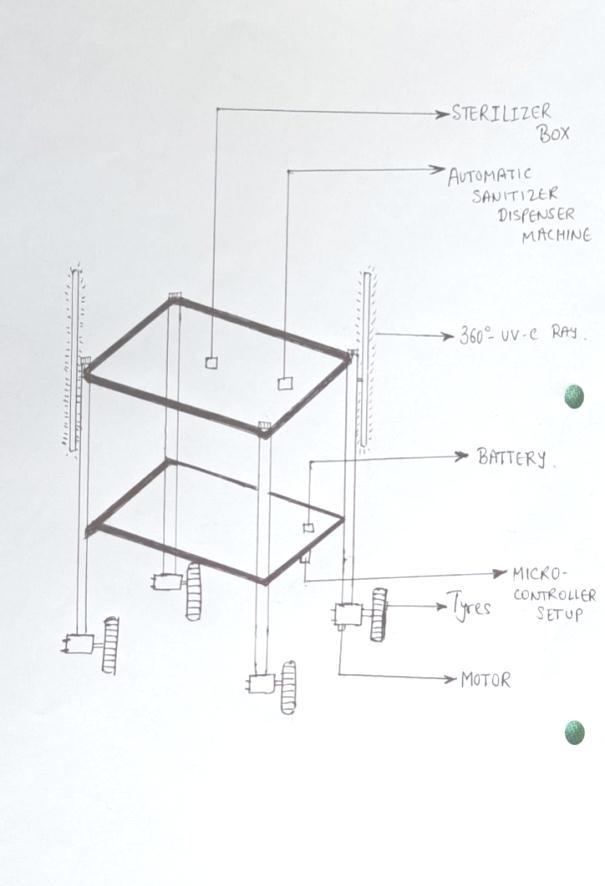
Stage 2: Device Design: In this stage of our project we designed a structure of the trolley, the below image showstheappearanceofthetrolley.
diagramshowinghowthesmartinfirmary trolley
look.
We need to ponder over various questions and other researchinordertodeterminewhethertherobotwillbe abletoperformthesaidtasks.Howefficientwoulditbe? What will be the approximate ETA from one point to another? Adding divergent features will complicate the process of making it and so even if it is kept just to the point, it should deliver its best. The main obstacles that are being tackled by this robot are: contact less sanitization, contact less sterilization, delivering accessorieswithoutmorecontact.
We need to design the robot such that it does not harm theenvironmentandisnotover expensive.
The following are a few things that we’ve kept in mind while designing the structure and designed as shown in theabovefigure1.
• Compact, efficient design: A compact robot design makesintegration easier. In addition, designs with complex integrations will not protect them from wear and damage, which would increase the overallcosts.
• Robot controller features: We are looking forward tomaketherobotinawaythatitisnotheavyand bulky instead it is lightweight and compact in structure. Apart from this we would take into
account the ease of integration i.e., if we were to accommodate more features, how modular and expandable it is without the expense of a new controller.
• Inexpensive offline programming software: The programmingsoftwarethatwillbeusedshouldbe costeffective.Itshouldnotincludeanyintricateor state of the art features which would then be unnecessary.
• Low energy consumption: The robot’s energy consumption efficiently designed, slim and lightweightrobotarmsrequirelesspower,sotheir motors draw less electrical current, which can resultinsignificantlong termcost savings.
• Continuous duty cycle time: The robot cycle time should be either in continuous duty, or only shorterburstsofanhourorless.
Once we have our basic frame and have decided on the materialstobeused,developingaprototypewillhelpin knowinganyvulnerabilities andflawsinthesystemand whatwillbethefurtherfuturechanges,ifany. Afterthis, weneedtowritethealgorithmortheprogramcodethat willdefinethemovementofthetrolley.Analgorithmisa series of instructions thatdefines the way to complete a task. Robots require comprehensive instructions, so developing the algorithm and then the program code is crucial. Writing instructions and coding them in the software about how the robot will respond to specific inputs.
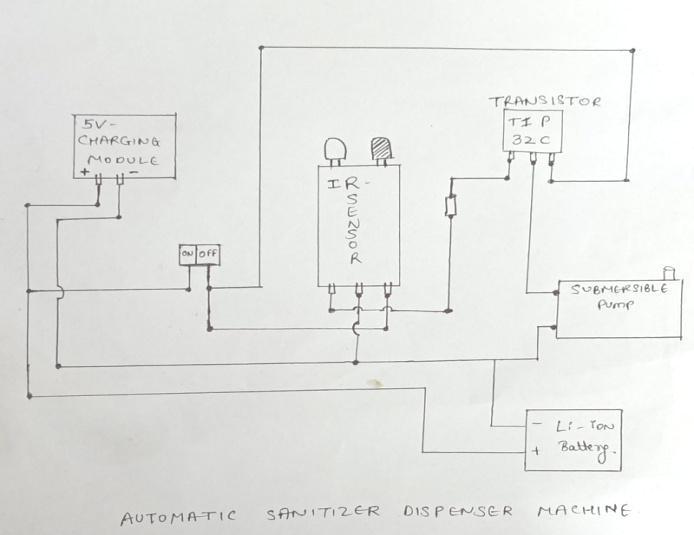
Stage 3: Here, the block diagram and the working of the trolley were planned and it also includes the requirementanalysisfordevelopingthetrolleyaswellas the circuit diagram of the automatic sanitizer dispenser machine.
requirementanalysisisasshownbelow:
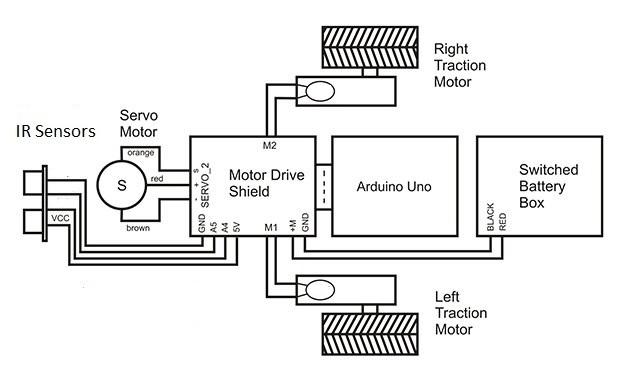
frame
-2: Blockdiagram
The switching battery box provides power to the motor drivershield.
The line follower robot follows a line, and to do so, the robot must first detect the line. To detect the line, we attach two infrared sensors on the robot's left and right sides, as shown in the diagram above. The line follower robothastwomotors,oneontheleftandoneontheright. Both motors revolve in response to the signals from the left and right sensors, respectively. The robot must move ahead,turnleft,turnright,andcometoacompletestopin fourdifferentmotions.Thefollowingparagraphsdetailthe variousscenarios:
When both sensors are on a white surface, the robot shouldmoveaheadsincebothmotorsshouldrotate.
The left sensor is on top of the dark line in this scenario, whereas the right sensor is on the white part, so the left sensor detects the black line and sends a signal to the
microcontroller. The robot should turn left because the signalcamefromtheleftsensor.Asaresult,theleftmotor rotates in the reverse direction while the right motor rotatesahead.Asaresult,therobotshiftshisweighttothe left.
Thisscenarioissimilartotheleftcase,exceptthatonlythe rightsensorrecognizesthelineinthiscase,indicatingthat therobotshouldturnright.Theleftmotorrotatesforward andtherightmotorrotatesbackwardstoturntherobotin the appropriate direction. As a result, the robot turns in therightway.
Inthiscase,thesensorsareontopofthelineandtheycan detecttheblacklinesimultaneously,themicrocontrolleris fed to consider this situation as a process for halt. As a result, both motors are turned off, causing the robot to stopmoving.
The line follower robot is based on the concept of light. The behavior of light on a black and white surface is used here.Thecolorwhitereflectsallofthelightthatfallsonit, whereasthecolorblackabsorbsit.
We use infrared transmitters and receivers in this line follower robot (photodiodes). They're used to transmit and receive light. When infrared rays hit a white surface, they are reflected back to the IR receiver, causing voltage fluctuations. When IR rays collide with a black surface, they are absorbed by the black surface, and no rays are reflected,sonoraysreachtheIRreceiver.
Fig -3: Circuitdiagramoftheautomaticsanitizer dispensermachine.
check of the system development
accordance
criteria and constraints, as well as that the plannedsystem
securedinadegreeofknowledgethatis connected from a specific access point and has a specific quantityofresources
providedbyverification.
CONCLUSION
The smart infirmary trolley is an integrated solution for patient care, help, and monitoring that is based on a comprehensive, interdisciplinary design approach. Research in this field is critical in the context of global ageing, and it is fuelled by a spike in the potential for accessibility solutions. When seamlessly integrated into the healthcare system, smart trolleys present a one of a kind ability to contribute to the caregivers work more efficiently, while also providing more responsive and safe environmentsforpatients.
REFERENCES
1. https://www.researchgate.net/publication/33353 8320_Automated_medical_surgical_trolley/fulltext /5de51b73299bf10bc3390e31/Automated medical surgical trolley.pdf
2. https://www.irjet.net/archives/V5/i3/IRJET V5I3596.pdf
3. Park, KeeHyun& Lim, SeungHyeon, (2012) “Construction of a Medication Reminder Synchronization System based on Data Synchronization”, International Journal of Bio ScienceandBio Technology,Vol.4,No.4,pp1 10.
4. R. S. Sutton and A. G. Barto. Reinforcement Learning: An Introduction.The MIT Press, Cambridge,Massachusetts,1998