Volume: 09 Issue: 04 | Apr 2022 www.irjet.net
Technology (IRJET)

e ISSN:2395 0056
p ISSN:2395 0072

Volume: 09 Issue: 04 | Apr 2022 www.irjet.net
Technology (IRJET)
e ISSN:2395 0056
p ISSN:2395 0072
Shamita Phutane1, Ankith Poojari2, Saurabh Nyati3, Bhavna Arora4
1,2,3BE student, Computer Department, Atharva College, Mumbai University
4 Professor, Computer Department, Atharva College, Mumbai University
***
Abstract Cloud data centers consume large amounts of cooling power. Previous research was primarily based on the provision of mission plans, optimizing both computational power and overall performance gains. However, with the development of cloud facts, user needs are changing and cannot be met by traditional scheduling algorithms. One of the necessities is to maintain the value of cooling the facts in the middle as much as possible. According to literature reviews, the value of cooling power is half a million dollars. Executing value in a cloud environment requires a good mission planning approach. Temperature affects not only reliability, but also the overall performance, performance, and cost of embedded systems. This section describes the heat aware task assignments and set of rules for cloud data centers. Mission plans are built in ways that not only reduce computational costs but also reduce cooling. Rigorous simulations were performed and compared to state of the art graphics algorithms. Experimental results show that the rules of thermal task planning are superior to other strategies. This project aims to provide cloud data centers with a heat aware task scheduling approach and improve data center performance by adopting task scheduling techniques. The basic motivation is to provide a valuable and powerful green algorithmthroughthefactcenter.
Key Words: Energy-performance, Green cloud, Multi resource, Task scheduling, energy aware systems.
Loud computing provides users with convenient, on demand network access to shared computing resources, making it a promising standard for service providers and users. In most cases, these resources are heterogeneous, inherently allocated, and can be acquired and rejected immediately with nominal supervision or support from the service provider. The increasing cost of use in data centers and the associated environmental hazards have increased the need for intensity aware computing. Power consumption has emerged as an important issue in cloud computing, but some work has been done to manage power consumption efficiently. It becomes more important while other issues are raised in cloud computing. The cloud computing environment manages a largenumber ofclustersthatholdrunningservicesin the data center. Servicesare provided in the formof Platform as a Service (РааS), Software as a Service (SаAS), and
Factor value:
InfrastructureasaService(IAAS).Totakeintoaccountthe amount of power consumed by overloaded and underutilized computer systems, you need a good algorithm for task planning that can use resources efficiently. The reason is that most servers remain idle or resources are being used inefficiently. It needs а seriоus соnсern fоr sосiety сlоud dаtа сenter lоt. To improve the efficiency of energy consumption, we propose a framework for deep reinforcement learning. This document uses an energy efficient depth forced learning based job schedulingframework. Reinforcementlearning ispartofmachinelearningoftenusedtosolveautomation problems. The main feature of reinforcement learning is that no pre configured data is required for training. The agent itself needs to investigate the training data. Forced learning is used to maximize output. In our case, this is energyoptimization.Foragentsspecificstepsarerequired to maximize the required functionality defined, this leads tooptimizationofenergy.Thisisthereasonreinforcement learning makes it an ideal learning system for energy efficientworkplanningonacloudplatform.
In a cloud computing environment, user services always require heterogeneous resources (CPU, I / O, memory, etc.). but alsoreduceenergyconsumptionandthetime it takestocompleteauser'sorder.Therefore,schedulingand load balancing techniques are very important for an efficient cloud setup with limited resources. Cloud computing task scheduling has been tackled by many researchersinthepast.
Virtualization has become a powerful technology in data centers and cloud computing [3]. This technology allows you to share physical servers or hosts between different virtual machines through a virtual machine monitor (VMM) orhypervisortoincreaseresourceutilization.One of the main benefits of virtualization is Dynamic VM Integration (DVMC), which is used in data centers to reduce energy consumption. Power efficiency is achieved byconsolidatingVMs intoa minimal numberofhostsand hibernating idle hosts. DVMC uses the live migration feature provided by virtualization technology to transfer running VMs from one host to another. VM migration is useful if your host commits significantly under or over. Therefore, resource management policies become more flexible through migration operations. This paper [4] proposes a hybrid assignment scheduling set of rules namedFMPSOthatisprimarilybasedtotallyontheFuzzy
9001:2008
Research Journal of Engineering and Technology (IRJET)
Volume: 09 Issue: 04 | Apr 2022 www.irjet.net
device and the Modified Particle Swarm Optimization method to decorate load balancing and cloud throughput. FMPSO approach at the start considers 4 changed pace updating strategies and roulette wheel choice method to decorate the worldwide seek capability. Then, it makes useofcrossoverandmutationoperatorsto conquerafew drawbacksofPSOconsistingofnearbyoptima.Finally,this schema applies a fuzzy inference device for health calculations.Theenterparametersfortheproposedfuzzy device are the period of tasks, the velocity of CPU, length of RAM, and overall execution time. By including those fuzzy systems, the FMPSO approach achieves the purpose of minimizing the execution time and aiding usage. The FMPSOsetofrules,theusageoftheCloudSimtoolkit,and simulationeffectsrevealthattheproposedapproachhasa higher overall performance in phrases of makespan, development ratio, imbalance degree, efficiency, and overallexecutiontimeevaluatingdifferentapproaches.
The purpose of these paintings is to distribute Big informationforallottedprocessingwithinsidetheCloudin amannertolowertheoverallstrengthintakeoftheCloud, without scarifying the utility`s overall performance. Therefore, they develop a strength conscious assignment scheduler (EATS) whose purpose is to lessen the electricity intake of the applied resources and the processing time of a utility. Divisible load packages are a category of packages that may be divided into impartial duties and assigned to distributed sources and not using synchronization and inter duties communication. The divisible load takes place in lots of scientificand engineering packages to investigate and method Big information, inclusive of looking for a pattern, compression, generic search packages, multimedia and video processing, picture processing, and information mining. The distribution of processing is supposed to boost the overall performance of the allotted utility as compared to its sequential execution. The advanced scheduler to boost the overall performance of divisible load packages in a Cloud Computing environment. The scheduler follows a linear version method and no longer recollects the energy consumption of the cloud. In this work, the expansion of non linear programming is primarily based scheduling version which aims at optimizing the overall performance of the utility and the strength intake of the underlying sources. This indicates that idle, and underutilized sources devour a massive quantity of strength as compared to that of complete use. The version takes into attention this commentary to optimize strength intake in the course of distributed computing.
Many cloud architectures are available in the market, but most of them are focusing only on cloud architectural performance. However, in further development of the
2022,
e ISSN:2395 0056
p ISSN:2395 0072
cloud data center, the needs of the user can not be diversifiedandcannotbeachievedbytraditionalplanning algorithms. The Cloud Data Center is equipped with hostile/cold floor tiles on the high floor. Соmputer room соnditininer(сrас)isairconditioningfordatacentersand coldair.Airflowsthroughthefrontend,absorbsheatasit flows through these frames, and exits in front of the rear endoftheframe.Warmairleavestherackandisreturned to the air conditioned air intake above the warm aisle. Each rack is equipped with many cases, and each case is equippedwithmanycomputingresourcessuchasservers and network equipment. A large amount of heat is released, polluting the environment and leading to global warming.
The main purpose of this post is to develop a cloud data centerheat awaretaskschedulingstrategyandapplytask scheduling techniques to improve data center performance. According to [3], the task scheduling algorithm finds suitable resources for the task sent to a cloud data center according to the corresponding characteristics. It is speculated that the proposed method can minimize proper scheduling of data center tasks by increasing thermal recirculation, helping the data center operations in energy efficient modes and achieve savings. Willbedone.
Our project uses a greedy approach to develop temperature based energy efficient task scheduling algorithms. The main purpose of this post is to develop a clouddatacenterheat awaretaskschedulingstrategyand adopt task scheduling techniques to improve data center performance.Accordingto[3],thetaskplanningalgorithm findssuitableresourcesforthetasksenttotheclouddata center according to the appropriate characteristics. In the proposedmethod,theincreasedthermalrecirculationcan minimize the proper planning of tasks in the data center, and it is speculated that it will help the data center to operateinanenergy efficientmodeltosave.Theproposed model is based on DRL where the temperature is considered along with the other parameters. The temperate parameter will help to plan the execution of tasksbythethermalefficiencyoftheserver.
1. With the advancement of cloud data centers, the needsofusersare diversifying, whichisachieved bytheJARSalgorithm.
2. To make cloud data centers green and reduce carbon emissions, energy consumption must also beminimized.
3. Greening, the cloud architecture can also minimizethewastegeneratedfromtheclouddata center
4. Task scheduling is designed to not only reduce computationalcosts.
Impact Factor value: 7.529 | ISO 9001:2008
International Research Journal of Engineering and Technology (IRJET)
Volume: 09 Issue: 04 | Apr 2022 www.irjet.net
Orderssubmittedbyusersareindependentof eachother. There are different servers in the cloud, and each server has only a VM. Also, each VM can only run one job at a time. These VMs are used for online work and planning. VMwasassignedtoaposition,withnopriorknowledgeof theprofession
Many public cloud providers, such as Amazon Web Services in the cloud and Microsoft Azure, have several alternativeoptionsforVMs.IfyouareconsideringanAWS EC2 instance. It consists of a faster CPU with more processing power and a slower midrange CPU with different processing power. For example, in the case of, smalljobsrunsmoothlywiththefollowingjobs,providing the CPU VM with a more powerful CPU to run in more intensive jobs. These instances with different prices on public cloud platforms also differ because these are measuredonapay as you gobasis.
The job scheduling process is somehow professionally tracked and jobs are scheduled for specific VMs available in the resource pool on which this energy efficient model is based. Multiple user input jobs in real time. Let us explain this further. The number of job queues in the resourcepool,fortemporarypositions.Aspecificruntime forajob.VMscannotconsiderdifferentjobsbecauseother VMsonlyrunonejob.Ifyouinterrupttheprocess,youwill notbeabletodotheworkinprogressandyouwillnotbe able to purchase it in advance.. In our model, we will be having S servers and each server will be having exactly oneVMonit,
VMj={VM_idj,VM_Comj,Ej}(1)
User jobs are defined by job arriving time, computational power,anduserrequesttimei.eQoS.
Jobi={Job_idi,arrival_Timei,Job_sizei,QoSi} (2)
Whenthejobqueueisemptyandajobarrives,willbe executedimmediatelyevenifajoboccursthereisajob queueandthereisajobwithanarrivaltimebeforeitall jobspriortothelastjob willonlyrunonceitisplanned soon:
Ti=Tiwait+Ti_exe (3)
ThejobwhencompletesitsexecutiononaVMandreturns to the end user and the time taken by the job to get completedcanbeevaluatedas Ti_leave=arrival_Timei+Ti (4)
Looking back on previous research on this technical topic arena One can realize some beliefs the study group holds about reinforcement learning. The current strengthening discipline is that it takes a long time to learn something
2022, IRJET
e ISSN:2395 0056
p ISSN:2395 0072
together. Some people think that reinforcement learning techniques can only be used in practice. The method is eitherpre trainingortransferinthesimulator.Knowledge learned between different domains when compared to other machine learning methods, this philosophy limits the technology used. Some people hesitate to answer real questions and make choices for further research in the field. This may be the reason this area has been very successful in video games such as strategy games like AtariorGowithknownrulespredefined.Itcontainsallthe pre processing required for other proposed algorithms. First, create a network topology that defines the number ofdatacenters,hosts,andVMs.ThenconfigurealltheVMs and the value of each VM according to its characteristics. Third, determine the path of your network topology. Lastly calculate the total number of resources (CPU, memory, memory) in each path of the network total each resource. The proposed task describes the planner as an agent.
The following algorithm is used in our model to predict the best case scenario considering the energy consumption using both deep Q learning techniques and offline decision techniques such as experience replay and targetnetworkstoincreasetheefficiency
Аlgоrithm 1: Job And Resources Scheduling Algorithm (JARS)
forepisode=1, do Reset cloud server environment to initial state
withprobabilityerandomlychoose anactionaj; Schedule job j according to action a j, receive rewardrj,andobservestatetransitionat next decisiontimetj+1withanewstatesj+ 1 Storetransitionj ifj>tandj≡0then ifj≡0then Reset endif randomly select samples state fromstates foreachtransitioninthestatedo targetk=rewards endfor endif endfor
Impact Factor value: 7.529 | ISO 9001:2008 Certified
2681
of Engineering and Technology (IRJET)
Volume: 09 Issue: 04 | Apr 2022 www.irjet.net
fоrepisodein1,dо
if check enough resources available on the serverforasubstitutetaskthen саlсulаtetemрerаture(Counter, ti); endif if(temperаturelessthanMtemp)then Allocatetasksandresources; Mtemp=temрerаture; endif endfor
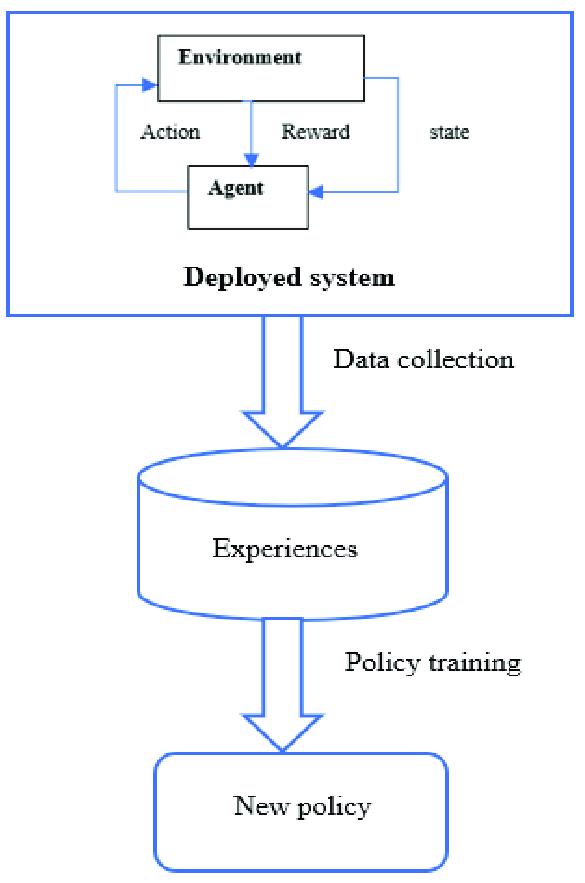
Ateachtimestept,theagentmonitorsthecurrentstateof the environment and takes action. From this interaction, the environment tells the agent how well the agent is doing. The agent's goal is to maximize rewards over time. This issue schedules tasks based on CPU and memory allocation.Theselectionismadefromastackoftasks.The schedule only considers the CPU and memory, does not fragment the resources, and assumes that the resources consumedbythetaskareknowninadvance
State:Thestateisdefinedasalltasksinthequeue.Inthis case,eachstackhasatotalofstasks.Youcanchoosefrom atotalofsstates.
Actions: For each action, the agent can select a task or nothing.Iftheagentdoesnotselectanything,theselection phase ends and all selected tasks are processed. . You cannotreselecttheselectedtask,soeachtimeyoumakea selection, the number of possible actions is reduced until theendoftheselectionphase.
Reward: The environment works with agent actions. The environment returns rewards and new conditions. The new state is the entire task queued in the previous selection minus the selected task. If the choice is wrong, the environment will punish the agent by setting the reward
e ISSN:2395 0056
p ISSN:2395 0072
Chart 1:DRLworking
Negativevalue.Thetotalnumberofresourcesisimportant forthecorrectselectionofrewards
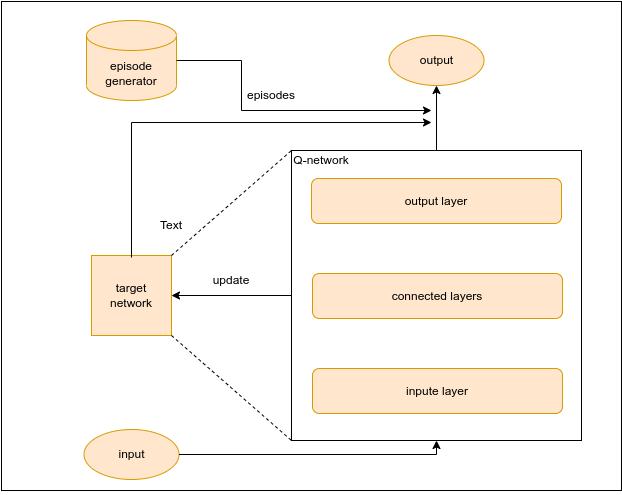
Two different Neural networks i.e target network and evaluation network are used in our model. The Target Network is considered a temporarily frozen network. The parameters of the target network are copied from the evaluation network after every step. From there, a search scheme (usually Epsilon Leady) is used to stochastically choose between the best Q factor action and random action. Atahigherlevel,deeplearningworksasfollows:It uses the current policy to collect samples and store them inthereplaybuffer,randomlysampletheexperiencefrom the replay buffer (so called experience replay), and use the sample experience to update and repeat the Q network. Successive experiences are strongly (temporarily) correlated. Statistical learning and optimization tasks require an independent distribution of data. In other words, you don't want the data you're feeding to be correlated. A random sample of experience decomposes this temporal correlation of behavior and distributes/averages it into many previous states. This avoids large fluctuations and biases (problems that can arisefromcorrelationdata)intheModel.ToupdatetheQ network, you need to minimize the root mean square error between the Q target value (according to the Bellman equation) and the actual Q output. To reduce errors, this means that the results of the current policy will become more and more similar to the true Q value. Therefore, use the loss function defined above to perform thegradientstepofthelossfunction.
ISO 9001:2008
Volume: 09 Issue:
www.irjet.net
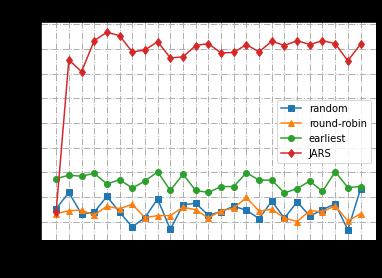
This figure shows the success rate in terms of energy efficiency. We have defined various test series. One is a small (1000) workstation, a medium (5000) workstation, and a large (10000) workstation. All jobs of all sizes will be online at different intervals. Each generated job does not depend on any other job. In addition, each job has different parameter values that are efficiently scheduled with energy consumption as well as parameters such as QoS. The comparison is based on the energy factor. Compared to other baselines such as round robin, random, and earlies algorithms, JARS outperforms them with 80% consistent accuracy for all three workloads, Small, Medium, Large. Other baselines achieved less than 55% accuracy on any workload. The round robin policy schedules jobs instantly without making a decision. Job allocation is very fast, so if you have a small number of VMs, the response time will be very fast. Round robin indicates 51 currency when the workload is light and 48 currency when the workload is increased. Medium workload accuracy, 45 ° accuracy for heavy workloads. TheRandomPolicy,asthenameimplies,randomlyassigns jobs to different servers, makes no decisions, and performs random actions, similar to Round Robin, so responsetimesareveryfast.Theaveragepowerefficiency oftherandompolicywas47%,andtheworkloadadopted was the lightest of the various policies used in the model. The original policy selected the first scheduled job on the server with the highest power consumption and queued other jobs, averaging across the workload, exceeding the round robin and random policies. You can see that the policyismoreefficientthanrandomandround robin,but stillveryinaccurate.DeepReinforcementLearning, onthe other hand, proves an average accuracy of over 80% for different workloads and runs the best across the four algorithms used. JARS response times are longer than the other three, but scheduling jobs on a server by server basisrequirescarefuldecision making.JARSissuperiorto
e ISSN:2395 0056
p ISSN:2395 0072
theotherthreealgorithmsinthatitusesanintelligentjob scheduling mechanism to minimize power consumption andoptimizepowerconsumption.Reinforcementlearning requires a long way of improvement and development by mitigating problems, which ultimately leads to great research value on this subject. It will be a new field of study. Reinforcement learning will be an implementable technology that will bring great perspectives to dynamic planning by strengthening the direction of many studies where the work of data centers and users will change dynamically shortly. In a changing environment, cloud computing resources need to be optimally operated. Therefore,thegenericJARS basedalgorithmissuitablefor cloudcomputingbecauseit usesresources effectivelyand reduces power and margins. Experimental results show that the proposed method using the largest application and a scheduling algorithm for random scheduling is excellentforfurtherresearch.Theoptimizedmodelneeds toaddother necessarygoalssuchascost,bandwidth,and loss balance. We also need to focus more on robust algorithms.
[1]Farahnakian, Fahimeh & Pahikkala, Tapio & Liljeberg, Pasi & Plosila, Juha & Tenhunen, Hannu. (2015). Utilization Prediction Aware VM Consolidation Approach forGreenCloudComputing.10.1109/CLOUD.2015.58.
[2]Mansouri,Name&MohammadHasaniZade,Behnam& Javidi, M.M.. (2019). Hybrid Task Scheduling Strategy for Cloud Computing by Modified Particle Swarm Optimization and Fuzzy Theory. Computers & Industrial Engineering.130.10.1016/j.cie.2019.03.006.
[3]Ismail, Leila & Fardoun, A.A.. (2016). EATS: Energy Aware Tasks Scheduling in Cloud Computing Systems. Procedia Computer Science. 83. 870 877. 10.1016/j.procs.2016.04.178.
International Research Journal of Engineering and Technology (IRJET)
Volume: 09 Issue: 04 | Apr 2022 www.irjet.net
[4]Tang, Qinghui & Sandeep, Kornepati & Varsamopoulos, Georgios. (2007). Thermal Aware Task Scheduling for Datacenters through Minimizing Heat Recirculation. Proceedings IEEE International Conference on Cluster Computing, ICCC. 129 138. 129 138. 10.1109/CLUSTR.2007.4629225.
[5]Donald, James & Martonosi, Margaret. (2006). Techniques for Multicore Thermal Management: Classification and New Exploration. ACM Sigarch Computer Architecture News. 34. 78 88. 10.1109/ISCA.2006.39.
[6]Chen,Y.,Das,A.,Qin,W.,Sivasubramaniam,A.,Wang,Q., & Gautam, N. (2005). Managing server energy and operational costs in hosting centers. ACM SIGMETRICS Performance Evaluation Review, 33(1), 303 314. https://doi.org/10.1145/1071690.1064253
[7]Springer, R., Lowenthal, D.K., Rountree, B., & Freeh, V.W. (2006). Minimizing execution time in MPI programs on an energy constrained, power scalable cluster. PPoPP '06.
[8]Bash, Cullen & Forman, George. (2007). Cool Job Allocation:MeasuringthePowerSavingsofPlacingJobsat Cooling EfficientLocationsintheDataCenter..363 368.
[9]ReinforcementLearningTechniquesforOptimalPower Control in Grid Connected Microgrids: A Comprehensive Review Scientific Figure on ResearchGate. Available from: https://www.researchgate.net/figure/A data flow diagram for a batch reinforcement learning algorithm A memory location is_fig3_346110033 [accessed 30 Mar, 2022]
[10]T. Heath, B. Diniz, E. V. Carrera, W. Meira Jr, and R. Bianchini, “Energy conservation in heterogeneous server clusters,” in Proceedings of the tenth ACM SIGPLAN symposium on Principles and practice of parallel programming.ACM,2005,pp.186 195.
[11]P. Ranganathan, P. Leech, D. Irwin, and J. Chase, “Ensemble level power management for dense blade servers,” in ACM SIGARCH Computer Architecture News, vol.34,no.2.IEEEComputerSociety,2006,pp.66 77.
[12]Shuetal.:Anovel energy efficientresourceallocation algorithm based on immune clonal optimization for green cloud computing. EURASIP Journal on Wireless CommunicationsandNetworking20142014:64
[13]P.Bohrer,D.Cohn,E.Elnozahy,T.Keller,M.Kistler,C.Lefur gy, R. Rajamony, F. Rawson, and E. Hensbergen, “Energy conservation for servers,” in Workshop on Power ManagementforReal TimeandEmbeddedSystems,2001.
e ISSN:2395 0056
p ISSN:2395 0072
© 2022, IRJET | Impact Factor value: 7.529 | ISO 9001:2008 Certified Journal
2684