09 Issue:
of Engineering and Technology (IRJET)
www.irjet.net

e ISSN: 2395 0056
p ISSN: 2395 0072

09 Issue:
of Engineering and Technology (IRJET)
www.irjet.net
e ISSN: 2395 0056
p ISSN: 2395 0072
1 , Ch. DurgaRao
2
1PG Student, Department of civil Engineering, Velaga Nageswara Rao (VNR) College of Engineering, (Approved by AICTE and affiliated to JNTUK, Kakinada), G.B.C. Road, Ponnur 522124, GUNTUR, A.P (INDIA)
2Guide, Assistant Professor & HOD of Department of civil Engineering, Velaga Nageswara Rao (VNR)College of Engineering, (Approved by AICTE and affiliated to JNTUK, Kakinada), G.B.C. Road, Ponnur 522124, GUNTUR, A.P INDIA.
***
Abstract - Now a days Cement and sand are basic needs for construction field. The fine Aggregate Sand (FAS) is a initial material that used in preparation of mortar for mix design of concrete. Now a days Erosion of rivers considering environmental issues. Based on environmental issues we have to find new another material to replace the river sand, in present days the sand availability is decreased. Almost 30% of original constructions are coming to the demolished site. In evolving states including India supervision of annihilation debris has become an interesting issue. While the mandate for aggregate is increasing day by day the natural resources like sand, gravel is reducing around the world. The essential forthe reusing ofaggregate improved from the rubble is the necessity to chance the expanding demand. So, we replaced the construction and demolition waste as fine aggregate and prepared mortar cubes at 0%,20%,40%,60%,80%,100% replacement and are tested for strength and durability testsat 7,14,28 days respectively.
Key Words: Sieve analysis of sand, Specific gravity of sand Bulking of sand, and Compressive strength of cement mortar.
Thefirstmortarsweremadeofmudandclay.Asofalackof pebbleandanwealthofclay,Babyloniancreationswereof seared brick, using lime or terrain for mortar. Gypsum mortar, too called plaster of Paris, remained used in the constructionoftheEgyptianpyramidstoomanyotherancient structures.Itiscompletefromgypsum,whichneedsalower firingtemperature.Cementmortarisanintactcombination ofcementandsandmixedwithsampleamountsofwaterto create synthetic paste. Its adhesive characteristics vary, dependingontheamountofwateraddedthemixture.
1.1.1 LeanMortar (LM): Mortar having aminimalamount ofcementcontentiscalledleanmortar.
1.1.2 RichMortar (RM) : mortarhaving highahighvolume ofcementcontentiscalledrichmortar.
1.1.3 Neat Mortar (NM): mortars having pure cement , meaningithasnosandcontentiscalledneatmortar.
1.1.4 Aggregate Mortar (AM) : mortars having coarser materials, usually gravel or fragmented rock is called aggregatemortar.
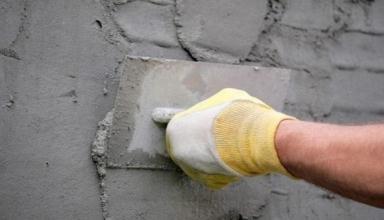
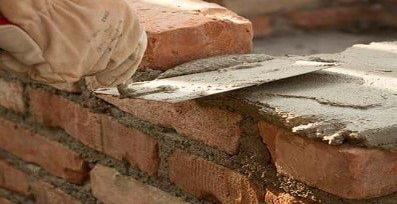
Normally,inmasonrystockadesthestructuralitemssuchas stones or else bricks stand bonded composed by using mortar. The scopes of elements for this determination are decided through respect towards the kind of mandatory substantialused.
Finishing mortar is used for pointing and plastering works.Forgeneraltypeofplasteringcementorlimemortaris used.Finishingmortarisalsousedforarchitecturaleffectsof building to give aesthetic appearances. The mortar secondhand for ornamental finishing’s must take great strength,flexibilityandresistanceagainstatmosphericaction likerain,wind,etc.
Fig 1.1 BricklayingorPebbleLayingMortar Fig 1.2 FinishingMortarof Engineering and Technology (IRJET)
Volume: 09 Issue: 04 | Apr 2022 www.irjet.net
Generallyheavyweightquartzesstandasadulterantsin HM mortars.Themortarwhichtakingbulkdensity(BD)of15 KN/m3 ormorethenitiscalledasHM.
Generally light spongy sands, easy sands are used as adulterantsinLWMMortar. Themortartakingbulkdensity (BD)oflessthan15KN/m3 thenitiscalledaslightmortar.
MortarissecretbyASTM C 270,UsualSpecificationfor Mortar Unit Masonry. Around four main types of mortar, whicharelabeledbelow.Inaddition,Type Kmortarisfrom time to time used, but comprised in the ASTM C 270 standard.
e ISSN: 2395 0056
p ISSN: 2395 0072
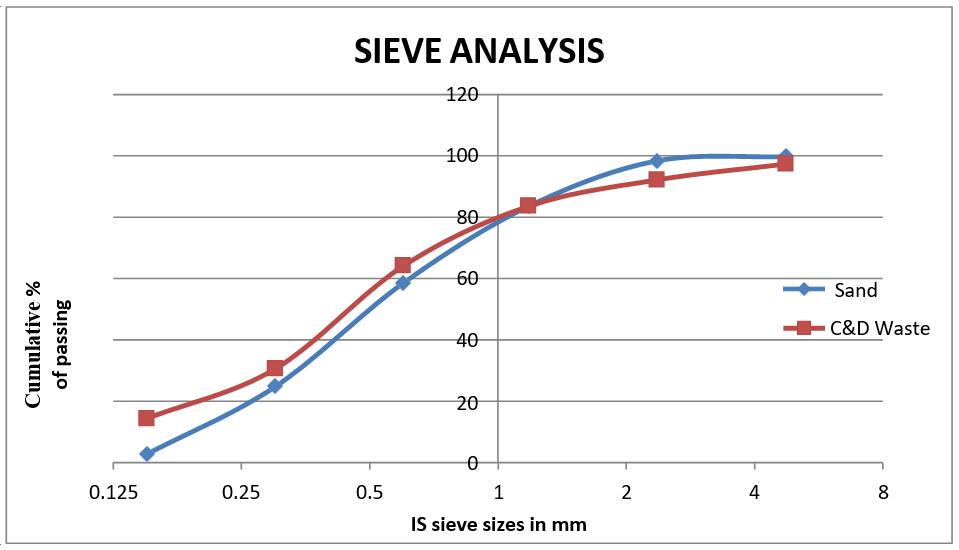
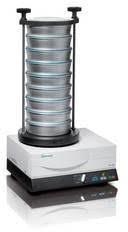
Sieveanalysishelpstoregulatethequalitymodulusand the particle scope distribution of the coarse and fine aggregates.ThisisdonebysievingtheaggregatesasperIS: 2386(part 1) 1963.ThestandardIScodeasbeentaken.
Apparatus: A set of IS sieves 4.75mm, 2.37mm, 1.19mm, 425microns,300microns,150microns,Balanceorscalewith anaccuracytomeasure0.1percentoftheweightofthetest sample.
International Research Journal Cumulative %of weight passing
Sieve size Weight retained Cumulative Weight retained
Cumulative %weight retained
The properties of mortar which are wanted to use in masonry are: Workability, Water Retentivity, Rate of Stiffening (RS), Strength, Resistance to Rain Penetration (RRP)andDurability.Thesepropertieshavebeendiscussed belowexplainingtheireffectonmasonry.Choiceofmasonry mortarisgovernedbyseveralconsiderationssuchas
Typeofmasonryunitanditsproperties,
Degreeofexposuretoweatherandenvironments,
Strengthrequirements,etc.
Table 1: Gradingofsandinzones1and1V
© 2022, IRJET | Impact Factor value: 7.529 | ISO 4.75 1 0.2 0.2 99.8 2.36 7 1.4 1.6 98.4 1.18 74 14.8 16.4 83.6 600 124 24.8 41.2 58.8 300 170 34 75.2 24.8 150 110 22 97.2 2.8 pan 14 2.8 100 0
9001:2008
ISSN: 2395 0056
ISSN:
S.NO %ofwater added
Volumeofsandv (c.c)
%bulkingof sand
1 2% 560 12 2 4% 590 18 3 6% 600 20 4 8% 580 16 5 10% 550 10 6 12% 520 4 7 14% 500 0
Specific gravity of fine aggregate is made use in design calculations of concrete mixes. Specific gravity of fine aggregate is also required to find out the compact factor while doing workability measurements. Specific gravity of fineaggregateisrequiredtobemeasuredwhenthedealwith lightandheavyweightconcrete.Averagespecificgravityof thesandvariesfrom2.6 2.8.
Apparatus: pycnometer, stability, weight box, oven, desiccators, desired distilled water, vacuum source and thermometer.
Itis done to determine the bulking characteristics of sand. Theincreaseinmoistureofsandincreasesthevolume of sand. The motive is that moisture sources film of water aboutsandelementswhichgradesintheincreaseofvolume ofsand.Generally,moisturecontentpercentagedifferfrom 5.2 to 8.5 but sudden increase in volume up to 20 to 40% depending upon sand. If the sand finer will remain more increaseinvolume.ThisisknownasBulkingofsand.Thus,it helpsindeterminingtheactualvolumeofsand,thedrysand is decreased. Thus, filled with water will have the exact volume. The volumetric proportioning of sand is greatly affectedbybulkingofsandtoagreaterextent.Theaffected volumewillbegreatforfinesandandwillbelessforcoarse sand.
Apparatus: Measuring jar, balance, oven dried sand and distilledwater.
3.1 Design of Cement Mortar Mix
3.1.1 Scheming of materials for 1 cum of 1.3 cement mortar with river sand
Specificgravityofcement=3.15;
Densityofcement=1440gg/cum
Specificgravityofsand=2.65;
Densityofsand=1765gg/cum@5%moisture First ofallwehavecalculateyieldof1
cement bag (50kg) mixed in 1:3 Weight of cement=50kg
Weightofsandmixed=3X50=150kg(contains5% moisturealso)
Approximate volume of sand=150/ (2.65X1000) =0.0567cum(contains5%moisturealso)Weightof onlysand=95%of150kg=142.5kg
Absolute volume of cement=50kg/ (3.15X1000) =0.016cum
Absolute volume of sand=weight of sand / (2.65X1000) =142.5/ (2.65X1000) =0.054cumLet volumeofwateradded=25liters=0.025cum
Moisture present in the sand= 150 142.5=7.5 liters=0.0075cum
Totalvolumeofwater=0.025+0.0075=0.0325cum
Let,Aircontentinthemortar=2%ofyield
TotalyieldY=0.1025/0.98=0.104cum
1 bag of 50kg cement produces=0.104cum of 1:3 cementmortarwith0.0567cum(equalsto150kg)of sand@5%moistureand25litersofwater.
Therefore,1cumof1:3cementmortarrequires:
Volume: 09 Issue: 04 | Apr 2022 www.irjet.net
Cement=1 bag X 1/0.104=9.615 bags Sand=150X1/0.104=1442kg
Water=25X1/0.104=240liters
3.1.2 Calculation of materials for 1 cum of 1.3 cement mortar with C&D sand
Specific gravity of cement=3.15; Density of cement=1440gg/cumSpecific
gravityofsand=2.82;Densityofsand=1550gg/cum
Firstofallwehavecalculateyieldof1cementbag (50kg)mixedin1:3Weightofcement=50kg
Weightofsandmixed=3X50=150kg
Approximate volume of sand=150/ (2.82X1000) =0.0532cumWeightofsand=150kg
Absolute volume of cement=50kg/ (3.15X1000) =0.016cum
Absolute volume of sand=weight of sand / (2.82X1000) =150/ (2.82X1000) =0.053cum Let volumeofwateradded=25liters=0.025cum
Totalvolumeofwater=0.025cum
Let,Aircontentinthemortar=2%ofyield
Y=0.094/0.98=0.096cum1 bag of 50kg cement produces=0.096cum of 1:3 cement mortar with 0.0532cum(equalsto150kg)ofsandand25litersof water.
Therefore,1cumof1:3cementmortarrequires:
Cement=1bagX1/0.096=10.42
Sand=150
Water=25
1/0.096=1563
value: 7.529
ISSN: 2395 0056
ISSN: 2395 0072
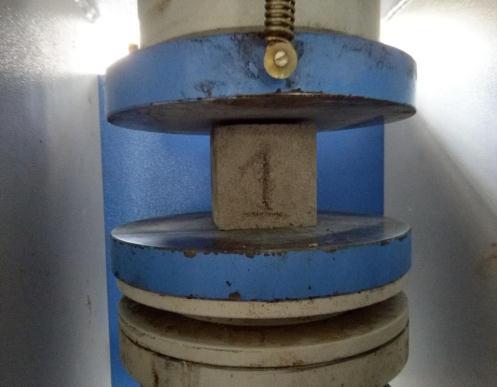
Fig 3 Compressivetestingofmortarcube
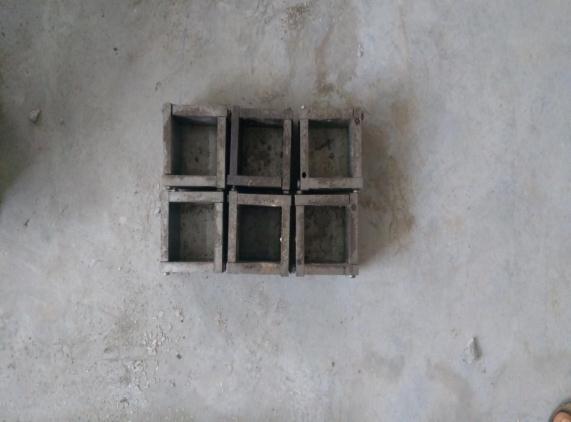
Compressivestrengthtestwerecarried outon70.8mmX 70.8 mm X 70.8mm specimen forthat three cubes were prepare for each mix. Thecompressive strength of mortar goesonreducingwithincreaseinpercentageofc&dbutthe rateofreducingcompressivestrengthisverylow.
127.5x10
129x10
124x10
ISO 9001:2008
of Engineering and Technology (IRJET)
Volume: 09 Issue: 04 | Apr 2022 www.irjet.net
Basedontheexperimentalstudy,itcanbeconcludedthat
The compressive strength of CDW mortar is Comparatively similar to that of conventional mortar.
CDWcanbereplacedassandto40% forimportant engineeringworks.
CDW can be replaced as sand to 100% for unimportantengineeringworks.
Theeffectofsodiumchloride(Nacl)onmortar(1:3) isquitelowandnotharmful.
The effect of Sulphuric acid (H2so4) on mortar (1:3)ishighandrisky.
CDW can be used as alternate material for fine aggregate and the usage of river sand can be reduced.
By replacing the river sand with CDW, usage of naturalresourcescanbeminimized.
TheuseofCDW iscosteffectivebecauseitcanbe availablefromthelocallydemolishedbuildings.
TheworkabilityofCDWsandisquitesimilartoriver sand.
CDW sand has potential to provide alternate to natural sand and helps in maintaining the environmentaswellasecologicalbalance.
Byreplacing the naturalsand with CDW sand the erosionofriverscanbereduced.
Thefollowingrecommendationscanbemadebasedonthe researchobservationsandconclusions
CDWsandisalternatematerialforriversand.Itis recommendedtouseinconstructionworks.
The use of CDW in constructions will reduce the total cost of construction. It is wellsuitable for economicstructures.
CDWsandcanbeused100%inlayingpavements, flooring,plastering,andalsoforbrickwork.
e ISSN: 2395 0056
p ISSN: 2395 0072
[1] R. Praba Rajathi. J. Jai kanth studiedtheexperimental investigation of CDWsand as replacement materialof fineaggregate. tar
[2] Nikhil Kaushik and V V Arora conductedstudieson usageofC&Dwasteasreplacementofnaturalaggregate inconcrete.
[3] Job Thomas and Wilson P. M recommendeduseofthe construction waste is a solution to prevent fast degradationofvirginrawmaterialsintheconstruction industry.
[4] K Radhika and A Bramhini researchedonalternative sourcesforthereplacementofthenaturalaggregatesin producingconcrete in thevariousfutureconstruction works.
[5] Concretetechnologyby A.R shantakumar.
[6] Concretetechnologyby M.S Shetty
9001:2008