09 Issue: 04
Apr 2022
e ISSN:2395
ISSN:2395 0072

09 Issue: 04
Apr 2022
e ISSN:2395
ISSN:2395 0072
1,2,3,4UG students, Department of Mechanical Engineering, Delhi Technological University
2 Assistant Professor, ,Department of Mechanical Engineering, Delhi Technological University

***
Abstract There is a growing need for supply chain management to incorporate the principles of sustainable development into its practice. Unfortunately, a broad framework for the supply chain of wheat production in India is not yet developed. This lack of understanding undermines the effectiveness of regulations designed to promote green supply chain management for wheat. This paper aims to provide a comprehensive classification of the various aspects of GSCM, which is needed to help academicians, researchers, and practitioners understand it from a wider perspective. It covers various aspects of the literature on the subject. Through a process based approach, the paper identifies the various factors that can contribute to the efficiency of the supply chain of wheat produce. The study explores how the wheat supply chain can reduce its environmental impact by replacing vehicles and tools with more energy efficient options.
Key Words: GreenSupplyChainManagement,EnvironmentalImpact,Efficiency,SustainableDevelopment
Despite the growing focus on designing an optimal wheat supply chain, the concept of optimal network design is rarely consideredintheexistingliterature. Thepaperproposesamixed robustoptimizationmodelfordesigningasupplychain network for wheat. The model was formulated according to three possible scenarios, namely optimistic, most likely, or pessimistic.Italsotriedtominimizethetotalnetworkcostbytakingintoaccountdifferentfactorssuchastransportation modes andthe presence of silos.Through the study of real data of the Iran wheat supplychainnetwork, ananalysiswas done on the various impacts of the proposed model on the network's cost. The results revealed that the reliability and perturbationlevelsplayeda major roleinthenetwork's cost. The performanceofthedifferentmodelswascompared by analysing the changes in the capacity of the silos. The results revealed that the uncertainty related to the supply and demandcanhavea direct effectonthecost ofthenetwork.Infuturestudies,thepaper proposesa model that takesinto account the various environmental and social impacts of the network. For future studies, the paper suggests taking into accountthevariousfactorsthataffectthetransportationcostsandchoosingthemostappropriatemodeoftransportation. Themodelcanalsobeextendedtoincludecross supplyofwheat,whichcanhelplowerthenetwork'stransportationcosts.
Supply chain management is a broad spectrum of functions that encompass various disciplines such as transportation, logistics, marketing, and distribution. It is designed to enhance a firm's performance. Modern business management has shifted from being autonomous entities to being a supply chain. Instead of being purely focused on one brand or store, businesses are now competing against each other through the use of various supply chains. The success of a single companywilllargelydependonitsabilitytointegrateitsvariousbusinessrelationships.Asaresult,theconceptofsupply chainmanagementhasbecomemoreprevalent.Theconceptofsupplychainmanagementisnotabouthavingone to one relationships with suppliers. It's about having a network of relationships that can be seamlessly integrated. This allows companiestoachievetotalbusinessprocessexcellence.
Due to the effects of climate change and resource depletion, people and businesses around the world are calling for transformative change in how they interact with the environment. As cost pressures and environmental constraints increaseinthesupplychain,businesseshavestartedtoconsidersustainableeconomicmodels.Duetothevariousfactors affectingtheenvironment,enterprisesandorganizationshavebeenrequiredtoimprovetheirenvironmentalperformance. Green supply chain management is a concept that draws on the principles of supply chain management and the environment. This concept involves addressing the relationships between supply chain operations and the natural environment.VarioustermshavebeenusedforGreensupply chainmanagement,suchasgreenpurchasingandintegrated green supply chains. {This paper aims to introduce the concept of Green supply chain management and how it can be utilisedinvariousaspectsofwheatsupply chainmanagement.}Itinvolves integratingenvironmentalconsiderationsinto the multiple aspects of a supply chainoperation. Green operations encompassthe variousactivities relatedto producing andremanufacturingproducts.Thegoalofgreenmanufacturingistominimisetheecologicalimpactoftheindustry. Due totheincreasinginterestinGSCM,variousindustriesandacademiahavestartedtoexploretheintegrationofsupplychain
Raghav Gupta1, Prateek Gupta2, Pranav Kalra3 , Pratham Singh4, Mukesh DadgeVolume: 09 Issue: 04 | Apr 2022 www.irjet.net
e ISSN:2395 0056
p ISSN:2395 0072
and environmental concerns. This can be achieved through the use of multiple green practices such as green design, reverselogistics,greenpurchasing,reuse,recyclingandenvironmentaltechnologies.
DuetotheincreasingpopulationinIndia,thedemandforwheathasalsoincreased.Thishasresultedintheneedformore production and proper transportation methods. The country's wheat production has also increased due to the use of modern agricultural technologies. The transportation and storage of food grains are some of the major issues that are faced in the functioning of wheat supply chain management therefore It is necessary to improve the efficiency of these operations.TheimpropertransportationandstorageofbulkwheatinIndiahasbeenidentifiedasoneofthemajorfactors thatcanaffectthecostofthefoodgrainsupplychain.
MichaelMutingi[1]conductedaresearchtoexploretheempiricalgreensupplychainactivitiesanddevelopaframework thatistaxonomicinnatureandcanbeusedtocreate/formulatenewstrategiesforexistingsupplychainstoconvertthem into green supply chain. He developed a taxonomic framework by analysing all the existing green supply chain activities present, he further identified all the major dimensions which influenced the green supply chain management strategies. From the research he concluded that there are a set of characteristics dimensions that influence strategic green supply chain.Hefurtherdevelopeda well organisedplanforselectinggreenstrategiesto beimplementedinthe existingsupply chain.
According to Zuraidah Sulaiman et al [2] the idea of green supply chain management is important as it directly impacts/influences the environmental impact of any organization’s activities. They defined the concept of green supply chain management as a method to integrate environmental thinking into normal supply chains. The main aim of their researchwastostudytheexistingsupplychainanditseffectsonenvironmentandfindstrategicwaystomodifythesupply chaintomakeitmoresustainableinnature.Afteranalysingthedatafromalreadypublishedarticlesandresearchpapersit was found that green supply chain and sustainability performance are two important aspects/concepts of supply chain, howeveritisdifficulttoimplementtheseconceptsonthewholesupplychainasitleadsto hugeinvestmentsandrequires significant time and resources to be implemented. It was suggested that organizations must establish long term collaborative relations with theirs vendors and customers which would make the implementation of green supply chain morefeasible.
TR Rajeswari et al [3] recognized that in post industrial era environmental impact of supply chain in businesses is a growing concern. They collected quantitative data from 12 companies concerned with corporate green supply chain practices and environmental drivers in order to identify the factors that influence the implementation of the environmental drivers. With the structural equation modeling technique, path analysis was performed to identify the significant environmental drivers. Theresultsofthestudied depictedthatthefactorsinfluencingthegreensupplychain areregulatorypressure,customerpressure,socio culturalpressureandcompetitorpressure. Howevertheyhavevarying levelofimpactinthesupplychainatdifferentstagesofmanufacturingprocess
Akinlabi et al [4] presented an overview of Green Supply Chain Management and its various components. Green Supply ChainManagementisaparadigmshiftthat'shappeninginthesupplychainmanagementindustry. Themainobjectivewas to brief on the various literatures on Global Sustainable Construction Management and to explore the new directions of this emerging field. In most corporate, construction firms and businesses the emphasis now is to raise environmentally responsibleconsumptionandproductionwithaviewofpromotingenvironmentalquality,reducepovertyandbringabout economic growth, with additional improvements in health, working conditions, and sustainability. Although it's widely usedintheconstructionindustry,mostcompaniesandindividualsarestillunawareofitsconcept.
Ming Lang Tsenga et al [5] reviewed and analyzed literature on GSCM through the use of Scopus and ISI web of science databases. Thestudyfindsthatthereisa declinein researchondriversandbarrierstogreensupplychainmanagement andthereisincreasingpopularityofimplementingmathematicaloptimizationmodelsforimprovingdecisionmaking.Also thereisanincreaseintheevaluationofgreensupplychainmanagementpracticesandperformance.Themetadataanalysis revealsinfluentialauthors,popularjournals,publicationsbyyear,topcontributingcountries,institutions,anddisciplines. Sarkis and Zhu were found to be the most influential authors in GSCM area considering the number of publications and citations.JournalofCleaner
Productionisthemostpopularjournalregardingitsimpactandnumberofpapersitpublishesduringthisarea. Chinaand America dominatethedisciplineintermsofthenumberofpublicationsaswell astheimpact The businessmanagement discipline dominates the share of literature published in GSCM. According to the content analysis, articles connected to
Volume: 09 Issue: 04 | Apr 2022 www.irjet.net
e ISSN:2395 0056
p ISSN:2395 0072
conceptual development are continuing on the rise, indicating that writers are still developing the concept of GSCM and thatmoreandmoresub disciplinesorbranchesareforming.Articlesconnectedtodriversandbarriers,ontheotherhand, reveal thatthe numberof papersis not rising whencomparedto othercategories, indicatingthattheresearch ofdrivers and obstacles in GSCM has achieved a maturity level. Firms are encountering new hurdles as new sub disciplines and branchesemerge.Theuseofmathematicalmodelsismostfrequentlyaimedataddressingthesenewissues.Furthermore, constant effort on the assessment of GSCP and GSCM performance has been noted throughout the time range. However, there are few studies in the literature that explore GSCM from the perspective of supply chain network parties such as suppliers, customers, logistics, and manufacturers There is also a scarcity of big data research. There is a lack of comparativeresearchbetweenvariousnationsandcontinents.Comparativeresearchbetweenindustriesarealsolimited. OnlyafewstudieshaveattemptedtoaddressthetheoreticalfoundationsofGSCPandperformance.Nonetheless,whenit comes to assessing the relationship between drives, practises, and performance, a considerable number of notable publicationsintheGSCPfieldlackgoodtheoreticaljustification.Mostresearchfocusandusedataforbigcorporationsand how these firms can adopt GSCP with little research and optimization being done on the SCP of smaller firms. Smaller businesses must be considered and cooperatively involved in environmental preservation in order for them to be motivatedandcontributetoamoresustainableprocess. andmakethemmoreeffective.Futuredirectionsincludetheuse ofalgorithmstopredictfuturetrends.
[6]AnassCherrafietalaimstoinvestigateandexplainthelinkbetweengreenandleanmanagement(LM)practicesandthe performanceofsupplychainmanagement(GSC).ItalsoaimstoidentifythevariouseffectsofthesepracticesonGSCs.The theoretical contributionsandimplicationsofvarious fieldsrelated togreenlean,supplychainsustainability, andprocess innovationhave been extensivelyreviewed. Thepracticalimplicationsarealsoapplicabletooperationsandsupplychain managers who are trying to improve their green performance. Greater knowledge about the link between green and processinnovationcanhelpineffectivelyimplementingGSC.Thisstudyaimstoprovideinsightintothevariousaspectsof sustainable development and how these practices can help improve the profitability of companies. It will also help them develop effective strategies and implement them within their organizations. Although this study mainly focused on the manufacturingindustry,otherindustrialsectorssuchashealthcare,logistics,andfoodservicescanalsobenefit fromthis study's findings. The implementation of a GSC can help an organization achieve its goals and provide it with the opportunity to sustain and improve its operations through continuous improvement. This study aims to encourage organizations that are not yet committed to sustainable operations to consider adopting a similar approach. Various limitations were identified in this study which prevented it from being able to provide a full analysis of the relationship between green and process innovation and the GSCs performance. This study can also provide insight into the various factors that influence the performance of GDSs. It can also reveal the various ways in which these factors can affect the performanceofGSCs.
Thispaperaimsto includetheoretical dimensionsof thestudysothat theycan be includedinthefinal product. Itisalso proposedthattheconceptsoflean,green,andprocessinnovationbeintegratedintothestudysothatitcanbeconducted inthefuture.
[7]M. Abdel Baset et al propose a robust technique for assessing and tracking the performance of green supply chain management(GSCM).Themethodisbasedontheneutrosophicsettheory.Itisusedtodetectandimprovetheefficiencyof GSCMpractices.
ArobustrankingtechniqueandneutrosophicsetcouldbeusedtodevelopGSCMpracticesandimprovetheirperformance. They proposed that the GSCM should be developed in three phases: reverse logistics, supplier environmental collaboration, and carbon management. The study revealed that GSCM practices could help organizations reduce waste, improve resource use, and lower costs. They could also contribute to the development of sustainable business models. Support of two case studies could help validate the approach and show that it could be adopted. This could also help us improve our predictionsandmake them more effective.Futuredirections includetheuseofalgorithms topredictfuture trends.
[8]R.P. Mohanty & Anand Prakash in their paper studied the practices of green supply chain management(GSCM) in the Micro,smallandmediumenterprisesofIndiaalsoknownasMSMEs.IntheareaofGSCMtheresearchhasbeengrowingin recentdaysbutwiththehelpofalltheliterature,itisstilldifficulttofindavalidexplanationforwhygreenpracticesare needed in supply chain management with the presence of internal and external pressures. The Indian MSMEs have been involved in the green supply chain practices only as far as their participation as distributors, suppliers, and business partners. Their study consolidates that MSMEs of India have to face significant pressures from stakeholders to practice GSCMpractices.
Volume: 09 Issue:
| Apr
www.irjet.net
e ISSN:2395 0056
p ISSN:2395 0072
TheirstudyempiricallyexaminedthereasonswhyIndianMSMEsareheavilyinvolvedingreensupplychainmanagement practices. It found that they face significant external and internal pressures to adopt these practices. This study also confirmsthattheseMSMEsarefullyinfluencedbytheiremployers.
ThestudysummarisedthatGSCMaimstoimproveefficiency.usageofallavailableresourcesregardlessofhowbusinessis conducted, regardless of whether the company is in the manufacturing, service, or retail industries, Whether it's transportation, mining, or agriculture, the overall concept is the same. The goal of GSCM is to improve environmental efficiency.GSCMisacomprehensivemanagementsystemstrategyandlooksforeconomicandenvironmentalefficiency.
[9]JamalFortesobservedthatsustainabledevelopmenthasmadesignificantprogressinestablishingagreensupplychain. Duringthelate1980s,manycompanieswentbeyondwhatwasrequiredinordertoachieveamoresustainableapproach. The key themes that emerged from the literature were green operations, green design, waste management, and reverse logistics.Thepaperconsiststhevariousissuesthatthesethemesfacedandwhyorganizationswouldpreferagreensupply chain. This paper reviews the various perspectives on Green supply chain management (GrSCM). It argues that these principleshavehelpedminimizetheecologicalimpactsofindustry.Overthelastcoupleofdecades,theliteratureongreen design,reverselogistics,wastemanagement,andgreen manufacturinghavebeenveryusefulforstudentsofGrSCM.This paper briefly discussed some of these concepts and their various applications. The next part of the paper covered green design and green operations, which were briefly discussed. Although the Green supply chain has been comprehensively reviewed,someareasstillrequirefurtherstudy.Oneoftheseisthestakeholder’sviewsongreensupplychain. Mostofthe time,whentheconceptofgreensupplychainmanagementcomesup,mostofthestakeholdergroupswouldagreethatit constrains the organization’s generation of profits. This paper argues that in order to properly implement green supply chainmanagement,researchersshouldfocusoninterviewingthevariousstakeholdergroups.
[10]MdShamimulIslametalnotedthatduetotheincreasingnumberofgreensupplychainstudies,manynewauthorsare venturing into this field. Although the literature review has been conducted over time, a comprehensive list of these practicesisnotavailable.Thisstudyaimstoprovideanup to datereviewofthesepracticesthroughastructuredreview process.Thestudywascarriedoutthroughastructuredreviewprocess,whichwasaimedatensuringthatthedatawere filtered through the highest quality peer reviewed journals. This paper presents a comprehensive list of various aspects andpracticesrelatedtothegreensupplychain.Someoftheseincludecarbonmanagement,reverselogistics,greendesign, and industrial symbiosis. The study focused on reviewing literature on green supply chain management. It compiled a comprehensive list of green supply chain's various aspects and practices. Although there are few studies on this topic, a comprehensivelistof these hasnotbeencompiledinthepast. Through a reviewof theliterature, ithasbeen discovered that there are various aspects of the green supply chain that were previously focused on purchasing green goods and services.Thisismainlyduetotheincreasingnumberofresearchersinthisfield. Thispapermainlyfocusesonthevarious aspectsandpracticesthatwereidentifiedbythescholarsoftheGSCMinthepasttwodecades.Itwillhelppeopleintheir studiesinthisfield.Duetothelimitationsofthestudy,thefindingswerenotpresentedinacomprehensivemanner.Future workshouldexplorethevariousfacetsofGSCMandidentifykeystrategiesandpracticesthatcanbeutilized.
[11]SethKofiNkrumahetalrecognizedtheliteratureongreensupplychainmanagementhasbeenheavilyfocusedonthe adoption of GSCM practices, the role of green capabilities has been neglected. This study aims to explore the four green capabilitiesthataremostlikelytoinfluenceGSCMadoption.Thesurveywasconductedin2017toexplorethecapabilities of 200 manufacturing and extractive companies operating in Ghana. The results revealed that the development of green suppliersandenvironmentalsolutionshadpositiveeffectsonGSCMadoption.Althoughgreenmarketingcapabilitieshave a positive impact on GSCM adoption, they did not significantly affect the adoption rate. The study also highlighted the importance of developing green capabilities in order to achieve higher levels of GSCM adoption. Despite the efforts of various authorities and other relevant parties to enforce strict environmental regulations, many firms have failed to achieve higher levels of green performance. This study suggests that firms should start developing their own green capabilities. The study only focused on Ghana, which is a sub Saharan African country. This limitation makes it hard to generalizethefindingstootherregions.Also,thedatacollectedforthestudywereonlylimitedtoGhana.
[12]Dhanavanth Reddy Maditati et al’s study aims to analyze the various factors that influence the green supply chain management process(GSCM).It providesa comprehensive view of the various GSCM factors' structural associations. Co citation analysis was coupled with content analysis of the 39 most cited articles and this was further used to identify six underlyingresearchstreams,namely(a)conceptualdevelopmentandsense making,(b)GSCMimpactonperformance,(c) integration of green and sustainable operations in the supply chain, (d) green supplier development, (e) GSCM implementation drivers, and (f) review and future research directions. HistCite software was used to perform a bibliometriccitationmeta analysison1523articlesongreensupplychainmanagement(GSCM).Theanalysisrevealedsix mainresearchstreamsthatcontributetothedevelopmentofgreensupplychainmanagement.
Volume: 09 Issue: 04 | Apr 2022 www.irjet.net
(IRJET)
e ISSN:2395 0056
p ISSN:2395 0072
Thispaperproposedacomprehensiveconceptualframeworkthatdrawsonthevariousgroupsandfactorsinvolvedinthe study of GSCM. It was also supported by the findings of key papers in the field. Future research may only focus on the relationshipsbetweendriversandpracticeindicatorsinordertovalidatetheframework.
[13]Yigit Kazancoglu et al’s paper aims to create a new conceptual framework for assessing and managing GSCM performance.ThisframeworkintegratesthevariousaspectsofGSCMperformanceandhasathree dimensionalhierarchy. Asthetransitiontoacirculareconomyapproaches,companiesshouldstartthinkingabouttheimpactoftheiroperations on the environment. This is because the concept of circular economy is focused on minimizing waste and environmental protection. The goal of this study is to provide a comprehensive view of GSCM's performance by analyzing the various indicatorssuchasenvironmental,economic/financial,operational,logistics,organizational,andmarketing performances. A framework is proposed to establish a system to assess GSCM performance. This process consists of gathering and analyzing data, establishing an assessment method, and monitoring and evaluating the gathered data. The importance of marketing criterion was added to the GSCM performance assessment to enable the companies to improve their environmentalperformance.Thiscriterionaimstomeasuretheextenttowhichtheirmarketingactivitiescontributetothe improvement of their customer satisfaction. Further research could be conducted to identify the causal relationships amongthevariouscriteriaandsub criteriaofGSCM,andtodeveloparoadmapforthecompany
[14]SulafaBadi,NiamhMurtaghetal’sstudyfocusedontheGreenSCMresearchconductedbeforetheendof2017inthe construction industry. It provided a comprehensive and rigorous analysis of the available literature on this topic. The sources cited have been described in terms of their publication outlet, date of publication, geographic setting, methods used,toolsandtechniques,conceptualdefinitionandtheroleplayedbythestakeholders. Radicalchangeisrareandmost ofthetimeitisincremental.Thisisbecausethecomplexityofthesystem,comprisingofhundredsofactor organizations andthousandsofactorsindividualsmakesitdifficulttoimplementradicalchange.
Baoshan Xing et al [15] studied the effect of chemical fertilizer, manure compost and biochar amended manure compost strategies on wheat production and its effect on the environment. It was observed that though the use of chemical fertilizers increased productivity, they had a lot of negative environmental effects. They conducted a study where the environmentalimpactofusingfourdifferenttypesoffertilizerswasanalyzed.Fromthestudyitwasfoundthattheuseof conventional chemical fertilizers impacted the environment in the most harmful manner. The use of manure compost instead of the conventional fertilizer was found to be significantly less damaging to the environment. The use of biochar fertilizersincreasedtheproductivityofwheat,whileimpactingtheenvironmenttheleast.
Mingxin Wang et al [16] conducted a life cycle assessment to examine the environmental impact of wheat production in winters. It was found that there was excessive use of nitrogen, potassium and phosphate fertilizers. Insufficient control measures and an improper application of nitrogen and phosphorus fertilizers were found to be the major factors that contribute to the excessive use of these chemicals. The study revealed that the use of these chemicals has a significant impactontheenvironment,suchasenergydepletion,aquaticeutrophicationandacidification.Theacidificationwasfound tobeanoutcomeofSO2emissionsandNH3volatilisationfromNfertilizers.Manufacturingoffertilizerswasfoundtobea veryenergyintensivetaskthuscausingenergydepletion.Itwasconcludedthatbyadoptingenergy savingtechniquesand reducingtheamountofSO2andCO2emissions,winterwheatproductioncouldimproveitsenvironmentalperformance.
[17]Amit Sachan et al stduied the effect of awareness programs to help in addressing the various issues faced by the farmers and government regarding the timely testing of soil. They also help in managing the storage capacity of the farmersand ensure the qualityof the agri produce. The acceptanceofagri produce dependsonthe storage facilities and the status of buyers in Mandi. The capacity of these facilities and the status of their payment cycle are important factors that influence the availability of seeds and fertilizer. The green revolution has greatly changed the scenario of India's agriculturalproduceindustry.Beforetherevolution,thecountrydidnotfaceascarcityofgrainandotherfoodcrops.The factors identified as enablers of an efficient supply chain for agricultural production have been identified and modeled throughaninterpretivestructuralmodellingapproach.Theresultsofthestudyrevealedthatthevariousfactorsidentified asenablersofanefficientsupplychaincanhelpincreasetheoverallsurplusofanagri produce.Someoftheseincludecrop rotationIfthepurchasingcapacityofbuyersinthemarketisnotsufficient,thenthefarmerswouldhavetoselltheircrop atalowerprice,whichwouldhavea negativeimpactontheirearnings.Thiscouldalsodiscouragethemfrom buyingthe necessary equipment at the right time. The inter relationships between these nine factors and the various other factors identifiedasenablersofanefficientsupplychaincanhelpboostthe
[18]AnkurChauhanetalfoundtheriseofthegreenrevolutionhassignificantlychangedthescenarioofIndia'sagricultural produce.Afterthis,thecountryhasneverfacedasituationofscarcityoffood.Inthestudy,thevariousfactorsthatplay a crucial role in sustaining an efficient supply chain for agriculture were identified. The findings of the study were then
Volume: 09 Issue: 04 | Apr 2022 www.irjet.net
(IRJET)
e ISSN:2395 0056
p ISSN:2395 0072
analyzed using various statistical methods, including an econometric model, to identify the most advantageous supply chain for an Agri produce. The model revealed that two key enablers are awareness programs and forecasts for demand forthecommodity.
[19]Seyyed Mahdi Hosseini Motlagh et al found that despite the growing focus on designing an optimal wheat supply chain,theconceptofoptimal network designis rarelyconsideredinthe existingliterature. Thepaper proposesa mixed robustoptimizationmodelfordesigningasupplychainnetworkforwheat.Themodelwasformulatedaccordingtothree possiblescenarios,namelyoptimistic,mostlikely,orpessimistic.Italsotriedtominimizethetotalnetworkcostbytaking intoaccountdifferentfactorssuchastransportationmodesandthepresenceofsilos.Throughthestudyofrealdataofthe Iran wheat supply chain network, an analysis was done on the various impacts of the proposed model on the network's cost. The results revealed that the reliability and perturbation levels played a major role in the network's cost. The performance of the different models was compared by analyzing the changes in the capacity of the silos. The results revealed that the uncertainty related to the supply and demand can have a direct effect on the cost of the network. In future studies, the paper proposes a model that takes into account the various environmental and social impacts of the network.Forfuturestudies,thepapersuggeststakingintoaccountthevariousfactors thataffectthetransportationcosts and choosing the most appropriate mode of transportation. The model can also be extended to include cross supply of wheat,whichcanhelplowerthenetwork'stransportationcosts.
[20] A. Ghalegolab Behbahani et al took 1 ton of wheat as a functional unit and conducted a life cycle assessment to study the impact of wheat and barley production on the environment under rainfed and irrigated farming systems. Soil acidificationandsalinization,emissionofgaseswithadverseeffects,nitrogenleachingtogroundwater,andeutrophication were someofthe environmental impactsfound due to the excessiveuseofsynthetic chemicalsandother environmental contaminants.Theoveruseofthesechemicalshasbecomeanirreversibleantagonisticconsequencefornature.
[21] D.G.Mogaleetal identifiedthemulti periodbulktransportationandstorageproblemsthatcansignificantlyaffect the cost savings of food grains. The proposed non linear programming model was designed to minimise the cost of transporting and storing food grains. The complexity of the Indian food grain supply chain's operations was a major challenge. This issue was caused by the various constraints faced by the various entities involved in the supply chain. In ordertoaddresstheseconstraints,theyproposedanovelalgorithmforthechemicalreactionoptimizationoffoodgrains. The proposed algorithm was able to solve the various problems faced by the users of the supply chain in different sizes. TheresultsofthestudyshowedthattheproposedalgorithmismoreeffectivethantheCROalgorithm.Thepaperfocused ontheIndianfoodgrainsupplychain'stwo stagemulti periodstorageandtransportationproblems.Theobjectiveofthe solution wastominimize thetransportationand storagecosts of the grain.The paper proposeda cyclicrandomnumber scheme (CROTS) for solving the problems related to the supply chain. The algorithm was then compared with a cyclic randomnumberscheme(CRO)fortheotherproblems.TheresultsofthestudyrevealedthattheimplementationofCROTS significantly improved the performance of the CRO algorithm for all the problems. The paper also focused on the single foodgraintransportationproblem.Infuture,itmayalsobeappliedtothemultifoodgraintransportationissue.Thepaper also noted that the algorithm could be extended to solve the multi objective problems of the supply chain. This method wouldhelptheFCIinplanningandcoordinatingthevariousactivitiesrelatedtothefoodgrainsupplychain.
[22] D.G. Mogale et al discussed the Public Distribution System of India's food grain supply chain problems. These issuesinvolvedthetransportationofbulkfoodcommoditiesfromsurplusstatestodeficitones.Anon linearprogramming model wasformulatedtominimizetheoverallcostofthesupplychainbytakingintoaccountvariousfactorssuchasthe vehicle preference constraints, seasonal procurement, and storage capacity. The complexity of India's food grain supply chain network was caused by the various interventions . This paper proposed a meta heuristic approach to address the issue. The proposed algorithm was then validated through the use of the Max Min Ant System (MMAS). A statistical analysis was then carried out to confirm its superiority. The issue of the public distribution system's food grain supply chainhasbeensolvedthroughthedevelopmentofamathematicalmodel.Thismodelallowedthesystemtominimizethe holdingandhandlingcostsofthefoodgrainswhileensuringtheirsafety.Themodelwasformulatedusingamixedinteger non linearframework.Itfeaturedanumberoffeaturessuchasvehiclepreferenceconstraintsandmulti periodshipments. Themodelwasformulated usingtheIMMASalgorithm.Thesolutionsobtainedfromthismethodarethendominatedthe solutionsoftheMMASalgorithm.Thecapacityandvehiclecharacteristicsofdifferentcapacitatedvehicleswereanalyzed through sensitivity analysis. The model can then be extended by considering a procurement process and a demand. Another modification of this work is the development of a multi food grain scenario. This scenario allows the transportationoffoodgrainstobehandledthroughdifferentmodesoftransportation.
[23]Gholamian et al presented a new mathematical model for the design of a wheat supply chain in Iran. It tackled the various aspects of the supply chain, including collection, production, inventory and distribution. The complexity of the
Volume: 09 Issue: 04 | Apr 2022 www.irjet.net
(IRJET)
e ISSN:2395 0056
p ISSN:2395 0072
wheatsupplychainnetwork'sstructurecanbechallengingto manageduetotheuncertaintiesrelatedtosupply,demand, relatedcosts,andclimatechanging.Thispaperaimedtointroducea robustapproachtoaddresstheseuncertainties.The studyrevealedthatthedesignoftherobustnetworkincreasesthecostofthewholesupplychain,butitalsosavescostsin situations where uncertainty exists in several parameters such as supply and demand and prevents the system from running out of wheatinthe future.Theseasonal supply ofwheataffectstheutilizationof the network and itscosts.This study also revealed that the location of silos is very important in terms of reducing wastages and keeping the network runningsmoothly.Thestudyalsoindicatedthatatthehigherlevelsofperturbations,therewillbemore siloswithhigher capacities which will raise the cost of construction and the overall network. Therefore, fewer silos should be established withmorecapacityforeachsilo.
[24]Hosseini Motlagh et al presented a multi period objective math model to support decision making processes. It proposed thatthe model canminimizesilosestablishment, transportation, food loss,inventoryholding,carbon emission, andriskpenaltycosts.Theproposedmodelisbasedonthesupplyanddemanddynamicsofthefoodgrainstock.Itcanbe utilizedtoplanandmanagethemovementoffoodgrainstockefficiently.Thecapacityofwarehousescanalsobeutilised through the well organised inventory storage plan to minimise post harvest losses and also ensure speedy movement of food grains. The proposed model can also be utilised to control the excess inventory cost by encouraging the use of lean and operational procedures. Food grain loss is less in bulk transportation and storage as compared to gunny bags. Therefore,conventionalactivitiesshouldbeshiftedtobulkgrainoperations.Oneofthemainfactorsthatcancontributeto thereductionoftheinventorycostisthereductionoffoodgrainloss.
[25]Mogale, D. G et al aimed to develop a robust supply chain model that will enable the procurement of food grains in India. It utilises the NK Hybrid Genetic Algorithm to cluster the villages and a density based approach to improve the supplychainnetwork.Itfoundthatpolicymakershavetofocusonestablishingprocurementcentresinadequatenumbers insurplusstates.Thestudyfocusedondevelopingananalyticalmodelthatwillenablefoodgrainsprocurementcompanies tomakeinformeddecisions.Itconsideredvariousenvironmentalandeconomicdimensionsoftheprocurementprocess.It also considered carbon emissions and freight transportation costs. The study tested the proposed model using various foodgrainsupplychaincases.Itconcludedthatpolicymakersshouldfocus onestablishingprocurementcentresbeforethe beginningofthemarketingsession,insurplusstatestoprovidemaximumbenefittothefarmers.TheFCIcanthencluster various villages into clusters based on the proposed algorithm. This method can help minimise the overall cost of the procurementprocess.ThestudywillalsohelpthefarmersinmakingthebestuseoftheMSPbysellingtheirproducetothe nearbyprocurementcenters.Thiswillhelpboosttheireconomicandwelfaregrowth.
Transportation in a supply chain is the process of moving products from one point in the supply chain to another. Transportationcostsareasignificantchunkofthetotalcostofacompany’ssupplychain.Althoughtheexactcontribution might vary, the number can go as high as 60 percent. Warehouse managers should consider the transportation of their productsaspartoftheiroverallsupplychainstrategytolowertheircosts.Thiscanhelpthemachievealowertotalcost.
The CO2 emissions from transport are 9000 billion tons. The emissions are expected to grow despite the significant developmentsinenergyefficiency;therefore,thereisagrowingneedforfindingefficientandgreeneralternatives.
Transportconnectsallthepartsofthesupplychaintogether. Forwheat,transportationdistancesandmodesoftransport vary depending on the field location and the products' path to market. Also, the backhaul and the modal contribution assumptionsvarybyfieldlocation.[30]
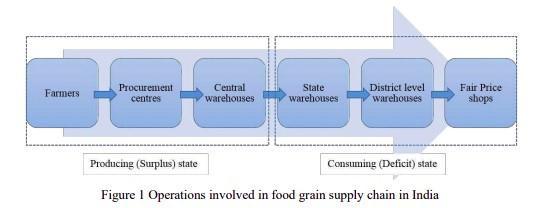
India's agriculture supply chain transport network consists of two parallel systems: Government procurement and distributionandprivateprocurementanddistribution.
The government implemented procurement and distribution consists of a transport network consisting of procurement, inter state transportation, intra state distribution, and finally, from district level warehouses to end delivery points, the FairPriceShops.
Volume: 09 Issue: 04 | Apr 2022 www.irjet.net
ISSN:2395 0056
ISSN:2395 0072
The privately implemented procurement and distribution consists of farmers, traders, commission agents, wholesalers, andretailers.
Electric trucks have not been a viable alternative to replace heavy duty trucks because the batteries have low energy density and high energy requirements. However, with the latest research progress in battery technology, the manufacturingofheavy dutyelectrictrucks,whichareviabletechnicallyandcommercially,hasbeenmadepossible.
LifeCycleanalysisperformedbySenetal.withdifferenttrucksintheUnitedStatesshowedthatelectrictrucksoutperform conventionaltrucksincostsandemissions.
With the latest research and development, battery prices are expected to decrease further. The lifecycle costs of electric truckscanbecomelowerthanthecostsofconventionalheavy dutytrucks,makingelectrictrucksaviablealternative.
Kurien et al. found out that even after considering the indirect carbon emissions from electricity generation, electric vehiclesstillhavemuchlowercarbonemissionsthaninternalcombustionenginevehicles.[31]
Zhouetal.performedthelifecycleGHGemissionsandthelifetimecostsofbattery electrictrucksandmedium dutydiesel trucksinToronto.Theyconcludedthatthelifetimecost ofElectricTruckscouldbe lowerwhencomparedtothelifetime cost of diesel trucks under driving conditions that involve frequent stops/starts and include low payloads, low charging stationscosts,andlowbatterycosts.[29]
Trucks used today produce significant amounts of emissions including CO2(70288.92), CO(491.15), NOx(859.51), CH4(12.28), SO2(193.73),PMandHC(38.20). Whichaccountsfor28.8%ofthetotalCO2,39%ofthetotalNOx,27.3%ofSO2,25%PM (0.03 Tg), and contributes 25% of the total vehicular emission of India. Electric trucks provide a greener alternative to diesel poweredtrucks,reducingthesupplychain'sgreenhouseimpact.[28]
ForcalculatingtheCO2producedforatonofpayloadtotravelakilometerofdistancefordieseltrucks,weconsideredthe CO2emissionsperkmoftrucksofdifferentpayloadsandthendividedthatbytherespectivepayloadofthetrucktoobtain theamountofCO2producedforatonofpayloadtotravelakilometer.
ForcalculatingtheCO2producedforatonofpayloadtotravelakilometerofdistanceforelectrictrucks,theenergy(kWh) requiredperkilometerforafewofthemostpopularelectrictruckswastakenanddividedbytheircapacity(tonnes)[27] tofindouttheirenergyperkilometerforcarryingatonofpayload (kWh/tkm)andtheiraverageweretaken.Thisvalue wasmultipliedbytheaverageemissionproducedtogenerateakWofelectricitytogettheamountofCO2producedfora tonofpayloadtotravelakilometer.
Research Journal of Engineering and Technology (IRJET)
Volume: 09 Issue: 04 | Apr 2022 www.irjet.net
Payload(tonnes)
AverageCO2(g/tkm)
7.4 102.9 10.3 84.0 13.8 56.5 6.3 110.9 13.4 64.7 10.3 84.0 13.8 58.6
Average: 80.17
CO2emissionsfordifferentcapacitydieseltrucks[26]
Payload(tonnes) Energy Consumption(kWh/km) Energy Consumption(Kwh/tkm)
e ISSN:2395 0056
p ISSN:2395 0072
AverageCO2(g/tkm)
7.5 0.69 0.092 87.4
11 0.88 0.08 76 12 0.88 0.0733 69 16 1.00 0.0625 59 16 1.00 0.0625 59 18 1.00 0.055 52.2
Average 67.1
Oncomparingtheaveragesproducedbythemethodsitwasfoundthattheelectrictrucksproduce16%lessCO2emissions ascomparedtotheirdieselalternatives.
The calculation should not be generalized to all electric trucks and all driving and terrain situations. Even though the Battery ElectricTruckhaslowerlifecyclegreenhouseemissions,thisisnotvalidforallconditions.
Theanalysisalsoshowsthat(asexpected)theaverageCO2emissionspervehiclesubgroupvarysignificantlyasaresultof theverydifferentmissionprofiles,averagepayloads,andannualmileage.
For thousands of years, humans have been using organic and mineral fertilizers to improve the soil fertility. In the last century,thesefertilizershaveevolvedfrombeingnaturaltobeingsynthesizedchemically.Theuseofthesefertilizershas greatlyincreasedcropproduction.Unfortunately,thisincreaseduse offertilizerhasresultedingreenhousegasemissions. Asaresult,agriculturehasbecomethesecond biggestsourceofglobalclimatechangepollution.
Since plants can’t absorb nitrogen from the air, they rely on the soil for their nutrients. During the 1900s, scientists discoveredawaytomass produceammonia,whichcanbeusedasafertilizer.Thedevelopmentofthistechniqueallowed farmers to double the amount of land they could feed. However, making ammonia at high temperatures requires a lot of energytogenerate.Thiscontributestothegreenhousegas'maincause.Asidefromcausingpollution,theuseoffertilizers alsoproducesgreenhousegasses.Whenthe nitrogenfromthefertilizer runsoffintotheatmosphere,it releasesapotent
© 2022, IRJET | Impact Factor value: 7.529 | ISO 9001:2008 Certified Journal | Page2617
Volume: 09 Issue: 04 | Apr 2022 www.irjet.net
e ISSN:2395 0056
ISSN:2395 0072
greenhousegasknownasnitrousoxide.Thisgas,whichwarmstheplanet300timesmorethancarbondioxide, accounts forasmallportionofglobalgreenhousegasemissions.
A study was conducted to understand the environmental impacts of different types of fertilizers using four fertilizers strategies.Thesestrategiesincludedconventionalchemicalfertilizer(CF),manurecompost(MC),andtwobiochar amended manurecompoststrategies[37].Twodifferenttypesbiochar amendedMCfertilizerswereusednamelyMCB5andMCB10 where5and10arethepercentageofbiocharinthefertilizer.
CFstrategyisafertilizingstrategywhereonlychemicalfertilizersareusedtocultivatecrops.Duringtheapplicationof CF strategy it was found that the chemical fertilizers are responsible for high environmental damage.It was observed that duringthelifecycleofwheatproduction,theuseofchemicalfertilizershadthemajorcontributioninthedepletionofthe stratosphericozonelayer. TheeffectoftheamountofchemicalfertilizerusedandsoilemissionofN2Oonthedepletionof thestratosphericozonelayerwas56.5%and41.3%respectively[37].
While analyzing the global warming potential (GWP) of various components in the wheat supply chain it was found that chemical fertilizer products and energy input required to synthesize these fertilizers had the maximum GWP. They were foundtobethemajorsourceforgreenhousegasemissions(GHG),releasing51.4%and29.5%ofthetotalGHGemissionsin thewheatsupplychainrespectively[32][33].
In Manure compost (MC) strategy 50% of the quantity of chemical fertilizer required in CF strategy was substituted by manurecompost. Whileusingthemanurecompostasfertilizer,themajorStratosphericozonedepletionstate(SOD)was found to be the stage where the compost is produced. The production of compost contributed 45.6% to the life cycle Stratosphericozonedepletion[35].GWPvalueinMCstrategywas9.33%higherthanthatofCFstrategy.[37]
Whileusingthebiochar amendedmanurecompoststrategytwotypesofmanureswereusedi.eMCB5andMCB10(5and 10denotethepercentageofbiocharadditioninthemanure)[38].BiocharisaCarbonrichadditivewhichisaddedinthe manurecomposttoreduceharmfulmethane(CH4)andnitrogenemissionsandenhancethenutrientretentioncapacityof the manure.Biochar posses properties such as large surface area, rich pore structure, and high sorption capacity, which makesthebiochar amendedmanurecompostsuperiortotheregularmanure.
ItwasfoundthatthebiocharamendedmanurecompostcausedthelowestlifecycleStratosphericozonedepletion(SOD)as theadditionofbicharreducedthebiogenicN2Ofromthecompostingstage[34][36].
Using MC or biochar amended MC in place of CF and reducing the input of chemical N can significantly impact the GWP positively.The biochar amended manure composts minimized fossil fueled heat generation which resulted in the MCB5 and MCB10 possessing higher reduction potentials compared to the manure composts.The contribution to life cycle greenhouse gas(GHG) emissions of the production stage of compost was found to be 41.6%, 22.3%, and 21.6% for MC, MCB5,andMCB10strategiesrespectively[38].Thisshowsthatthecompostproductionstageisamajorcontributortothe GWPlifecycle.TheresultsofthecomparisonbetweenthedifferentstrategiesindicatethattheuseofMCB5,MCandMCB10 canreducethelifecycleGWPofwheatproduction.Additionally,increaseduseofbiocharcanfurtherreducethelifecycle GWP.WhencomparedtotheGWPofCFstrategy,theGWPofMCBstrategywasfoundtobereducedto36.9%forMCB5and 48.2%forMCB10[38].
Compared to the grain yield rate in the CF strategy,the mean increase rate of grain yield for the MC strategy was 18.7%, whilethatfortheMCB5andtheMCB10strategieswas17.7%[37][40].
The water consumption of wheat production during the application of compost strategies had decreased. This suggested thatthereductionofwaterconsumptionhasapositiveeffectontheproductionofwheat.
MC and MCB strategies displayed lower values in all 3 damage categories (namely human health, ecosystems and resources) , although MCB10 displayed exceptionally higher values in human health and resources. It was also observed thatdamagetohumanhealthdecreasedfrom39.9%to22.2%iffreshliquidorsolidmanurewasusedinplaceofhalfofCF [42].Whenitcomestoreducingtheenvironmentalimpact,thebestresultswereobtainedwithMCB5.
Tractors play an essential part on the farm to haul machinery used in agriculture for plowing, planting, harvesting & cultivating crops. Besides this they are also used for landscape maintenance, clearing bushed, lawn care and spreading
Volume: 09 Issue: 04 | Apr 2022 www.irjet.net
e ISSN:2395 0056
p ISSN:2395 0072
fertilizers.Theyareevenusedfortransportationofproducefromthefarmtolocalwarehouses.Mostofthetractorsused today run on diesel powered combustion engines which produce GHG(s) and further contribute to the total carbon footprint of the harvest. However electric tractors provide a cleaner and greener alternative to their diesel powered counterparts astheydirectlydonotemitexhaustgasses.HowevergenerationofelectricitydoesproduceGHG(s)butthese arewaylesswhencomparedtothoseproducedbydieselengines.StudiessuchasthoseconductedinNantancity,Kyotoin 2008indicatethatuseofelectrictractorscanleadtoareductioninupto70%ofCO2from9.7kgforanenginetractorto 2.9kgfortheelectrictractorfortillinganareaof13acresfor1hat0.33m/s.[34][41]
Theabovestudyshowcasedthatreplacingexistingtoolsandvehicleswiththeirgreeneralternativessignificantlyreduces theenvironmentalimpactofthewheatsupplychain.It wasfoundthatwhileploughingthesameland,forthesametime, underequalloads,electrictractorsproducedapproximately70%lesscarbondioxidewhencomparedtotheconventional diesel tractors. Similarly, average CO2produced by electric trucks is 16% less than that of diesel trucks for carrying the same payload while covering the same distance. It was found that the use of chemical fertilizers possessed the majority environmental impact in the wheat supply chain. Application of chemical fertilizers contributed 51.4% of the total greenhouse gases emitted in the wheat supply chain. It was found that the use of chemically fabricated fertilizers accounted for 56.5% of all stratospheric ozone depletion caused by the supply chain of wheat. In manure compost(MC) strategy, compost production stage is the major contributor to Stratospheric ozone depletion(45.6%). MC strategy also displayed 9.33% more GWP when compared to CF strategy.Biochar amended manure showed the lowest life cycle Stratospheric ozone depletion because the biogenic N2O from the composting stage was reduced drastically.MCB5 and MCB10havethegreaterpotentialtoreducegreenhouseemissions,ascomparedtomanurecomposts,duetominimaluse of fossil fueled heat generation. Compared to CF strategy, MCB5 and MCB10 reduced GWP by 36.9% and 48.2%. MC and MCB strategies also showed an increased grain yield along with reduced water consumption , when compared to CF strategy. MC and MCB strategies showed increased grain yields of 18.7% and 17.7% respectively.MC and MCB strategies displayed lower values in all 3 damage categories (namely human health, ecosystems and resources) , although MCB10 displayedexceptionallyhighervaluesinhumanhealthandresources.
Silosusedforstorageneedtobeofoptimumsizesoastostorelargeamountsofwheatforlongdurationsoftimeandavoid wastage. Silos also need to be set up at strategic locations to optimize transportation of wheat from farms to silos for multiplevillages.Optimizationoftransportationofwheatfromsilostomillsalsoneedstobeconsideredwhiledecidingthe location for silo setups.Machine learning should be incorporated to a greater extent while optimizing silos size and deciding the best location for them.Conventional tools and machinery such as harvester, combine etc, used for the cultivation of wheat can be replaced by their electric alternatives. Moreover, all the fossil fuel and electric powered vehiclesusedinthewheatsupplychaincanbereplacedbybiofuel(suchasH2,Bio ethanol)poweredvehicles.
[1] Mutingi, M. (2013). Developing green supply chain management strategies: A taxonomic approach. Journal of Industrial Engineering and Management (JIEM), 6(2),525 546.
[2] Chin, T. A., Tat, H. H., & Sulaiman, Z. (2015). Green supply chain management, environmental collaboration and sustainabilityperformance. Procedia Cirp, 26,695 699.
[3] Padmalalitha,T.V.,&Rajeswari,T.R.(2020).EnvironmentalDriversonGreenSupplyChainPractices.
[4] Ojo, E., Mbowa, C., & Akinlabi, E. T. (2014, January). Barriers in implementing green supply chain management in constructionindustry.In International Conference on Industrial Engineering and Operations Management.
[5] Tseng, M. L., Islam, M. S., Karia, N., Fauzi, F. A., & Afrin, S. (2019). A literature review on green supply chain management:Trendsandfuturechallenges. Resources, Conservation and Recycling, 141,145 162.
[6] Cherrafi, A., Garza Reyes, J. A., Kumar, V., Mishra, N., Ghobadian, A., & Elfezazi, S. (2018). Lean, green practices and process innovation: A model for green supply chain performance. International Journal of Production Economics, 206, 79 92.
Volume: 09 Issue: 04 | Apr 2022 www.irjet.net
e ISSN:2395 0056
p ISSN:2395 0072
[7] Abdel Baset, M., Chang, V., & Gamal, A. (2019). Evaluation of the green supply chain management practices: A novel neutrosophicapproach. Computers in Industry, 108,210 220.
[8] Mohanty, R. P., & Prakash, A. (2014). Green supply chain management practices in India: an empirical study. Production Planning & Control, 25(16),1322 1337.
[9] Fortes,J.(2009).Greensupplychainmanagement:Aliterature. Otago Management Graduate Review, 7(1),51 62.
[10] Tseng, M. L., Islam, M. S., Karia, N., Fauzi, F. A., & Afrin, S. (2019). A literature review on green supply chain management:Trendsandfuturechallenges. Resources, Conservation and Recycling, 141,145 162.
[11] Nkrumah, S. K., Asamoah, D., Annan, J., & Agyei Owusu, B. (2020). Examining green capabilities as drivers of green supplychainmanagementadoption. Management Research Review.
[12] Maditati,D.R.,Munim,Z.H.,Schramm,H.J.,&Kummer,S.(2018).Areviewofgreensupplychainmanagement:From bibliometricanalysistoaconceptualframeworkandfutureresearchdirections. Resources, Conservation and Recycling, 139,150 162.
[13] Kazancoglu, Y., Kazancoglu, I., & Sagnak, M. (2018). A new holistic conceptual framework for green supply chain managementperformanceassessmentbasedoncirculareconomy. Journal of cleaner production, 195,1282 1299.
[14] Badi, S., & Murtagh, N. (2019). Green supply chain management in construction: A systematic literature review and futureresearchagenda. Journal of cleaner production, 223,312 322.
[15] Jiang, Z., Zheng, H., & Xing, B. (2021). Environmental life cycle assessment of wheat production using chemical fertilizer,manurecompost,andbiochar amendedmanurecompoststrategies.ScienceofTheTotalEnvironment,760, 143342.
[16] Wang, M., Wu, W., Liu, W., & Bao, Y. (2007). Life cycle assessment of the winter wheat summer maize production system on the North China Plain. The International Journal of Sustainable Development & World Ecology, 14(4), 400 407.
[17] Sachan, A., Sahay, B. S., & Sharma, D. (2005). Developing Indian grain supply chain cost model: a system dynamics approach. International Journal of Productivity and Performance Management
[18] Chauhan, A., Kaur, H., Yadav, S., & Jakhar, S. K. (2020). A hybrid model for investigating and selecting a sustainable supplychainforagri produceinIndia. Annals of Operations Research, 290(1),621 642.
[19] Hosseini Motlagh, S. M., Samani, M. R. G., & Abbasi Saadi, F. (2021). Strategic optimization of wheat supply chain networkunderuncertainty:arealcasestudy. Operational Research, 21(3),1487 1527.
[20] Fallahpour, F., Aminghafouri, A., Ghalegolab Behbahani, A., & Bannayan, M. (2012). The environmental impact assessment of wheat and barley production by using life cycle assessment (LCA) methodology. Environment, development and sustainability, 14(6),979 992.
[21] Mogale,D.G.,Kumar,S.K.,Márquez,F.P.G.,&Tiwari,M.K.(2017).Bulkwheattransportationandstorageproblemof publicdistributionsystem. Computers & Industrial Engineering, 104,80 97.
[22] Mogale, D. G., Dolgui, A., Kandhway, R., Kumar, S. K., & Tiwari, M. K. (2017). A multi period inventory transportation modelfortacticalplanningoffoodgrainsupplychain. Computers & Industrial Engineering, 110,379 394.
[23] Gholamian,M.R.,&Taghanzadeh,A.H.(2017).Integratednetwork designofwheatsupplychain:ArealcaseofIran. Computers and Electronics in Agriculture, 140,139 147.
[24] Hosseini Motlagh, S. M., Samani, M. R. G., & Abbasi Saadi, F. (2021). Strategic optimization of wheat supply chain networkunderuncertainty:arealcasestudy. Operational Research, 21(3),1487 1527.
[25] Mogale,D.G.,Ghadge,A.,Kumar,S.K.,&Tiwari,M.K.(2020).Modellingsupplychainnetworkforprocurementoffood grainsinIndia. International Journal of Production Research, 58(21),6493 6512.
Volume: 09 Issue: 04 | Apr 2022 www.irjet.net
e ISSN:2395 0056
p ISSN:2395 0072
[26] Ragon, P. L., & Rodríguez, F. (2021). CO₂ emissions from trucks in the EU: An analysis of the heavy duty CO₂ standards baseline data (No.2021 35).
[27] Liimatainen, H., van Vliet, O., & Aplyn, D. (2019). The potential of electric trucks An international commodity level analysis. Applied energy, 236,804 814.
[28] Ramachandra, T. V. (2009). Emissions from India's transport sector: statewise synthesis. Atmospheric Environment, 43(34),5510 5517.
[29] Zhou, T., Roorda, M. J., MacLean, H. L., & Luk, J. (2017). Life cycle GHG emissions and lifetime costs of medium duty diesel and battery electric trucksin Toronto, Canada. Transportation Research Part D: Transport and Environment, 55, 91 98.
[30] O’Donnell,B.,Goodchild,A.,Cooper,J.,&Ozawa,T.(2009).Therelativecontributionoftransportationtosupplychain greenhouse gas emissions: A case study of American wheat. Transportation Research Part D: Transport and Environment, 14(7),487 492.
[31] Kurien, C., & Srivastava, A. K. (2020). Impact of electric vehicles on indirect carbon emissions and the role of engine posttreatmentemissioncontrolstrategies. Integrated environmental assessment and management, 16(2),234 244.
[32] Montemayor, E., Bonmatí, A., Torrellas, M., Camps, F., Ortiz, C., Domingo, F., ... & Antón, A. (2019). Environmental accounting of closed loop maize production scenarios: Manure as fertilizer and inclusion of catch crops. Resources, Conservation and Recycling, 146,395 404.
[33] Zhu,Z.,Jia,Z.,Peng,L.,Chen,Q.,He,L.,Jiang,Y.,&Ge,S.(2018).Lifecycleassessmentofconventionalandorganicapple productionsystemsinChina. Journal of Cleaner Production, 201,156 168.
[34] Luo, W., O'Brien, P. L., & Hatfield, J. L. (2019). Crop Yield and Nitrous Oxide Emissions following Swine Manure Application:AMeta Analysis. Agricultural & Environmental Letters, 4(1),190024.
[35] Li, S., Wu, J., Wang, X., Ma, L., 2020. Economic and environmental sustainability of maize wheat rotation production whensubstitutingmineralfertilizerswithmanureintheNorthChinaPlain.J.Clean.Prod.271
[36] Liu, B., Cai, Z., Zhang, Y., Liu, G., Luo, X., & Zheng, H. (2019). Comparison of efficacies of peanut shell biochar and biochar basedcompostontwoleafyvegetableproductivityinaninfertileland. Chemosphere, 224,151 161.
[37] Montemayor, E., Bonmatí, A., Torrellas, M., Camps, F., Ortiz, C., Domingo, F., Riau, V., Antón, A., 2019. Environmental accounting of closed loop maize production scenarios: Manure as fertilizer and inclusion of catch crops. Resour. Conserv.Recy.146,395 404
[38] Jiang, Z., Zheng, H., & Xing, B. (2021). Environmental life cycle assessment of wheat production using chemical fertilizer, manure compost, and biochar amended manure compost strategies. Science of The Total Environment, 760, 143342.
[39] Nantan city, Kyoto. 2008. Global Warming Countermeasures execution plan in Nantan. (Accessed 17. September. 2013) JSAM. 1996. Handbook of biological production machinery, 390 391, 422 423. Tokyo: Corona Publishing Co., Ltd.
[40] Jiang, Z., Lian, F., Wang, Z., & Xing, B. (2020). The role of biochars in sustainable crop production and soil resiliency. Journal of Experimental Botany, 71(2),520 542.
[41] YukoUeka,JunYamashita,KazunobuSato,YoshinoriDoi(2013),StudyontheDevelopmentoftheElectricTractor,
SpecificationsandTravelingandTillingPerformanceofaPrototypeElectricTractor,EAEF6(4):160 164
[42] Li,S.,Wu,J.,Wang,X.,&Ma,L.(2020).Economicandenvironmentalsustainabilityofmaize wheatrotationproduction whensubstitutingmineralfertilizerswithmanureintheNorthChinaPlain. Journal of Cleaner Production, 271,122683.