International Research Journal of Engineering and Technology (IRJET)

Volume: 09 Issue:
2022 www.irjet.net
e ISSN: 2395 0056
ISSN: 2395 0072

International Research Journal of Engineering and Technology (IRJET)
Volume: 09 Issue:
2022 www.irjet.net
e ISSN: 2395 0056
ISSN: 2395 0072
5 Professor, Dept. of Information Science and Engineering
Vidyavardhaka College of Engineering, Mysuru, Karnataka, India
***
Abstract These days, Heart related problems are increasing day by day because of way of life, inherited. Most importantly coronary illness is the new normal, hence the lifespan of them is in greater danger. So, identification of Cardiac disease at early stages and providing proper treatments plays a vital role in the current medical sector. Many efficient techniques and algorithms are utilized for the disease prediction with interest in Cardiac sector. As per medicallydemonstratedresultstheordinaryBloodpressureis 120/90andheartbeatrateis72bpm.Thepatientdangerlevel is grouped utilizing machine learning and data mining arrangement procedures like Naive Bayes, Support Vector Machine, KNN, Logistic Regression, Decision Tree, Neural networks, Random Forest (RF).
Key Words: Cardiacdisease,DataMining,NaiveBayes,KNN, SVM, Logistic Regression, Decision Tree, Neural networks, Random Forest.
Nowadays,Heartrelatedissuesaregrowingdaybydayin viewoflifestyle,acquired.Especially,coronaryailmenthas becomemoreordinarythesedayswhichmakespeoplelife difficult. The patient risk level is calculated using SVM, Logistic Regression, KNN and many more. A few non modifiable variables are additionally present such as smoking,drinkingadditionallyjustificationbehindcoronary illness.Wheneverbloodveinsareoverstretched,thedanger meteroftheveinsareexpandedwhichpromptstheblood pressure.
Ageisafactorthatisnon modifiableandisadangerwhich additionally one of the justifications for coronary illness. Nearlymorethan41%ofdemiseduetoheartsicknesscan be seen due to the smoking as the major issue. Since it majorly cut offs the entry of oxygen to the blood thereby causing harm to the veins. Different mining strategies are used to foresee the risk of cardiac illness. The patient movementisobservedcarefullyandoftenintheeventthat there are any progressions happen, the hazard level of illnessissaidtothepatientbyspecialist
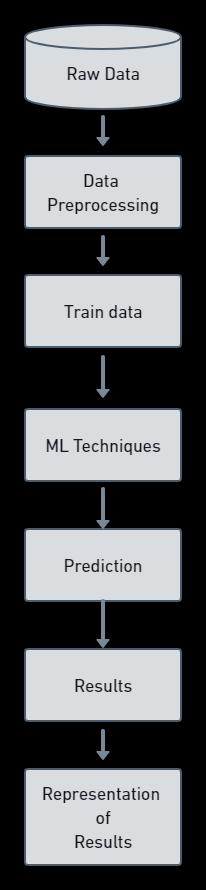
Intheinitialphase,wegatherclinicalinformation.Inearlier yearspatients'informationwasgatheredforhandling.More than 5000 + informational collections are utilized for handling. Preparing informational indexes will contain patient subtleties and furthermore boundaries that are expected for expectation. Clinical information is dissected and only significant information is extricated. Required informationextractionisdoneinlightofthefactthatwhole preparation information is not needed for handling and assumingweinputallinformation,itrequiresalotoftime forhandling,soinformationhandlingisfinished.Supervised LearningTechnique:It'saprescientmodelutilizedforthe assignments where it includes a forecast of one worth involvingdifferentqualitiesintheinformationalindex.We
9001:2008
Research Journal of Engineering and Technology (IRJET)
Volume: 09 Issue: 04 | Apr 2022 www.irjet.net
havenumerouscalculationstoconstructmodelsinregulated learninglikeKNN,NaiveBayes,andsoforth.Dependingon the necessity, marks, boundaries, and informational index weselectthefittingcalculationforexpectations.
Thecalculationisutilizedtoconstructamodelthatmakes forecastsinlightofproofwithinthesightofvulnerability. The doctor can access the module where the framework predicts the cardiac problems and types for the new patients. Results produced by the algorithm are checked with precision by utilizing the confusion matrix strategy, hereweapprovetheoutcomesproducedbythecalculation. The final results are displayed on GUI. At the point when clients get to sign in to the application, the framework predictsthesicknessandpresentationsitonaGUI.
Thereareseveralchallengesineachstageofcardiacdisease prediction:
1. Choosing the right dataset: Plenty of datasets are availableofdifferentvarieties.Pickingtherightone which serves our purpose is crucial as the whole processdependsonthisphase.
2. Picking the right attribute for producing the accurateoutcome:Wemayhave100+fieldsinour data. But eliminating the fields whose absence doesn'taffecttheperformanceofthealgorithmis important.
3. Distinguishingandtakingcareofthemissingvalues. In information pre processing, it is crucial to distinguishandaccuratelyhandlethemissingparts, neglectingtodothis,youcouldmakeerroneousand flawed determinations and inductions from the information. Obviously, this will hamper the venture.
4. Choosingthesuitablealgorithmtoachieveagood accuracyscore:Whenitcomestoalgorithmsitisall aboutaccuracy,sopickingtherightalgorithmwhich yieldsgoodresultsisamust.
5. Assess the model's presentation and lay out benchmarks. Assessment incorporates model metric assessment, confusion matrix estimations, KPIs,modelexecutionmeasurements,modelquality estimations and a last assurance of whether the modelcanmeetthelaid outbusinessobjectives.
6. Repeat and change the model: Even however the modelisfunctionalandyou'reconstantlychecking its exhibition, you're not done. With regards to carryingoutadvances,it'sgenerallyexpectedsaid thattherecipeforprogressistobeginlittle,imagine something truly mind blowing and repeat frequently.
2022,
e ISSN: 2395 0056
p ISSN: 2395 0072
More number of individuals are getting coronary disease consistentlyandthesearethegreatestenemyofpeopleall over the planet. The World Health Organization (WHO) examined that twelve million occurring happens overall becauseofHeartillnesses.Coronaryillnessistakingthelives of many individuals in a very frequent manner Clinical conclusionassumesanessentialpartbutisamuddledtask that should be executed proficiently and precisely. To decreasethecostofclinicaltests,suitablePC baseddatais required.Learningofthemajorriskypartsassociatedwith coronary disease helps administrations specialists to perceive patients at high risk of having cardiac illness. Finallyforthepurposeofhumanlivingbenefits,spreading awareness to the society and helping them is the main motivation.
Differentstudieshavebeen doneandmodelshasbuiltfor predictionofheartdisease,variousdataminingandmachine learning methods are used for predicting the disease and accuracylevelisobtainedforvariousmethods
In[1]TheresaPrincy,etal.Therisklevelforthepatientis classifiedusingmachinelearningtechniqueslikeKNNand ID3algorithm.TherearetwophasesnamelyClassification andregression,studyconsistsoftwomodulesi.e.,classifier and prediction module. Using basic attribute such as BP, Cholesteroltheaccuracylevelofthepredictionwas40%and by adding smoking and family history the accuracy was increased to 80%. In [10] C. Kalaiselvi et al. the main objective is to diagnose heart disease with the reduced number.Classificationandclusteringalgorithmareusedin this method. The implementation part is done using the MATLAB12wheredataisclassifiedastwotypesasgetting heartdiseaseandwithnoheartdisease.Thecostisreduced for different medical test and it help patients to take precautionarymeasuresinadvance.Theaccuracyfornaive bayesclassifierisabout90.72%,decisiontreeisof96.62% andKNNisabout97%.
In [6] N. Komal Kumar et al. mainly determines about the prediction the ailment dependent on the side effects and conditionsofpatientandmainlydealswithcardiovascular disease. The cleaned data is split into two types namely trainingandtestingdataandsubjectedto5classifiersand accuracyisfoundbyconfusionmatrixtherebyfindingbest classifier for predicting cardiovascular disease. Among all the predicted models, the higher accuracy was observed using random forest with 85.71%. The other models like decision tree and logistic regression have accuracy of 74.28%,SVMwith77.14%andKNNwith68.57%.
Mortality of the patients with heart disease is predicted using data mining methods [4]. ANN [Artificial neural
Impact Factor value: 7.529 | ISO 9001:2008
Research Journal of Engineering and Technology (IRJET)
Volume: 09 Issue: 04 | Apr 2022 www.irjet.net
networks],logisticregressionanddecisiontreearethethree models used in predicting death of patients within 12 monthsofsufferingfromdisease.Inthismodel,RapidMiner studiowasusedforimplementation.Modelperformanceis dealt with some of the criteria like accuracy, specification and precision Among the three methods, neural network givesthehigheraccuracyof74.3%.In[2]Sana Bharti, Dr. Saliendra Narayana Singh talks about how various algorithms can be used to predict the heart disease. The algorithmsincludedata miningtechniqueslikeclustering, associationruleforprediction.Thebasicflowofthismodel consists of database of patients, analysis of data, feature selection,optimizationalgorithm,trainingandclassification. Therearetotalof14attributesusedinthismethodlikeage, gender,BPlevel,obesity,heartrate,sugarleveletc.Thistype ofpredictionhasanaccuracyrateof60.74%.
The [5] is about prediction of cardiac disease by using decisiontreemethodwithanaccuracyrateof73%whereas other major algorithm like Naïve Bayes, KNN [K Nearest neighbors],SVM,LogisticRegressionwhichhasarangeof accuracyrateabout60 70%.Theobjectiveofthispaperisto useacardiacdatasetwhichisgroupedbyusingsupervised machinelearningalgorithms.Somemethodtofindoutthe accuracy of an algorithm include Accuracy prediction, precision, this method has proven more accuracy using decision tree. In [12] it is a study conducted by different algorithms like Naive Bayes, KNN, Logistic Regression. Regularizationofmodelisusedinthisapproachwhichhelps inimprovingoverallaccuracyrate.Duetocomplexnatureof cardiac disease, the models need professional advices, implementationofpatient’sissuestodeterminehowsevere istheattackonheartandalsoanypreviousattackinfoofthe patient. Logistic regression has an accuracy of 77% and 81.48%
Accuracywithnaïvebayes,highestaccuracyisrecordedin KNNmodelwith94.60%.
In [3] Seyedamin Puriyed et al. have provided aim to comparedifferentmachinelearningtechniquesondataset. Thealgorithmsareappliedindividuallyandincombinations using precision(sensitivity). In [9] Khashman adan, et al. mainlydetermineaboutthediscussionregardingthedeath rate infused by various cardiovascular heart disease, by designinganintelligentsystemforpreventingmisdiagnosis ofheartdisease.Thedatasetisdividedintotwocategories namelytrainandtestset.Thedatasetisintheratioformatof 60:40. The advantage of this type of division is to avoid underfittingofthedatawhichoccurifthetrainingdatasetis very smaller than the testing dataset. The designing of networkincludesstandardratioofdividingdatasets.Neural network at once is provided for batch training's entire patterns. The accuracy was more when back propagation methodisusedwithneuralnetwork(BPNN),givesaccuracy of85%.
2022,
e ISSN: 2395 0056
p ISSN: 2395 0072
In[8]SanjidaRezaRafaetal.PrincipalComponentAnalysis (PCA) is used to reduce the count of attributes. K means methodisusedforclusteringthedata.Thedimensionalityof dataset is reduced by PCA and then combined them with heuristicalgorithmforbetteroptimization,theaccuracyfor decisiontreeisabout99.62%.
Aportionof the regulatedAIstrategies[11]utilizedinthe expectationofcoronaryillnessareartificialneuralnetwork (ANN) has model with human like neurons, decision tree (DT)withclassificationandregressiontree,randomforest (RF), support vector machine (SVM) with one, two, three, four dimensions as point, line, plane and hyperplane respectively, naïve Bayes (NB) with independency of the attributes and k nearest neighbors algorithm .It also mentionsaboutvariouskindofheartdiseaseswithrespect todifferentattributesthatareconsidered.Gridsearchand random search algorithms are used for selecting features and hence provides better results. Decision tree has 86% accuracy during testing phase and 87% during training phase.SabaBashiretal.predictstheheartdiseaseusingdata science [7]. The research is based on feature selection methodsandalgorithms.Themainobjectiveistoprovidean accuratewayofdiagnosingdiseasewithreducedfeatureset. The results obtained shows accuracy of 84.85% by using Logistic regression (SVM) and 84.17% for Random Forest classifier.
In[13]themodelpurposesAIforforeseeingthegambleof coronaryfailure,asMLcananticipatepreciselyandsimply decide.TheproposedframeworkutilizesClevelandcoronary illness dataset and information mining techniques like regressionandclassificationandAIstrategieslikeRandom Forest, Decision tree, hybrid breed model is utilized. The exactnesspaceofDecisiontreeis79%,forrandomforestis around 81%, when hybrid of these both are taken the precisionismorewith88%.
The dataset has 3 sorts of characteristics specifically key, information and forecast attributes [1]. Out of many info credits, age and orientation are nonmodifiable qualities. Patient information gathered (2011 to 2017) at cardiovascularwardofMostarmedicalclinicwereutilizedto fabricate the model [4], the dataset contains 507 patients withcardiovascularinfection,ithas71characteristicsand twospecialsincludingpatientID,Vitalstatus.Differenttraits arePeripheralOedema,HbA1c,ACEinhibitorsandsoforth. In[12]theClevelandcoronaryillnessdatasetfromUCIvault isutilized;thedatasethas303caseswith76characteristics for certain inadequate properties. Six examples were dismissed in the concentrate because of missed esteem in tasksectionsandhencetotalof279tests.In[2]thedataset has 14 ascribes for coronary illness forecast resting electrocardiographic outcomes, resting pulse, practice incitedanginaisfewmanyamongthem.
Impact Factor value: 7.529 | ISO 9001:2008
09
| Apr 2022
e ISSN: 2395 0056
ISSN: 2395 0072
Sl. No Citations
1 Theresa Princy et al. [1]
2016 Conference UCI machine Learning datarepository
2 SanaBharathietal.[2] 2015 Conference Realtimedata
3 Seyedamin Puriyed et al.[3] 2017 Conference UCI dataset repository andClevelanddataset
4 Damir Imamovic et al. [4] 2020 Conference UCI machine Learning DataRepository
5 Jane Preetha Princy et al.[5] 2020 Conference UCIdatarepositoryand Cardiovasculardataset
6 Sagarikaetal.[6] 2020 Conference UCIDataRepository Heartdiseasedatasets
7 Sabaetal.[7] 2019 Conference UCIRepository
Accuracyofpredictionwasatthe rangeof80%
Accuracy:61%
KNN(K=15) >828% Naivebayes >83.49% DecisionTree >77.52% SVM >69.96%
Decisiontree >65.13% Neuralnetworks >74.34% Logisticregression >69.74%
Decisiontree >73%
LogisticRegression >72% SVM >72% KNN >60%
RandomForest >85.71%,
Decisiontree >82%
LogisticRegression >82.5% RandomForest >84.2% NaiveBayes >84% LogisticRegression >85%
8 Sanjidaetal.[8] 2020 Conference UCI Machine Learning Repositoryheartdisease dataset
9 Khashmanetal.[9] 2015 Conference UCI machine Learning DataRepository
10 Kalaiselvietal.[10] 2015 Survey UCI machine Learning DataRepository
DecisionTree(15attributes) 99.62% Proposedsystem 94.06%.
DecisionTree >84.33% NaïveBayes >84% BPNN >85%
NB >94.43% DT >96.1% KNN >96.5% 12attributesused NB >90.72% DT >96.62% KNN >97%
11 Polipireddyetal.[11] 2020 Survey ClevelanddatasetUCI Chronic disease diagnosis between82%and92%
12 Samiretal.[12] 2020 Conference UCI Machine Learning Repositoryheartdisease dataset
13 Saietal.[13] 2021 Conference UCI Machine Learning Repositoryheartdisease dataset
Logisticregression >77% NaïveBayes >81.48 KNN >94.60% SVM,MLP >80.41%
DecisionTree >79% RandomForest >81% Hybrid (DecisionTree+RandomForest) >88%
Volume: 09
www.irjet.net
and Technology (IRJET)
e ISSN: 2395 0056
ISSN: 2395 0072
1 TheresaPrincyetal.[1] 5
2 SanaBharathietal [2] 9
3 SeyedaminPuriyedetal.[3] 13
4 DamirImamovicetal [4] 8
5 R.JanePreethaPrincyetal.[5] 12
6 N KomalKumaretal [6] 10
7 SabaBashiretal.[7] 15
8 Md.TouhidulIslametal [8] 15
9 Khashmanadan[9] 270instances;13attributes
10 C.Kalaiselvi[10] 13
11 RahulKataryaetal [11] 13
UCIMachineLearningDataset
RealTimeDate
UCIDatawithClevelanddataset
UCIMachineLearningDatarepository
UCICardiovascularDataset
UCIheartdiseasedataset
UCIMachineLearningrepository
UCIMachineLearningDataset
UCIMachineLearningDatarepository
UCIMachineLearningDatarepository
UCIDatawithClevelanddataset
12 SamirSYadavetal [12] 297instances;13attributes Heartdiseasedataset
13 Dr M Kavithaetal [13] 303instances;14attributes Heartdiseasedataset
Asitisveryhardtoforecastthecoronaryillnessinrealtime, some efficient research works required to predict cardiac diseaseinlesstime.Eventhoughmanyworksdoneonthis cardiac disease, still some efficient and proper research worksrequiredtopredictcardiacdiseaseusingefficientdata sciencealgorithms.Developingarealtimesystemalsohelps inrealtimetopredictcardiacdiseaseinlesstimeandbetter wayanddoctorscanhandlethepatientsinbetterway
[1] Thomas, J., & Princy, R. T. (2016, March). Human heartdiseasepredictionsystemusingdatamining techniques. In 2016 international conference on circuit, power and computing technologies (ICCPCT)(pp.1 5).IEEE.
[2] Bharti, S., & Singh, S. N. (2015, May). Analytical study of heart disease prediction comparing with differentalgorithms.InInternationalConferenceon Computing,Communication&Automation(pp.78 82).IEEE.
[3] Acomprehensiveinvestigationofmachinelearning technique in the Domain of Heart disease SeyedaminPuriyed,sadavahid(2017)
[4] Prediction of mortality in patients with cardiovasculardiseaseusingdataminingmethods DamirImamovic,ElmirBabovic,NinaBijedic(2020)
[5] Princy, R. J. P., Parthasarathy, S., Jose, P. S. H., Lakshminarayanan, A. R., & Jeganathan, S. (2020, May).Predictionofcardiacdiseaseusingsupervised machine learning algorithms. In 2020 4th InternationalConferenceonIntelligentComputing andControlSystems(ICICCS)(pp.570 575).IEEE.
[6] N. Komal Kumar, G. Sagarika Sindhu, D. Krishna Prashanthi,AShaeenSultana(2020) Analysisand predictionofCardio vasculardiseaseusingMachine Learningclassifiers
[7] Bashir, S., Khan, Z. S., Khan, F. H., Anjum, A., & Bashir,K.(2019,January).Improvingheartdisease prediction using feature selection approaches. In 2019 16th international bhurban conference on appliedsciencesandtechnology(IBCAST)(pp.619 623).IEEE.
[8] Islam, M. T., Rafa, S. R., & Kibria, M. G. (2020, December).Earlypredictionofheartdiseaseusing PCAandhybridgeneticalgorithmwithk means.In 202023rdInternationalConferenceonComputer andInformationTechnology(ICCIT)(pp.1 6).IEEE.
[9] Olaniyi,E.O.,Oyedotun,O.K.,Helwan,A.,&Adnan, K.(2015,September).Neuralnetworkdiagnosisof heartdisease.In2015InternationalConferenceon AdvancesinBiomedicalEngineering(ICABME)(pp. 21 24).IEEE.
9001:2008
Research Journal of Engineering and Technology (IRJET)
Volume: 09 Issue: 04 | Apr 2022 www.irjet.net
[10] Kalaiselvi, C., & Nasira, G. M. (2015). Predictionofheartdiseasesandcancerindiabetic patients using data mining techniques. Indian JournalofScienceandTechnology,8(14),1.
[11] Katarya, R., & Srinivas, P. (2020, July). Predicting heart disease at early stages using machinelearning:Asurvey.In2020International Conference on Electronics and Sustainable Communication Systems (ICESC) (pp. 302 305). IEEE.
[12] Yadav,S.S.,Jadhav,S.M.,Nagrale,S.,&Patil, N.(2020,March).Applicationofmachinelearning for the detection of heart disease. In 2020 2nd InternationalConferenceonInnovativeMechanisms for Industry Applications (ICIMIA) (pp. 165 172). IEEE.
[13] Kavitha,M.,Gnaneswar,G.,Dinesh,R.,Sai, Y. R., & Suraj, R. S. (2021, January). Heart disease predictionusinghybridmachinelearningmodel.In 2021 6th International Conference on Inventive ComputationTechnologies(ICICT)(pp.1329 1333). IEEE.
[14] Roopa,C.K.,Harish,B.S.,&KasturiRangan, R. (2022). Variants of Fuzzy C Means on MRI Modality for Cancer Image Archives. In Recent Advances in Artificial Intelligence and Data Engineering(pp.161 169).Springer,Singapore.
9001:2008
e ISSN: 2395 0056
p ISSN: 2395 0072