
Volume: 09 Issue: 04 | Apr 2022 www.irjet.net
and Technology (IRJET)

e ISSN:2395 0056
p ISSN:2395 0072
TOUCHLESS ECOSYSTEM USING HAND GESTURES
Soham Patil1, Sakshi Kodarlikar2, Shruti Marathe3, Deepti Vijay Chandran4
1 3Students, Dept. of Computer Science, Smt. Indira Gandhi College of Engineering, Navi Mumbai, Maharashtra, India.
4Professor, Dept. of Computer Science, Smt. Indira Gandhi College of Engineering, Navi Mumbai, Maharashtra, India.
***
Abstract: In COVID 19, touchless interfaces are becoming increasingly important. For businesses to resume safely, it is important to reduce or eliminate touchpoints. The pandemic has accelerated the development and deployment of touchless technologies whose value proposition is now re shaped by the pandemic. Among the top factors driving demand for touchless technology are contactless interaction and health concerns. Humanity has been inundated with touchless interfaces and gesture controls as the pandemic spreads. They enable users to interact with devices without physically touching them. In order to reduce the spread of the virus, COVID 19 has created a need for alternatives to common diurnal practices. With the current pandemic of Coronavirus, it's understandable why some people are unwilling to use touchscreensinpublicareas.Sincetouch freetechnologyis capableofpreventingthespreadofviruses,itmakessense inthiscase.Inordertominimizevirusspread,peopletend to use touchless systems as much as possible. These days, airlinesuseself servicecheck in,whichusesatouch screen system. At present, the service is not safe and touchless technologyhasneverexistedasmuchasitdoesnow.Inthis project,wewillbeusingTensorFlowtodetecthandpoints andtorecognizethedifferentgestures.
Keywords: Hand gestures, Mediapipe, tensorflow.js, handposemodel,touchlessecosystem
I. INTRODUCTION
At present, the world is experiencing the crisis of the COVID 19virus,thereforetouchinganyrandomobjectcan prove to be harmful to anyone. Nowadays, people try to avoid touching anything as much as possible in order to minimize the spread of viruses. Almost all airlines have implemented self service check in, which usually revolves around touch based technology. There are a lot of people who come in contact with the machine in the current scenario, so it's not safe to use that service. Interactive surfaces that use gestures have become widespread over the last few years. The goal of our project is to apply MachineLearningtodevelopagesture baseduserinterface thatcanbecontrolledwithouttouchingthemachine.
Sincetouch basedsystemscanspreaddiseases,theyare no longer safe. In addition to ATMs and Airport Check ins, Touchlessecosystemsincluderestaurantorderingand bill
2022,
payinginmallsorstores.
In a Check In kiosk, users can interact with the services through hand gestures. Examples include selecting seats, entering boarding pass data, and printing boarding pass. Security levels of the ecosystem are higher than those of ATMs, which require a high level of security. To access his/her account and make transactions, the user has to first scan the QR code provided by the bank, after which an OTP Verification email has to be cleared, and finally his/her pin has to be entered. Multi system ecosystems can also be added based on necessity. With the help of the Tensor flow hand pose model, this touch less hand gesture based model is very accurate and capable of performing all steps. Our check insystemhasthereforebeenmadeintuitiveandeasy to use by combining deep learning and an user friendly interface.
II. LITERATURE SURVEY
The use of Deep Learning over Machine Learning is done because Machine Learning shows output accuracy in the form of 0 or 1, whereas Deep Learning provides better numerical accuracy results that range from 0 to 1. Since the proposed project demands a high need for accuracy in Classification Algorithms it is better to make use of Deep Learning. Just like Data Classification is the most important aspectofDataScience,similarly,ImageClassificationplaysa very big role in Computer Vision. Image Classification first deals with image preprocessing, then it executes image segmentation and then it deals with key feature extraction thathelpsforfindinguniquenessindifferenttrainedimages, andlastlyexecutesmatchingidentification.
The implementation consists of four main steps: 1. Image Enhancement and Segmentation 2. Orientation Detection 3. Feature Extraction 4. Classification. This work was focused ontheabovefourcategoriesbutthemainlimitationwasthat the change of color was happening very rapidly by the change in the different lighting conditions, which may cause an error or even failures. For example, due to insufficient light conditions, the existence of the hand area is not detectedbutthenon-skinregionsaremistakenforthehand areabecauseofthesamecolor.Involvesthreemainstepsfor the hand gesture recognition system: 1. Segmentation 2. Feature Representation 3. Recognition Techniques. The system isbased on Hand gesture recognition by modeling
Factor value:
| ISO 9001:2008
2533
Engineering and Technology (IRJET)
Volume: 09 Issue: 04 | Apr 2022 www.irjet.net
the hand in the spatial domain. For modeling, the system uses various geometric and non geometric 2D and 3D models.
Hand gesture segmentation based on skin color may be interrupted by objects with similar colors to the hands, such as the human face. For this reason, hand gesture segmentation using model features is adopted after detecting skin color. A large number of hand gesture samplesarethenusedtoextractthehandgesturefeatures, which are then used to train a classifier to distinguish betweenthehandareaandtherestoftheimage.Thepaper adoptstheAdaBoost classifier basedonHaar feature.Haar feature reflects the image grayscale value change. The featuremodeliscomposedofblackandwhiterectangles.In the feature model, the pixel sums under white areas are subtracted from the pixel sums under the black areas. and express the feature value of objects. As a result of traversingallrectanglefeatureareaswhencalculatingHaar feature values, many calculations will have to be repeated, which wastes a lot of time. By combining two integral images, you can quickly calculate the rectangle feature and itisthemain concept toconverttheoriginal image intoan integralimage.
III. MODULES/FRAMEWORKS USED
A) HANDPOSE MODEL
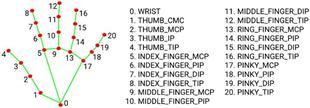
Handpose is a tensorflow.js model based on the google mediapipe model, which detects hands in real time using TensorFlow. Based on an input image or video stream, it draws a bounding box around the hand, and then, after processing,itreturnstwenty one3Dlandmarkspointingto the hand's features. Different landmarks define different locations on each finger joint and on the palm. The key points are then used to train different gestures, such as pinching.
Fig.1Different3Dlandmarksplottedonahand
B) DJANGO
DjangoisaPythonframeworkforcreatingMVTpagesina web application. With Django, we can create multiple applications that can be used to design multiple systems inourecosystem.Theprojectconnectsthefrontendtothe
2022, IRJET
e ISSN:2395 0056
p ISSN:2395 0072
database and provides a user friendly admin page to manageandviewthedata.
C) TENSORFLOW.JS
TensorFlow.js is a machine learning framework used to train and deploy models in web frameworks or node.js. It provides tools, libraries, and community resources to help developers build and deploy ML powered applications. Handpose is implemented in tensorflow.js, which can be easily implemented and used in web frameworks such as Django.
IV. METHODOLOGY
A) HOW THE HANDPOSE MODEL WORKS
With TensorFlow, 21 3D landmarks of a hand are detected from a live video stream using the handpose model. Handpose is an application that is based on the Google media pipe hands and is enabled in TensorFlow by embedding them in the web based tensorflow.js. The model predicts whether an input contains a hand. This model returns the location of each finger joint along with the palm if it contains, as well as coordinates for the boundingboxaroundthehand.Ratherthantrainingahand detector, we train a palm detector since the estimation of boundingboxesofrigidobjectslikepalmsandfistsismore straightforwardthanhandlingarticulatedfingers.Thenon maximum suppression algorithm also works well for two hand self occlusions, such as handshakes, since palms are smallerobjects.Inaddition,palmsareoftenmodeledusing squareboundingboxes(anchorsinMLterminology),which ignoreotheraspectratios,reducingthenumberofanchors by a factor of 3 or 4. Furthermore, the encoder decoder featureextractorisusedtomakelargerscenescontextually awareofsmallobjectsaswell.Lastly,weminimizethefocal loss during training to support an outsized number of anchorsduetothehighscalevariance.Thisisthenusedto simulateamousecursorusingthecentroidof thehand.As the centroid moves along the screen, the x and y distances are recorded and a cursor appears on the screen that the user can use to navigate around the UI. A click function is trainedbyusingtheHandsfreemodule,wherevariationsof the hand are captured and stored, and two pinches of the thumb and index finger are made, which can then be implemented withinthe webapplicationasa new gesture. In order to simulate a mouse click, the cursor is used in conjunctionwiththeindexfingerandthumbbeingpinched twice within an 80 millisecond interval to implement the clickfunction.
Impact Factor value: 7.529 | ISO 9001:2008 Certified Journal |
2534
Volume: 09 Issue: 04 | Apr 2022 www.irjet.net
B) HAND DETECTION
In this system, the user uses hand gestures to perform tasks that would otherwise need touch input to perform, with the system being focused on user data interaction. In the handheld sensor, the hand position of each marker's fingers is tracked in real time, and gestures are used to interact based on that location. A bounding box is plotted aroundthehandusingthehandposemodel.Inordertoplot the various 3D landmarks on the hand, the bounding box image is further processed. You can then use these key points to train different gestures using the graph on the hand.
V. SECURITY FEATURES
Multiple levels of security are necessary to secure systems suchasATMsormallswheretransactionswilltakeplace.In order to make an ecosystem secure, the following security precautions can be taken. To make a system more secure, oneorseveralmeasurescanbeimplemented.
A) QR CODE
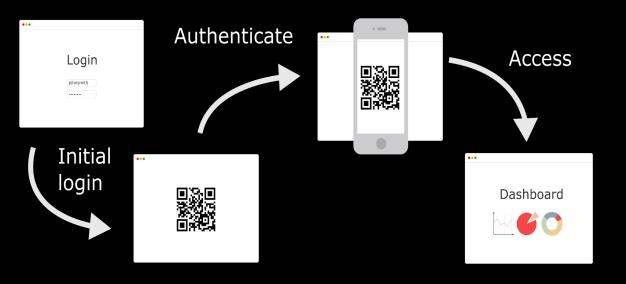
A unique QR code containing the user's information is providedtotheuserinthistypeofsecurity.Inordertolog in to the user, the system accesses the information when the card is scanned. QR codes have the following advantages:
1.FastscanningandOmnidirectional:QRcodescanbe scanned Omni directionally from any angle, so the scanner does not have to be situated as per the code symbol,allowingformuchfasterscanning.
2. Smaller size: QR codes are much smaller than barcodes. It is possible to store the same amount of datawithQRCodesinonlyatenthofthespaceof1 D barcodes.
3. Massive Storage Capacity: QR codes offer massive storagecapacity.
4. Data Types: QR codes can handle binary data, numbers, alphabetic characters, and Japanese, Chinese,orKoreancharacters.
5. Wide Range of Uses: QR codes have many potential uses. They also can be implemented to extend the experienceofuserin store,restaurants,websites,etc.
e ISSN:2395 0056
p ISSN:2395 0072
|
Fig.2QRCodeAuthenticationB) OTP VERIFICATION
A one time password will be sent to the user by email or phone. A user is logged into the system upon entering the correctOTP.One timepasswordsaregeneratedbytheOTP system creator by using the user's secret passphrase, as well as a seed entered from the server, to rehash a secure hash function multiple times. As soon as a successful authentication is performed, one secure hash function repetitionisremoved.Anentirelynewpasswordsequence is created as a result. A secure hash function is calculated on time and compared with the one time password selected prior to the submission by the creator on the server.
Fig.3OTPverificationworking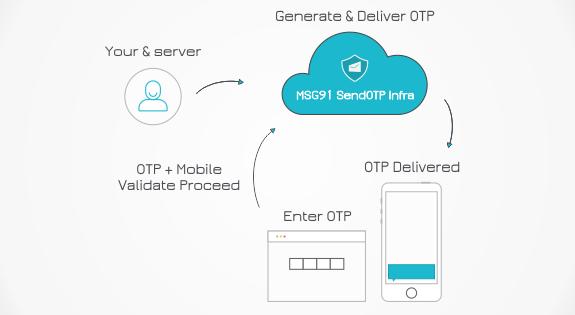
C) FACE DETECTION
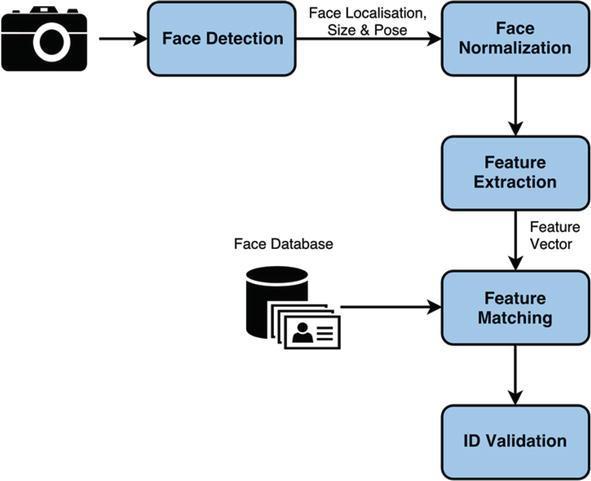
The user's face must be detected and recognized by a high qualitycameraforthistypeofsecurity.Whenthetwo faces match, the system logs in to the user. Using a databaseofstoredfaces,theinputimageiscomparedwith the picture in order to locate the person in it. The method for face recognition is influenced by factors such as shape, size, pose, occlusion, and illumination. It has two main applications:basicandadvanced.Thereareseveralfactors thatdefinemajorfacerecognition,suchasthewidthofthe nose,thewidthoftheeyes,thedepthandangleofthejaw, the height of cheekbones, as well as the distance between theeyes.
9001:2008
Fig.4FaceDetectionworking
A unique numerical code is created by using this information. The numerical code allows a system to compareoneimagewithanotheranddistinguishhowthey are similar. In face recognition, video camera signals and preexistingimagesareusedtodeterminetheprovenanceof the image. This can be done by detecting faces, extracting features,andthenrecognizingpeople.
D) PALM VEIN AUTHENTICATION
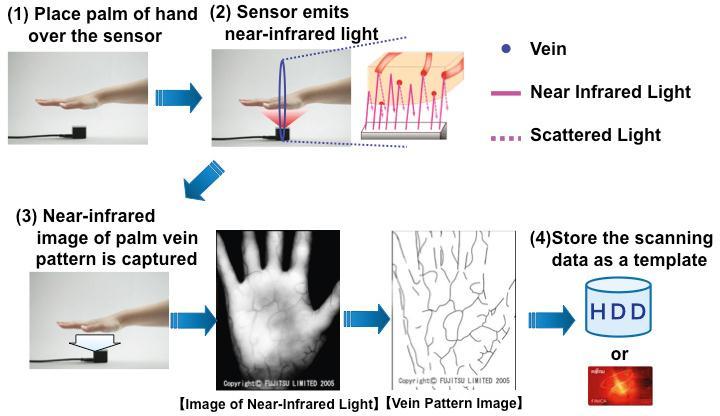
Authentication is based on vein patterns on individuals' palms, and a user's palm pattern must match one in the system'sdatabasetobeverified.Anear infraredlightmaps the vein lines on the hand using near infrared light. This information is then saved by the system. Authentication data is stored in the palm, so it would be difficult to forge thepalm.Thisisthemostsecurewayofscanning.
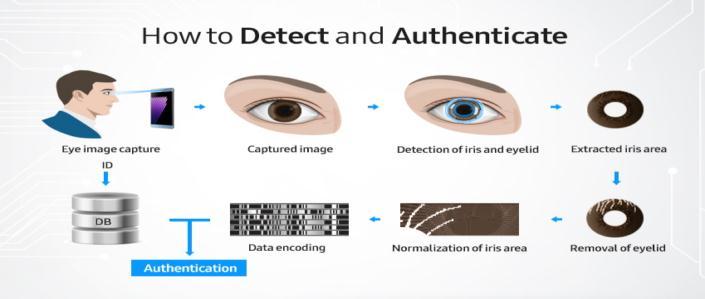
extraction,and feature matching are the main stepsiniris recognition. To recognize an iris, methods use machine learning models like DCNN, andCNN;the resultfrom the methodiscomparedtotheresultsfromthedatabase.
VI. SYSTEMS
A) AIRPORT CHECK IN
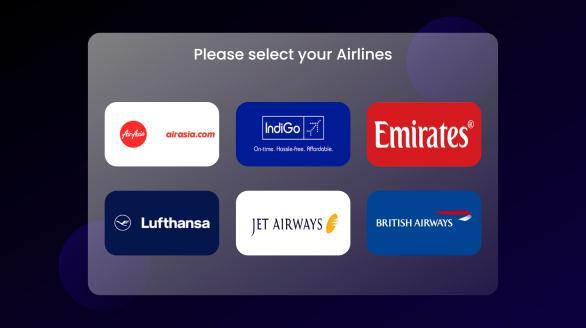
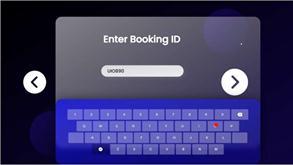
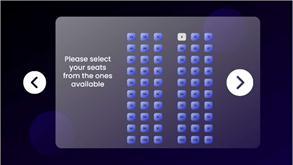
Using this system, customers can print their boarding passes instead of using traditional airport check in kiosks. The user can print out their boarding passes, select their desiredseatsontheplane,andprinttheirboardingpasses with this touchless system. Simple hand gestures can be used to type the booking ID, select the seats, and navigate the UI. There is an on screen keyboard that is designed to beusedwithgesturessoitcanbeusedwithease.
E) IRIS SCANNING
To obtain high resolution clear images of the iris, a high qualityscanneralongwitha camera are needed,whichare then compared to the user's data gathered in the system. Logging in to the user is automated if the iris is matched. Acquisition, segmentation, normalization, feature
B) TOUCHLESS ATM
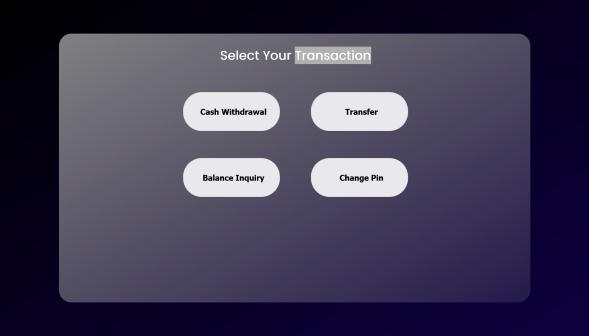
The second part of the ecosystem that we implemented, replacing the ATM machine, which is one of the most frequently used systems. Several security features have been implemented to enhance the level of security providedbythisTouchlesssystem.
Additionally, this system offers multiple levels of security, including QR code, OTP verification, Face detection, and more. In order to avoid card contact, the QR code is implemented thus providing each customer with a unique code.Thiscodecanthenbescannedtoretrieveallofthe
Fig.5Palmveinauthenticationsystem Fig.6Irisscanning Fig.7AirportCheckincustomer's information. The user is requested to enter a one time password (OTP) after scanning via an email or phonenumberprovidedonthescanningpage.TheOTPis sentviaemailorphonenumberprovidedbytheuser.The ATMrequiresasecuritycodetobeenteredbytheuserto further enhance security. The system can be further enhanced with additional security features as needed. This system and other ones in the ecosystem can be utilizedbyusingthesameeasy to usegestures.
D) MOVIE TICKET BOOKING
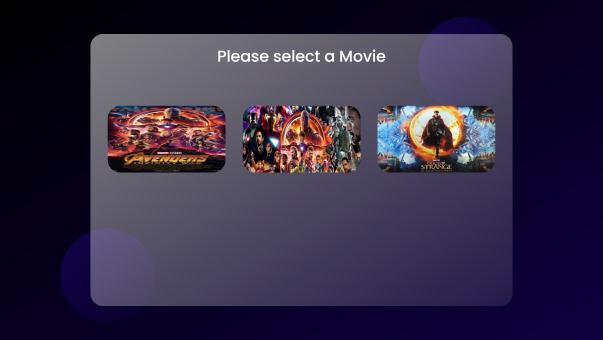
This system is designed to be used in malls or theaters for booking movie tickets by using touchless systems. Customers can select the movies from the home page whichcanbeupdatedregularlybythetheaters.Alongwith booking the tickets, customers are provided with a UI to selecttheseatstheydesirefromtheonesthatareavailable. Seats can easily be selected or deselected as per requirementandfurthercanbeusedtopayforthenumber oftickets.Customersaregiven the optiontouse razor pay which supports multiple payment options along with a secure and user friendly way to complete the payment. After successful payment,theticketscan becollectedfrom thekiosk.Thiscanbeusedinplaceofthetraditional ways tobookaticketfromthetheaters.
C) RESTAURANT/CAFE ORDERING
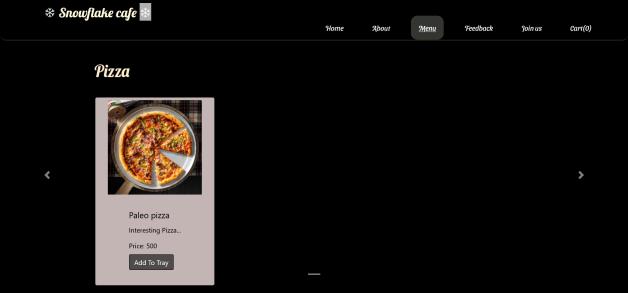
Thissystemismadetobeusedinrestaurantsorcafes by the customers to place orders. The customers can use the same hand gestures as in other touchless systems to navigate the UI and place orders. The system is based on Django as the backend which keeps a record of all the orders placed by the customers along with the current status of their order. When the order is ready, the customer is notified of the same. Razor pay is also implemented as a payment option in the system which can be used by the customers to pay for their orders. It supports multiple payment options along with a secure and user friendly way to complete the payment. This system can be used to replace the currently used touch basedkiosksinmanyplacesfororderingfood.
Fig.10Movieticketbooking
VII. RESULT
The handpose model we are using gives highly accurate results even in many different lighting conditions which solves the major issue in hand recognition where the results produced are inaccurate if there is a frequent changeinlightingconditionsorshiftincolors.Thegestures are also tracked accurately and produce the required results.
Fig.8TouchlessATM
Fig.9RestaurentOrdering
Fig.11Typingusingthehandgestures
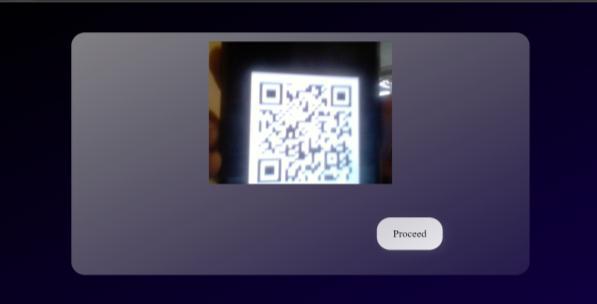
Multiple security systems can be implemented to make the payments and transactions more secure and easy to perform. We have implemented a QR code that can be scanned to verify the user details. Further, an OTP verificationisimplementedwheretheusergetsacodeon his provided mobile number or email which can be used tologinintotheaccount.
VIII. CONCLUSION
Touch based systems aren’t safe anymore, as they can contribute to the spread of disease. This Touchless ecosystemensuresthatallofitsgesture basedsystemsare safer to use as compared to the systems. With the help of hand gestures, the user can easily navigate the UI and perform the same operations as in traditional systems but touch free. This touch less hand gesture based model is very accurate and capable of performing all the steps with the help of the Tensor flow hand pose model along with robust security systems that can be implemented to make thetransactionsetcassecureaspossible.Thus,usingdeep learning models, multiple security systems, and the very user friendly UI we have successfully achieved our objectivesandimplementedanecosystemthatcanperform thetasksofthemostusedsystemsbyuserstouch free.
IX. FUTURE WORK
Any new system can be added to the ecosystem which needstouch freeinteraction.Addingmoresecurityfeatures like Iris scanning, Face detection, etc. Optimizing the algorithmtoworkfaster.
REFERENCE
[1] Dharmik Bhanushali, Dipanshu Someshwar, Vismay Chaudhari, Ms. Bhargavi Dalal (2020). Hand Gestures RecognitionusingDeepLearning.
[2] B., Abhishek & Krishi, Kanya & M., Meghana & Daaniyaal, Mohammed & S., Anupama. (2020). Hand gesture recognition using machine learning algorithms. Computer Science and Information Technologies. 1. 116 120.10.11591/csit.v1i3.p116 120.
[3]Fan ZhangValentin BazarevskyAndrey VakunovAndrei Tkachenka George Sung Chuo Ling Chang Matthias Grundmann.( 2020). MediaPipe Hands: On device Real timeHandTracking
[4] Nhu Tai Do , Soo Hyung Kim *, Hyung Jeong Yang and Guee Sang Lee(2020).Robust Hand Shape Features for Dynamic Hand Gesture Recognition Using Multi Level FeatureLSTM
[5] M. H. Eldefrawy, K. Alghathbar and M. K. Khan, "OTP Based Two Factor Authentication Using Mobile Phones," 2011 Eighth International Conference on Information Technology: New Generations, 2011, pp. 327 331,doi:10.1109/ITNG.2011.64.
[6] Shally, & Aujla, Gagangeet & Aujla, Singh. (2014). A REVIEW OF ONE TIME PASSWORD MOBILE VERIFICATION. International Journal of Computer Science Engineering and Information Technology Research(IJCSEITR).4.113 118.
[7] Alapetite, Alexandre. (2010). Dynamic 2D barcodes for multi device Web session migration including mobile phones.PersonalandUbiquitousComputing.14.45 52. 10.1007/s00779 009 0228 5.
[8] Nithya, Alice & Lakshmi, C.. (2015). Iris recognition techniques:ALiteratureSurvey.InternationalJournalof AppliedEngineeringResearch.10.32525 32546.
[9] Jain, Tarshi & Kumar, Rajendra. (2019). A STUDY OF VEIN RECOGNITION SYSTEM. Acta Informatica Malaysia.3.13 15.10.26480/aim.01.2019.13.15.
[10] Guimarães, Nuno. (1991). Building generic user interface tools. ACM SIGPLAN Notices. 26. 89 96. 10.1145/117954.117961.
[11] Kumar, Ashu & Kaur, Amandeep & Kumar, Munish. (2019). Face Detection Techniques: A Review. Artificial IntelligenceReview.52.10.1007/s10462 018 9650 2.
Fig.12Selectingseatsusingthehandgestures Fig.13ScanningtheQRCode