
Genetically Optimized Neural Network for Heart Disease Classification
Snehal Patil1 Manish Patil2Abstract This study seeks to implement and analyze a methodology for Heart Disease (Cardiovascular disease) detection using machine learning, based on quantitative procedures, to assist in the diagnosis of individuals with heart disease, through the investigation and selection of variables that have a greater degree of importance in determining this event. The diagnosis of heart disease is performed using a model of Neural Networks after a sequence of pre treatment procedures and selection of variables. Further neural network is optimized with genetic algorithm to get better accuracy. Confusion matrix is plotted for accuracy.
Keywords Back Propagation; Cardiovascular disease; ConfusionMatrix;GeneticAlgorithm;NeuralNetwork.
1. INTRODUCTION
A sedentary lifestyle, high cholesterol and stress are some of the heart's worst enemies. They fit within the so called modifiable factors, that is, they are repairable fromchangesinthepopulation'shabits.Somepeopleare more likely to develop heart disease, especially given their age and family history. But that doesn't mean youngerpeopleshouldn'tbeworried.
However, despite the serious problem that cardiovascular diseases currently pose, knowledge of their main modifiable risk factors makes prevention possible. The three most important modifiable cardiovascular risk factors are smoking, hypertension and hypercholesterolemia, followed by diabetes, overweight/obesity, sedentary lifestyle and alcohol abuse[1].
Artificial Intelligence (AI) applied to medicine is a resource important in solving health care problems and comes becoming an essential component of medical informatics. Growing increase in challenges potentiated bylongerlifeexpectancy,inadequatelifestyle,inequality in access to health services, increased expenses and shortage of professionals of health, demand technological updates, with robust forecast values and alternative scenarios that can map future health problems and options to modify these trajectories [2]. With the growing demand for computational methods thatcancontributetodiagnosesandoptimizethetimeof health professionals, several researches related to the application of Machine Learning (ML) to health have
been developed [3] ML is a sub area of research in AI, which aims to develop computational techniques on learning, as well as the construction of systems capable ofacquiringknowledgeautomatically[4].Inaddition,he has the ability to learn from large volumes of data and generate useful hypotheses [5], which can help the health professional in the diagnosis, prevention and search for more effective treatments. The ML model has all the necessary information about a problem, such as, what data constitute the analysis and also what it is expected to produce as knowledge [6]. In addition, ML can also potentially predict the likelihood that future subjectswillhaveSpecificdiseases,givenearlyscreening from the data routine physical and laboratory examinations.
In the context of the present research, learning algorithmsofmachinecancontributetothepredictionof suchdiseasesaccordingtowiththecharacteristicsofthe individual. However, you must select among various machine learning algorithms the one that best fits the context of the problem. In view of this, the main the objective of the research was the evaluation and comparison of performance of different ML techniques applied to the prediction of cardio metabolic diseases. The main motivation of this work is the study of data dimensionality reduction techniques in order to should correspond with a reduction of those hospitalizations. The objective of this study is to analyze the effect that the preventive programs of the cardiovascular diseases applied in primary care have on the avoidable hospitalizationspecificofthesediseases.
2. LITERATURE
In medicine, there are implementations of predictive algorithms with techniques of Machine Learning and Data Mining in different fields. There are investigations and even several implementations to detect cancerous tumours, classify the cancer of accompaniment to differentcategoriesofdiagnoses,eventodetecttheheart diseases[7].Therearedifferentalgorithmsthatareused forpredictivesystemsandeachonethrows resultswith different degrees of precision depending on the data usedandonthemexpectedresults.
Thereare3typesoflearningalgorithmswithinMachine Learning:
 1&2 Department of Electronics and Telecommunication Engineering, Gangamai College of Engineering, Nagaon, Dhule, MS, India
Supervised, unsupervised and by semi supervised. Depending on the needs from the problem to be solved, the environment and what will develop and the factors that will affect decision making [8], each of these types oflearningintheoffersabetterapproach.
The objective is to develop a predictive system to determine patients who can be prone to suffering heart diseases, through the use of the algorithms supervised, Naive Bayesian [9] and Semi Naive Bayesian and comparetheseresultswiththeexistingMachinelearning techniques[10].Theideaistotrainthesystemwithreal patient data from which medical data are taken (diabetes,etc.)andpersonaldata(age,sex)tobeableto determine there, according to certain characteristics, whichpeoplecanbepronetosuffersometypeofillness fromheartdiseases.
3. PROPOSED METHODOLOGY
Theproblemwithrisk factorsrelatedtoheartdiseaseis that it includes many risk factors such as age, cigarette use,bloodcholesterol,fitness,bloodpressure,stressand so on and it is important as well as difficult task to understand the importance of each and classify it. Also, heart disease is often diagnosed when the patient has reachedanadvancedstageofthedisease.Therefore,risk factors can be analyzed from different sources [9] [10] The dataset was composed of 12 important risk factors which were sex, age, family history blood pressure, Smoking Habit, alcohol consumption, physical inactivity, diabetes, blood cholesterol, poor diet, obesity .The system indicated whether the patient had risk of heart diseaseornot.Thedatafor50peoplewascollectedfrom surveys done by the American Heart Association [10] Most of the heart disease patients had many similarities in the risk factors [11]. Table 4.1 shows the identified importantriskfactorsandthecorrespondingvaluesand theirencodedvalues
Inbrackets,whichwereusedasinputtothesystem.
Below
240mg/dL
[12]
5 Hereditary Family Member diagnosed with HD Yes(1) Otherwise No(0)
6 Smoking Yes(1)orNo(0)
7 AlcoholIntake Yes(1)orNo(0)
8 Physical Activity Low( 1),Normal(0)orHigh( 1)
9 Diabetes Yes (1)or No(0)
10 Diet Poor( 1),Normal(0)orGood(1)
11 Obesity Yes(1)orNo(0)
12 Stress Yes(1)orNo(0)
Output HeartDisease Yes(1)orNo(0)
Dataanalysishasbeencarriedoutinordertotransform data into useful form, for this the values were encoded mostly between a range [1, 1]. Data analysis also removed the inconsistency and anomalies in the data. This was needed. Data analysis was needed for correct data pre processing. The removal of missing and incorrect inputs will help the neural network to generalizewell.
In this paper, genetically optimized Neural Network approach is used to determine optimum number of clusters in analyzed data. These methods are described below
A. Diagnosis using Genetically Optimized Neural Network
In previous phase, Neural Network is trained using back propagation algorithm to find weight and bias values. The proposed GA NN approach uses Genetic Algorithmtofindweightandbiasvalues.Inthisproposed NN, the value of weight and bias are random and to correct these values a fitness function is employed for GeneticAlgorithm.
B. Fitness Function
The fitness function is a function of weight and bias with the objective of minimizing the mean square error between the predicted and target classes of the training data.
( ) ∑ [ ( )] (1)
Normal
4
High
Below120mmHg Low( 1)
120to139mmHg Normal(0)
Above139mmHg High ( 1)
Where, is input and is target output. Fitness function in equation (1) is minimized using Genetic Algorithmtooptimizedweightandbiasvalues.
C. Neural Network
Artificial Neural Network (or simply "Neural Network") is a distributed model composed of units (called
"neurons" in the literature) made up of non linear functions (typically sigmoid and hyperbolic tangents). The combination of these units, through parameters estimated from the data, is what gives this model the ability to infer non linear relationships of arbitrary complexity.Inthewayusedinthisstudy,theseunitsare arrangedinlayers,includingahiddenlayer,whichisnot directly connected to the model output. These connections between units, or neurons, are called weights (originally the terminology was "synaptic weights"). These weights are the model parameters that are adjusted by an iterative algorithm through the data. Once the weights are adjusted, the network has the ability to represent the relationship between the input dataandtheoutputvariable,inthiscasethediagnosisof disease.Theabilitytolearnfrom"examples"ordata(in sample) and to generalize (out of sample) information generated in complex non linear environments is undoubtedlythegreatadvantageofNeuralNetworks.
The relevant and non redundant variables are used as input to the Neural Network, and, after the training process,thediagnosisofheartdiseaseisoutputfromthe Network. Thus, in the training phase, the output of the network assumes values 0 or 1 for each of two possibilities, non sick or sick, respectively. A sigmoid activation function is used in the output unit so that the Mains output always varies between 0 and 1, since this function saturates these values. In the test phase, and laterintheuseofthemodel,valuescloseto1indicatea highpossibilityoftheindividualbeingsickandcloseto0 indicate a small possibility of being sick. The cut off point adopted to differentiate high from low possibility was 0.5 and thus only two types of output were considered, sick or non sick, for values above 0.5 or valuesbelow0.5,respectively.
The relevant and non redundant variables are used as input to the Neural Network, and, after the training process,thediagnosisofheartdiseaseisoutputfromthe Network. Thus, in the training phase, the output of the network assumes values 0 or 1 for each of two possibilities, non sick or sick, respectively. A sigmoid activation function is used in the output unit so that the Mains output always varies between 0 and 1, since this function saturates these values. In the test phase, and laterintheuseofthemodel,values closeto1indicatea highpossibilityoftheindividualbeingsickandcloseto0 indicate a small possibility of being sick. The cut off point adopted to differentiate high from low possibility was 0.5 and thus only two types of output were considered, sick or non sick, for values above 0.5 or valuesbelow0.5,respectively.
D. Optimization of the Map Weights Set
In this approach, the application of the genetic algorithm will be done using one of the fitness criteria
discussed here. From the formal model defined here for Kohonennetworks,weset: thesetN ofmappositions, a setofinputvectorsX,thetopologyT ofthemapandthe FA activation and Fw weight adjustment functions, establishing low learning rates for this and initial and final neighbourhood regions. We optimize the set of initial weights of the network W (0); resulting in a network with prior training. The data for risk factors relatedto heartdiseases collected from50peoples with riskfactorprovidedinTable1
E. Genetic Algorithms
Geneticalgorithms(Goldberg,1989),herealsocalledGA, are search methods based on the principles of natural evolution and genetics. In this method, a population of possible solutions to the problem in question evolves undertheapplicationofprobabilisticoperatorsidealized from biological processes. Thus, there is a tendency for elements of the population become well and a better approximationofthesolutionasthealgorithmdevelops.
The individuals of the population are represented in a coded way, being common the binary representation, expressed by a string of bits called chromosome. The positionsinthechainarecalledgeneandthesenormally assumethe binaryvalues 0 and1,calledalleles.GAs are iterative algorithms, with each iteration called a generation. In most applications the initial population is generatedrandomly.
GAs assigns to each member of the population a non negative value of an objective function to be optimized called “fitness” or suitability. This value indicates the quality of the individual in the population, being a measure of its adaptability to the environment. Individuals stronger, with better fitness, will have a better chance of surviving and passing on to the next generation. GA simple is composed of 3 basic operators: selection, crossover or “crossover” and mutation. At selectioneachindividual“i”ofthepopulationisselected ornotaccordingtoaselectionprobabilitypi=Pfiwhere fi is your “fitness”. The selected individuals are grouped into pairs and subjected to the crossover operator. It occurs according to a fixed probability Px, simulating sexual reproduction, where chromosome fragments (sub bitstrings)areexchanged.
The mutation occurs according to a probability Pm and consistsofselectinga positioninthechainchromosome and changes its binary value. The mutation introduces new genetic material into the population and allows the explorationofnewregionsintheparameterspace.After applying these operators a new population of possible solutions is obtained. The process continues until some stopping criterion. GAs only need information about the value of an objective function, not requiring derivatives or any other kind of knowledge. GAs can be applied to
problems of global optimization, in multidimensional spacesandwithobjectivefunctionsstronglynotlinear.
Therowandcolumnarethelabelsfordetectionandno detection of heart disease from database. There are 2 sets of classes and each class having different set of detection. Total 15 samples of Patients are taken out of which3 patientsareclassifiedcorrectlyand none of the samples were misclassified but in normal category 10 samples are classified correctly out of 15 samples and 2 samples are misclassified. The confusion plot indicates theaccuracyi.e.90%forthisapproach.
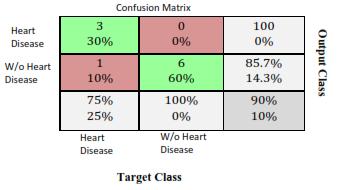
OptimizationofWeightAdjustmentParametersandMap Topology
Inthisapproach,theapplicationofthegeneticalgorithm will be done using one of the fitness criteria here discussed. From the formal model defined for Kohonen networks,wefixthefollowingsetNfrommappositions, asetofXinputvectors;therandomsetofinitialweights W(0);thenetworktrainingtimeTf;andtheFAactivation and Fw weight adjustment functions, described in the formal specification of the model. The parameters that will be optimized are: the radius of initial and final neighborhood, σi and σf; the initial and final learning rate, αi and αf and the topology T of the map. In this study, the line, grid and cube topologies are used, respectively, forming uni, bi and three dimensional maps.
Simple Genetic Algorithm
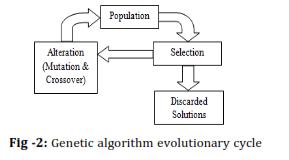
{
t = 0;
Initialization (P (t));
Evaluation (P (t));
While not end to t = t+1;
P'= select (P (t));
Recombining (P'(t);
Mutation (P'(t));
Evaluation (P '(t));
P = Survival (P, P'(t));
}
Fig
evolutionarycycle
4. SIMULATION AND RESULTS
The performance of proposed technique has been studied by means of MATLAB simulation. The row and column are the labels for detection and no detection of heart disease from database. There are 2 sets of classes andeachclasshavingdifferentsetofdetection.
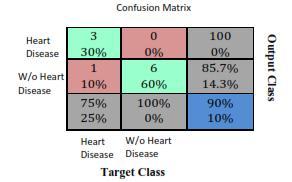
Fig 3: ConfusionmatrixforNNmethod
Total 15 samples of patients are taken out of which 4 patientsareclassifiedcorrectlyandnoneofthesamples were misclassified but in normal category 10 samples areclassifiedcorrectlyoutof15samplesand1sampleis misclassified. The confusion plot indicates the accuracy i.e.93.3%forthisapproach.
PopulationSize:30
Iteration:500
Fig 4: ConfusionmatrixforGA NNmethod

5. CONCLUSIONS
Adjusting the weight of the original neural network model requires high computing costs because we adjust alltheweightsofthemapforeachvectorofthetraining phase. So, the approach of adjusting the weight adjustmentparametersforeachpopulationgeneratedby the genetic algorithm, according to the desired fitness function, is useful to identify which set of weight adjustment parameters can be used in the conventional model. It can be seen that the cultural algorithm gives similarresultstotheGA NNapproachi.e.93.3butatthe loweriterations.Therefore,theCulturalalgorithmbased approachisbestamongallthreeapproaches.
REFERENCE
[1] Safdar, S., Zafar, S., Zafar, N., & Khan, N. F. (2018). Machine learning based decision support systems (DSS)forheartdiseasediagnosis:areview.Artificial IntelligenceReview,50(4),597 623.
[2] Al’Aref, S. J., Anchouche, K., Singh, G., Slomka, P. J., Kolli, K. K., Kumar, A., ... & Min, J. K. (2019). Clinical applications of machine learning in cardiovascular disease and its relevance to cardiac imaging.European heart journal,40(24), 1975 1986.
[3] Otoom, A. F., Abdallah, E. E., Kilani, Y., Kefaye, A., & Ashour, M. (2015). Effective diagnosis and monitoring of heart disease.International Journal of Software Engineering and Its Applications,9(1), 143 156.
[4] Nagavelli, U., Samanta, D., & Chakraborty, P. (2022). Machine Learning Technology Based Heart Disease Detection Models.Journal of Healthcare Engineering,2022.
[5] Alarsan, F. I., & Younes, M. (2019). Analysis and classification of heart diseases using heartbeat
featuresandmachinelearningalgorithms.Journalof bigdata,6(1),1 15.
[6] World Health Organization, 2007. Prevention of cardiovasculardisease.WorldHealthOrganization.
[7] Cowie, M.R., Anker, S.D., Cleland, J.G., Felker, G.M., Filippatos, G., Jaarsma, T., Jourdain, P., Knight, E., Massie, B., Ponikowski, P. and López‐Sendón, J., 2014.Improvingcareforpatientswith
[8] acute heart failure: before, during and after hospitalization.ESCHeartFailure,1(2),pp.110 145.
[9] Arabasadi, Z., Alizadehsani, R., Roshanzamir, M., Moosaei,H.,&Yarifard,A.A.(2017).Computeraided decision making for heart disease detection using hybrid neural network Genetic algorithm.Computer methodsandprogramsinbiomedicine,141,19 26.
[10] Centre for Disease Control and Prevention, Online available at: http://www.cdc.gov/heartdisease/risk_factors.htm
[11] American Heart Association, Online availableat: ttp://www.heart.org/HEARTORG/Conditions
[12] Truong, V. T., Nguyen, B. P., Nguyen Vo, T. H., Mazur, W., Chung, E. S., Palmer, C., ... & Le, T. K. (2022).Applicationofmachinelearninginscreening for congenital heart diseases using fetal echocardiography.The International Journal of CardiovascularImaging,1 9.
[13] Syed Umar Amin, Kavita Agarwal, Dr. Rizwan Beg, “Genetic Neural Network Based Data Mining in Prediction of Heart Disease Using Risk Factors”, Proceedings of IEEE Conference on Information and Communication Technologies (ICT), pp. 1227 1231, April2013.
modelof