
Tajamul Magrey et al 2016 It also helps in reducing the cost of concrete manufacturing. In light of this in the contemporary civil engineering construction, using alternative materials in place of natural aggregate in concrete production makes concrete as sustainable and environmentally friendly construction material. In this research,theeffectofcoconutshellaspartialreplacement ofcoarseaggregateandwasteglassaspartialreplacement of fine aggregate on the properties of concrete were studied. The characteristic properties of concrete such as compressive strength, flexural strength, and water absorptionofvariousmixeswerereviewedinthiswork.
Comparative Study of Concrete by Using Glass Powder and Coconut Shell Ash by Partial Replacement of Cement
INTERNATIONAL RESEARCH JOURNAL OF ENGINEERING AND TECHNOLOGY (IRJET) E ISSN: 2395 0056 VOLUME: 09 ISSUE: 02 | FEB 2022 WWW.IRJET.NET P ISSN: 2395 0072 © 2022, IRJET | Impact Factor value: 7.529 | ISO 9001:2008 Certified Journal | Page67
I. Introduction Concrete is a blend of coarse aggregate, fine aggregate(sand), admixtures and water. Today Global Warming (GW) and environmental pollution have become manifest harms in early and recent years, concern about environmental issues. It can happen due to use and production of the mass waste, mass consumption, mass production.Normallyitcanseethatglassdoesnotharmto environment due to not produced pollutants matter but it canharmanimalaswellashumanshortlywhenwedonot take care off that time it harmful and it is not non biodegradable. For that we required new technologies to overcome them from this problem. The glass has many chemical diversities like Soda lime Silicate Glass, Alkali Silicate Glass & Boro Silicate Glass. These all types of glasses generally used in Civil Engineering work as Pozzolana. The Alkali contents increases the properties of cement. It also used in brick manufacturing & ceramic manufacture.Theusefulandrecycledmaterials,glassesand glass powder are mainly used in various Civil Engineering project because glass powder as supplementary cementitious material and coarse aggregate. All type of glass is near to100%recyclable.Italso increasesconcrete durability without affects any property in concrete. In recently glass & glass powder has used as a construction material for reducing environmental pollution. In concrete mixed the coarse & fine glass aggregate produced Alkali SilicaReaction(ASR)butthisproblemcannothappeninthe case of glass powder because it has Supplementary CementitiousMaterial(SCM).Therefore,glasspowderused asreplacementofSCM.Thisworkisbased on utilization of waste material like coconut shell and glass powder used in concrete construction industry for their valuable application. Use of such waste material not only reduction in land fill cost, savinginenergyandprotectingenvironmentfrompossible pollutioneffectbutalsogettingthemutilizedincementand otherconstructionmaterial.Differenteffortmadebymany researchers in using coconut shell ash, coconut shell, coconut husk ash as replacement material for cement, coarse aggregate & cement respectively. This research set outtheeffectofcoconutshellash.
II. Literature Reviews
Civil Engineering School of Research and Technology Bhopal (M.P.) India Pratap Singh2
Civil Engineering School of Research and Technology Bhopal (M.P.) India
On the earth's surface, the amount of waste material from industrial and agricultural activities has begun to cause a sustainability issue for the environment aswellastheecologyoftheearth.Theproductionofwaste accounts for global warming because it releases CO2 and other harmful gases during disposal or manufacturing. In this research work, we use waste materials like coconut shell ash (CSA) and glass powder (GP) in place of cement. More than 108 specimens were prepared and tested by using CSA and GP with 0%, 2.5%, 5%, 7.5%, 10%, and 12.5% as replacements with cement. After design mixing, wefindtheratioofconcretemixedis1:2.03:3.10byweight of cement sand and coarse aggregate at a 0.55 water to cement ratio. The properties of concrete and cement that were studied include initial setting, final setting time, compressive strength, split tensile strength, and flexural strength. The workability of CSA and GP mixed concrete was tested immediately after preparing the concrete mix, andcompressivestrengthwastestedat7daysand28days of curing. The addition of waste CSA and GP increases the strength of concrete at a certain point, after that it decreases.ThecompressivestrengthofCSAandGPmixed concreteincreasesupto10%ofreplacementcement with anamountof28.44kg/cm2 and29.02kg/cm2 respectively, then decreases. In the case of split tensile strength and flexuralstrength,thestrengthalsoincreasesupto7.5%of the replacement of cement in CSA and GP mixed concrete with an amount of 3.81 kg/cm2, 3.90 kg/cm2 and 9.20 kg/cm2, 9.22 kg/cm2 respectively. Finally, we clearly say thatthereplacementofCSA&GPwithcementisupto10% for compressive strength and up to 7.5% for split tensile andflexuralstrength. Keywords Polyethylene Terephthalate (PET), Compressive Strength, Split Tensile Strength, Flexural Strength.
Hirendra
*** Abstract
Bikash Kumar Yadav1

It was fresh and free from any lumps. For best result cement stored in moisture less storage. To find out physical properties of cement the following test performs whichshownintable1andthecorrespondingstandardfor that parameter as per BIS: 8112 2013 is also listed in Table3.1.
INTERNATIONAL RESEARCH JOURNAL OF ENGINEERING AND TECHNOLOGY (IRJET) E ISSN: 2395 0056 VOLUME: 09 ISSUE: 02 | FEB 2022 WWW.IRJET.NET P ISSN: 2395 0072 © 2022, IRJET | Impact Factor value: 7.529 | ISO 9001:2008 Certified Journal | Page68
Hamdule Abdul Rehman et al 2021 Wedidtheproject Powder‟workforthedeterminationoftheeffectoftheuseof„Glassasapartialreplacementofcementtoassessthe pozzolanic nature of fine glass powder when mixed in concrete and compare the performance when other pozzolanic materials are mixed. The present study shows that waste glass, if ground finer than 600µm shows a pozzolanic behavior. It reacts with lime at early stage of hydration forming extra CSH gel thereby forming denser cementmatrix.Thus,earlyconsumptionofalkalisbyglass particles helps in the reduction of alkalisilica reaction hence enhancing the durability of concrete. Number of tests were conducted to study the effect of 0%,10%,20%,30% and 40% replacement of cement by glass powder on workability and compressive strength. Theresultsshowedthatthemaximumincreaseinstrength of concrete occurred when 20% replacement was done withglasspowder.
M.J. Garba, A.S.J. Smith, et al 2020 The result of oxide composition of CSA showed that CSA is a good pozzolana and can be used as a mineral admixture. The inclusion of CSA in cement decreased linear drying shrinkage but increased consistency, initial and final setting times and could be used as a retarder. The use of CSA in concrete showed a decrease in workability but increase in compressive and splitting tensile strengths respectively with addition of CSA up to 2%. Therefore, up to 2% addition of CSA is recommended for use as a retarding admixture and strength improver in concrete in normal environment.
A Gupta, N Gupta et al 2020 It is evident that the exploitation of waste increases insignificantly every year worldwide and is not recycled as per the need of the environment Allthesecauseaproblemtodisposeofafter they have been used once. In order to deal with such a situation, the application of such waste in concrete production has become a great means of managing them. These wastes can be utilized as a partial or complete replacement of certain ingredients of the concrete. The recycling of these waste materials in concreting not only helps in managing solid waste but also renders the occurrence of natural resources. This review paper will provide an understanding of the adoption of waste materialsasaresourceduringconcreteproduction.
1 (%)ConsistencyNormal 32% 2 Setting SettingI.(Minutes)TimeInitialTime 150 Minutes170 Minutes30 mmuMini II.FinalSetting Time 210 Minutes300 Minutes600 mmuMaxi
3.2 Test Performed on Coconut Shell Ash: -
III. Methodology 3.1 Properties of OPC
K.I.M. Ibrahim 2021 TheWGPreplacementratiosfrom cementweightwere0%,5%,10%,15%,and20%.Some mechanical and other concrete properties have been investigated at both hardened and fresh stages. This reduction was about 13 % 14 %, respectively, at a 20 % WGP ratio. Additionally, the water absorption and density of plain, SF, and FA concrete mixes incorporating the proportions 5 % 20 % WGP as a partial replacement of cementweightdecreasedcomparedtoreferenceconcretes [0%WGP]. The fresh and dry density of ordinary concrete (group 1) lessened by around 3 % compared to control concrete at a 20 % WGP ratio. The decreasing ratios in water absorption of groups 1,2, and 3 specimens made of 20 % WGP compared to control concrete [0%WGP] are 27.78 %, 14.75 %, and 18.75 % respectively. The workability increased by increasing the WGP content for allconcretetypesutilizedinthisstudy.
Table 1: Properties of OPC 43 grade cement oNS. Particulars AfterValuesResultTest 1991ofRequirementsIS:1489(Part1)
The Coconut Shell Ash (CSA) was obtained by burning the coconut shell to a temperature of 600 650ºC in an incinerator and controlling the firing at that temperature for about three hours to produce the ash. The ash was collectedaftercooling,andthensievedthrough75μmsieve. The CSA is of specific gravity of 2.30, bulk density of 505 kg/m3andmoisturecontentof1.46%. Table 2: Properties of Coconut Shell Ash No.S Specification Obtained 1 Type Burn 2 Colour DarkBlack 3 Shape PowderForm 4 MaximumSize 75microns 5 SpecificGravity 2.30 6 WaterAbsorption 1.46%
Degree tyworkabiliof Mix1 0 0 100 Medium Mix2 10 0 90 Medium Mix3 20 0 70 Medium Mix4 0 0.25 90 Medium Mix5 10 0.25 80 Medium Mix6 20 0.25 60 Medium Mix7 0 0.50 84 Medium Mix8 10 0.50 70 Medium Mix9 20 0.50 54 Medium 0Mix1 0 1.00 55 Medium 1Mix1 10 1.00 45 Low 2Mix1 20 1.00 40 Low 3.5
3Mix 50.5 5
4Mix 50.5 7.5
771113. 719 6Mix 50.5 512.
Mix %sludgeHypo
359
iii)Inthirdstepwiththehelpofslumpconetestdetermine iv)Thewatercontent.cement content can be determined from the water/cement ratio determined by slump cone test and watercontentobtainedinstep(ii)and(iii)respectivelyand v)ischeckedforthewaterrequirements.Withthehelpofcharacteristics of course and fine aggregatefindoutproportionoffineandcoarseaggregate. vi)Thetrialmixproportionsaredetermined. vii) After verifying compressive strength with the trial mixes tested are made to get there the final mix composition.
771113. 719
Table 4: Test results for workability of
Table 5: Mix proportions of different concrete mixes for Coconut Shell Ash (CSE) Mix oRatiCW/ %CSE m3kgCSE/ m3kg/ntmeCe kg/m3atesaggregFine 3kg/mgateAggreeCoars m3l/terWa 50.5 0 0 359 730.89 771113. 719 50.5 2.5 8.9 359 730.89 771113. 719 917. 359 730.89 771113. 719 926. 359 730.89 771113. 935. 359 730.89 844. 730.89
TheslumpvalueforeachmixisgiveninTable3Inorder todeterminetheDegreeofworkability,theslumpofeachof the mix is compared with slump value v/s degree of workability. Based on this, the Degree of workability of eachmixisspecifiedinTable4 concrete fibre%lenePolypropy (mmSlump) BIS Mix Design Method: The following steps used to design mixed of concrete i)summarizedbelow:Infirststepwehave to find out target mean strength from the specified characteristics strength on the level of qualitycontrolled. ii)InsecondstepselectW/Cratio(WaterCementRatio)for targetstrength.
INTERNATIONAL RESEARCH JOURNAL OF ENGINEERING AND TECHNOLOGY (IRJET) E ISSN: 2395 0056 VOLUME: 09 ISSUE: 02 | FEB 2022 WWW.IRJET.NET P ISSN: 2395 0072 © 2022, IRJET | Impact Factor value: 7.529 | ISO 9001:2008 Certified Journal | Page69 3 3 Test Performed on Glass Powder: This waste glass was collected and washed with clean water, to remove the dust and dirt. Waste flat glass after washingitbycleanwater. Table 3: Properties of Glass Powder S No. Specification Obtained 1 Type Crushed 2 Colour Radish 3 Shape FormPowder 4 MaximumSize 68microns 5 SpecificGravity 2.55 6 WaterAbsorption 0.9% 3 4 Workability of concrete as per IS: 1199 1959
2Mix
719 5Mix 50.5 10
1Mix
INTERNATIONAL RESEARCH JOURNAL OF ENGINEERING AND TECHNOLOGY (IRJET) E ISSN: 2395 0056 VOLUME: 09 ISSUE: 02 | FEB 2022 WWW.IRJET.NET P ISSN: 2395 0072 © 2022, IRJET | Impact Factor value: 7.529 | ISO 9001:2008 Certified Journal | Page70 Table 6: Mix proportions of different concrete mixes for Glass
No.S. CSA % StrengthCompressiveAfter 7 Days (kg/cm2) (kg/cm28StrengthCompressiveAfterDays 2) 1 0% 14.48 25.38 2 2.5% 15.71 25.83 3 5% 17.16 27.17 4 7.5% 18.32 27.97 5 10% 19.44 28.44 6 12.5% 18.26 26.98
3.5 Compressive Strength of CSA and GP mixed Concrete: The compressive strength of all the prepared mixes was determinedattheagesof7,14and28days forthevarious addition levels of CSE and GP with cement concrete. The values ofaverage compressive strengthfor different mixes preparedbyadditionofCSEandGP(0%, 2.5%, 5%, 7.5%, 10% and 12.5%) at the completion of different curing periods (7 days, 14 days and 28 days) are given in the variousTablesbelow Table 7 Combine Compressive Strength of Coconut Shell Ash (CSA) mix Concrete for all Mixes
Figure1:CombineCompressivestrengthat7dayand 28daysforallmixesofCoconutShellAsh By these test results we can say that compressive strength of coconut shell ash concrete can be increased approximately28.44kg/cm2 byaddingwastecoconutshell ash10%oftheweightofthecementcontent.Itisalsoclear by these results that more than 10% waste coconut shell ash start reducing the compressive strength of coconut shellashconcrete
all Mixes No.S. %CSA StrengthCompressiveAfter 7 Days (kg/cm2) (kg/cm28StrengthCompressiveAfterDays 2) 1 0% 14.48 25.38 2 2.5% 15.71 25.83 3 5% 17.16 27.17 4 7.5% 18.32 27.97 5 10% 19.44 28.44 6 12.5% 18.26 26.98 Mix oRatiCW/ %GP m3kg/GP m3kg/ntmeCe 3kg/mgatesaggreFine 3kg/mgateAggreeCoars 3l/merWat 1Mix 50.5 0 0 359 9730.8 771113. 197 2Mix 50.5 2.5 8.97 359 9730.8 771113. 197 3Mix 50.5 5 17.95 359 9730.8 771113. 197 4Mix 50.5 7.5 26.92 359 9730.8 771113. 197 5Mix 50.5 10 35.90 359 9730.8 771113. 197 6Mix 50.5 512. 44.87 359 9730.8 771113. 197
Figure 2CubeCasting Table 8 Combine Compressive Strength of Coconut Shell Ash (CSA) mix Concrete for
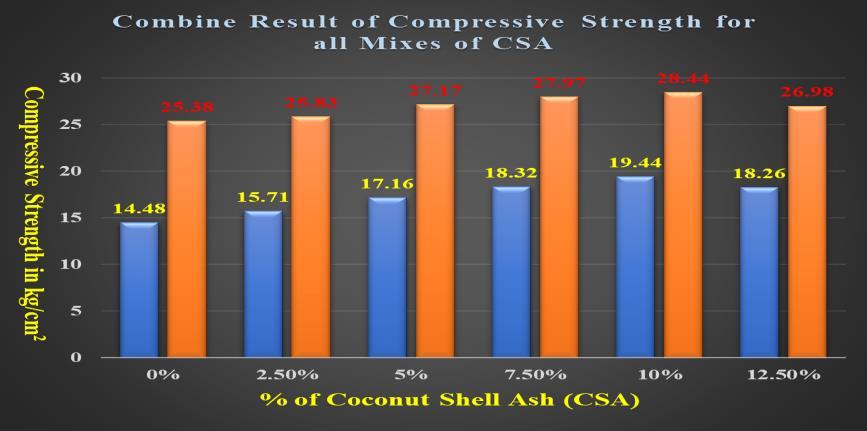
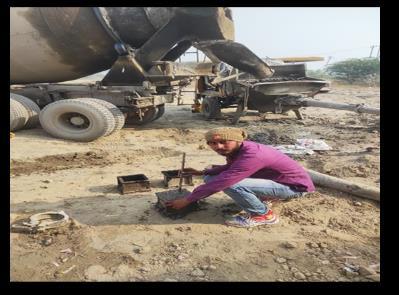
Figure 5: Combine Split Tensile strength at 7 day and 28 days for all mixes of Coconut Shell Ash BythesetestresultswecansaythatSplitTensilestrength of Coconut Shell Ash concrete can be increased approximately 3.81 kg/cm2 byaddingwastecoconutshell ash 7.5% of the weight of the cement content. It is also clear by these results that more than 7.5% wastecoconut
Bythesetestresultswecansaythatcompressivestrength of glass powder concrete can be increased approximately 29.02kg/cm2 by adding waste coconut shell ash 10% of the weight of the cement content. It is also clear by these results that more than 10% waste glass powder start reducing the compressive strength of glass powder mixed concrete. 3.6 Split Tensile Strength of CSA and GP mixed Concrete (IS:5816 1970) [38]: The splitting tests are well known indirect tests used for determination the tensile strength of concrete sometime referred to as split tensile strength of concrete. Uniform tensile stress is developed nearly 2/3 of the loaded diameter, due to compression loading. The magnitude of this tensile stress Fsp acting in a direction perpendicular to the line of action of applied loading is givenbytheformula(IS:5816 1970). 10 Combine Split Tensile Strength of Coconut Shell Ash (CSA) mix Concrete for all Mixes Split (kg/cmAfterStrengthTensile7Days After 28 Days (kg/cm
Table
No.S. GP %
2) 1 0% 1.11 2.55 2 2.5% 1.43 2.78 3 5% 1.63 2.89 4 7.5% 1.91 3.81 5 10% 1.73 3.24 6 12.5% 1.70 3.46
INTERNATIONAL RESEARCH JOURNAL OF ENGINEERING AND TECHNOLOGY (IRJET) E ISSN: 2395 0056 VOLUME: 09 ISSUE: 02 | FEB 2022 WWW.IRJET.NET P ISSN: 2395 0072 © 2022, IRJET | Impact Factor value: 7.529 | ISO 9001:2008 Certified Journal | Page71 Figure3:CombineCompressivestrengthat7dayand28 daysforallmixesofCoconutShellAsh Bythesetestresultswecansaythatcompressivestrength of coconut shell ash concrete can be increased approximately28.44kg/cm2 byaddingwastecoconutshell ash10%oftheweightofthecementcontent.Itisalsoclear by these results that more than 10% waste coconut shell ash start reducing the compressive strength of coconut shellashconcrete. Table 9 Combine Compressive Strength of Glass Powder (GP) mix Concrete for all Mixes No.S. GP % (kg/cm7StrengthCompressiveAfterDays 2) StrengthCompressiveAfter 28 Days (kg/cm2) 1 0% 13.47 25.10 2 2.5% 15.05 26.39 3 5% 16.96 27.16 4 7.5% 18.06 27.90 5 10% 19.48 29.02 6 12.5% 18.21 27.18 Figure4:CombineCompressivestrengthat7dayand28 daysforallmixesofGlassPowder
2) Split Tensile Strength
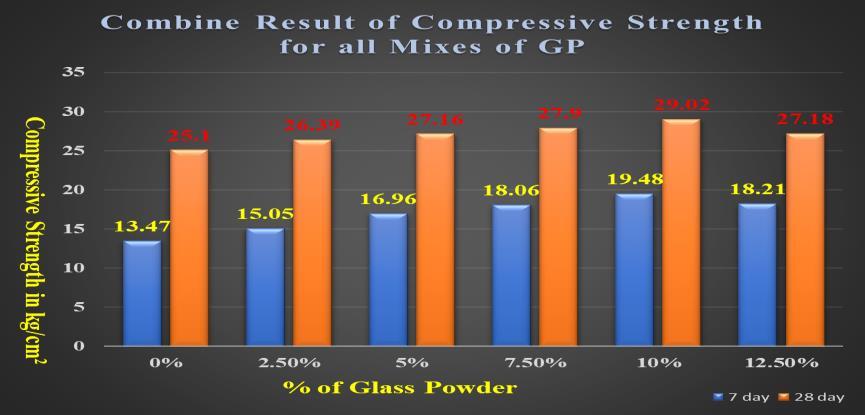
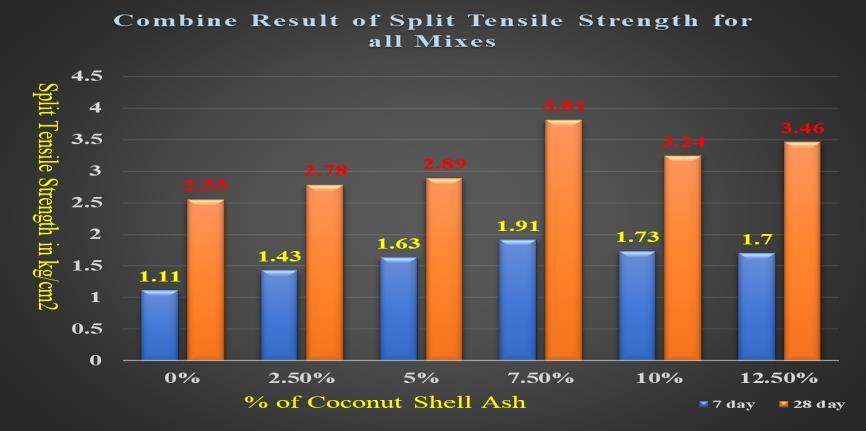
Table 13 Combine Flexural Strength of Glass Powder (GP) mix Concrete for all Mixes
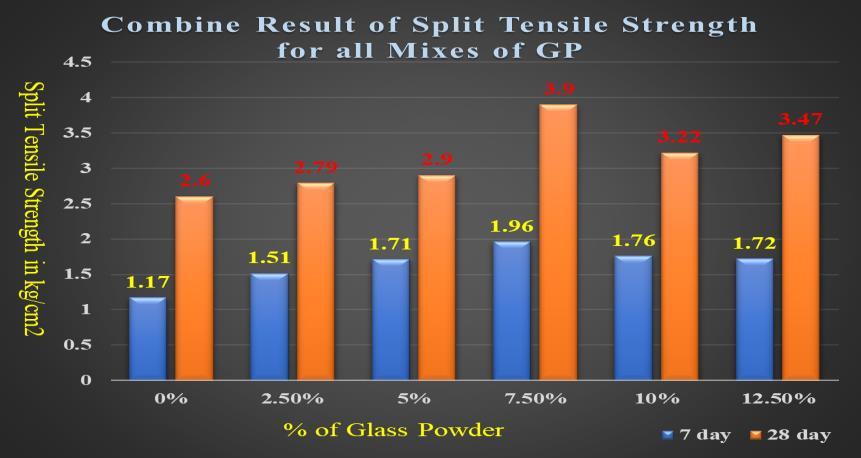
INTERNATIONAL RESEARCH JOURNAL OF ENGINEERING AND TECHNOLOGY (IRJET) E ISSN: 2395 0056 VOLUME: 09 ISSUE: 02 | FEB 2022 WWW.IRJET.NET P ISSN: 2395 0072 © 2022, IRJET | Impact Factor value: 7.529 | ISO 9001:2008 Certified Journal | Page72 shellashstartreducingthesplittensilestrengthofcoconut shellashmixedconcrete. Table 11 Combine Split Tensile Strength of Glass Powder (GP) mix Concrete for all Mixes No.S. GP % Split Tensile Strength After 7 Days (kg/cm2) Split (kg/cmDaysAfterStrengthTensile28 2) 1 0% 1.17 2.60 2 2.5% 1.51 2.79 3 5% 1.71 2.90 4 7.5% 1.96 3.90 5 10% 1.76 3.22 6 12.5% 1.72 3.47 Figure 6: Combine Split Tensile strength at 7 day and 28 days for all mixes of Glass Powder BythesetestresultswecansaythatSplitTensilestrength of Glass Powder concrete can be increased approximately 3.90 kg/cm2 by adding waste glass powder 7.5% of the weight of the cement content. It is also clear by these results that more than 7.5% waste glass powder start reducing the split tensile strength of glass powder mixed concrete. 3.7 Flexural Strength of CSA and GP mixed Concrete (IS: 516 1959): The flexural strength test of beam, a specimen of size (700*150*150) mm is placed over two point loading arrangement and the stress produced during breakage of specimen. The flexural strength is reported as Modulus of Ruptureft(N/mm)
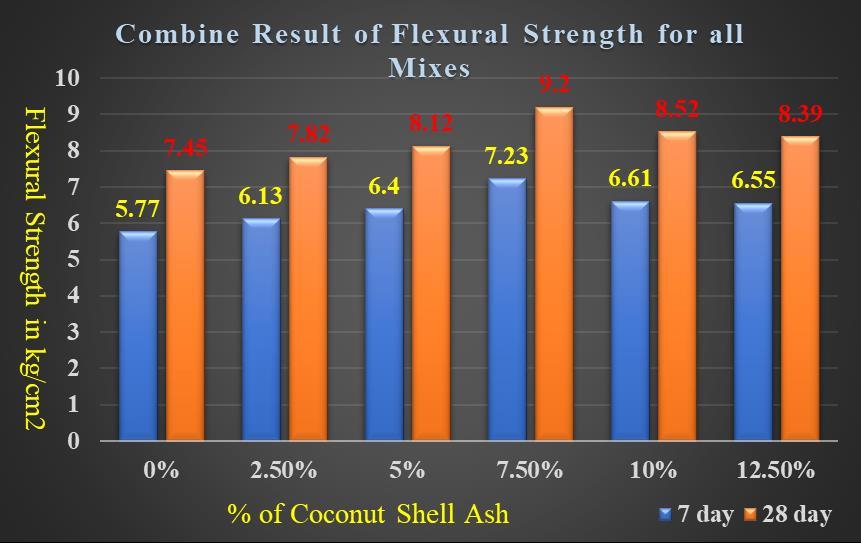
Table-12 Combine Flexural Strength of Coconut Shell Ash (CSA) mix Concrete for all Mixes No.S. CSA % StrengthFlexural After 7 Days (kg/cm2) Flexural Strength After 28 Days (kg/cm2) 1 0% 5.77 7.45 2 2.5% 6.13 7.82 3 5% 6.40 8.12 4 7.5% 7.23 9.20 5 10% 6.61 8.52 6 12.5% 6.55 8.39
Figure 7: Combine Flexural strength at 7 day and 28 days for all mixes of Coconut Shell Ash
By these test results we can say that Flexural strength of Coconut Shell Ash concrete can be increased approximately 9.20 kg/cm2 byaddingwastecoconutshell ash 7.5% of the weight of the cement content. It is also clear by these results that more than 7.5% wastecoconut shell ash start reducing the Flexural strength of coconut shellashmixedconcrete.
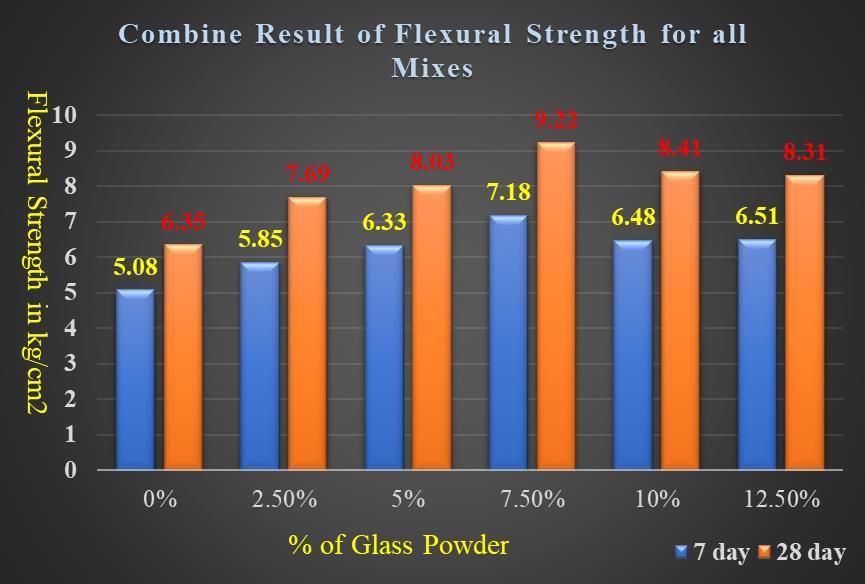
No.S. GP % StrengthFlexural After 7 Days (kg/cm2) Flexural Strength After 28 Days (kg/cm2)
1 0% 5.08 6.35 2 2.5% 5.85 7.69 3 5% 6.33 8.03 4 7.5% 7.18 9.22 5 10% 6.48 8.41 6 12.5% 6.51 8.31
[1] For the right and the accurate result, we have to prepare assessment report for every activity and everystepofworktoensuretheproperdegreeof control.
[2] We prepare for result new and accurate machine andupdatedIScodesforformulation.
[2] Further studies need to be conducted by using other waste materials (combination of artificial andnaturalmaterial)withcementcouldincreases strengthofconcrete.
Figure 8: Combine Flexural strength at 7 day and 28 days for all mixes of Glass Powder
[5] The gradual increase seen in the Split Tensile Strength of Coconut Shell Ash & Glass Powder mixedconcreteat7 days and28days curing with 7.5%additionofCSAandGPintheamountof3.81 kg/cm2 and3.90kg/cm2respectivelybutafterthat it starts reducing the Split Tensile Strength with increaseofCSAandGPaddition.
[2] The addition of waste CSA & GP does not affect verymuchthedensityofconcretemix.
INTERNATIONAL RESEARCH JOURNAL OF ENGINEERING AND TECHNOLOGY (IRJET) E ISSN: 2395 0056 VOLUME: 09 ISSUE: 02 | FEB 2022 WWW.IRJET.NET P ISSN: 2395 0072 © 2022, IRJET | Impact Factor value: 7.529 | ISO 9001:2008 Certified Journal | Page73
By these test results we can say that Flexural strength of glass powder concrete can be increased approximately 9.22kg/cm2 byaddingwasteglasspowderash7.5%ofthe weight of the cement content. It is also clear by these results that more than 7.5% waste glass powder start reducing the Flexural strength of glass powder ash mixed concrete.
Intheconstructionindustriesthatispurelymanagedwork has good communication and clear guideline on the scope of the work are essential in the construction to avoid undesirableandconfusion.
[3] Allocation of financial and skilled human resourcesforthepurposeofeffectiveandefficient qualitymanagementshouldbeprovided.
IV. Conclusion
[1] Further studies need to be conducted for the test ofdurability, soundness, thermal insulation, crack patternandwaterabsorptionoftheconcrete.
VI Scope for the future
[4] There should be training program and quality guidelinestoassuredesiredquality.
[4] The gradual increase seen in the compressive strength of Coconut Shell Ash & Glass Powder mixedconcreteat7 days and28days curing with 10% addition of CSA and GP in the amount of 28.44 kg/cm2 and 29.02 kg/cm2 respectively but after that it starts reducing the compressive strengthwithincreaseofCSAandGPaddition.
[3] The addition of waste CSA & GP increases the strength of concrete for all curing ages up to a certain point. After that there is an abrupt reduction in the strength of the CSA & GP mixed concrete.Becauseathigherdosage,concreteloses itsabilitytomakeaproperbond.
V. Recommendations
[6] WealsofindthattheFlexuralStrengthofCoconut ShellAsh&GlassPowdermixedconcreteat7days and28dayscuringwith7.5%additionofCSAand GPintheamountof9.20kg/cm2 and9.22kg/cm2 respectively but after that it starts reducing the Flexural Strength with increase of CSA and GP addition.
[1] CSA & GP waste material improves the compressive strength, split tensile strength and flexuralstrengthofconcrete.
[7] The mix which was prepared with the addition of 10% CSA & GP with 0.55 W/C ratio possess the maximum compressive strength. Therefore, this mixisrecommendedformaximumstrength.
Afterthedetailanalysisofthetestresults,wecansaythat the addition of waste coconut shell ash and glass powder significantly affect the 7 day and 28 days compressive strength, split tensile strength and flexural strength of the concrete.Fromthecriticaldifference,itcanbeclearlyseen that the addition of waste coconut shell ash and glass powder in certain amount i. e. (0 7.5) % of the weight of cementincreasesthecompressivestrengthaswellassplit tensile strength and flexural strength increases. Experimental results also show similar trend. Hence, the results of statistical analysis are equivalent to the experimental results. From the experimental investigation thisresearchworkcanbeconcludedasfollows:
International Research Journal of Engineering and Technology(IRJET),Volume03,Issue03,Page 500 503.
INTERNATIONAL RESEARCH JOURNAL OF ENGINEERING AND TECHNOLOGY (IRJET) E ISSN: 2395 0056 VOLUME: 09 ISSUE: 02 | FEB 2022 WWW.IRJET.NET P ISSN: 2395 0072 © 2022, IRJET | Impact Factor value: 7.529 | ISO 9001:2008 Certified Journal | Page74 [3] If we increase the plastic limit of CSA in concrete thenweincreasehugethestrengthincompressive strengthandflexuralstrength. [4] Experiments can be performed to study the behavior of soil reinforced with CSA & GP material.
International Journal of Scientific & EngineeringResearch(IJSER),Volume9,issue 4,Pages143 148.
16. Anandh Sekar, Gunasekaran Kandasamy (2019) “Study on durability properties of coconut shell concrete with coconut fiber” Multidisciplinary Digital Publishing Institute (MDPI),Volume9,page1 13.
11. Nitin S. Taksande, G. O. Dhawale, S. G. Makrande, M. R. Nikhar (2019) “A comparative study on behavior of concrete to partial replacement of cement by rice husk ashandglasspowder”InternationalAdvanced Research Journal in Science, Engineering and Technology(IARJSET),Volume6,Issue4,Page 30 36.
5. Code ISO: 7884 6:1987, “Glass viscosity and viscometricalfixedpointsPart6Determineof softeningpoint”
“Experimentalstudyonpartialreplacementof cement with coconut shell ash in concrete”
17. G.M.SadiqulIslam,M.H.Rahman,NayemKazi (2017) “Waste glass powder as partial replacement of cement for sustainable concretepractice”Volume6,Page37 44.
International Journal of Science and Research (IJSR),Volume3,issue3,Page651 661.
Case studies in construction material, Volume 15,Page1 10. 9. M.J.Garba,A.S.J.Smith,E.N.Ogork,A.Aboshio (2020) “Effect of coconut shell ash (CSA) an admixture on the properties of cement paste and concrete “British Journal of Educational Technology (BJET), Volume 15, Issue 02, Pages22 29.
14. Vignesh Kumar nagarjun, S. Aruna Devi, S. P. Manohari, M. maria Santha (2014)
8. K. I. M. Ibrahim (2021) “Recycled waste glass powder as a partial replacement of cement in concrete containing Silica Fume and Fly Ash”
13. Murthi palanisamy, Poongodi koloandasamy, Paul Awoyera, Ravindra Gobinath
“Permeability properties of light weight self consolidating concrete made with coconut shellaggregate”JournalofMaterialsResearch and Technology (JMR&T), Volume 9, Issue 3, Pages3547 3557.
References 1. Shyamji Gautam, Abhishek Kumar, Mohd. Afaque (2016) “A review report on comparative study of waste glass powder as pozzolanicmaterial inconcrete”
3. M.J.Garba,A.S.J.Smith,E.N.Ogork,A.Aboshio (2020) “Effect of coconut shell ash (CSA) an admixture on the properties of cement paste and concrete “British Journal of Educational Technology (BJET), Volume 15, Issue 02, Pages22 29.
18. Gopu ganesh naidu, Nettikoppula Ramesh babu, Pappula Ravi Kumar (2021) “Strength characteristics of concrete by partial
12. R.Gopinath,T.AjitKumar,M.Nithin,V.Sanjay Srikant, P. Sivakumar (2012) “Experimental study on partial replacement of coarse aggregate by coconut shell & ordinary Portland cement by rice husk ash”
2. ] Tajamul Margey, Bital Malik, Mohd Akeeb Rar, nazeer Bijian (2016) “Coconut Shell and waste glass based concrete A comparative study “International Journal of Engineering Development and Research (IJEDR), Volume 04,Issue1,Pages359 371.
7. Handule abdul Rehman, Ghazi sarim Khan, HarisKhan,NumanKhan(2021)“Useofglass powder as partial replacement of cement in cement concrete “International Journal of Engineering Research & Technology (IJERT), Volume7,Issue4,Page83 86.
6. TajamulMargey,BitalMalik,MohdAkeebRar, nazeerBijian(2016)“CoconutShellandwaste glass based concrete A comparative study “International Journal of Engineering Development and Research (IJEDR), Volume 04,Issue1,Pages359 371.
10. A. Gupta, N. Gupta, A. Shukla, R. Goyal, S. Kumar (2020) “Utilization of recycled aggregate plastic glass waste and coconut shell in concrete a review” International Symposium on Fusion of Science and Technology (ISFT), Volume 03, Issue 02, Page 1 8.
15. Vrindra Maloor, Greeshma Pradeep, nasil A Rizeen Moza (2018) “Experimental study on concrete by partial replacement of sugar bagasseashandpartialreplacementofcoarse aggregate by coconut shell ash” International Journal of Innovative Research in Science, Engineering and Technology (IJIRSET), Volume7,Issue5,Pages6222 6229.
4. Code ISO: 9383:1995/ AMD 1:2004, “Products in fiber R/F cement short corrugatedorasymmetrical sectionsheetand fittingforrolling”Amendment1.
24. M. Arivazhagan, T. Balakrishna, A. Deepak, M. Hariskumar (2019) “Experimental study on partial replacement of cement by groundnut shell ash in concrete” International Journal of Current Engineering and Scientific Research (IJCESR),Volume6,issue3,Page144 160.
25. Book P. Mehta, J. Paulo, M. Monteiro (2005) “Concrete microstructure properties and material” Hc Graw Hill Professional Edition, Page659. 26. M. Nabil, Al Akhras, Ayman Ababnesh (2009) “Effect of glass powder on the mechanical properties of mortar” An Najah National University(ANNU),Volume4,Issue3,Page1 66. 27. Code IS:383 1970 “Specification for coarse and fine aggregate from natural sources for concrete” 28. Gopal Charan Behera, Ranjan Kumar Behera (2013) “Effect of coconut shell aggregate on natural strength concrete running title: coconut shell as coarse aggregate” International Journal ofEngineering Research & Technology (IJERT), Volume 2, Issue 6, Pages2405 2415.
International Journal of Scientific & Engineering Research (IJSER),Volume5,issue7,page2175 2179. 21. Abhishek Kumar, Shyamji Gautam, Mohd. Afaque (2016) “A review report on comparative study of waste glass powder as pozzolanicmaterial inconcrete”International Research Journal of Engineering and Technology(IRJET),Volume03,Issue03,Page 500 503. 22. V. Sravika, G. Kalyan (2017) “A Study on the partial replacement of course and fine aggregate by coconut shell quarry dust mix” IOSR Journal of Mechanical and Civil Engineering(IOSR JMCE),Volume14,Issue4, Page63 69. 23. A. R. Ayyappa, B. Sandeep Reddy, G. Swammy Yadav, Dara Swelhasudarshan (2019) “Partial replacement of cement and coarse aggregate by egg shall powder and coconut shells” International Journal of Innovative Technology and Exploring Engineering (IJITEE),Volume9,Issue4,Pages1242 1246.
replacementofcoarseaggregatewithcoconut shell & cement with glass powder” International Conference on Trends in Material Science and Inventive Materials (ICTMIM),page1 9.
INTERNATIONAL RESEARCH JOURNAL OF ENGINEERING AND TECHNOLOGY (IRJET) E ISSN: 2395 0056 VOLUME: 09 ISSUE: 02 | FEB 2022 WWW.IRJET.NET P ISSN: 2395 0072 © 2022, IRJET | Impact Factor value: 7.529 | ISO 9001:2008 Certified Journal | Page75
20. Dr. R. Umamaheswari, M. Vigneshkumar (2018) “Experimental study on partial replacementofcementwithcoconutshellash and silica fume in concrete”
29. Book P.N.Balaguru, S. P. Shah “Fibre reinforced cement composites” Mc Graw Hill Inc,NewYorkUnitedStateofAmerica. 30. Code BIS:8112 2013 “Ordinary Portland Cement,43Grade Specification” 31. Code BIS:4031 1988 (Part 4) “Methods of physicaltestsforhydrauliccement” 32. Code BIS:1489 1991 (Part 1) “Portland PozzolanaCementSpecification” 33. Book S. K. Khanna, C. E. G. Justo, A. Veeraragavan “Highway Material and pavementtesting” 34. Code BIS:1199 1959 “Methods of sampling andanalysisofconcrete” 35. Code BIS:10262 2009 “Concrete mix proportioningguideline” 36. Code BIS:456 2000 “Plain and Reinforced concretecodeofpractice” 37. Code BIS:5816 1970 “Splitting tensile strengthofconcretemethodoftesting” 38. Code BIS;516 1959 “Method of tests for strengthofconcrete”
19. R. Ranjith Kumar, R. Mahendra, S. Gokul Nathan, P.Sathya (2017) “An experimental studyonconcreteusingcoconutshellashand egg shell powder” South Asian Journal of Engineering and Technology (SAJET), Volume 3,issue7,Page15 161.