International Research Journal of Engineering and Technology (IRJET) e-ISSN: 2395-0056

Volume: 09 Issue: 12 | Dec 2022 www.irjet.net p-ISSN: 2395-0072
International Research Journal of Engineering and Technology (IRJET) e-ISSN: 2395-0056
Volume: 09 Issue: 12 | Dec 2022 www.irjet.net p-ISSN: 2395-0072
Utkarsh Dwivedi1 , Prabhat Rao2
1Post Graduate Student, MURP, Faculty of Architecture and Planning, Dr. APJ AKTU, Lucknow, U.P. 2Assistant Professor, Faculty of Architecture and Planning, Dr. APJ AKTU, Lucknow, U.P. ***
Abstract - The community-based approach is an effective way to plan a city's water-sensitive development. The study looksintothecommunity'sperceptionofwatermanagement, climate change, and willingness to participate in Kanpur's water-sensitivedevelopment.Structuredinterviewsandgroup discussions were used to collect data from households at random.Thestudyincluded117participants,37.6%ofwhom were females and 62.4 % of whom were males. The average number of people in a household is 4.64. In June, 33.80% of HHsfacedwaterscarcity.75.64%ofthehouseholdsarewilling toreuserecycledtreatedstormwaterfornon-potabledomestic purposes, and 77.72 % have no objection to reusing treated wastewater for non-potable public purposes. 87.2 % of respondentsbelieveclimatechangeisreal,and54.7%believe it will significantly impact the upcoming generation. In addition, 73.5 % of respondents agreed to participate in community programmes promoting water-sensitive development and climate change. More awareness and communityparticipationarerequiredto achievesustainable urban water management.
Key Words: community;Kanpur;management;perception; water-sensitiveurbandevelopment
Waterisavitalcomponentoflifeonearth.Everylivingthing andnon-livingthingisimpactedbywater,eitherdirectlyor indirectly.Humansusewaterformanydailytasks,suchas drinking, cooking, agriculture, washing, and cleaning. Reduced availability of water is one of the critical global issues.AccordingtotheWorldBank,Indiaisamongthemost water-stressed countries in the world (The World Bank, 2022) With rapid urbanisation, unplanned development, population growth and climate change, there will be immensepressureonurbanhydrology.Citiesaremorelikely toexperienceincreasedfloods,droughtsandothernatural disasters like cyclones. Goal 6 of the Sustainable DevelopmentGoals(SDG)aimstoenableuniversalaccessto cleandrinkingwaterandsanitationfacilities,aswellasto increase water efficiency, water quality, integrated water resourcemanagement,andtherestorationofwater-related ecosystems (United Nations, 2022) According to R. R. Brown,asustainablewatermanagementapproachisneeded to develop water-sensitive cities to make cities water and
climate change resilient (Brown, Keath, & Wong, 2009) A comprehensive strategy for the utilisation of water resourcesisnecessaryforsustainablewatermanagement. Cities of many countries like Australia, China, the United States of America (USA), the United Kingdom (U.K), and Japan have adopted a sustainable water management approach per their requirements. India also adopted a similarapproachwhenDelhiDevelopmentAuthority(DDA) plannedtheDwarkasub-cityin1989asa‘zero-runoffcity’ butcouldnotimplementit.LaterNationalInstituteofUrban Affairs (NIUA) prepared the strategic framework for managingurbanriverstretchesundertheGangariverbasin as the Urban River Management Plan (URMP) under National MissionforClean Ganga.Theprimarygoal ofthe URMP is to create an integrated approach to manage the riveranditsassociatedaspectsinthecityinasustainably andhaveariver-centricurbandevelopment (NIUA;NMCG, 2020). Kanpur is the first city of the country to have its URMPpreparedbyKanpurMunicipalCorporationin2021.
Indiancitieshavestartedworkingonwatersensitiveurban designinlastfewyears.Bhopal’sgreen-bluesmartcityplan, Masterplan of New Delhi (2041), and Chennai’s water as leverageinitiative,aresomeoftheeffortstowardsdeveloping water-sensitive cities through urban policy and developmental guidelines (Anand & Janakiraman, 2021) After 2014, Government of India launched two flagship programmes – Atal Mission for Rejuvenation and Urban Transformation (AMRUT) and the Smart City Mission, focused on improving quality of life through improving physical infrastructure in urban areas. The thrust areas of AMRUT are water supply and sewerage, stormwater drainage,greenspacesandparks,andnon-motorisedurban transport (Udas-Mankikar&Driver,2021).
AccordingtoCentralWaterCommission,approximately820 million people living in 22 river basins across the country havepercapitawateravailabilityclosetoorlowerthan600 cum (Commission, 2019) 70% of India’s surface water is contaminated (NitiAyog,2019) Basedonthedatagathered in the service level benchmarking system implemented by MoUD, it primarily covers 28 cities and analyses that the
International Research Journal of Engineering and Technology (IRJET) e-ISSN: 2395-0056
Volume: 09 Issue: 12 | Dec 2022 www.irjet.net p-ISSN: 2395-0072
averagewatersupplydurationwas4.1hoursrangingfrom 0.1 hours per day to 24 hours per day (CEPT University, 2014). As per CPCB, only 30-40% of India's wastewater is treatedpotentially,andtherestoftheuntreatedwastewater flowsintothegroundwaterorseaoftherivercanal (CPCB, 2021).Morethan70%ofIndia’sannualrainfalloccursduring thethreemonthsofmonsoon,andmostofitfloodsouttosea (Central WaterCommission,2021) AsperCentral Ground WaterBoard,theaveragedepthtowaterlevelrangesfrom2 metres to 10 metres below ground level (Central Ground WaterBoard,2016)
MouritzinitiallyusedthetermWaterSensitiveUrbanDesign (WSUD) in Australia in 1992, and the corresponding guidelineswerepublishedin1994(RadcliffeJ.C.,2018).The inter-governmentalagreementonNationalWaterInitiatives definesWSUDastheintegrationofurbanplanningwiththe management, preservation, and conservation of the urban water cycle, ensuring that urban water management is responsivetonaturalhydrologicalandecologicalprocesses (Wong, 2015) WSUD is an integrated approach for sustainableurbandevelopmentbyintegratingurbanwater systems with natural water cycle. It aims at flood control, rainwaterharvestingandwaterpollutioncontrolbyefficient stormwatermanagementandon-sitelocaltreatmentandreuseofwastewater(Barton&Argue,2007) WSUDhasvarious economic,socialandenvironmentalbenefitssuchasithelps inrecharginggroundwater,minimizestheimpactofurban development on environment, ameliorating Urban Heat Islands(UHIs).
Low impact development (LID) refers to a system that mimics natural processes that result in the infiltration, evapotranspiration,oruseofrainwaterinordertoprotect waterqualityandadjacentaquaticecosystems(UnitedStates
Environmental Protection Agency, 2021) LID is a land developmentstrategyformanagingstormwateronsitewith decentralised small-scale control measures (Ahiablame, Engel,&Chaubey,2012).TheideaofGreenInfrastructure, which integrates water cycle management with landscape architectureandurbanecosystemservices,hasbeenadded to LID. Nature-based solutions such as green roofs, rain gardens, swales, permeable pavements, wetlands, green spaces,andnatural plantcorridorsareutilisedtoimprove urban amenity and reduce the risk of floods and pollution (RadcliffeJ.C.,2019)
ChinesePresidentXiJinpingcoinedthetermSpongeCitiesat theCentralWorkingConferenceofUrbanizationin2013.The mainideaofspongecitieswastonaturallyconserve,purify andinfiltratestormwaterforpotentialreuse(RadcliffeJ.C.,
2019) Thespongecitiesprojectseekstodevelopresiliencein urban areas by simulating the natural water cycle using permeable surfaces and green-grey-blue infrastructures. Traditionaltechnicalsolutionscannothandletoday'surban drainage and water management problems. In order to rechargegroundwater,lowertheriskofflooding,andenable thereuseofrainfallandrunofffordifferentresidentialand urbanuses,thecityistobeconstructedlikeaspongethat absorbs water (IUCN European Regional Office, 2021) In 2015,Chinaselected16citiesaspilotcitiesfortheSponge Citiesprojecttocollectanduse70%ofstormwaterby2020 and80%by2030inurbanareas.
Singaporecreatedastrategytoimprovewatersecurityand self-sufficiency in 2011. The Public Utilities Board (PUB) overseesthewatercycleinthecountry.Singaporehasfour watersources:importedMalaysianwater,desalination,water recycling (NEWater), and catchment water (Radcliffe J. C., 2019) PUB focuses on institutional efficacy, building an enabling environment, such as political will, regulatory framework, and staff, and efficient supply and demand managementofwater,wastewater,andstormwater.Byusing economic tools to ensure efficient use of its limited water resources,adoptingcutting-edgetechnologicaladvancements toproducenewwatersources,improvingstoragecapacities through proper catchment management, and engaging in waterconservationpractices,Singaporehasreachedalevel ofsustainablewatermanagement(Tortajada,2006)
Kanpur is the industrial centre of Uttar Pradesh and the country's12thlargestmetropolitanagglomeration.Kanpur, located on the Ganga's banks, is well connected to major
International Research Journal of Engineering and Technology (IRJET) e-ISSN: 2395-0056
Volume: 09 Issue: 12 | Dec 2022 www.irjet.net p-ISSN: 2395-0072
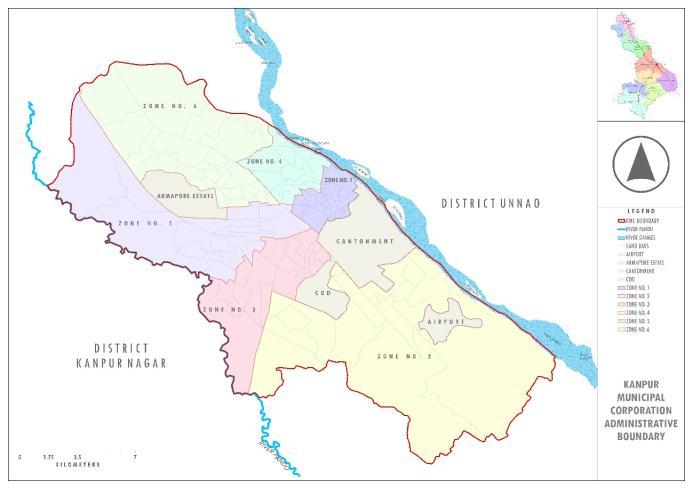
cities around the country by NH-2 on the Delhi-AgraPrayagraj-KolkatarouteandNH-25ontheLucknow-JhansiShivpuriroute.Itisoneoftheoldestindustrialtownshipsin NorthIndiaandoneofthefastestdevelopingcitiesinterms of industrial growth. According to the 2011 census, the population of the Kanpur Municipal Corporation (KMC) regionwas27,65,348people,spreadthroughoutanareaof 260squarekilometres.Itisadministrativelyorganizedinto six administrative zones and 110 wards, with an average wardpopulationof18,000to26,500.(showninmap1).
Therehasbeenuncontrolleddevelopmentinthecityalong withsteadypopulationgrowthovertheyears.Between1991 and2001,populationgrowthincreasedfromthepreceding decade'saverageannualgrowthrateof2.6%toanaverage annualgrowthrateof3.5%(1981-91). GiventhatKanpuris a prosperous industrial city, increased migration from neighbouringareaswillonlyaddtotheexistingproblemsof watermanagement.
Thetemperaturerangesfrom2°Cto48°C,andtheclimateis tropicalinnatureofthecity.ThemonthsofJulyandAugust oftenseetheheaviestrainfallduringtherainyseason,which lasts from June through September. During the monsoon season,almost89%oftheyearlyrainfallisrecorded(Juneto September).Theregionreceivesbetween450and750mmof rainannually.Inthedistrict,thereareabout40rainydays each year (Kanpur Nagar Nigam, 2013) According to the State of Groundwater report from 2021, Kanpur's groundwaterisdepletingatarateof0.5to1.0mtrperyear. Thegroundwaterlevelrangesfrom13.36metresto37.80 metresbelowgroundlevelinKanpur(Sinha,2021).
Individualstakeholders,citizens,andotherorganisationsare necessaryparticipantsinthewater-sensitivedevelopmentof the city. Their awareness of water management problems and willingness to participate to the community good are crucialfactorsofsustainablewatermanagement.Thestudy attemptstocomprehendcitizens'perspectivesonthecity's water-sensitive development to provide an integrated strategy for managing water supply, stormwater, and wastewater. For this objective, a questionnaire survey has beendevelopedtoreachouttolargeanddiversegroupsof city residents from various age groups, socioeconomic classes,anddifferentlocationswithinthecity.
Thequestionnairewaspreparedintwolanguages,i.e.Hindi and English and then disseminated. The aim of the questionnairewasgiven:Thesurveyaimstounderstandand quantify community knowledge, behaviour and actions associatedwithstormwater/urbanwatermanagement.The questionnairewasdividedintotwosectionswithtotalof17 questions:
i. PersonalinformationandSocio-EconomicStatus–Questions1-6
ii. TowardsWater-SensitiveCommunity–Questions717
A total of 117 respondents took part in the survey, distributed randomly to persons in the city's six administrative zones on important roundabouts, neighbourhood streets, open parks, Ganga ghat, shopping malls,andlocalvegetablemarkets.
Toanalyserespondents'attitudes,perceptions,awareness, and desire to participate in the city's water management, socio-economic parameters including gender, age, the number of people living in the household, average yearly income,housingtypology,andhomeownershipwerelooked into.Therespondentsfitthefollowingprofile:
Gender: 37.6 % of females and 62.4 % of males participatedinthesurvey.
Age Distribution: Out of 117 respondents, 50.4 % of respondentswerefromtheagegroup18-35years,30.8 respondents from 35-60years,and 18.8 % were from above60years.
Household Size: 4.64 persons per household was the averagehouseholdsizeof117respondents.
Annual householdincome: 4.27 %of households have incomebelowRs1lakhp.a.,23.93%ofhouseholdshave paymentofRs1-3lakhsp.a.,25.64%ofhouseholdshave incomeRs3-6lakhsp.a.,23.93%participantshavean incomeofRs6-12lakhsp.a.,8.55%householdsearns betweenRs12-18lakhsp.a.,and3.42%householdsearn aboveRs18lakhsp.a.
Housingtypology:5.98%ofrespondentswerelivingin apartments,23.08%haddetachedhouses,34.19%of respondentswerelivinginthesemi-detacheddwelling, and36.75respondentshadrowhouses.
Tenurestatus:80.34%ofrespondentsownedthehouse, and19.66%livedonrent.
International Research Journal of Engineering and Technology (IRJET) e-ISSN: 2395-0056
Volume: 09 Issue: 12 | Dec 2022 www.irjet.net p-ISSN: 2395-0072
Outof117respondents,71(55.56%)reportedexperiencing waterloggingorfloodingintheareaonrainydays,37(27.35 %) said having no such problem, and 9 (7.69 %) were unawareoftheissue.
Theaverageweightedmeanoftheresponseswascalculated in order to understand the citizen's viewpoint on the significanceofstormwatermanagement.Ona5-pointLikert scale,therespondentswereaskedtoratethesignificanceof stormwatermanagement.Withascoreof3.18,theaverage weighted mean indicates that city residents believe it is importanttomanagestormwaterto decreaseinstances of waterlogging.
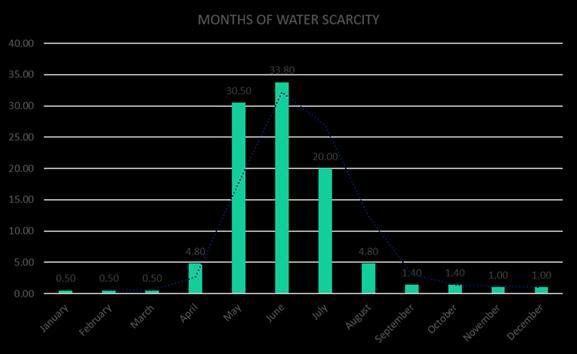
Figure 1: Monthsofwaterscarcity
Accordingtothefindings,peopleexperiencewaterscarcity from April to August. Out of the 117 HHs who provided feedback, 33.80% HHs reported a water shortage in June, followedby30.50%inMay,20%inJuly,and4.80%inApril andAugust.
Table 1: Communityperceptiononreusingtreatedstormwater/wastewaterfordomesticandpublicpurpose
Reuse Recycled Treated Stormwater for Domestic use
WashingClothes Gardening FlushingToilet Cleaning(mopping floor)
Yes 5556% 8718% 8889% 7094% No 27.35% 4.27% 3.42% 17.09% Don’tKnow 17.09% 8.55% 7.69% 11.97%
Reuse Recycled Treated Stormwater/Wastewater for Public purpose
WateringPublic Gardens/Lawns Cleaning (floormopping) Flushingtoilets(public amenities) Other municipaluses
Yes 7520% 7860% 7950% 7760% No 850% 680% 680% 690% Don’tKnow 1620% 1450% 1370% 1550%
RooftopRainWaterHarvestingisoneofthebestoptionsfor boosting groundwater recharge/storage in a city like Kanpur,wherenaturalrechargeisseverelyreduceddueto increased urban activity, and limited land is available for implementing any other artificial recharge approach. The question Do you have Rooftop Rain Water Harvesting in practice?wasposedtorespondentstounderstandthestate of rainwater harvesting in the city. Only 11.97% of respondentssaidyes,comparedto88.03%whosaidno.
4.4 Reuse recycled treated Stormwater/Wastewater
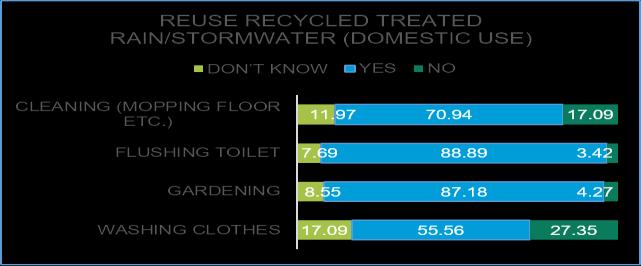
Figure 2:Communityperceptiononreusingstormwater fornon-potabledomesticuse
International Research Journal of Engineering and Technology (IRJET) e-ISSN: 2395-0056
Volume: 09 Issue: 12 | Dec 2022 www.irjet.net p-ISSN: 2395-0072
Inordertounderstandcommunityattitudetowardreusing treatedstormwaterfornon-potabledomesticuse,thesurvey presented the respondents' four end purposes shown in table1.Accordingtothefindings,respondentswereopento usingtreatedstormwaterfornon-potableuses.Asaresult,it was determined that washing clothes were the least preferreduse,and88.89%ofrespondentswerewillingto usetreatedstormwaterfortoiletflushingand87.18%for gardening/washinglawns(showninfugure-2).
Atotalof87.2%ofrespondentsagreedthatclimatechange isreal,whereasonly12%wereunsureand0.9%believedit tobeuntrue.Theresultsofthestudyshowthat54.7%of respondentsthinkthatclimatechangewillhaveasignificant impactonthenearfuture,27.4%opted it will havea fair amountofanimpact,12.8%madeapointofsayingitwill havealittleimpact,and5.1%claimeditwillhavenoimpact.
73.5 % of participants were willing to participate in community awareness programmes relevant to watersensitivecityplanningandclimatechangeawareness,16.2 %wereunsure, and10.3 % refused toparticipateinsuch communityawarenessprogrammes.
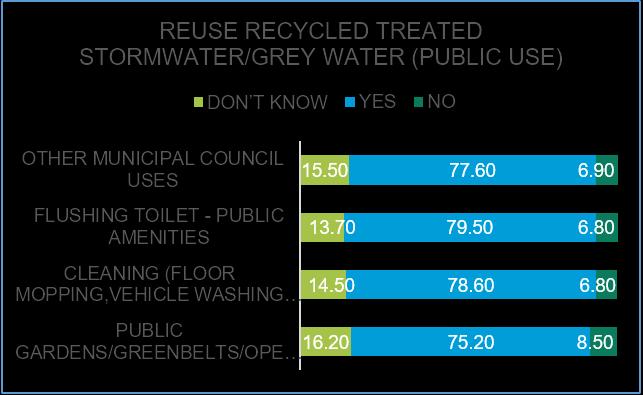
Figure 3: Communityperceptiononreusingtreated stormwater/wastewaterfornon-potablepublicuse
75.20 % of respondents approved the reuse of treated wastewater for non-potable public uses, such as watering greenbelts and public gardens. 78.60 % of respondents agreed to reuse it for routine cleaning tasks like mopping floors,77.60%agreedtoreuseitformunicipalapplications likedustsuppressants,and79.50%agreedtoreuseitforthe publicamenities(flushingpublicrestrooms).
74.35% respondents get information related to environmental issues from newspaper/magazine, 65.81% getinformedfromsocialmedia,49.57%ofrespondentsget informedfromTV/radio,8.54%ofrespondentsgetinformed fromfriendsandfamily,and5.98%respondentsusebooks and other sources for getting information related to environmentalissues.
Respondents were asked to mark the government programmestheyareawareofinamultiple-choicequestion to gauge their awareness of water management. The National Mission for Clean Ganga (NMCG), the Swachh BharatMission(SBM),theJalJeevanMission,andtheSmart CityMissionarefivegovernmentprogrammesthatsynergise urban water management and were offered as options. Accordingtotheresults,96.58%ofrespondentsknewabout SBM,78.63%knewabouttheSmartCitymission,76.06% knewaboutNMCG,39.30%knewaboutAMRUT,and36.75 %knewaboutJalJeevanMission.
The study looked at how community views influence city planning for water-sensitive development. Their perspectives on water scarcity, stormwater management andrainwaterharvesting,utilizingrecycledstormwaterand wastewater, understanding of relevant environmental issues,andclimatechangewereanalyzedusingdescriptive analysis,aswastheirinvolvementinthestudy.
Accordingtothefindings,theaveragehouseholdsizeis4.64 peopleperhousehold.Juneisthecity'smostwater-stressed month. There is an opportunity to collect rainwater from residential rooftops, recycle it, and reuse it for domestic purposes, as 76% of respondents agreed to use recycled rainwater/stormwater for non-potable domestic use. Treated/recycledstormwaterandwastewatercanbeused for non-potable public use. On various platforms such as Social Media/Newspapers, and TV/Radio, there is the potentialtoraisepublicawarenessaboutwatersensitivity and climate change. Even NGOs and schools can organise multipleawarenessprogrammesatthelocallevel,as74%of respondents are interested in participating in community awarenessprogrammes.
[1] Ahiablame, L. M., Engel, B. A., & Chaubey, I. (2012). Effectiveness of Low Impact Development Practices: LiteratureReviewandSuggestionsforfutureresearch. Water Air Soil Polution, 4253-4273. doi:10.1007/s11270-012-1189-2
[2] Anand,A.,&Janakiraman,S.(2021,June30). Creatinga flood resilient Indian 'Sheher' through water sensitive urban design. Retrieved from WRI India: https://wriindia.org/blog/creating-flood-resilient-indian%E2%80%98sheher%E2%80%99-through-watersensitive-urban-design
International Research Journal of Engineering and Technology (IRJET) e-ISSN: 2395-0056
Volume: 09 Issue: 12 | Dec 2022 www.irjet.net p-ISSN: 2395-0072
[3] Barton, A. B., & Argue, J. R. (2007). A review of the applicationofWaterSensitiveUrbanDesign(WSUD)to residentialdevelopmentinAustralia. AustralianJournal of Water Resources, 31-40. Retrieved from https://www.tandfonline.com/doi/abs/10.1080/13241 583.2007.11465309
[4] Brown, R. R., Keath, N., & Wong, T. H. (2009). Urban water management in cities: historical, current and future regimes. Water Science & Technology, 847-855. doi:10.2166/wst.2009.029.
[5] Central Ground Water Board. (2016). Ground Water Scenario in India. New Delhi. Retrieved from http://cgwb.gov.in/GroundWater/GW%20Monitoring%20Report_January%20201 6.pdf
[6] CentralWaterCommission.(2021). Water and Related Statistics. New Delhi. Retrieved from http://www.cwc.gov.in/sites/default/files/water-andrelated-statistics-2021compressed-2.pdf
[7] CEPTUniversity.(2014). Water and Sanitation service levels in cities of India. Ahmedabad. Retrieved from Based on the data gathered in the service level benchmarking system implemented by MoUD, it primarilycovers28citiesandanalysesthattheaverage watersupplydurationwas4.1hoursrangingfrom0.1 hoursperdayto24hoursperday
[8] Commission,C.W.(2019). WaterandRelatedStatistics. New Delhi. Retrieved from http://www.indiaenvironmentportal.org.in/files/file/w ater-and-related-statistics-2019.pdf
[9] CPCB.(2021). National Inventory of Sewage Treatment Plants. New Delhi. Retrieved from https://cpcb.nic.in/openpdffile.php?id=UmVwb3J0Rmls ZXMvMTIyOF8xNjE1MTk2MzIyX21lZGlhcGhvdG85NTY 0LnBkZg==
[10] IUCNEuropeanRegionalOffice.(2021). GrowGreen. Wuhan.
[11] KanpurNagarNigam.(2013). City Sanitation Plan for Kanpur. Kanpur.
[12] Niti Ayog. (2019). Composite Water Management Index. New Delhi. Retrieved from https://www.niti.gov.in/sites/default/files/201908/CWMI-2.0-latest.pdf
[13] NIUA;NMCG.(2020). UrbanRiverManagementPlan - A Strategic Framework for Managing Urban River Stretches in the Ganga Basin. New Delhi: NIUA. doi:https://nmcg.nic.in/writereaddata/fileupload/48_U
rban%20River%20Management%20Plan%20framewor k.pdf
[14] Radcliffe, J. C. (2018). Australia's Water Sensitive UrbanDesign. InternationalSpongeCityConference,(pp. 38-52). Xi' an. Retrieved from https://www.researchgate.net/publication/327718865 _AUSTRALIA'S_WATER_SENSITIVE_URBAN_DESIGN#:~: text=The%20term%20Water%20Sensitive%20Urban,p rinciples%20in%20their%20planning%20legislation.
[15] Radcliffe, J. C. (2019). History of Water Sensitive Urban Design/Low Impact Development Adoption in Australia and Internationally. In T. G. Ashok Sharma (Ed.), ApproachestoWaterSensitiveUrbanDesign (pp.124). Woodhead Publishing. Retrieved from https://www.sciencedirect.com/science/article/pii/B9 780128128435000010
[16] Sinha, R. S. (2021). State of Groundwater in Uttar Pradesh-Asituationanalysiswothcriticaloverviewand Sustainable Solutions. Lucknow. Retrieved from https://cdn.cseindia.org/gic/state-of-ground-water20210927.pdf
[17] The World Bank. (2022, March 14). World Water Day 2022: How India is addressing its water needs Retrieved from The World Bank: https://www.worldbank.org/en/country/india/brief/w orld-water-day-2022-how-india-is-addressing-itswater-needs
[18] Tortajada, C. (2006). Water Management in Singapore. International Journal of Water Resources Development, 227-240. doi:10.1080/07900620600691944
[19] Udas-Mankikar,S.,&Driver,B.(2021).Blue-Green Infrastructure: An opportunity for Indian Cities. ORF Occasional Paper. Retrieved from https://www.orfonline.org/research/blue-greeninfrastructure-an-opportunity-for-indian-cities/
[20] United Nations. (2022). The Sustainable Development Goals Report. Retrieved from https://unstats.un.org/sdgs/report/2022/TheSustainable-Development-Goals-Report-2022.pdf
[21] United States Environmental Protection Agency. (2021). Urban Runoff: Low Impact Development Retrieved from https://www.epa.gov/nps/urbanrunoff-low-impact-development
[22] Wong,T.H.(2015).WaterSensitiveUrbanDesignthe journey thus far. Australian Journal of Water Resources,213-222.