International Research Journal of Engineering and Technology (IRJET) e-ISSN:2395-0056

Volume: 09 Issue: 12 | Dec 2022 www.irjet.net p-ISSN:2395-0072
International Research Journal of Engineering and Technology (IRJET) e-ISSN:2395-0056
Volume: 09 Issue: 12 | Dec 2022 www.irjet.net p-ISSN:2395-0072
1-2Graduate, Department of Civil Engineering, JMI, New Delhi 3Assistant Professor, Civil Engineering Section, University Polytechnic, JMI, New Delhi *** -
Abstract – In this paper, STAAD.Pro and ETABS software is used to analyse and design a G+10, regular residential building. Famous software programmes like STAAD.Pro and ETABS are widely used in the field of structural engineering for analysing basic and complex structures under a variety of loading conditions. For the analysis purpose, Limit State method is used and the individual members are designed in accordance to IS:4562000 and for the loading conditions IS:875 (Part-3) were used.
Key Words: STAAD.Pro, ETABS
With the aid of physics principles, mathematical equations, and mechanics theories, the field of civil engineering deals with the design, construction, and maintenance of structures such as buildings, bridges, tunnels, highways, and so forth. A structure's weight is eventually transferred to the earth. As a result, the structure's various parts experience internal tensions. For instance, in a building, a slab that is under load will transferthatloadtothegroundviabeams,columns,and footings. Structural analysis is the process of determining these internal stresses in a structure's components, while structural design is the process of determining the ideal size of a structural component In comparison to former periods, when it took weeks or evenmonths toperformthetask,employingSTAADand ETABSsoftwarehasmademodellinganddesigningvery time-efficient, allowing the entire structure to be modelled and developed using various methods of analysisinamatterofhours.
1. Analysing and designing of G+10 residential building subjectedtowindloadbySTAAD.ProandETABS.
2. Comparing the so obtained results of bending moment, shear force, axial force, and deflection from boththesoftware’s.
Prof. Neeraj Singh Bais, Sayali Jilhewar (2021)
They did a comparative study of multi-storied building by STAAD.Pro and ETABS and verified it by doing manual calculations. They concluded that the values of shearforce,bendingmomentandstoreydisplacementin STAAD.Pro are slightly higher than that obtained from ETABS while the roof displacement increases with increaseinnumberofstoreysandithasahighervaluein ETABSascomparedtoSTAAD.Pro.
They did a comparative study on the design results of a multistoried buildingusing STAAD.ProandETABSfor a regular and irregular plan configuration and concluded that the vertical reactions obtained after the analysis werethatthevaluewasslightlyhigheronSTAAD.Proas comparedtoETABS.
They did a comparative study on analysis of G+2 residential building by STAAD.Pro and ETABS and concluded that the displacements that were obtained after analysis from both the software’s were approximately same, however STAAD.Pro shows a higher value for shear force and bending moment and ETABS was found to be more user friendly compared to STAAD.Pro.
They did a comparison of analysis and design of a regular and irregular configuration of a multi storied building in various seismic zones and various types of soils using ETABS and STAAD.Pro. They concluded that the baseshearvalueand storydriftvalue ismore in the regular configuration as the structure has symmetrical dimensions.Whentheresultswerecomparedfromboth thesoftware’s,STAAD.Progaveahighervalue.
International Research Journal of Engineering and Technology (IRJET) e-ISSN:2395-0056
Volume: 09 Issue: 12 | Dec 2022 www.irjet.net p-ISSN:2395-0072
They did a comparative study on analysis of G+8 Commercial Steel Building using STAAD.Pro and ETABS. They concluded that ETABS showed a higher value for maximum shear force and STAAD.Pro showed a higher valueforbendingmoments.
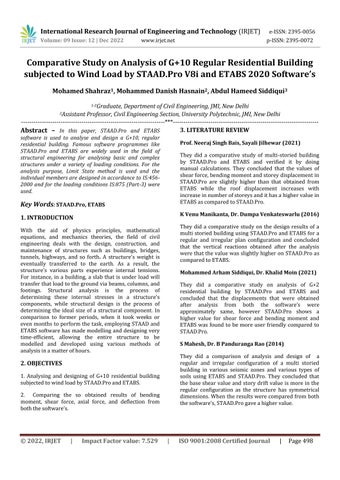
The modelling of the structure has three major components; Plan Elevation 3-DimensionalView
Aplanisadrawingthatshowstheviewfromthetopofa building.Itiscommonlyusedtorepresentthelocationof rooms,windows,wallsetcinabuilding.Thepanareafor thisstructureis
Fig:2 PlanofstructureinETABS
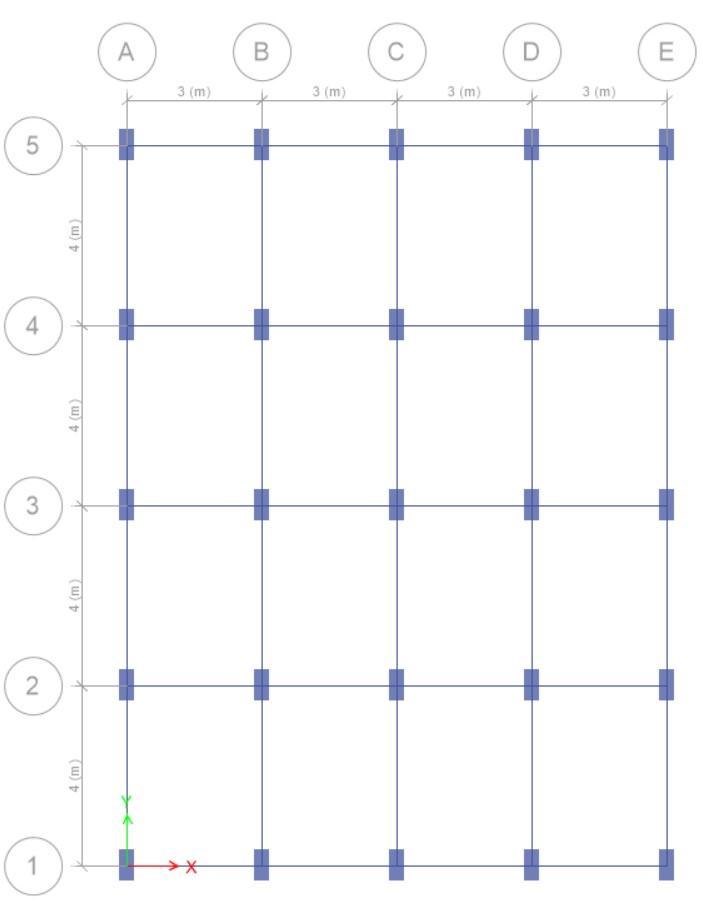
Elevation
Elevation drawings are a particular kind of drawing usedtodepictabuildingoraspecificareaofabuilding.
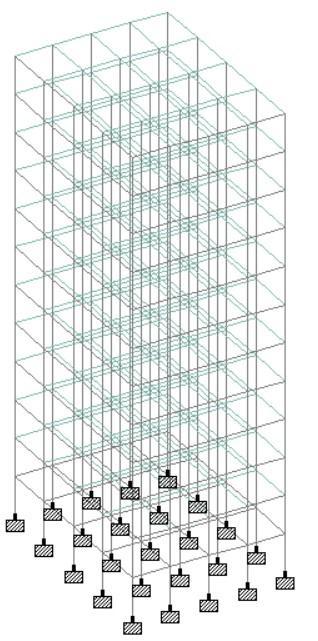
Fig:1 PlanofstructureinSTAAD.Pro
Fig:3 ElevationofstructureinSTAAD.Pro
International Research Journal of Engineering and Technology (IRJET) e-ISSN:2395-0056
Volume: 09 Issue: 12 | Dec 2022 www.irjet.net p-ISSN:2395-0072
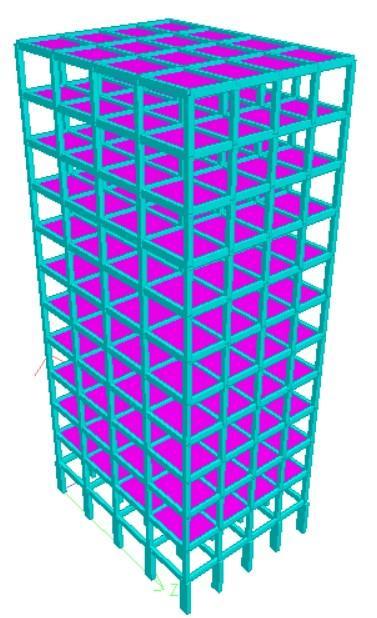
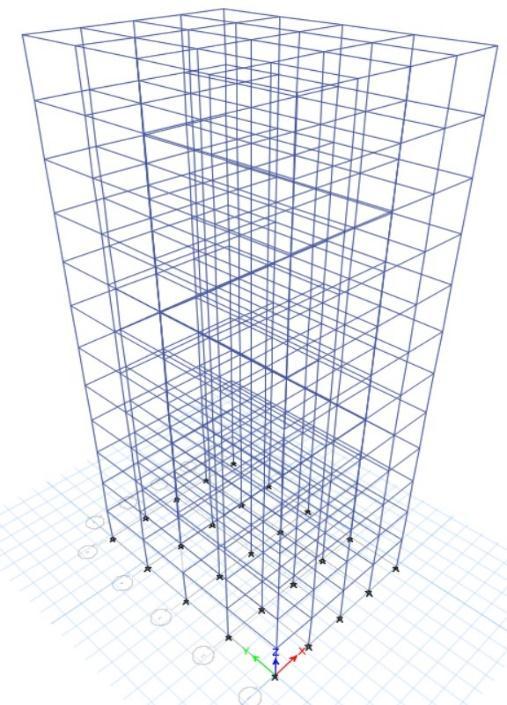
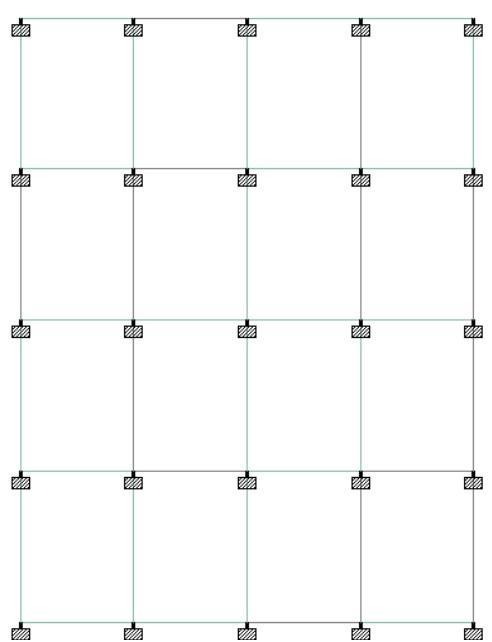
A building facade or inner surface is depicted from a vertical plane in an elevation. This is comparable to standinginfrontofastructureandlookingstraightatit. Elevations are a popular design drawing and a technical architectural or engineering standard used to describe building graphically. Elevation drawings are projections in orthographic space. For this structure, the height of eachflooris3mandtheplinthheightis2m.
A3Dprojection(alsoknownasagraphicalprojection)is a design method that displays a 3D object on a 2D surface. In order to project a complex object into a simpler plane for viewing, these projections rely on visualperspectiveandaspectanalysis.
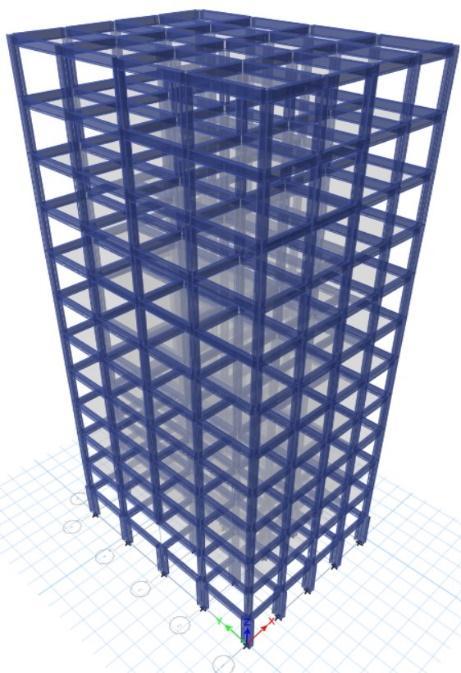
For both engineers and clients, 3D view in civil engineering is a crucial tool. Instead of sifting through various drawings and patterns to determine the overall project's design, it provides both parties with an accurate picture of the project that is constructed to scale.
While 3D models can give depth information to the concept,2Dmodelscanonlyshowlengthandheightona plan. Engineers employ 3D modellinglaterinthe design process to precisely plan the site, assisting in obtaining the optimum development with the fewest negative effectsandminimisingconstruction-relatedunknowns.
Fig:5 3-DviewinSTAAD.Pro
Fig:6 3-DviewinETABS
International Research Journal of Engineering and Technology (IRJET) e-ISSN:2395-0056
Volume: 09 Issue: 12 | Dec 2022 www.irjet.net p-ISSN:2395-0072
The comparison of results given by both softwares are tabulatedbelow.
Dead Loads and Live Loads
GradeofConcreteused:M25
GradeofSteelused:Fe500HYSD
DensityofConcrete:25kN/m2
FloorLoad:4kN/m2
StaircaseLoad:3kN/m2
SunkLoad:2kN/m2
ParapetLoad:5.4kN/m
PartitionWallLoad:6.9kN/m
MainWallLoad:13.5kN/m
UnitWeightofBrickMasonry:20kN/m3
ThicknessofPartitionWall:115mm
Self-Weightofslab:125mm
HeightofeachFloor:3m
RiskCoefficientFactor(K1):1
TerrainCoefficientFactor(K2):1.036 TopographyCoefficientFactor(K3):1 ImportanceFactor(K4):1
Comparison of maximum and minimum axial force, shear force and bending moment on both softwares
Axial Force (Fx) STAAD.Pro ETABS Maximum 3090.031kN 3095.121kN Minimum -17.756kN -13.356kN
Table:1 MaximumandMinimumAxialForceonboth softwares.
Shear Force (Fy) STAAD.Pro ETABS
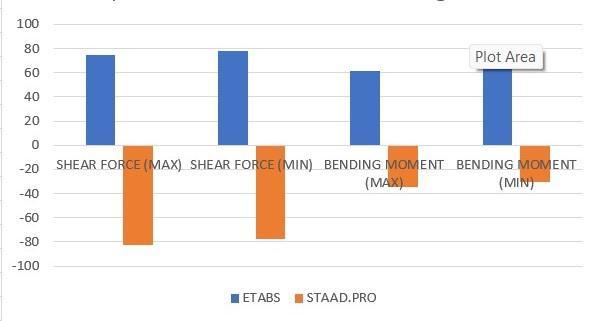
Maximum 77.559kN 74.224kN Minimum -77.396kN -82.973kN
Table:2 MaximumandMinimumShearForceonboth softwares.
Shear Force (Fz) STAAD.Pro ETABS
Maximum 27.950kN 33.190kN Minimum -27.140kN -22.344kN
Table:3 MaximumandMinimumShearForce(inZ direction)onbothsoftwares.
Bending Moment (Mx) STAAD.Pro ETABS
Maximum 0.538kNm 0.412kNm Minimum -0.510kNm -0.677kNm
Table:4 MaximumandMinimumBendingMoment(inX direction)onbothsoftwares.
Bending Moment (My) STAAD.Pro ETABS
Maximum 44.000kNm 42.112kNm Minimum -42.089kNm -47.132kNm
International Research Journal of Engineering and Technology (IRJET) e-ISSN:2395-0056
Table:5 MaximumandMinimumBendingMoment(inY direction)onbothsoftwares.
Bending Moment (Mz)
STAAD.Pro ETABS
Maximum 66.695kNm 61.454kNm
Minimum -30.187kNm -34.309kNm
Table:6 MaximumandMinimumBendingMoment(inZ direction)onbothsoftwares.
Displacement STAAD.Pro ETABS
Maximum 9.634mm 9.121mm Minimum 5.632mm 4.934mm
Table:7 MaximumandMinimumDisplacementsonboth thesoftwares.
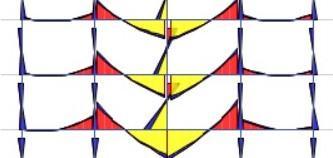
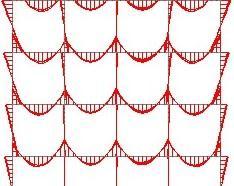
Fig:9 BendingMomentDiagramasshowninSTAAD.Pro
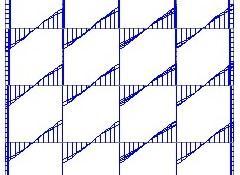
Fig:7 ShearForceDiagramasshowninSTAAD.Pro
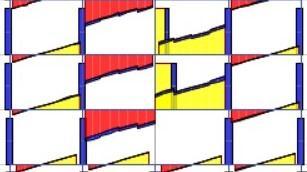
Fig:10 BendingMomentasshowninETABS
Fig:8 ShearForceDiagramasshowninETABS
Fig:11 ComparisonofShaerForce(FY)andBending Moment(MZ)
Volume: 09 Issue: 12 | Dec 2022 www.irjet.net p-ISSN:2395-0072 © 2022, IRJET | Impact Factor value: 7.529 | ISO 9001:2008 Certified Journal | Page502
From the analysis of the G+10 Residential Building in STAAD.ProandETABS,followingconclusionsaredrawn:
Upon comparing the axial force and the shear force (in Z direction) from both the softwares, it was found that ETABS gave a slightly higher value when comparedtoSTAAD.Pro.
International Research Journal of Engineering and Technology (IRJET) e-ISSN:2395-0056
Volume: 09 Issue: 12 | Dec 2022 www.irjet.net p-ISSN:2395-0072
Upon comparing the shear forces in in X and Y directions,thebendingmomentsinallthedirections and the displacement, it was found that STAAD.Pro gaveaslightlyhighervalueascomparedtoETABS.
[9] EtabsSoftware,IntegratedBuildingDesignSoftware, UniversityAvenueBerkeleyCalifornia.
ETABS has a better interface and is more user friendlyascomparedtoSTAAD.Pro.
[10] IS:875 (part 1)-2015, “Code of Practice for Design loads (other than earthquake) for buildings and structures”, Bureau of Indian Standards, New Delhi.
ETABS software is found more easier to use for analysisandmodellingofstructurethanSTAAD.Pro.
[11] IS:456-2000, “Code of Practice Plain and Reinforced Concrete”, Bureau of Indian Standards, NewDelhi.
Overall, both the softwares are widely used for analysinganddesigningastructure.
[1] K Venu Manikanta, Dr. Dumpa Venkateswarlu
“Comparative study on design results of a multistoried building using Staad Pro and Etabs for regular and irregular plan configuration”2[15], 204215,IJRSAE,September-2016.
[2] Mohammed Arham Siddiqui, Dr. Khalid Moin, “Comparative study on analysis of G+2 residential building by Staad.Pro and Etabs softwares” 8[8], 1521-1527,IRJET,August2021.
[3] Prof.NeerajSinghBais,SayaliJilhewar“Comparison of Analysis of Multi-Storied Building by ETABS & STAAD Pro: Effect of Number of Stories” 8[8], 692695,IRJET,August2021.
[4] Mohammad Kalim, Abdul Rehman, B S Tyagi “Comparative study on analysis and design of regular configuration of building by Staad Pro and Etabs”5[3],1793-1797,IRJET,March-2018.
[5] Gurudath C, Arun Kumar Sah, Manoj Kumar Sah, RamBabuSharma,RameshSah“Analysisanddesign of commercial building using Etabs”5[12], 678-683, IJIRT,May-2019.
[6] S. Mahesh, B. Panduranga Rao, “Comparison of analysis and design of regular and irregular configuration of multi-story building in various seismic zones and various types of soils using Etabs andStaad”,6[1],45-52,IOSR,November2014.
[7] Ayesha Siddiqui, Dr. Madhuri Kumari, “A comparative study on analysis of G+8 commercial steel building using Staad.Pro and Etabs”, 9[9], 761766,IRJET,September2022.
[8] STAAD.Pro,BentleySystems.
[12] IS:875 (part 2)-2015, “Code of Practice for Design loads (other than earthquake) for buildings and structures”, Bureau of Indian Standards, New Delhi.
[13] IS:875(part3)-2015,“CodeofPracticeforWind loads for buildings and structures”, Indian Standard Institution,NewDelhi.
[14] IS:875 (part 5)-2015, “Code of Practice for Design loads (other than earthquake) for buildings and structures”, Indian Standard Institution, New Delhi.