International Research Journal of Engineering and Technology (IRJET) e-ISSN:2395-0056

Volume: 09 Issue: 12 | Dec 2022 www.irjet.net p-ISSN:2395-0072
International Research Journal of Engineering and Technology (IRJET) e-ISSN:2395-0056
Volume: 09 Issue: 12 | Dec 2022 www.irjet.net p-ISSN:2395-0072
1 Research Scholar, Indian Institute of Technology, Kharagpur, West Bengal, India
2 Professor, Indian Institute of Technology, Kharagpur, West Bengal, India
3 Associate Professor, Indian Institute of Technology Kharagpur, West Bengal, India ***
Abstract - Vetiver Grass (Vetiveria zizanioides, L. Nash) is native to Mysore of Karnataka in south India and is found throughout the tropic regions. But it is reported to grow satisfactorily in the temperate regions up to 420 latitudes (north) also (Greenfield, John C., 1993; World Bank, 1990). It is characterised by a deep root system, and its ability to withstand harsh environmental conditions like drought, fire incidents, frost, heavy metal toxicity, water logging etc. makes it a global tool for efficient soil stabiliser, crop conservator, soil ameliorator and remediator from heavy metal toxicity. It is also known for the aromatic and medicinal properties of its various parts. There is no wonder that the World bank took the initiative to establish the global Vetiver Network around the world for soil conservation. Developed countries like China and Australia are researching to discover and model the capacity of Vetiver to bring about a sustainable and economical solution namely Vetiver Grass Technology to many environmental problems. In this paper, the authors review the vivid application of Vetiver grass worldwide giving a glimpse of its recent uses in the Kusmunda opencast coalmine, Korba for dump slope stabilization and Bongoigaon Refinery, Assam in India. Vetiver showed positive results in the control of erosion at the dumps but is found somewhat ineffective to beat the harsh conditions. Whereas the application of Vetiver for effluent contaminated with oil for its treatment showed oil is trapped in roots. Moreover, the total dissolved solids (TDS) and total suspended solids (TSS) showed lower levels consistent with the roots and shoot growth rates of Vetiver grown in floats in eco-ponds at the refinery. Vetiver grass is also observed to uptake heavy metals such as Pb, Se, Co, Zn, Ni, Cu etc. Their concentrations are found to be more in the roots than in the shoots except for the Zn. Vetiver is also found to control eutrophication by up-taking macronutrients (NPK) in the test site.
Key Words: Vetiver Grass. Uses of Vetiver Grass. Dump SlopeStabilization,EffluentTreatment
TheVetivergrass(Vetiveria zizanioides, L. Nash)orVetiver (hereinafter) issynonymic to Chrysopogon zizanioides (L.) Roberty sssssss to Panicoideae subfamily of the Poaceae family in Sorghina subtribe of the Andropogonae tribe
(BertaandCamussso,2002).Itiscommonlyknownas Bala inHindi, Abhaya, Amrinala, Bala inSanskrit,and Khas Khas in Bengali. It’s a perennial grass with a lifespan of 1.5-2 years. It is an established phyto-stabilizer and soil erosion controller, grass system, being popularly used worldwide today.Itischaracterizedbyalong(sometimesupto3.5m) fibrous root system with morphological properties such as bulk shear and tensile strengths which aids in both the aspects of stability and erosion control. As per Grimshaw (1994), “roots of trees and other vegetation provide a reinforcing effect to the soil through tensile resistance and frictional and adhesion properties”. It has tolerance to extreme conditions such as highly acidic, high salinity, water scarcity, insects, and high metal toxicity. It is known foritsmedicinaladvantagesandrootoil.Thus,ithasbeena sustainable and economical environmental protection tool with manifold uses for society. Dalton et al., (1996) reportedthatVetiverisbothaxerophyteandahydrophyte and not affected by either drought or flood once established.Literaturerevealsthatvetiver grassistolerant tofrost,heat,sodicandsalineconditionsandcangrowona widerangeofsoilpH(3-11).
TheVetiverisnativetoMysoreofKarnatakainsouth India and is found throughout the tropic regions. But it is reportedtogrowsatisfactorily inthetemperateregionsup to 420 latitudes (north) also (Greenfield, John C., 1993; World Bank, 1990). The advantageous physiological features of Vetiver include tolerance to adverse climatic conditions (drought, flood, heat waves, and frost, etc.), edaphic (Acidity, alkalinity, saline, Aluminum(Al), and Manganese(Mn) Toxicities, etc.), and high levels of heavy metals, such as Copper (Cu), Chromium (Cr), Lead (Pb), Mercury(Hg), Nickel(Ni), Selenium(Se) and Zinc(Zn) (TruongandBaker,1998).
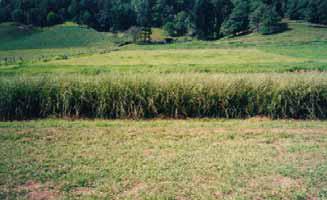
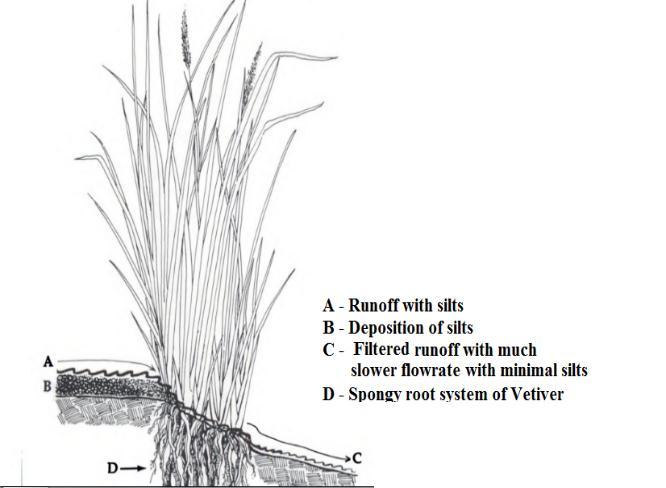
Vetiver is capable of forming thick hedgerows (Fig. 1.1) whenplantedwithoutsignificantspacingwhichiseffective in reducing sheet erosion as shown in (Fig. 1.2). The raindrops impact upon the loose surface soil particles and makethemdislodgedwhichisthencarriedawaybyrunoff tocausefatalsheeterosionVetiverhedgeresiststherunoff (A) flow and reduces the kinetic energy of the suspended particle. The particle thereby settles down to form a silt
International Research Journal of Engineering and Technology (IRJET) e-ISSN:2395-0056
Volume: 09 Issue: 12 | Dec 2022 www.irjet.net p-ISSN:2395-0072
sediment bed (B) retained by a Vetiver hedge. The runoff, (C)aftersiltdeposition,flowsacrosstheVetiverhedgerows at a slower rate and thus, has lesser erosion-causing potentials (Liu et al., 2014). The deep spongy root system withstands the hydrodynamics and soil movement caused by runoff and supports the stiff Vetiver shoot forming hedgerows.
Various articles report the use and application of the Vetiver system to control various environmental problems such as wastewater treatment (Truong and Hart, 2001). The main purpose for developing the Vetiver system is to conservesoilandwater,butithasalsofounditsapplication in wastewater treatment. It has been developed from researchanddevelopmentsconductedinvariouscountries forthelastfifteenyearsand hasbeenusedin40countries with tropical and subtropical climates. This shows its worldwide application for environmental protection purposes. Their research work tried to: (1) develop a hygienic, practical, and economic method of disposing of effluents from small domestic sources, (2), quantify the effectivenessoftheVetiverSysteminreducingthenutrient load and volume of domestic and industrial effluents, and (3) calibrate Vetiver grass for application in computer modelling. Vetiver has been used for waste treatment in Thailand(Xiaetal.,2000)andChina(Kongetal.,2003)
Fig. -1.1:Vetiverhedgesareformedwhenplantedclose together(after,Truongetal.,2008)
Fan et al. (2008) reported the fibrous roots found in Vetiver grass are advantageous in high moisture content during rainy conditions giving it higher shear resistance than those of trees and shrubs with tap roots. Soil conservation and moisture retention in has increased the productivityofcropsofmaize(Babolaetal.2003).
Zheng et al. (1998) mention the applications of the Vetiver System in China, which are grown in wetlands, or created for the treatment of excessive N and P (a potential cause for the eutrophication in water bodies), or grown in water hydroponically on floating platforms. P (mg/L) removal percentage is found greater than N (mg/L). About 99.3% of P removal and a maximum cumulative of 71.0 % ofTotalNremovalisobtainedbetweenthreetofourweeks ofplantationofVetiversaplings.
Fig.-1.2: Thecross-sectionoftheVetiverplant(After, Greenfield,1993)
Vetiver hedges planted in sugarcane farms in north Queenslandarefoundtotrapsomenutrients,suchasPand Ca, which are particulate bound whereas it has little effect on soluble nutrients such as N and K (Truong, 2000). Reduction of the P is found ranging from 26% to 69%, whereas, for the Ca such reduction by Vetiver Hedge, ranged from 51% to 56%. Cotton farms with such Vetiver hedge shows prevention of ‘herbicides (diuron, trifluralin, prometryn, and fluometuron), pesticides [organochlorine (α, β and sulphate endosulfan) and organophosphate (chlorpyrifos, parathion, and profenofos)]’ (Truong, 2000). ‘Endosulfan’ is a chlorinated hydrocarbon insecticide and acaricide of the cyclodiene subgroup which acts as a poison to a wide variety of insects and mites on contact’(Theextent toxicology network website (2016)). Endosulfan is banned in India to use as a pesticide. Thus, Vetiver could be an effective bioengineering tool for preventing the accumulationoftheseharmful organicmattersinsoils and itactsasamobilizerforthosepesticides.
International Research Journal of Engineering and Technology (IRJET) e-ISSN:2395-0056
Volume: 09 Issue: 12 | Dec 2022 www.irjet.net p-ISSN:2395-0072
Vetiver growth is studied to be unaffected by some herbicides (Atrazine or Diuron up to 2000 μgL-1) when used in wetland treatments. On the contrary, the wetland plant,PhragmitesAustralis,suffersfromtheseherbicidesat given concentrations. Vetiver is found suitable for growth inwetlandconditionsandalsotoleranttothoseherbicides at specified high-level concentrations (Cull et al.2000). It can reduce the flow velocity of the water and increase the sedimentations of sediment-bound heavy metals and can enhance the bed stability of such pollutants. It also stimulatesmicrobialactivitiesintherhizosphere.
In these connections, it is noteworthy to mention that, in Thailand, it is reported that Vetiver could decontaminate agrochemicals and could prevent those accumulations in the crops. Some experiments also show Vetiver has the ability to uptake a significant amount of NPK, Ca, Mg, Pb, Cd, and Hg. The laboratory experiments exhibit that Vetiver could uptake Heavy metals. Thus, it is foundsuitableforwastewatertreatment(Culletal.,2000).
Vetiver is used to test its efficiency in the treatment of effluents from both domestic and industrial sources. In Brisbane(1995),Vetiverhedgerows areabletocompletely suckuptherunoffofdomesticeffluentfromaholidaycamp and prevent the nearby lake from leaching of it to the lake shore.Asimilarapplicationofreducingthevolumeeffluent fromasepticsystem,using100Vetiverplantsinanareaof less than 50 m2 , is shown experimentally at the Beelarong CommunityFarminBrisbane,Australia.
InAustralia,leachateistreatedwithVetivergrasses, and in a case study (Truong and Stone, 1996), it is found that leachate runoff is highly contaminated with Cadmium, Copper, Chromium, Zinc, and Lead. This is completely stoppedbytheVetiverplantafteroneyearofplantationin Brisbane, Queensland, Australia. Similarly, at Port Douglas, northQueensland,Vetiverisplantedtochecktheleachates fromthelandfills(TruongandHart,2001).InIndia,theuse of Vetiver for the reclamation of wastelands and for site recreation is also reported (Nikhil and Sunil, 2012; Ansari andNikhil,2014a,b;andNikhil,2014).
Plants show different kinds of sensitivity to metal concentrations in soil. They vary in their response in a manner that some plants are sensitive to even low concentrations of some metals, whereas others show significant tolerance to fairly high metal concentrations in soil. Vetiver has been used for treating heavy metal
contaminations in China (Wong et al, 1999; Wong M.H., 2003;Chenetal.,2004).Vetiverisreportedtoenhancethe uptakeofAs,Zn,andCu witha chelatingagent (Chiuet. al, 2005) and with manure compost (Chiu et. al, 2006). It is found satisfactorily growing in lead-contaminated soil and up taking lead (Rotkittikhun et al., 2007) Its capability of toleranceproduceshyperaccumulationofmetalsinVetiver without any significant symptoms of toxicity in roots and shoots that it is extractable from plant shoots. This phenomenon is also known as ‘Phyto-extraction’ (Manoj et al., 2014). The hyperaccumulation of some metals in the plantshasbeenproposed:‘100mgkg-1 forCd,1,000mgkg-1 for Ni, Cu, Co, and Pb, and 10,000 mg kg-1 for Zn and Mn’ (Anginetal.,2008).
The Vetiver newsletter by Newsletter of the Vetiver Network(1996)providesprovenusesofVetiversuchas: (a) As Natural Resources - (1) on-farm soil and water conservation (2) groundwater recharge (3) wasteland rehabilitation (4) gully control (5) drainage stabilization (6) wind erosion control (7) Floodplain stabilization (8) Inhibitor to the movement of excess soil chemicals (9) river bank stabilization (10) permanent boundary and demarcation (11) in construction and engineering as a resource for - Embankment and cut stabilization (12) Construction site stabilization and (13) minedumpstabilizationandrehabilitation
(b) In Pollution Control - (1)tolerancetohighlevels of toxic metals (2) inhibitor to the movement of toxic metals (understudy) (3) municipal and industrial waste dumpstabilization(3)excessherbicideandpesticidecleanup (understudy) (4) clean-up of brackish water fishery waste (understudy) (5) wastewater clean-up and in (c) various economic uses like livestock mulch, fodder, crop yield enhancement, medicinal, aromatic oil, thatch, compost, fuel, natural herbicides and pesticides (under study),handicrafts,andmushroomsubstrate.
The Vetiver (Vetiveria zizanioides L. Nash) grass grows in a ‘versatile situation’ having finer branched rootlets. A number of uses of the Vetiver system are reported in India, such as ‘oil is extracted from it for perfumes’, dump and slope stabilization in surface mines, soil and water conservation in agricultural lands etc. The dry roots of Vetiver are used for making fans, cushions, mats, and other fancy handicrafts which are aromatic in wet conditions (Alam and Kumar, 2005). Vetiver grass is alsousedasmedicinetraditionallybymanytribesinIndia. It is also the primary material for making various
International Research Journal of Engineering and Technology (IRJET) e-ISSN:2395-0056
Volume: 09 Issue: 12 | Dec 2022 www.irjet.net p-ISSN:2395-0072
householdgoods.TheusesofVetiverbyIndiantribesareas tabulatedbelowasperRaoandSuseela(2000)
Table-1: TraditionalusesofVetivergrassandits constituentsasmedicinebyIndiantribes(RaoandSuseela, 2000)
Santhals Root decoction
As cooling in high fever, inflammation, sexual diseases, etc. Tribes of Varanasi Root vapour Malarial fever South Indian tribes Leaf paste Rheumatism andsprain Tribes of M. P. Root juice Anthelmintic Most tribes Vetiver oil Stimulant, diaphoretic and refrigerant Lodhas Root paste Headache, fever, Ayurvedic preparation“Brihat Kasturi”,and“Bhairava Rasa”forfever,diarrhoea, chronic dysentery South Indian tribes Root and stem juice Boil, burn, epilepsy, scorpion sting, snakebite, and mouth ulcer Oraons Root ash Acidity
Hengchaovanich and Nilaweera (1998) report a strong and positive relationship between Vetiver roots to slopeStabilisation In India, some remarkable initiatives to use Vetiver grass for slope stabilization in Indian mines were adopted. In this connection, Zoda East Iron mines (22°0′11″N, 85°26′28″E) in Odisha state were introduced withVetiverforspoil dumpslopestabilizationsuccessfully (Banerjee et al., 2016). The Vetiver plants have shown the character of tolerating toxic metal concentration with “reduced chlorophyll content fewer numbers of tillers, reduced chlorophyll content, upregulation of antioxidant enzymes, and increased proline content” (Mukherjee et al., 2015). Similarly, Vetiver grass is also introduced in the Noamundi Iron Mines of Tata Steel company in Jharkhand successfully. The Vetiver grass could grow 1.5 - 2m in height in less than six months and sustain the summer season.
A test project of Vetiver grass plantation is launched in 2017-18 for dump slope stabilization and environmental protection at Dump-13 and slopes at railway siding at the Kusmunda Opencast Project of south easterncoalfieldslimited(SECL)duringmonsoonandpostmonsoonseasons bythemethodofslipmultiplication.The plant spacing was adopted as 30 cm (Plant to Plant) X100 cm(Interrow). The
(i) (ii)


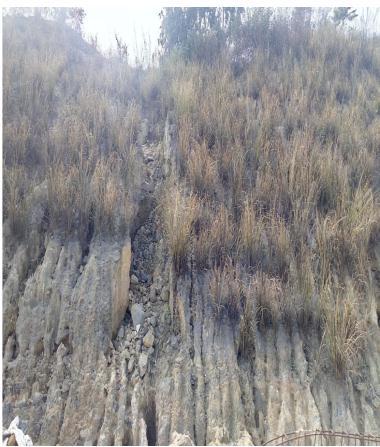
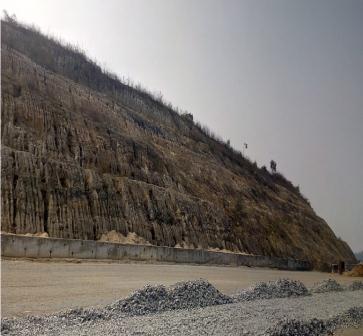
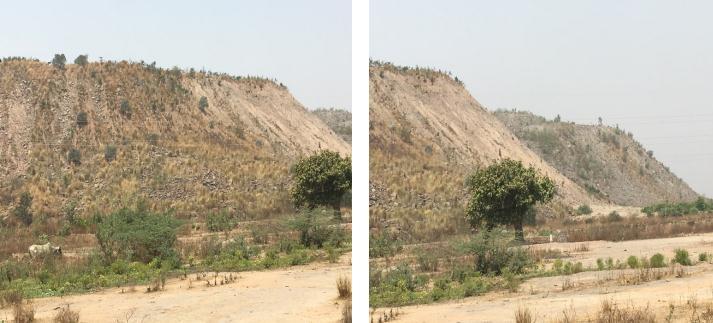
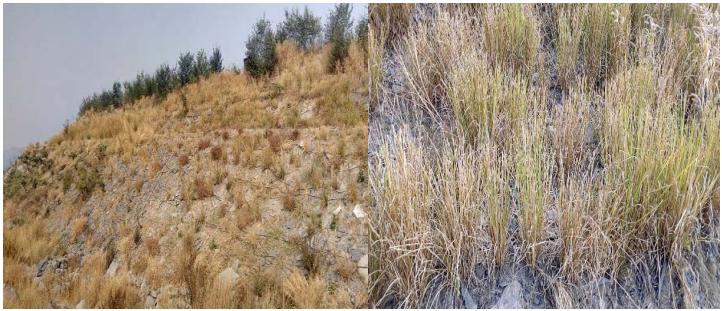
Vetiverslipshavebeengrownwiththegardensoil of a nursery that has been established for the purpose of the supply of the slips. The photographic presentation of Vetiver grass growth in Dump 13 and in Railway siding is showninFig (2)&Fig.(3).
It is evident from the photographs that Vetiver grass could thrive with sustenance protecting the slopes from erosions such as sheet erosion and reel erosion. But thespacing ofVetiver rowtorowcouldnotproducea stiff hedge,limitingitsabilitytocontrolerosion.Thiscouldbea reason for the presence of erosional features such as reels or gullies, though less severe, as observed across the slope withVetivergrass.
It will be noteworthy that Vetiver grass could not competewithwildernessafteritisleftuncheckedforalong in natural conditions. Many patches of Vetiver die in the shadesoftreesplantedandarereplacedbyspreadingwild ‘Deenanath Grass’ (Pennisetum pedicellatum) sown for makinggreencover beforetheplantationofVetiver onthe slopesofDump13.
International Research Journal of Engineering and Technology (IRJET) e-ISSN:2395-0056
Volume: 09 Issue: 12 | Dec 2022 www.irjet.net p-ISSN:2395-0072
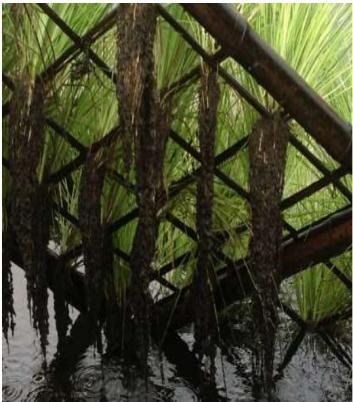
It is seen that Vetiver roots grow longer with effluents and oil trapping them. The TDS values initially increase after which they decrease sharply. The initial increase in TDS values may be due to the presence of contaminants in water which release various components into water. However, with time the contaminants may get removedbytheVetiverplantsresultinginadecreaseinthe TDSvalues.
Fig.-3: TheviewoftheDump-13beforetheplantationof Vetiver(i)&(ii)andafterVetiverhasgrownonitsslope (iii)&(iv)(after,PathakK.,2019).
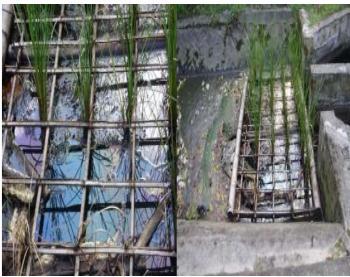
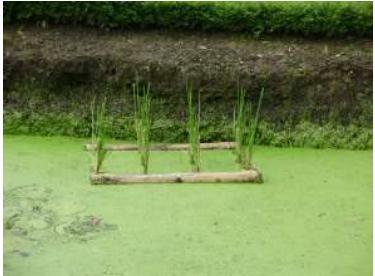
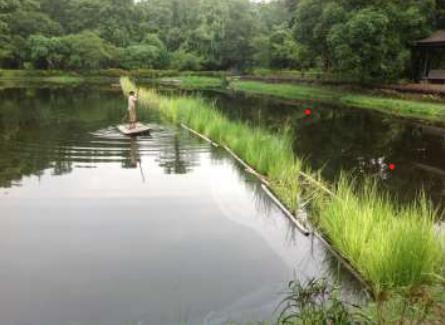
Intheyear2013-14,Vetiver grass is testedforthe treatment of effluent, especially, total dissolved solids (TDS), total suspended solids (TSS) treatment in the hydroponic system at Bongoigaon Refinery, Indian Oil Corporation Limited (IOCL), Assam. The Vetiver grass is grown in the eco-pond’s inlet and inside the eco-pond contaminated with oil, tied-in floats constructed of the bamboo framework as shown in Fig. (4) The initial root length and shoot length of Vetiver kept was 30cm and 200cm respectively for multiplication. The average humidityvariedfrom60%to88%ineightweeksperiodof study. The temperature varied from 270C to 330C with a fluctuating but rising trend where the temperature dips about20Cinthe2nd -3rd weekandinthe5th -6th weekoutof the8th weeksofthestudy.
It is encouraging to witness that the Vetiver survives in effluent contaminated with the oil. It is observed that Vetiver slips could grow their roots about 162.85cm insixmonths(anincreaseof 81.57%)andtheir shoots about 654.64 (an increase of 76.59%). The rate of root and shoot growth is faster during the first 14 days, which becomes steady after 21 to 30 days and decreases later
(i) (ii ) (iii ) (iv )


Fig. 4: TheresponseofVetiversontrappedoil-(i)EcoPond inlet,(ii)Pondwithpuree,(iii)Vetiverrootstrappingoils (iv)floatineco-pond(after,PathakK.,2013)
The root and shoot samples were taken and analysed using AAS for heavy metals uptakes by Vetiver (Pathak K., 2014). The resulting concentrations of the macronutrient (NPK) and heavy metals in the root and shoot are shown in Table (2) and compared graphically in Fig.5(i)and(ii).
As shown in the abovementioned figures, Vetiver can reduce eutrophication by gulping macronutrients NPK byarangeof293.3–15586ppm Theirconcentrationsare foundto bemoreintheshoots(368 – 15586ppm)thanin the roots (293.3 – 6123 ppm) of Vetiver. Potassium (K) is found to be the highest in concentration, whereas, Phosphorus is the lowest nutrient among the NPK in these tests.
e-ISSN:2395-0056
Volume: 09 Issue: 12 | Dec 2022 www.irjet.net p-ISSN:2395-0072
Onthecontrary,theconcentrationofheavymetals (Co, Ni, Pb, Se, Cu and Zn) is found to be magnificently lesser (3.8 – 67.6 ppm) than those of NPK. All of them, except the Zn, are found greater in roots than in shoots of Vetiver. Among the heavy metals, selenium is absorbed unimaginablyhigher(381ppmand884.16ppmintheroot andshootofVetiverrespectively)duetocontamination.
*NotApplicable
pp m
Zn Heavy
Cu
NPK Shoot Root Pb
742 293.3 6123 1106 368 15586 0 5000 10000 15000 Ni
381 Se
Concentration in Vetiver’s shoots (ppm) Nitrogen(N) 742 1106 Phosphorous(P) 2933 368 Potassium(K) 6123 15586 Cobalt,Co 4.9 ND* Nickel,Ni 43 38 Lead,Pb 426 46 Selenium,Se 88416 381 Copper,Cu 14.1 6.8 Zink,Zn 1116 676 Co
The potential of Vetiver grass to enunciate remedies to various environmental problems is reviewed and found to be well-established globally. Its recent uses in Indian industries viz. Kusmunda opencast coal mine for dump slope stabilization and Bongoigaon Refinery for effluent treatment are found effective. The Vetiver showed promising results in both cases as per the observation It grows to form thick bush grass with a height of up to 22.5m as reported in various studies But, its lack of selfsustenance in harsh conditions and its inability in combatting weeds such as Deenanath Grass (Pennisetum pedicellatum) shows that it requires caring for its efficient working It might be because of the sterile cultivar The Vetiver is found to uptake heavy metals to considerable levels such as Co, Se, Ni, Pb, Cu and Zn as per the study conductedatBongoigaonRefineryforthesame.Further,it is found to uptake macronutrients (NPK) and limit eutrophic algal bloom in eco-pond there. The concentrations of these nutrients are found to be more in theshootthanintheroots.Potassium(P)isfoundtobethe mostconsumedmacronutrientamong(NPK).
Metals
Shoot Root (ii )
(i ) pp m
Table-2: The concentrations of the macronutrients and heavymetalsfoundintherootandshootofVetiver Fig. 5: The concentration of NPK (i) and Heavy Metals (ii) asfoundintherootandshootpartsofVetiver













The authors are obliged to the Department of Mining Engineering, Indian Institute of Technology Kharagpur for the permissions offered for the studies and publication of findings We acknowledge all the support concerned officialsofferedbytheprojectpartners,KusmundaProject, SECL, Korba, Chhattisgarh and Bongoigaon Refinery, IOCL, Assam

International Research Journal of Engineering and Technology (IRJET) e-ISSN:2395-0056
Volume: 09 Issue: 12 | Dec 2022 www.irjet.net p-ISSN:2395-0072
[3] Ansari, Iqbal and Nikhil Kumar, “Lignocellulosic bio decomposition: A green solution in coal mining area”, International Journal of Engineering & TechnicalResearch,2(3),2014(a),pp.104-206.
[4] Ansari, Iqbal and Nikhil Kumar, “Algal approach for sustainable development: A critical review”, International Journal of Emerging Trends in Engineering Research, 2(4), April, 2014 (b), pp. 8385.
[5] Baker, A. J. M., and Brooks, R., "Terrestrial higher plants which hyperaccumulate metallic elements- A review of their distribution, ecology and phytochemistry”, Biorecovery,1(2), 1989, pp 81126.
[6] Chen, Y., Shen, Z., and Li, X.,“ The use of Vetiver grass (Vetiveria zizanioides) in the phytoremediation of soils contaminated with heavy metals.”, Applied Geochemistry,19(10),2004,pp.1553-1565.
[7] Chiu,K.K.,Ye,Z.H.,andWong,M.H.“Enhanceduptake of As, Zn, and Cu by Vetiveria zizanioides and Zea mays using chelating agents” Chemosphere, 60(10), 2005,pp 1365-1375.
[8] Chiu, K. K., Ye, Z. H., and Wong, M. H. “Growth of Vetiveria zizanioides and Phragmities australis on Pb/Zn and Cu mine tailings amended with manure compost and sewage sludge: a greenhouse study”, BioresourceTechnology,97(1),2006,pp 158-170.
[9] Cull, R., Hunter, H., Hunter, M., and Truong, P. “Application of Vetiver grass technology in off-site pollution control II. Tolerance to herbicides under selected wetland conditions. InSecond International VetiverConference” ,2000,pp 404-408.
[10] Dalton, P.A., Smith, R.J., Truong, P.N.V. “Vetiver grass hedges for erosion control on a cropped flood plain: hedge hydraulics.” Agric. Water Manage. 31, 1996, pp 91–104.
[11] Fan, C. C., and Su, C. F. “Role of roots in the shear strength of root-reinforced soils with high moisture content.Ecological Engineering” ,33(2), 2008, pp 157-166.
[12] Greenfield, John C. “Vetiver Grass: The Hedge Against Erosion,4thedition,Volume64,1993,pp 16-17.
[13] Grimshaw, R.G. “Vetiver grass its use for slope and structure stabilization under tropical and semitropical conditions. In: Vegetation and Slopes”, Institution of Civil Engineers, London, 1994, pp. 26–35.
[14] Hengchaovanich D, Nilaweera NS “An assessment of strengthpropertiesofVetivergrassrootsinrelation to slope stabilization”. In: Proc. 1st Int’l Conf. on Vetiver.ChiangRai,Thailand,1998,pp 153–158.
[15] Kong X, Weiwen L, Biqing W and Fuhe L “Study on vetiver’spurificationfrompigfarm”,In:Proceedings oftheThirdInternationalConferenceonVetiverand Exhibition,China,6-9October2003,pp.181-185.
[16]Liu,Y.J.,Wang,T.W.,Cai,C.F.,Li,Z.X.,andCheng,D.B. “Effectsofvegetationonrunoffgeneration,sediment yield and soil shear strength on road-side slopes under a simulation rainfall test in the three gorges reservoir area”, Science of the Total Environment,485,China,2014,pp 93-102.
[17]NikhilKumarandSunil Kumar, “Developmentofalgae based technology to mitigate energy crisis in coal mining area. First brain storming workshop on waste to energy”, CSIR –NEERI Nagpur held at Mumbai,Maharashtra,2012.
[18]NikhilKumar“Developmentofalgaebasedtechnology to mitigate energy crisis in coal mining areas” , International Journal of Environmental Technology andManagement, 17(2,3,4),2014,pp.334-363
[19] Pathak K., “Final Report of Studies on hydroponic vetiver treatment of effluent water in oil refinery Submitted to IOCL, Bongaigaon Refinery” , Department of Mining Engineering, Indian Institute ofTechnologyKharagpur,2013,pp 4,15-17,27
[20] Pathak K., “Final Report on Erosion Prevention and Soil Dump Stabilization at Overburden Dump of Kusmunda OCP at an Area of 10000 sq.m. (1.0 Ha) Through Implementation of Vetiver System Technology for Development of Horticulture on Restored Mine Site Technology on Experimental Basis”, Department of Mining Engineering, Indian Institute of Technology Kharagpur, 2019, pp 3, 1517,20-21
[21] Rao, R.R. and Suseela, M.R. “Vetiveria zizanioides (Linn.) Nash–a multipurpose eco-friendly grass of India”, ICV-2 held in Cha-am, Phetchaburi, Thailand, 2000,pp.18-22.
[22] Rotkittikhun, P., Chaiyarat, R., Kruatrachue, M., Pokethitiyook, P., and Baker, A. J. M. “Growth and lead accumulation by the grasses Vetiveria zizanioides and Thysanolaena maxima in leadcontaminated soil amended with pig manure and fertilizer: a glasshouse study”, Chemosphere, 66(1), 2007,pp 45-53.
International Research Journal of Engineering and Technology (IRJET) e-ISSN:2395-0056
Volume: 09 Issue: 12 | Dec 2022 www.irjet.net p-ISSN:2395-0072
[23] Truong P, Van TT, Pinners E. “Vetiver System Applications; Technical Reference Manual”, The VetiverNetworkInternational,2ndEd,2008
[24] Truong, P. “The global impact of Vetiver grass technology on the environment. InProceedings of the Second International Conference on Vetiver”, Office of the Royal Development Projects Board, Bangkok,January2000,pp.48-61.
[25] Truong, P. and Baker, D. “Vetiver grass system for environmental protection”, Volume 2004: Bangkok, Thailand, Pacific Rim Vetiver Network, Office of the Royal Development Projects Board, 1998, Retrieved December29,2004
[26] Truong, P. and Stone, R. “Vetiver grass for landfill rehabilitation: Erosion and leachate control” ,Report toDNRandRedlandShireCouncil,1996
[27] Truong, P. N. and Hart, B. “Vetiver system for wastewater treatment”, N. Chomchalow, & S. Sombatpanit(Eds.),OfficeoftheRoyalDevelopment ProjectsBoard,2001.
[28] Wong, M. H. “Ecological restoration of mine-degraded soils, with emphasis on metal-contaminated soils”, Chemosphere,50(6),2003,pp 775-780.
[29] Wong, M. H., Lan, C. Y., Gao, L., & Chen, H. M. “Current approaches to managing and remediating metalcontaminated soils in China”, In Proc. 5th Int. Conf. Biogeochem, Trace Elements, Vienna, Austria, 1999, pp.232-3.
[30] WorldBank“Vetivergrass,thehedgeagainsterosion” , 3rd ed., ASTAG, World Bank, Washington DC, USA, 1990
[31] Xia H, Liu S and Ao H “Study on purification and uptake of garbage leachate by vetiver grass”, In: Proceedings of the Second International Conference on Vetiver, Thailand, 18-22 January 2000, pp. 394406