International Research Journal of Engineering and Technology (IRJET) e-ISSN: 2395-0056

Volume: 09 Issue: 12 | Dec 2022 www.irjet.net p-ISSN: 2395-0072
International Research Journal of Engineering and Technology (IRJET) e-ISSN: 2395-0056
Volume: 09 Issue: 12 | Dec 2022 www.irjet.net p-ISSN: 2395-0072
1University of Sindh, Jamshoro, Pakistan
2
3
Abstract - Cloudcomputinghastransformedintoa daily lifeactivityforpeopleworldwide.Ithelpsconnectbillionsof users digitally. Because of massive data centers, the evergrowing energy consumption affects the environment and increasesthecostfortheserviceproviders.Whichthenleads to a poor Service Level Agreement (SLA). This paper conductedasystematicmappingstudyon74peer-reviewed articles to evaluate energy-efficient technologies that optimize power consumption in virtualized data centers. Moreover, we proposed a characterization framework to select only relevant data before classifying it with our conceptualization map. We also distributed the studies according to the characterization criteria: a) generic attributes, b) contribution type and evaluation method, c) technological attributes, and d) quality management. The results showed that virtualization, consolidation, and workloadschedulingarewidelyimplementedtechniques.In addition, results suggested that the contribution type in around 60% of the studies is based on solution and validation.Themethodseitherinvolvedspecificexperiments or comprised theoretical examples of model development. Likewise, DVFS-enabled scheduling and dynamic server consolidation methods seemed vital in saving energy in the virtualized cloud data center. In brief, we surveyed an existential need for a standardized and centralized benchmarking system for researchers to bridge the gap between industry and academia. Also, the results can help understandthecurrent trends inthis research domain, and this paper can be used as a benchmark to assess and evaluatecurrentresearchprogress.
Key Words: Data Centers; Energy-Efficiency; Cloud Computing; Virtualization; Consolidation; Scheduling; DVFS; Evaluation; Metrics
Thegrowthofclouddatacentershasalsoincreasedthe development cost, which amounts to approximately $20 billion yearly.[2]. Similarly, power consumed by data centers has also become a major concern for the service providers and the environment because of the carbon emissions caused, which have also risen exponentially in the recent past. The major contributor to the energy
***
consumption in a data center is the IT infrastructure, which comprises servers, cooling systems, lighting, and other IT equipment. Likewise, the enterprise servers' power consumption dominates the data center's power, representing up to 60% of the overall data center consumption." [3]. IT systems in data centers play an integralroleinproductivityandreliabilityoutcomessince atraditionaldatacentercomprisespower-hungryservers, whichcanbedynamicorstaticpowercontributionsbased onhowtheyfunction.
For example, a traditional data center consumes more power due to outdated infrastructure, poor energy management, and underlying system incompatibility issues. On the contrary, power-efficient data centers release fewer carbon emissions. In addition, they can also help cloud service providers with productivity and costeffectiveness. Provided the proper implementation of energy-efficient techniques and quality management of physical resources is addressed. The most common methodstodealwithenergyconsumptioninatypicaldata center are virtual machine placement and server consolidation, especially in a virtualized data center. Modern interconnectivity is a kind of digital globalization that has attracted billions of active users worldwide. Hence, the quantity of servers in a typical data center has also increased. A typical data center comprises various components, such as a cooling system, servers, storage, etc. Moreover, servers consume more energy, leading to costs that are a big concern for Cloud Service Providers (CSPs). Throughout the 2011-2035 timeframe, forecasts suggest that the energy production for cloud services to expand by upwards of 66%.[4]. Therefore, cloud services oughttoenforceenergy-efficientdatacentermanagement to cope with the growing energy needs for cloud services and satisfy the demands for cloud applications while ensuring the SLA and usability goals of the end-users. Besides, it is also to sustain low costs, provided that the interest in saving energy must be a concern for Cloud Service Providers, especially big corporations. [5] Given the massive energy consumption aspects of data centers, one of the major issues is that power measures are essential for ensuring energy and cost. It means determining efficient resource allocation to each client's
International Research Journal of Engineering and Technology (IRJET) e-ISSN: 2395-0056
Volume: 09 Issue: 12 | Dec 2022 www.irjet.net p-ISSN: 2395-0072
requests to satisfy client needs and meet the service provider'sbusinessmodel.Mostoftheseprioritiesfallinto theenergymanagementofdatacentersorcostreductions forthedatacentersbecausethesearethecloudcomputing backbones. Hence, energy-saving technologies can help create a sustainable, reliable, and eco-friendly infrastructure model across various platforms to be followed as a benchmark, which would benefit CSPs and the environmental cause and end-users in the long run. Therefore, this paper successfully implemented a Systematic Mapping Study (SMS) and Systematic Literature review (S.L.R.) with a characterization framework on the broadness of energy-efficient technologies, details of energy-saving methods, and the future of such developments for cloud data centers. In addition, this study can help reflect on environmental problems caused by a growing number of electrical, power-hungry systems that suck up energy inefficiently. Our study analyses research venues and methods using a set of pre-defined, easy-to-track steps. We proposed a characterization framework that extracts invaluable information from 74 selected publications based on their relevance, soundness, and solutions. We categorized each section using a mapping criterion. In addition, solutions, examples, experiences, and evaluation methods are systematically mapped in section 4. Given the maturity of power management and energy-efficient strategies, this paper aims to classify and synthesize a comparative overview of recent research works and map an assessment of ongoing work in the data centers' energysaving technologies. This paper also identifies the global trend, assesses the industry standards, and evaluates the emergingmethodologiestaxonomicallyindomain-specific andgenericmanners.
Furthermore, this undertaking has resulted in a knowledgebasethatistheessenceofmodernapproaches, quality features, techniques, and best practices for Cloud Energy Efficiency, power management, and data center performance. Wehavesystematicallydividedthesections forhigherreadabilityandeffectiveanalysis.
1. Firstly, our work discusses and overviews the energy consumption problem globally. Then, it maps out the energy-saving methods and power management strategies through comparison. It also highlights best practices and standard benchmarks to specify the appropriate solution and benchmarks for scientists to study.
2. We overview traditional literature on energysaving techniques in virtualized cloud data centers. We focus on major techniques while reviewing the latest algorithms, their service quality, and real-world parameters.
3. Section 3 addresses our proposed systematic mapping study with methodological steps. Moreover, it
also proposed a characterization framework, our novel approach to classify this research into various components, such as technologies, quality parameters, researchmethods,andothervariables.
4. Section 4 presents the results comprehensively. We use a modular approach to classify research venues, methods, and significant empirical data. That includes tables, graphs, and a critical analysis of each finding. As it narrows down each technique, it highlights significant findings. And it also discusses the progress made in the area of research. Also, it reviews the promising technologiesthatscientistscanuseinthefuture.
5. Section 5 examines the open challenges and critical analysis of the literature and concludes the study withacomprehensivediscussion.
In [21], authors surveyed computational clouds using consolidation, resource allocation, and virtualization techniques.Theirapproachistraditional,asitneedstouse more data to set a benchmark. In [22], authors reviewed 68 studies and concluded that the server infrastructure is the main energy consumer. Besides, a work by [23] conducted a systematic mapping study (SMS) on five databases, used 58 publications for their review, and found that almost all the studies were solution-based or experimental.Nevertheless,theirconclusionlackedcrucial parameters such as the level of deployment, execution, qualityofservice,andinfrastructuremetrics.Inaddition,a study undertaken by [24] concludes that using hardware frequency scaling capabilities in clusters can save energy forparallelprogramsduringtheircommunicationtimesin high-performancesettings.Chaseetal.explainmethodsto reduce power usage in data centers by activating and disabling servers on demand for server systems [6]. Supportforenergy-efficientdiscarrayshasbeenextended [39] to identify the data center's requirement for disc power control. The work [25] proposed incorporating temperatureawarenessintoworkloaddistributionindata centers, coupled with emulation environments, to investigate the thermal consequences of power management [15]. Researchers have also studied the use, in conjunction with the DVFS [8], of such cluster-level reconfiguration or spare servers [32] to increase the thermal and energy efficiency of business systems. Other techniques have enforced power budgets by non-uniform allocation of power between nodes [10], blade enclosure granularity [33], or even virtual machines employing energy accounting capabilities [35]. The experimental assessments conducted in this work show that global management policies such as these are easily implemented with the right VPM rules based on the rich rangeofpowercontrolmethodsusedbyVirtualPower.In data center environments, the ability to handle hardware
International Research Journal of Engineering and Technology (IRJET) e-ISSN: 2395-0056
Volume: 09 Issue: 12 | Dec 2022 www.irjet.net p-ISSN: 2395-0072
heterogeneity is an important attribute of online power management. This is apparent from previous work on heterogeneous multi-core architectures management extensions [21] and cluster environments, the latter proposing a scheduled approach to the power control of processors with varying fixed frequencies and voltages [13]. Smart strategies for distributing requests in corporate systems have used hardware heterogeneity to
reduce power use [16]. There have also been investigationsonusingheterogeneityinhardwareandthe underlying power management capabilities for data centers [26]. The experiments here highlight heterogeneity support's significance in Virtual Power and further demonstrate the utility of heterogeneity awarenessinpowermanagementapproaches.
Table -1: ComparisonbetweenourSystematicMappingStudyandOthers’
[1] Survey N/A Manual X N/A X
Energy-saving technologies for two components of data centers: IT equipment and cooling systemsMathematical support and discussion on AI based techniques-
[2] Survey N/A Manual X N/A X
[3] SMS 58 Snowballing X 20172019 X
[4] Survey N/A Manual Snowballing X N/A X
[5] Survey X Manual X N/A X
Taxonomies for categorizing and reviewing current research,aswellasananalysisanddiscussionofdata centerenergy-savingtechnologies-
To render cloud data centres energy-efficient, software strategies, affected stakeholders, performancefeatures,databases,andtoolswereused.
Server consolidation strategies are divided into four categories:static,dynamic,prediction-baseddynamic, andhybrid.
A method for evaluating the energy performance of the most critical data center domains, such as server andnetworkequipment,usingasystematicapproach.
This Work Proses: 74 Manual, Snowballing, and Database 20052021 Characterization Data Center Energy Saving Technologies in Cloud: A systematicmappingstudy
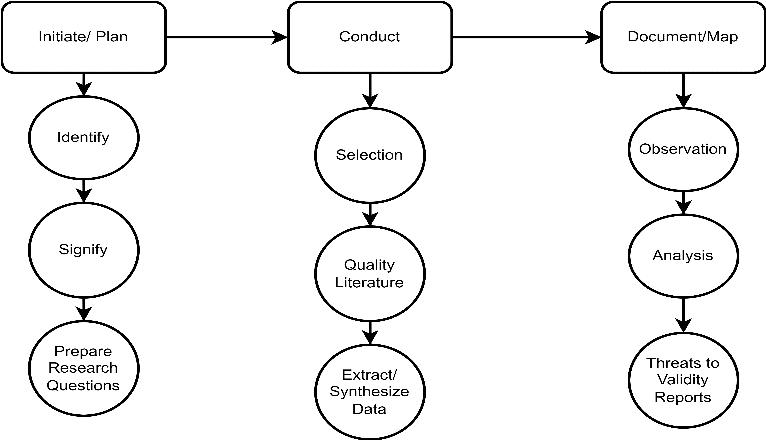
Our systematic mapping study (SMS) follows a sequential process to categorize primary search results for an effective literature review. It comprises a set of methods trackedthrough systematicstepsfor the classificationand analysisoftheselecteddata.Ourinspirationisdrawnfrom the work presented in [24, 25], which is a three-step processforqualityreview;itcomprisesthestudyselection, assessment,andconclusionstrategy:
International Research Journal of Engineering and Technology (IRJET) e-ISSN: 2395-0056
Volume: 09 Issue: 12 | Dec 2022 www.irjet.net p-ISSN: 2395-0072
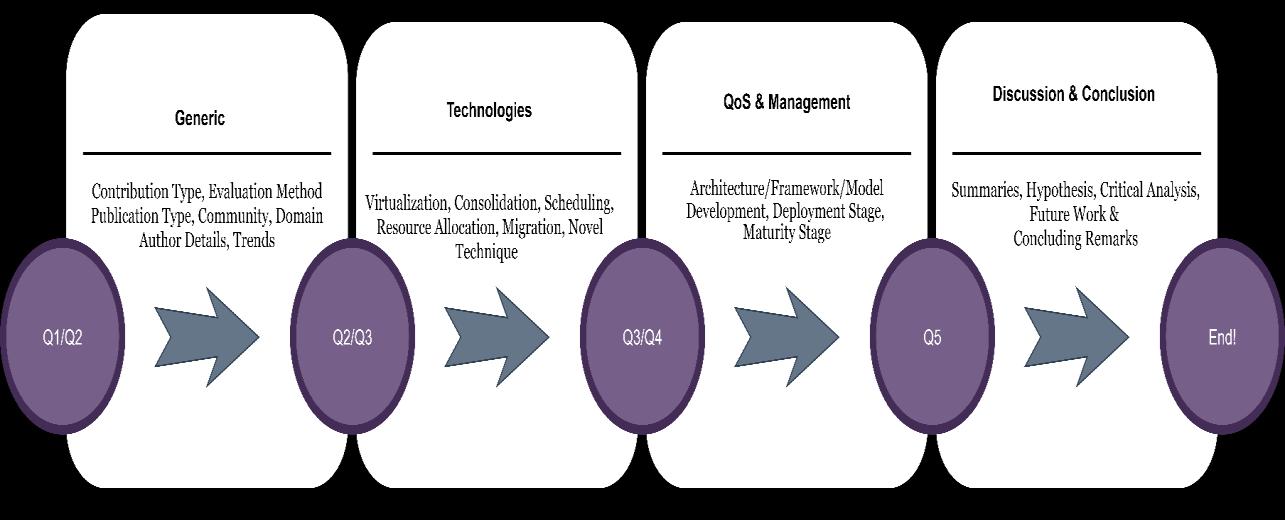
For better visualization of individual steps, we have formulatedandrevisedsomeofthestepstosuitourwork, shown in (Fig - 2). The review follows a systematic mapping process with a predicted outcome for each action. Besides, we provide an additional categorization scheme(Fig-4),aprerequisitetothe(Table-7),whichis ourconceptualizationtocomprehensivelyclassifyselected data. We aim to review energy-efficient technologies in a broad context and data centers' energy-saving mechanisms with a taxonomical review strategy in specific. Moreover, we review and philosophize current researchintoperspective byusinga systematicapproach. This work has been conducted on the selected studies listed in (Table - 7) with clarity of context, relevance, authenticity,andsignificance.
Moreover, we go through research questions and conduct a primary search on model papers based on their credibility and publication standard. Thereafter, the screeningofpapersisdefinedandkeywordingbasedona specific search strategy using the title and abstract. Then we extract and map all the data, which is presented graphically in (Section 4). As we focus on systematic mapping study, each step we take has an outcome based onthemapping.First,wemustsystematicallyclassifyeach step to initiate mapping to exploit our literature extraction. It is worth noting that each step this study takeshasanoutcome. Fig -2: SystematicMappingStudyProcessforourwork
Q.2 What is the frequency of a particular research techniqueasasubcategory?
To understand applications into an individual method based on its activity and frequency. To evaluateandreflectonactivejournals,publishers, authors, countries, and institutions actively contributingtothisresearch.
Q.3 What are the evaluation methods and their contributionsandwhatistherelevanceofemployingsuch atechniqueanditspracticalimplications?
To accumulate a solid perspective into the solutions, proposals, evaluations, and validations ofanindividualresearchitemandtodifferentiate among empirical research- To reflect on technology stacks, categorize, evaluate, and understandeachtechnique.
Q.4 What level of quality is the study on management, servicelevelagreements,andparametersdeterminingthe quality of service, as well as the classification of models, frameworks,andlearningcurvesinallofthose?
Tounderstandthequalityofservice,management strategies,andarchitecturalconcerns.
Q.5 What are some of the reservations, and what is the futureofenergyconservationinthedatacenter?
The central idea is to reflect on the gaps while assessing the best practices and finally come up with fruitful suggestions for the active participantsinthedomain-
The methodological approaches demonstrate the current procedures that must be resolved or the usefulness of gathering data and answering questions. Therefore, the research question will help the reader assess the research'sscope.
Q.1 What is the frequency of research conducted to optimizeenergyinclouddatacentersinabroadview?
To understand the broad activity in the research area,toclassifydomains,andtoanalyzetrends-
Our search strategy is based on PICO (Population, intervention, comparison, and outcomes) suggested [24], which was developed to identify keywords and formulate search strings from research questions. We use PICO searchguidelinesasourprimarysearchmethodduetoits reliability and broad scientific citation. We apply our context for scoping and mapping energy-saving technologies in the Cloud, guided by individual steps. It is essential to have a search strategy to minimize the researcher's bias. Because a credible visualization of extracted data is only possible if the data collected is precise, brief, sound, and relevant. The quest for primary studies is usually carried out by scouring significant databases. It can also be accomplished manually by looking through conference and journal materials. We have assigned attributes derived from RQ1 to RQ5 to conceptualize our PICO search strategy, and each point is aligned with the PICO search term, which can be seen in (Table-2).
International Research Journal of Engineering and Technology (IRJET) e-ISSN: 2395-0056
Volume: 09 Issue: 12 | Dec 2022 www.irjet.net p-ISSN: 2395-0072
PICOMethod [6]
Population Need for the Study/Frequencies of the researchvenues.
Frequenciesofindividualresearchitems. Historical context, significance, worldview, technical, commercial, and environmental aspects.
Quality of service, execution, architectural, technological,andmaturitystage. Future work, conclusions, philosophies, and criticalanalysis.
Intervention Categorization, extraction, validation, and analysis
Comparison Mapping based on comparison selection of studies with proposed characterization framework
Result Proposed Characterization Framework (Figure9)
Table -3: DigitalLibrariesforScholarlySearchDatabases forPrimaryDataSelection
(URLs)
ACM https://dl.acm.org/ IEEE http://www.ieeexplore.ieee.org Scopus https://www.scopus.com/
Clarivate(W.O.S.) https://clarivate.com/
GoogleScholar GoogleScholar
Finding papers for this comprehensive review required searching through various digital libraries. This work prioritizesthebroadworldviewoftheselectedstudies,as thisisareview,notatechnicalpaper.Wehavefocusedon analyzing the existing technologies through our proposed methods.Someofthesub-areasmaybeunderrepresented inthisstudy.However,asperourprimarygoal,thisstudy will use search techniques to evaluate broad topics concerning data center energy-saving technologies in the Cloud, such as virtualization & consolidation, scheduling, and server management. (All of these techniques are classifiedandnarroweddownin(section4).
Digital libraries are quite essential tools for study selection. However, their search results result in many unwanted effects; they help search the content with keywords,titles,abstracts,years,orothersets.Hence,itis commontoendupwiththousandsofsearchresultsevenif our queries are well-written. The selection of the data is excessivelydiscussedinthenextpart.
Thearticleschosenfortheprimarystudiesareallsubjectspecific, i.e., "Energy Saving Technologies in Cloud." Thus, prime facets dealt with the selected items in the cloud computing domain. Key terminology, normally performed on the abstracts of peer-reviewed journals, is the foundation of a systematic mapping analysis. As a result, stories from newspapers, social media sites, and other outletswhichfallintothegraystudyareaareexcluded.
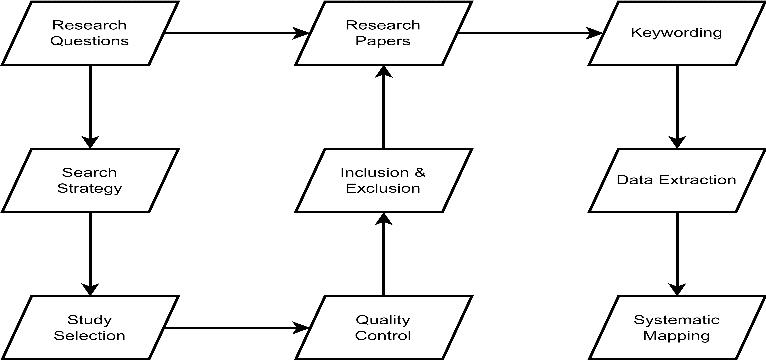
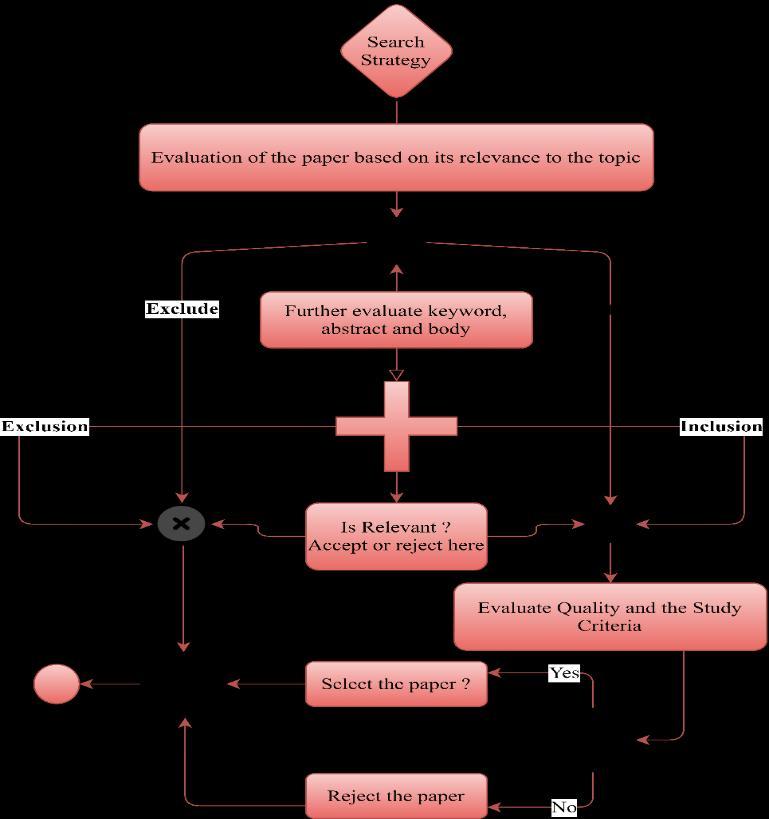
Ourwork'sinclusionandexclusionmechanismaresubject to rigorous extraction of primary data) Moreover, transformed into a secondary study to provide readers withanecessaryliteraturebackgroundandpeer-reviewed research articles. In addition to inclusion/exclusion criteria,asystematicextractionsearchmodelisappliedto the process of search evacuation. Furthermore, we have useda studyselectionstrategybasedon[27]dividedinto two parts. First, we measured the primary date's significanceinthefirstsectionbyreadingthedescription, abstract,andkeywords;ifthatwerenotenoughtomakea meaningfulconclusion,thefulltextwasreviewed.Second, if the article is irrelevant, it will be excluded, and if the relevanceisinquestion(duetoissuesamongevaluators), athirdpartyshouldbecontacted.
Our primary concern is to extensively highlight energy-efficientand energy-savingapplicationsand technologies in Cloud data centers; this is a broad topic,asitincludesthesystemsideandnetworking. Our chief inclusion parameter lies within the application domain for this novel mapping and scoping study- Hence, we have explicitly doublechecked the papers before including them in this work,see(Table-7)
The literature not outlined in inclusion is excluded, including non-peer-reviewed material and misleading papers. Only English language papers areincluded.
International Research Journal of Engineering and Technology (IRJET) e-ISSN: 2395-0056
Volume: 09 Issue: 12 | Dec 2022 www.irjet.net p-ISSN: 2395-0072
Our selection strategy is based on the guidelines set by [27].Ourfollow-upandcross-checksontheinclusionand exclusion criteria also prevent any unimportant data selection or pieces of gray literature from affecting our mapping analysis. Therefore, we carefully followed standardguidelineswhileselecting,extracting,andfinally mapping.
Fig -3: TheStudySelectionStrategy[27]
keywording process necessitated a thorough examination oftheabstractstoidentifykeyterms,whichcanbehelpful for the overall structure of the work. The keywords can furtherbedividedintoas:
Title Most important keyword for targeting primary data
Abstract Theabstractisextractedbasedontherelevance andsoundnessofthestudy
Classification Scheme SeeClassificationFramework(Figure–4)
Mapping Eachstepleadingtoanoutcome
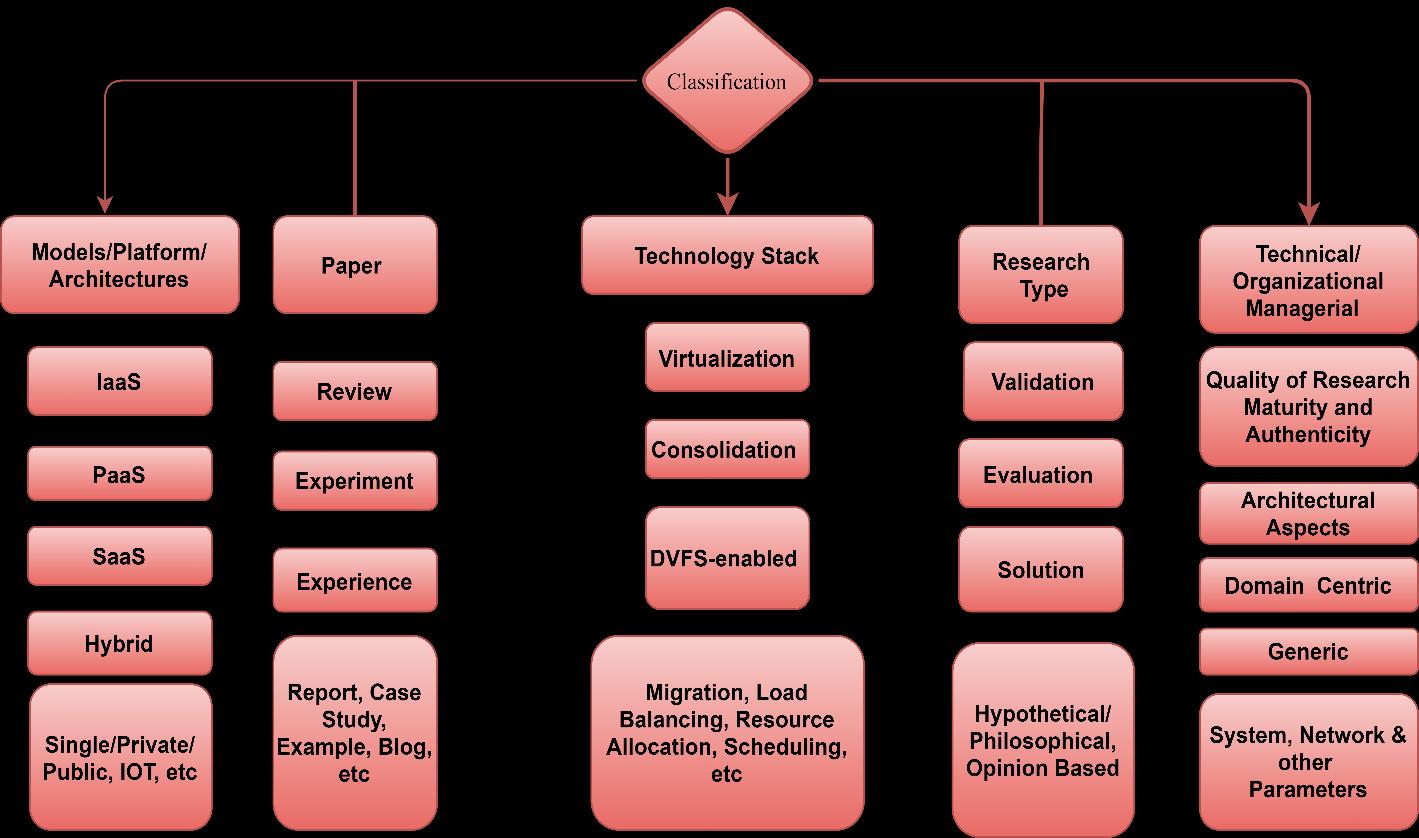
We have classified significant categories based on guidelinesset by[28].Itsortsalltheselectedtypesbased on a systematic approach for better categorization and visualization.Inaddition,weareusingthistechniqueasit appliestotheworkwehavecarriedoutandfallenintothe cloud computing domain. We use the category as Contribution Type. The remaining classes are subject to technical, managerial, architectural, domain-centric, and generic domain aspects, particularly to answer questions from Q1 to Q5, emphasizing Q2 to Q4 as these comprise technicalandqualityconcerns.
Keywordingwillhelpcutdownontimeittakestocreatea classification scheme. This methodological step ensures that only suitable and sound papers are gathered. The
Fig -4 CategorizationScheme
International Research Journal of Engineering and Technology (IRJET) e-ISSN: 2395-0056
Volume: 09 Issue: 12 | Dec 2022 www.irjet.net p-ISSN: 2395-0072
Table -6 ClassificationofResearchContribution
ValidationResearch Themethodstestedwerenewbuthaveyettobeimplemented.
EvaluationResearch Methodsaresuccessfullyimplemented,andtheefficacyoftheprocessisevaluated.
SolutionBased Anissueisaddressed,andaresolutionissuggested;theapproachmaywellbeneworaconsiderableimprovementofan existingmethod.
Opinions&Discussions Suchpapersshareaperson'sopinionoverwhetheraprocedureisrightorwrongorhowthingsaredone.
Experience Experiencearticlesdescribewhathasalreadybeendoneeffectivelyandhowithasbeendone.Itmustbethewriter'sown directexperience.
Wehavecategorizedourresearchschemeintofourmajor components, each containing topics leading to various sub-topics. We align each with the proposed research questiontohaveclarityofthoughtandclarityoffacts.Our mapping study promises a systematic visualization, characterization,andcategorizationoftheprimarystudies to synthesize a worldview and then narrow it into a personal research agenda, discussing each with facts accumulated from a deep analysis, validation, and prevention of authors' bias approach before representation.
Inaddition,dataextraction(SystematicMapping)followed by extensive quality assessment and data filtration was alsoexplainedinthestudyselection.Afterthat,wedivided primary data into categories to represent the results. Furthermore, before analyzing the results, we have transformed our classification scheme into a conceptual framework (Fig - 5). In addition, the classification of the studies selected; was strengthened; some minor changes and revisions were necessary to sort data and keep its usefulnesstothefullest.Wealsodiscussedhowwegained our primary data in the previous sections. Before inclusion, we manually compiled a spreadsheet to input various digital sources while paying utmost attention to thekeywording,primarilyabstractandtitles.
Moreover,wemanuallygotridofduplicationofthesource papers. We have used (Pivotal Tables) and some advanced Excel formulas to extract data into readerfriendlyvisualizations.Besidesexcel,wetriedtousetheR programming language and other bolometric libraries, which are familiar with the studies related to literature analysis.However,tooursurprise,thecredibilityofsucha process could be clearer. The authors must disclose how they merge two sources of different selections, for example,WebofScienceandScopusorIEEandSpringer.
We, on the contrary, replied to the principles set by guidelines of [24-26] and updated guidelines of [29]. The author stressed the technology stack and generic results, suchasvenues,typeofpublication,frequencyofeacharea of research, and others. We aim to comprehensively analyze the active and frequent technologies in the cloud domain. Hence, our job is to synthesize primary material to analyze useful concepts, the type of research contribution (Table- 7), and the venues and frequencies. Thus,wehavedividedtwopotionsfortheresults:thefirst deals with the generic terms and the latter technical aspects. Because we can achieve the latter using any digitallibraryonline.Ourfocusontechnologyalonecovers the most widely applied energy efficiencies and power management techniques, such as types of virtualizations and consolidation, scheduling, migration, resource allocation, provisioning, and dynamic scaling of the CPU power utilization. In addition, we kept a category for the state-of-the-artnovelresearchotherthanthesecategories because we could not show substantial data in the table. Besides, primary data contain similarities, so we merged categoriespreciselytoeliminatetheinformationoverflow. Moreover, categorizing terms such as contribution type and evaluation method has subtitles and subcategories similar for the management and administration. We have covered various subcategories, such as quality of service and service level agreement, execution, and maturity stages. Finally, there are system models, cloud delivery models, cloud settings, and other relevant sub-areas concerningarchitecturalaspects.
Inordertoorganizedatacollectedintosubjectmatterthat is both reader-friendly and visually appealing, we have categorized our work into this characterization process (Table - 7). We were inspired by the system development life cycle principles used in software engineering project management for our proposed framework. It demonstrates the pertinent information and the classificationstandards.
International Research Journal of Engineering and Technology (IRJET) e-ISSN: 2395-0056
Volume: 09 Issue: 12 | Dec 2022 www.irjet.net p-ISSN: 2395-0072
Fig -5: CharacterizationFramework
Our characterization framework results from our characterizationscheme,whichresultedfromtheprimary data selected. It is a conceptual framework that depicts majorandminorcategories,classes,andsubclasses.There arefourmajorcomponents:
Technological
ResearchContribution
Management
Platform/Architecture.
As discussed earlier, each step has subcategories elaboratedinsectionVin-depth.Thisframeworkhasbeen modified several times, as it is hard to classify a whole area of research. The second author and a guest researcher were approached to reflect and suggest preventing the author's preconception. However, the classification may underrate or overrate some research areas because of the vast selection of literature and broadness of the topic itself; however, as a big picture, it has been true to its very purpose, which is to address, energy-savingtechnologiesfordatacentersintheCloud.
Weaddressedtheclassificationframeworkearlier;now,it istimetorespondtotheresearchquestionsfrom(section 3.1). This section will discuss those questions using graphicssuchasexcel&origincharts,tables,andcustommade diagrams. We will begin with a general topic/concern attributed to research questions 1 and 2. After that, we will address technology-related concerns attributed to research questions 3 to 5. While we also identify the articles concerning publication format, platform, and technical engagement. In addition, we presentedourfindings'validityandimplicationsforfuture
studies.Startingfromthefirstquestion,whichisbroadas it deals with the central topic of the proposed mapping study:"DataCenterEnergy-SavingTechnologiesinCloud," we will see how active this research field is before classifyingitintosubcategories.
· Whatisthefrequencyofdatacenterenergy-saving research, and when did it become popular in the community?
· Whatactivevenuesforenergy-savingtechnologies intheCloud,andwhichforumsallowthemostresearchin thiscategory?
· Who are some of the most notable scholars, and whatistheircontributionconcerningeachtechnology?
· Whichcountrieshaveproducedthemostresearch articles,andwhatistheirfrequency?
The emphasis on energy saving by cloud computing platforms quickly grew as of 2008. This innovation was made possible by creating a market tightly connected to technology.CompanieslikeGoogle,Amazon,andFacebook saw exponential growth. Such massive growth also brought with it real challenges. As a result, the investigation of energy-saving methods for data centers alsoemerged with a seemingly unrelated failure in 2012. However,thepacequicklypickedup,particularlybetween 2013and2018.Asaresult,cloudserviceprovidersbegan constructing energy-efficient data centers. To create a narrativeforadditionalanalysis,we,therefore,considered
International Research Journal of Engineering and Technology (IRJET) e-ISSN: 2395-0056
Volume: 09 Issue: 12 | Dec 2022 www.irjet.net p-ISSN: 2395-0072
the publications across several years. Our study selection is between May 2008 and May 2021. (the time of writing thearticle).Byrevealinghowactivethisresearchtopichas become over time, it will enable us to properly characterizeit.
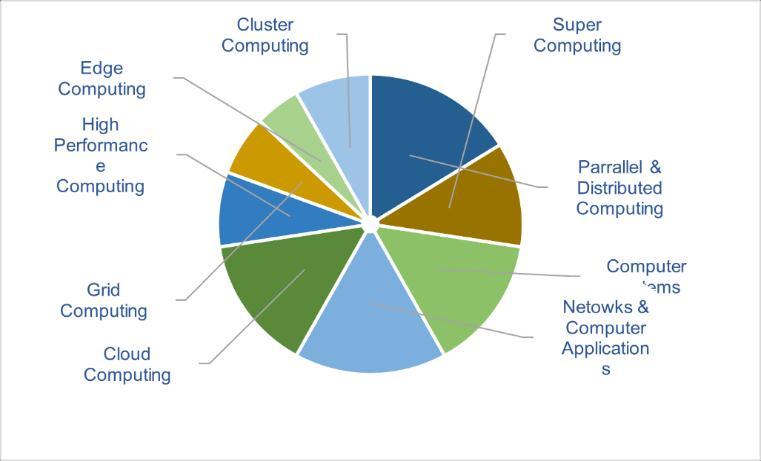
Anotherkeyareatostudyistheactiveresearchcategories andtheirrespectivedisciplines:cloudcomputing,bigdata, edge computing, parallel and distributed computing, supercomputing, high-performance computing, grid computing, cluster computing, and network-related computer applications and systems. We can see the gradual increase of research activity on energy efficiency in nearly all cloud computing and computer science counterparts. We can also note that emerging areas like edge computing contribute immensely to the research before we categorize the papers based on our research questions, which will address in two ways: a. generic terms b. technical details. It is worth noting the following questions that directly relate to the general terms of the mapping study, for our goal is to address a broad perspective.
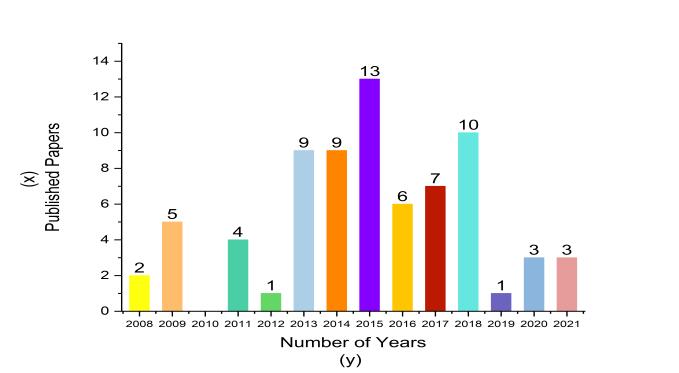
The total number of publications over time is depicted in Figure 6. This illustration was created using our main collection of data. Since energy concerns indicate using variousITcomponents.Itonlyappliestothesoftwareside of energy-saving techniques. We only used management and optimization techniques in software-related technologies. Such as virtualization and consolidation, green scheduling, and energy-efficient policies, models, and architectures, to justify our inclusivity. The figure above shows that the research area experiences certain variations each year because our primary data visualization uses data from articles pertaining to years. For instance, in 2010, there was no study. However, in 2015, there were 13 studies as opposed to just one study in2019.
We have separated the subject into several research disciplines based on the major data analysis used for this study,includingseveral engineeringdisciplines,computer science & systems, telecommunications, and software engineering,eachrepresentingasub-discipline. Fig -7 PrimaryDataDistributionBasedonCommunity
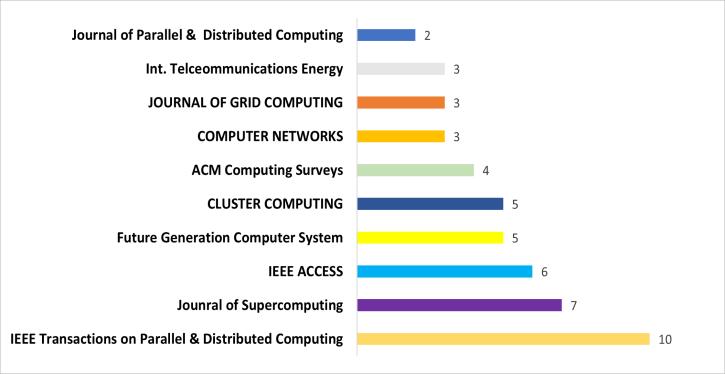
The sources selected for our mapping study are peerreviewed. Although we paid much attention to list out active journals, we have also considered reputable conferences, reports, and other distinguishable formats. We acknowledge and classify journals based on the frequency of articles on the topic related to our analysis. (Fig – 8) shows the topmost sources that published the most content on data center energy-efficient technologies andtopicrelated.
The categorization of research on the chosen topic based on nations and author preferences is another factor we noticedinouranalysis.Butweonlyclassifycertainthings. We followed a strict normalizing procedure to eliminate redundant and irrelevant data. To accommodate only research that best connects to this topic and our purpose foramorevitalsubject-specificin-depthunderstandingof the region we focus on. Thus, we divided up research productivityandfrequencybycountry.
Fig -8: TopmostJournalsThatPublishScienceRelatedto (DataCenterEnergy-SavingTechnologies)
International Research Journal of Engineering and Technology (IRJET) e-ISSN: 2395-0056
Volume: 09 Issue: 12 | Dec 2022 www.irjet.net p-ISSN: 2395-0072
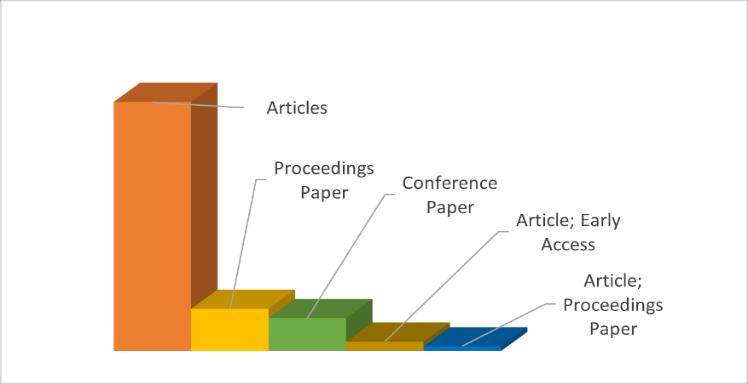
Figure9showsvariouspublishingformats.Wedividedthe categories into articles, proceeding papers, conference papers,earlyaccesspapers, andproceeding papers. Some of the most common formats of research publication, especially in reputable peer-reviewed journals in the domain. As we previously mentioned in community discussion, it is noticeable that parallel & distributed computing, grid computing, and others are some of the topmostactivecommunities.Nowwecanseethejournals basedonthosecategories.
Over time, scientists may identify the leading countries producing a vast amount of quality research in energysaving technologies in the Cloud. Figure 10 demonstrates thetopmostactivecountries.Chinahasproducedthemost significant number of papers in areas as diverse as cloud computing, big data, edge computing, and others. And the general reason behind this development is the number of affiliated research institutions in the country. Another reason is that the size of the economy is huge, which has enabledtheresearchertoconductresearch.
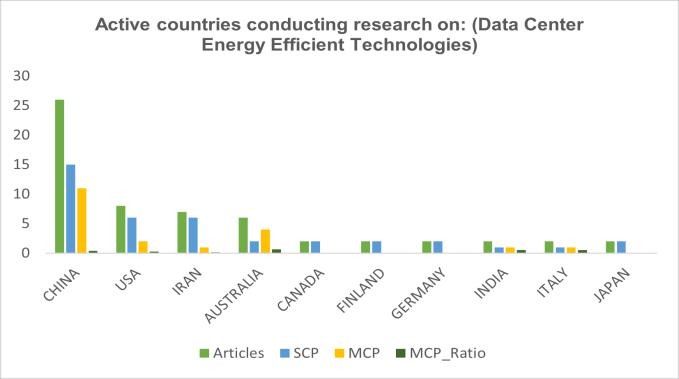
With 850 million smartphone devices as of the end of 2018, China had the highest number of smartphone subscribersamongitscounterparts,morenearlydoubling the number of phone devices in the neighboring state (India) [30]. This aspect stimulates the demand for new technologies, including the emerging 5G technologies and a growing number of data centers. Besides, the need for cloud computing to boost customer quality of service is increasing. [31] Furthermore, the Chinese cellular market has actively promoted various technologies, namely semantic analysis, voice recognition, and computer vision and image processing techniques, which help boost further development of energy consumption; thus, the need for energy conversation also becomes necessary. It also holds the title of the highest-ranked country for the number of active cellular subscribers.[31] In addition, Cloud computing has received much attention from Chineseresearchers,includingenergyefficiencyinparallel and distributed computing. After China, the United States, Iran,Australia,Canada,Finland,Germany,India,andJapan hasthemostarticlesintheSCImagoCountryrank.[32].
We have chosen important publications that have helped develop dynamic methodologies and effective evaluation techniques. Additionally, we ensured that most of the articles we chose were peer-reviewed and had solid contributions, intricate design, real-world applicability, andmodularity.Inaddition,wealsocreatedsubcategories fromthemajorstudytopicsoncloudenergyefficiency.
Figure11showsthespecifictechnologiesandwriterswho focused on those subjects. Besides using an automated R program,wealsoconductedathoroughmanualanalysisof the articles. Hence, studies are distributed by their top relevantauthors.
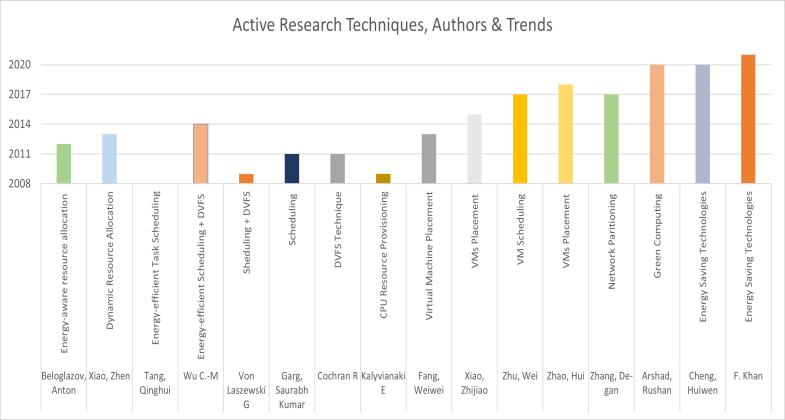
•For example, [33] has presented an energy-efficient resource allocation algorithm with the help of a consolidation-aware dynamic virtual machine placement technique while discussing opportunism and underlying challengesfacingthisfieldofstudy;theirworkprovideda baseline and answered some questions for many researchers.
• On the other hand, [34] presented an energy-efficient resource management system in which they proposed a method that adaptively transfers virtual resources to physical resources. In addition, they have also used the
International Research Journal of Engineering and Technology (IRJET) e-ISSN: 2395-0056
Volume: 09 Issue: 12 | Dec 2022 www.irjet.net p-ISSN: 2395-0072
skewness metric to integrate virtual machines with differentresourcerequirementstoadoptservercapacity
• Another work [35] focused on a technique, MPIT-TA (Peak Inlet Temperature Minimization Problem). This method aims to improve the energy efficiency of a virtualizedcloudenvironmentand,ultimately,reduceSLA violation. Besides, they estimated that the proposed method could maximize the supply temperature and thus reduceair-conditioningenergyrequirements.
•Theauthors[36,37]workedonresourceutilizationina data center; their proposed method is based on Dynamic Voltage Frequency Scaling (DVFS) aware power management strategy. Moreover, they incorporated scheduling algorithms such as a DVFS-enabled approach to be of greater interest among many scientists. The number of DVFS based research papers has become popular, especially concerning green and energy-efficient schedulingalgorithmsanddynamicresourceprovisioning.
• This study [38] focused on implementing flexible resource provisioning and scheduling policies that take advantageofheterogeneitythroughmultipledatacenters. Theproposedmethodaimstoreduceenergyconversation andcosts.
• While work by these authors [39] implemented a method for the performance of multithreaded workloads on a multi-core CPU, their major proposal combines the DVFStechniqueintoaschedulingalgorithmbyusingrealtime workload traces and benchmarking measurements forperformanceandvalidationofsystems.
• Furthermore, the work done by [40] is based on virtualization techniques, especially Vm selection and placement problem; the authors' proposed technique dealswithvariousaspectsconcerningatypicaldatacenter suchasnetworkperformance,cost,andenergyutilization, to address these concerns, authors worked on a virtual machineplannermethodologytooptimizeenergy.
•Moreover,[41]developedanalgorithmbyextendingthe evolutionary game theory to solve the virtual machine problem to optimize power. Their proposed model analyses the amount of power consumption during the processofadjustingavirtualmachine.
• On the contrary, efforts were made to develop an Ant Colony optimization method to solve the VM placement problem (PPVMP) to obtain energy efficiency in virtualizedclouddatacenters.
•Thatleadstotheworkconductedby[42],whichisbased on a novel unequal clustering routing protocol that considersenergybalancingbasedonnetworkpartition.In a nutshell, their effort was to create an energy-aware network clustering mechanism to solve energy
conversation. Finally, the works of [6], [8] and, [43] have produced state-of-the-art surveys on emerging challenges facing green computing, data center energy efficiency, performance, architectural concerns, cost, and S.L.A. violation,tonameafew.
This section of the mapping study, related to research questionnumber3to5,willfirstevaluateeachcategory's research contribution and evaluation methodologies. We have conducted our research on 74 studies. We have categorizedeachstudybyapplyingaconceptualizedtable (Table - 7), which extends our characterization framework.Themethodthatweusedisauniqueapproach to conducting a dynamic mapping study. Besides, the categorizationwemadetodistinguishandexploitprimary data is subject to a careful review of each selected study. Table 7 overviews all selected studies based on the most significant categories that range from technologies to methodologies. In addition, we focused on management concerns and quality of service, architectural aspects, and models.Multipleoccurrencesoccurbecausemany studies use similar techniques, and some apply a combination. However,wewillclassifyeachtimeintosubcategoriesand sub-groupings for clarity and understanding. To begin with, we will first visualize results based on research question3:
TosubcategorizeandevaluateresearchQ3
1. To compare the contribution type for understanding research direction in a particular area with an emphasis on a specific research methodology,technique,orstrategy.
2. To reflect on the evaluation type and explore the various types to meet the requirements of our characterizationframework?
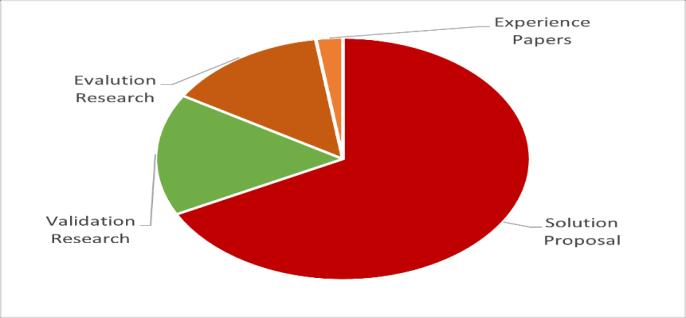
Based on our characterization framework, we have divided the selected studies for mapping into categories such as solution-based work, example, evaluation, experience, and validation. Multiple occurrences can be seen.However,ourschemeandframeworkcanbeusedas areferencemodel.Aswehaveclassifiedtheresearchinto varioussubcategories,itisalsoworthnotingthatwehave aligned techniques within the contribution type result to have a clear view of which processes are commonly aligned with what popular methodologies. Figure 12 depicts the contribution type in which solution-based research is in high number. One reason is that the data center'scentricresearchhasgainedhuge momentumdue to the large corporations' interest in the domain. Another reason is the nature of the research, for it involves controlled experiments of virtual machines to evaluate
International Research Journal of Engineering and Technology (IRJET) e-ISSN: 2395-0056
Volume: 09 Issue: 12 | Dec 2022 www.irjet.net p-ISSN: 2395-0072
energy consumption, which is a solution-driven, experimentalkindofresearch.
Fig -12: StudyDivisionbyContributionType
utilized both the validation type of research and the evaluation type of research. Because of the technical specificity and the investigations' reliance on various approaches. Others also combined examples and experiences at the same time. Which is one reason some resultscanappeartobeidentical.
Fig – 13: StudyDivisionbyEvaluationMethod
Figure 12 depicts most research based on solution proposal, followed by validation and evaluation. Each category shows a different method of research implementation based on 74 research articles. We have also demonstrated contribution type concerning evaluationtechnique,aswereliedonmanualreadingsand cross-checks. To reduce the author bias, we got the work cross-checkedandproofreadbyguestreviewers.
The results of a few studies, including experimental research, example-based research, case studies, and experience-oriented research, are shown in Figure 13 in severalcategories.Thesearesomeoftherequiredcourses following the principles of software engineering. Like the solution suggestion, experiment-based research accounts for nearly 62% of the contribution type. Some articles
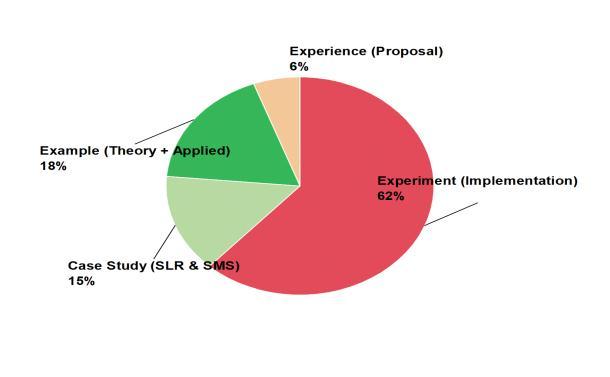
This section addresses the technology stacks based on previous terms such as contribution and evaluation methods. We focus on each technology now, and then we will presenttheresultsintheformof(PieCharts %).The novelty of this work is that we classified each technology in this section. Since the technologies are well-integrated andrelyonvariousmethods,wewillextractcriticalterms inthetablestohavethebestunderstanding.
International Research Journal of Engineering and Technology (IRJET) e-ISSN: 2395-0056
Volume: 09 Issue: 12 | Dec 2022 www.irjet.net p-ISSN: 2395-0072
Validation & Evaluation [72][21][49][50][73][74,75]
Review SLR [76][77-79][80-82][83,84][85][86][87]
SMS Evaluation Method
ServiceLevelAgreement
ModelsProposals
StageofDevelopment
Deployment
WorkloadorBenchmarks
Experiment [57, 58] [59] [60] [61] [44] [45] [20][46] [21] [22] [23] [47] [55] [7] [13] [62] [33] [56] [64] [16][17][34][35,51][26][9][36][27,65][37] [10][69,70][11][13][7,53,71][38,67][42,66,68][43][31]
CaseStudy Broad [76][73][77,78,82,84][84][81,85][86]
Specific [73][79,83][80][54,87]
Example Theoretical [72][22][48][63][73][52][28][74,75][12][41]
Applied [49,50][25]
[57][20,58][22,62][33][56][64][34,36,51,65][27,67][10,66,68,70,71][69,81][39-42]
[59][72][46][22][7,49,50][63][16][25][51,74,75][80]
[59][45][22][47,49,62][56][63][16][25,51][28][68,84][75][69,70][13][7,40-42][43]
[57][58,59][60][61][44][45][20][46][21][22][47][55][13,50][56][64][16][25][10,27, 70][75][69]
[58,59][59][46,64][76][34][26][26,66]
Flexibility [60][61][46][55][7,33][56][63][64][34][25][36][52][28][74] [66][38,53,67,85][84][78][80] [70,79,81][13][86][87]
Modularity [57][58,59][61][44][45][20][46][21][22][23][47][55][7][48][13,49,62][33][63][64] [16][34][25][35][26][9][37,65][27][68] [10,42,54][75][41,69,71][11][12][39][7,40][43][31][31]
Others [59][22][47][48,49,63][28] [10][75][80]
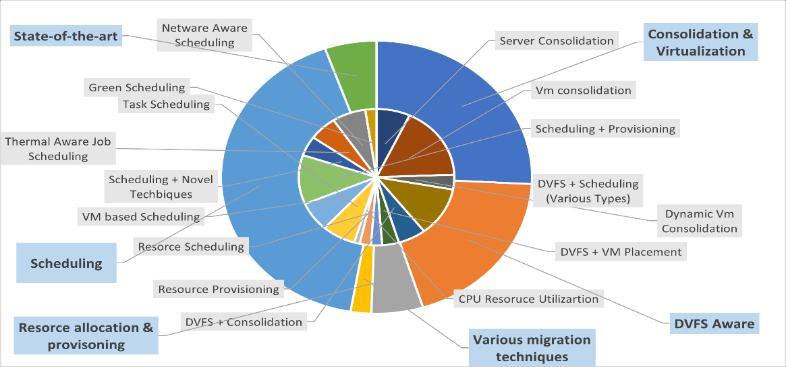
The usage of virtualization and consolidation techniques arepopularmethodsfollowedbyschedulinganddynamic server management, including various hardware-centric processes, such as cooling mechanisms, energy storage systems, architectural aspects, and others. In addition, dynamic voltage and frequency scaling is becoming popularrecently.
On the contrary, resource allocation and provisioning are also high, such as load balancing and virtual machine migration.Wealsofocusedonenergy-efficientalgorithms, models and frameworks, theoretical proposals, and alternative solutions-based approaches and containerization discussed in the results section in depth. Therefore,wehavecomparedvarioustechniquesbasedon
our categorization scheme and characterization frameworkin(Table-7)
We have highlighted the results mapped from our primary data selection following the guidelines of our research questions. The table highlights the major components of the categorization. The reason behind this approach is to narrow down our mapping analysis and to enhancereadability.
International Research Journal of Engineering and Technology (IRJET) e-ISSN: 2395-0056
Volume: 09 Issue: 12 | Dec 2022 www.irjet.net p-ISSN: 2395-0072
We found scheduling based on resource allocation and provisioning methods to be in high number, approximately26%,followedbynetworkscheduling,task scheduling,virtualmachinescheduling,thermalawarejob scheduling. Our findings suggest that scheduling algorithmsareprevalentinmoststudies
In addition, figure 17 shows the number of DVFS-aware articles,thethirdmostpopulartechniqueafterscheduling andconsolidation.
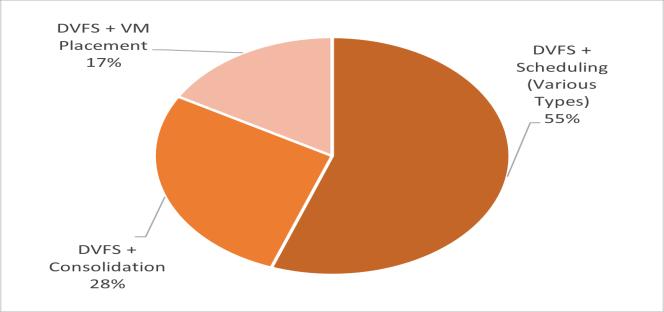
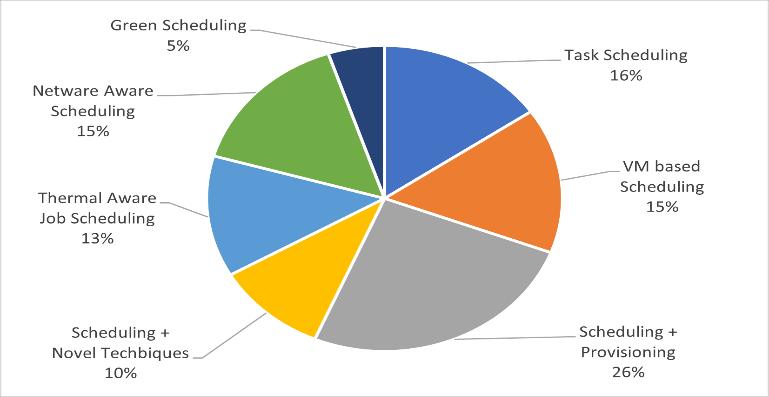
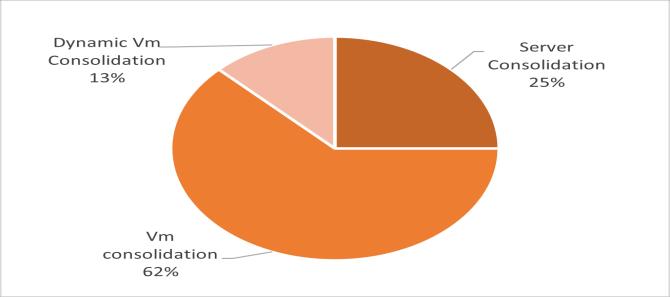
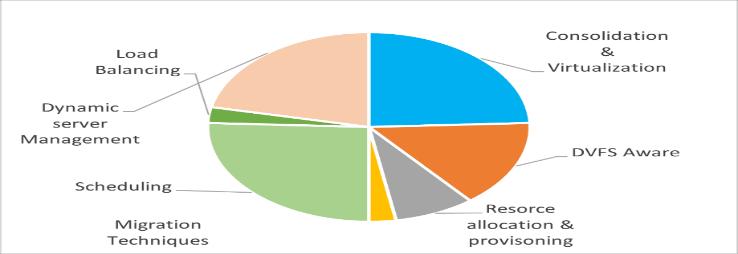
Fig – 17: IntegrationofDVFSwithScheduling
Table 8 is a collection of studies that used DVFS based schedulingalgorithms.Allthestudiesselectedinthetable are previously discussed in table 8, respectively, to prevent multiple occurrences; only references are included.
International Research Journal of Engineering and Technology (IRJET) e-ISSN: 2395-0056
Volume: 09 Issue: 12 | Dec 2022 www.irjet.net p-ISSN: 2395-0072
[10] Power management strategy DVFS for implementing urgent CPU intensivebagoftasks
Cloud-Aware EnergyEfficientScheduling
NA [88] Green Energy Efficient Scheduling Algorithm (MMS-DVFS) based approach
[11] DVFS enabled scheduling algorithm for VM placement, green scheduling approach.
[12] Pack & Cap, robust method for improving the performance of multithreadedworkloadsonamulti-coreCPU
DVFS-enabled green scheduling
Scheduling algorithm for DFVS-enabledclusters
NA [7] Experiment:Developmentofanewtaskmodelusingpowermanagement approach(DVFS)
MECRI, PTAB & Local Task Migration
[40] Combination of Scheduling exploiting DVFS for tasks management in heterogeneousenvironment
Energy Aware DVFSenabledScheduling
NA [42] Job Scheduling into an energy objective model based on non-convex function
DVFS-enabled online adaptive and energy-aware schedulingalgorithm
Figure18showsthefrequencyofrecurrenceofeachterm in the derived sentences from the samples. The key methods of the classification scheme are related to the term"occurrences": Fig – 18: PercentageofAllMajorTechnologies
What are quality concerns in management and architecturalelements?
What are some of the tools, simulators, workloads, and frameworks within the selected studies?
First, we evaluated each technique individually. Second, we integrated most methods to find commonalities, interdependence, and alliance. Our effort has narrowed down specifics, characteristics, and underlying subcategories amongst the significant energy-saving technologiesintheclouddatacenter.
We introduced quality of service criteria to address the power consumption issue concerning the following questions.
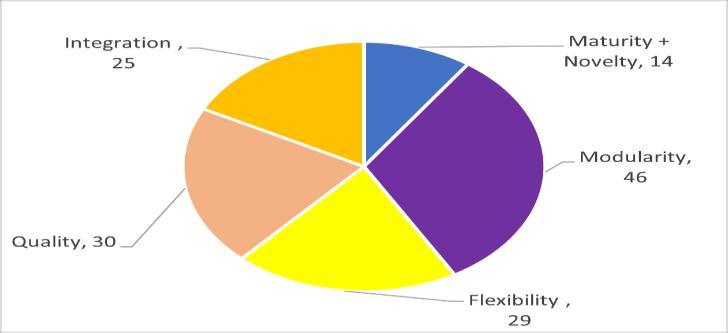
In this section, we focus on the management and architectural concerns starting with the quality of service parameters with respect to selected studies (Table - 10). We classified primary attributes from studies that rely on simulation and use real-time workload traces or benchmarking suites (Table- 11). Aside, we classified models and frameworks that report SLA violations. We also address architectural concerns such as flexibility, modularity, integration, and adaptiveness, listed in (Fig19). Besides, we calculated the percentage of simulationbased research. The most popular simulation tool is CloudSim, especially concerning the implementation of virtualization/consolidation, scheduling, DVFS, and migration-based energy-efficient algorithms, as these techniques exploit the services and functionality by extending the built-in classes of the CloudSim simulator. While customized simulators either use a platform or integrate their model independently of any outsourced simulator, primarily using their model and programming technique.Then,wealsofocusedonperformance parameters such as cost, and environmental concern, at the same time. In this regard, most studies used green scheduling algorithms for resource management and
2022, IRJET | Impact Factor value: 7.529 | ISO 9001:2008 Certified Journal |
International Research Journal of Engineering and Technology (IRJET) e-ISSN: 2395-0056
Volume: 09 Issue: 12 | Dec 2022 www.irjet.net p-ISSN: 2395-0072
distribution.Moreover,weincludedprovisioningbasedon theextractedkeywordswithinthestudies.
CountofQoS
SLAParameters
Reliability + Performance + Design + Modifiability 30
Infrastructure Parameters Datasets + workloads + benchmarks + clusters 23
SystemParameters Disk + Storage + Cooling Systems + Cloud Infrastructures 34
Simulation CloudSim + Green Cloud + Customized & Commercial 36
Performance Cost + Time + Resources Management + Distribution+Provisioning 62
QoS helps understand the key findings, and creates a learningcurve,buildsanarrativebypointingoutthemost significant properties of the selected studies. Although manystudiesclaimtoreduceSLAviolations,theratesare not high enough, so there is a lot of research gap in this very area. SLA breaches impact shareholders and users. We observed that clients, cloud providers, and infrastructure providers affected stakeholders based on the existing literature or that not recognizing SLA violationssignificantlyaffectsusers.
And service providers profit from implementing virtualization and consolidation techniques, as articles that discussed these methods reported (limited scope of enhancement in cost reduction, efficient resource consumption, and management). Moreover, we derived keywords from our keyword extraction strategy. According to our findings, the respective performance featuresinmostofthestudiesstressedthekeywordsand attributes such as resource management, cost, time, distribution,andprovisioning.
Table 11 depicts some of the most used real-time workloadtraces.WecanseethePlanetLabishigh,andall othersaredeficient.Wenoticedthatthearticlesthatused simulation-based methods to perform their operations heavily relied on real-time workload traces, especially worksthatextendedtheCloudSimsimulator.
NotablementionsofFrameworks
Lyapunovoptimizationframework [63] Profiling-basedserverconsolidationframework [20]
DataCenter-wideEnergy-Efficient ResourceSchedulingframework(DCEERS) [33]
ArchitecturalFramework [90]
Frameworkfor"energyefficiencyofMapReduceApplications [34]
Another qualityconcern withinthe managementcategory is the framework and models. It implies that a particular solution from one of the selected studies in this paper relied on one of the listed frameworks (Table 12). In addition, figure 19 depicts the architectural concerns foundinourprimarystudyselection.
Fig – 19: ArchitecturalConcerns(BasedonPrimary Study’sKeywordsExtractionAnalysis)
Based on our conceptual table, which extended our characterization framework, we specified the generalized terminologies to reflect on the quality of service of the studies from the perspective of the architectural characteristics, which accounts for significant attributes such as flexibility, modularity, integration, maturity, and qualityaspects.Modularity standsoutbasedontheresult (Fig - 19), meaning that the studies primarily used solution-basedresearchfortheirevaluationmethods.
Moreover, we extended our results in each section to classify major categories into various subcategories. Our classificationissubjecttoourproposedscheme.Figure20
International Research Journal of Engineering and Technology (IRJET) e-ISSN: 2395-0056
Volume: 09 Issue: 12 | Dec 2022 www.irjet.net p-ISSN: 2395-0072
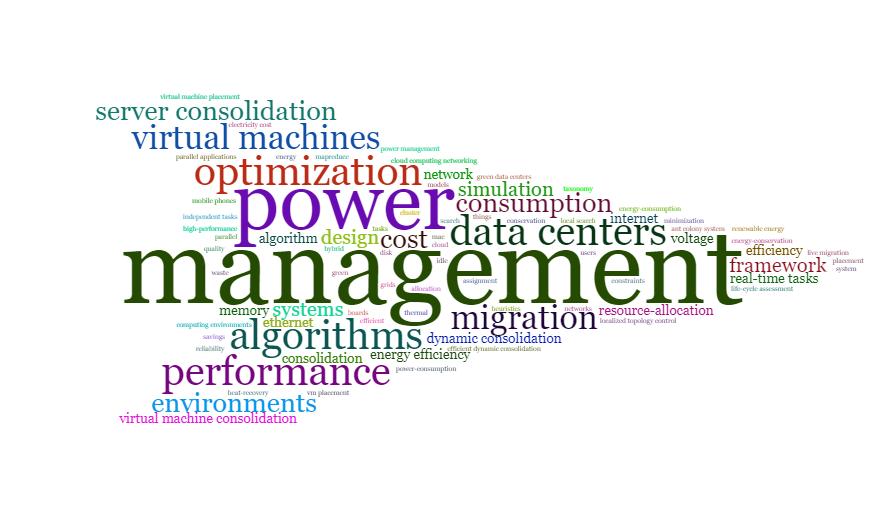
showcases the most used keywords derived from the complete text, mainly focusing on the abstracts of all the selected papers. It unfolds that we systematically discussedthemotiveofthisstudywhileimplementingour classificationcriteria.
efficient policies and algorithms. CloudSim toolkit is perhapsthemostfamoussimulationsoftwareforresource scheduling and planning. It is used to measure different QoSmetrics,suchasmakespantime,powerconsumption, accessibility, dependability, energy usage, using sustainable classes based on algorithm criteria.See the following most popular simulation tools available for modellingCloudcomputingresources.
Even though we have followed a rigorous method to implement our study, we have also mentioned threats to thevaliditywithineachsection.Besides,wesystematically avoided multiple occurrences of similar terms as two authors searched for the keywords to reduce the similarities and enhance the scientific accuracy. In addition, we created a workbook to record our keepings betweentwoauthorstopreventanybias.Additionalguest authors evaluated and proofread the selection to enhance the quality before merging the table into a single source document. In addition, we discarded grey literature, nonpeer-reviewed articles, and articles whose content mismatched their abstracts. Besides, we applied the search quality mechanism, inclusion, exclusion, and PICO criteria (seeSection3).We filteredprimarystudies based onthestudyselectionstrategy(Fig-7).
Experimentation with new methods in a real-world Cloud environment is complex since some tests affect the enduser quality of service. Testing in the real-world environment evaluates a system's performance, but it is expensive and time-consuming [91]. In addition, the consumer does not have access to all the components of the device that need to be evaluated. Simulation distinguishesqualityproblemsandenablestheidealissue to be concentrated [92]. Cloud simulators provide a stable, cost-efficient, and scalable environment where the testing community can reproduce, repeat, and validate experiments.They allowuserstomonitorall layersofthe cloud system and the configuration of physical resources, the topology of the infrastructure, the middleware code platform, the services of the cloud application, and the actions of user workload [92]. There are a few noteworthymodellingtoolsrelatedtocloudcomputingto evaluate and monitor the effectiveness of most energy-
Virtual machines have several issues, including server failures due to consolidation, network congestion, and sprawl waste. Performance, management, and cost are all major problems as well. Researchers are always looking for more efficient and powerful technologies. Containerizationisapotentialstudyareathathasrecently attracted much scholarly interest. Since it allows applicationstorunindistinctuserareas(containers)that all share the same OS kernel. As it helps make the formation and deployment of applications quicker and much safer. Furthermore, it is not unusual for problems when code executes using conventional methods in one computer network and then switches to a new console. Containerizationcapturestheentiresourcecodeandallof its interconnections and file system. Therefore, lightweight virtualization technology rapidly increased, andtoday'smostpredominantideaiscontainerization(or containerization). In the maritime industry, container technologyreferstoprocessinganapplicationtoseparate its dependencies. Microsoft Azure, Amazon Web Services (AWS), and Google Cloud Platform have embraced container technology and widely deployed it in hyperscaledatacenters.Whencontrastedwithvirtualmachines, containerscansharetheOSkernelandreducetheneedto identify an operating system for each implementation. Since containers get much smaller than a VM and require very little startup time, they could operate many more occurrencesonasingleserver.Thereisindeedareduction inenergyconsumptionforthesamenumberofapplicants. Forthosethatwanttoputdockercontainersintoexercise, hereareamongthemostlikelychoices:KataContainer(by OpenStack)byIBM,LinuxLXCbyDocker,FireCracker,and Shifter (by IBM) (by Amazon). Unikernel is an intelligent new technology that has the potential to improve the advantages of lightweight virtualization. Unikernel, also recognized as container 2.0, takes simplicity to the next level by giving only the applications required to run the selected software. Regarding technicalities, Unikernel relies on specialty implementations to integrate software andsupportOSfeaturesduringtheexecutionstagerather than at runtime. A standalone executable image contains everything that the implementation gets to execute the consequence of this procedure. For building virtual machines, energy saving is a primary concern. When we reduce the complexity of virtual machines, the servers conceivably become more efficient. There is a price for
International Research Journal of Engineering and Technology (IRJET) e-ISSN: 2395-0056
Volume: 09 Issue: 12 | Dec 2022 www.irjet.net p-ISSN: 2395-0072
additional benefits, and it weakens the price segregation among applications, which might lead to quality and energyassertiontroubles.
Renewable energy has a charm, and it is no doubt that tech-savvy companies want to invest in a potential business opportunity while enhancing their performance andraisingstandards.Itisafactthatrenewableenergyis not an alternative now; the overall utilization ratio is lower than 1%. However, it can change in the future because the trends support this argument. Facebook promised to use only renewable power in 2011. In 2012, Google (the world's biggest tech giant corporate buyer of renewable energy) and Apple accompanied. Almost 20 Internet providers have completed the same as in 2017. Based on the facts, big companies only seriously considered renewable energy alternatives recently. However, the trend has shifted already. Enormous investment is being made by the top-most tech giants, namelyAmazon,Apple,andGoogle.Suchatrendishealthy for academia and industry. A smart and innovative AIdriven approach to optimize power-intensive infrastructure is a way forward to green and clean data centers. Following are some outstanding studies discussing,reviewing,andassessingprobablesolutionsto bridge the gap of energy crisis and will use renewable energyasasourceofpowerdatacenters:[93-98]
Datacenter server management was no exception to the generalruleinthepastcoupleofyears:anempiricalstudy anddomainexpertisearethego-tomethodstodetermine ideal setups and strategic goals. Recent technologies such as artificial intelligence (AI) have gained widespread attention. Artificial intelligence alternatives have succeededinvariousreal-timecomputationalapplications that people consider complex and puzzling human jobs. Dynamic power management of servers in data centers is a complicated and cost-heavy process, as discussed throughoutthepaper.DVFS-basedAImethodscanworkin some ways, but we still need a set of tried and tested benchmarks to follow. Most independent studies need to provide more evidence on how to opt for the exact configuration when dealing with DVFS. However, few studies showed promising results and supported the theory for real-time AI-driven power-efficient data center resource management. One such instance is.[99] They proposed a deep enforcement learning method for optimizing DC cooling control in the data center. According tothemodelingsystem'sresults,thesuggested CCAcouldsaveupto11%oncoolingcostscomparedtoa manually designed benchmark controller.[99] Another
study [100] showed a practical example of AI-driven optimization to reduce energy consumption in a data center. For example, computer-controlled cloud provisioning on AWS using deep reinforcement learning recommends using Deep Reinforcement Learning (RL) to digitize cluster scale-out/in as an alternative approach. Using Q learning, they designed a good cluster controller that discovers how and where to take good actions in a specified Q-state, considering the consequent condition and recompense. These are some of the useful studies in the light of AI-enabled power-efficient and cost-effective datacenters:[101-103]
Because the cloud is a business strategy, we must regard users'focusthroughoutimplementation.Energyefficiency is a complicated environmental problem; thus, a substantial study is necessary for energy-based resource provisioning. Cloud service providers focus on their businessmodel;thereoughtalsotobeanemphasisonthe users'qualityofserviceparameters,energyefficiency,and usability goals. Besides, some characteristics in the implementation process of Cloud performance through modeling and simulation ought to be performed in a thorough and controlled setup. Such as identifying a thresholdlevel,VMmigration,trackingCPUordiskusage, andtaskmigration.
Moreover,eventhoughdeterminingtheincomingloadina private cloud is tough and more efficacious, researchers ought to analyze and establish workload prediction technologies by utilizing (deep learning, artificial intelligence, and machine learning techniques). In addition,energyefficiencyisacomplicatedenvironmental problem;thus,asubstantialstudyisnecessaryforenergybasedresourceprovisioning.
Furthermore, researchers must ensure security concerns, suchasnetworksensitivityandvulnerabilities,toprevent data loss and information leakage. For robust resource management, some advanced novel models must be incorporated and aligned with current dynamic task scheduling algorithms. CSPs and independent academic researchers can pay more attention to multi-aim schedulingalgorithmsthatincludecost-awaremodels,and heuristic and meta-heuristic technologies that satisfy usability goals should be considered. Moreso, CSPs and independentacademicresearcherscanpaymoreattention to multi-aim scheduling algorithms that include costaware models, and heuristic and meta-heuristic technologies that satisfy usability goals should be considered. Ultimately, we can focus more on reducing SLAviolations,especiallywhileprovisioningresources.
International Research Journal of Engineering and Technology (IRJET) e-ISSN: 2395-0056
Volume: 09 Issue: 12 | Dec 2022 www.irjet.net p-ISSN: 2395-0072
Our topic centers on energy-efficient data center technologies. We researched multiple research significance viewpoints. To prevent the bias of generalization before the very selection of the primary studies, we focused on the software engineering side of the energy-saving technologies; we shortlisted only technologies that authors experimented with the help of software-centrictoolssincetheinvolvementofthesystem and networking is quite repetitive and at various stages. Hence, we mitigated multiple occurrences, which we either discussed in relevance or discarded in case of repetitiveness. Our prime goal is to discuss, evaluate and reflect on virtualization and consolidation technologies, scheduling, resource allocation & provisioning, and dynamic server management. However, server management has many research significances to undertakefromthehardwareperspectivetothesoftware. However, we only manifested the terms and results suitable for the software-centric approaches, such as serverconsolidationtechniques.
Green data centers involve various power management approaches. Optimization of energy has the most significant factor in achieving the goal of green energy. In this paper, we assessed data center energy-saving technologies and software aspects of energy-efficient techniques. We focused primarily on virtualization and consolidation approaches while discussing and evaluating various scheduling algorithms, state-of-the-research, dynamic server management, resource allocation and provisioning,migration,andloadbalancing,tonameafew. In addition, we stressed energy-efficient software-centric technologies in the Cloud, which helps boost the performanceofthedatacentersandhelpsreducecostfor the Cloud Service Providers (CSP.). We applied a systematic mapping study on selected primary studies (74) publications. Besides, our approach comprises a series of systematic steps: a quality mechanism of selection of the studies including manual, snowballing as well as database, a search strategy into the most reputed digital libraries, an extraction method, a characterization framework to record relevant data for classification, a conceptual scheme to collect primary data. Moreover, the results are distributed based on a) generic Systematic Literature Review (SLR), b) Dynamic Systematic Mapping Study (SMS). In addition, we classified the contribution type of each study and the evaluation method. The relationship between techniques and processes by listing out the primary implementation flow of almost all effective ways by extracting essential contents from the primarydata.Wehavefoundthatnearly60%ofthestudy is solution-based, which involves experimentation. Model
development,integration,andcustomizationoftechniques are popular. Since 2018, containerization-based research is emerging. They shifted more and more focus on the environmental aspects of Cloud Data Centers. In brief, virtualization and consolidation-based analysis appear to be one of the most implemented, especially concerning dynamic server consolidation. Whereas workload scheduling and scheduling algorithms also seemed promising in their regard, especially DVFS-enabled energy-efficient algorithms with customized provisioning policies for resource allocation and distribution. Besides, CloudSim based simulation is also popular in many types of research that we focused on in this paper. In which, authors are applying DVFS and Scheduling techniques for power management. Apart from this, load balancing and live migration techniques have seen a drastic decline in popularity. Techniques such as containerization, AI-based energy efficiency methods, and edge computing concepts are getting popular. Our graphs also visualized QoS, SLA, development, deployment, architectural concerns, workload, and benchmarking. In addition, we presented our results to focus on the models, frameworks, tools, platforms, performance, and other technical aspects. In addition, we reflected a learning curve altogether in a systematic, reader-friendly visualization. In sum, we have evaluated major data center energy-saving technologies concerningvirtualization &consolidation-basedsoftwarecentricmethodsinthiswork.Hence,ourpaperprovidesa roadmap and can be used as a reference model for many scientistswhowanttostudyenergy-efficienttechniquesin clouddatacenters
1. Cheng, H., et al., A survey of energy-saving technologies in cloud data centers. The Journal of Supercomputing,2021.
2. Kaur,T.andI.Chana, EnergyEfficiencyTechniques in Cloud Computing: A Survey and Taxonomy. 2015. 48(2%JACMComput.Surv.):p.Article22.
3. Khan, F., et al., Software techniques for making cloud data centers energy-efficient: a systematic mapping study. 2020 46th Euromicro Conference on Software Engineering and Advanced Applications.2020.479-86.
4. Abadi, R.M.B., A.M. Rahmani, and S.H. Alizadeh, Server consolidation techniques in virtualized data centers of cloud environments: A systematic literature review. Software-Practice & Experience, 2018. 48(9):p.1688-1726.
5. Mastelic, T., et al., Cloud Computing: Survey on Energy Efficiency. 2014. 47(2 %J ACM Comput. Surv.):p.Article33.
International Research Journal of Engineering and Technology (IRJET) e-ISSN: 2395-0056 Volume: 09 Issue: 12 | Dec 2022 www.irjet.net p-ISSN: 2395-0072
6. Kitchenham,B.,etal., Systematicliteraturereviews in software engineering-A systematic literature review. Information and Software Technology, 2009 51:p.7-15.
7. Wang, S.Y., et al., A DVFS Based Energy-Efficient Tasks Scheduling in a Data Center. Ieee Access, 2017. 5:p.13090-13102.
8. !!!INVALIDCITATION!!![8,9].
9. Zhou,Z.,etal., MinimizingSLAviolationandpower consumption in Cloud data centers using adaptive energy-aware algorithms. Future Generation ComputerSystems,2018. 86:p.836-850.
10. Calheiros,R.N.,R.Buyya,andIeee, Energy-Efficient Scheduling of Urgent Bag-of-Tasks Applications in Clouds through DVFS, in 2014 Ieee 6th International Conference on Cloud Computing TechnologyandScience.2014.p.342-349.
11. von Laszewski, G., et al., Power-Aware Scheduling ofVirtualMachinesinDVFS-enabledClusters.2009 Ieee International Conference on Cluster ComputingandWorkshops.2009.144-153.
12. Cochran, R., et al., Pack & Cap: Adaptive DVFS and Thread Packing Under Power Caps, in Proceedings of the 2011 44th Annual Ieee/Acm International Symposium on Microarchitecture. 2011. p. 175185.
13. Tang,Z.,etal., AnEnergy-EfficientTaskScheduling Algorithm in DVFS-enabled Cloud Environment. JournalofGridComputing,2016. 14(1):p.55-74.
14. !!!INVALIDCITATION!!![8,15-17]. 15. !!!INVALIDCITATION!!![17,18].
16. Mukherjee, T., et al., Spatio-temporal thermalaware job scheduling to minimize energy consumption in virtualized heterogeneous data centers. Computer Networks, 2009. 53(17): p. 2888-2904.
17. Mishra, S.K., et al., An adaptive task allocation technique for green cloud computing. Journal of Supercomputing,2018. 74(1):p.370-385. 18. !!!INVALIDCITATION!!![21,22]. 19. !!!INVALIDCITATION!!![27,28].
20. Ye, K.J., et al., Profiling-Based Workload Consolidation and Migration in Virtualized Data
Centers. Ieee Transactions on Parallel and DistributedSystems,2015. 26(3):p.878-890.
21. Yang, T., et al., Energy-Efficient Data Center Networks Planning with Virtual Machine Placement and Traffic Configuration, in 2014 Ieee 6th International Conference on Cloud Computing TechnologyandScience.2014.p.284-291.
22. Yadav,R.,etal., AdaptiveEnergy-AwareAlgorithms for Minimizing Energy Consumption and SLA ViolationinCloudComputing. IeeeAccess,2018. 6: p.55923-55936.
23. Xiao, Z.J., et al., A solution of dynamic VMs placement problem for energy consumption optimization based on evolutionary game theory. Journal of Systems and Software, 2015. 101: p. 260-272.
24. !!!INVALIDCITATION!!![33,34].
25. Lovasz, G., F. Niedermeier, and H. de Meer, Performance tradeoffs of energy-aware virtual machine consolidation. Cluster Computing-the Journal of Networks Software Tools and Applications,2013. 16(3):p.481-496.
26. Li, X., et al., Holistic Virtual Machine Scheduling in Cloud Datacenters towards Minimizing Total Energy. Ieee Transactions on Parallel and DistributedSystems,2018. 29(6):p.1317-1331.
27. Horri, A., M.S. Mozafari, and G. Dastghaibyfard, Novel resource allocation algorithms to performance and energy efficiency in cloud computing. Journal of Supercomputing, 2014. 69(3):p.1445-1461.
28. Ghribi, C., M. Hadji, and D. Zeghlache, Energy Efficient VM Scheduling for Cloud Data Centers: Exact allocation and migration algorithms, in Proceedings of the 2013 13th Ieee/Acm International Symposium on Cluster, Cloud and Grid Computing, P. Balaji, D. Epema, and T. Fahringer,Editors.2013.p.671-678.
29. !!!INVALIDCITATION!!![38,39].
30. !!!INVALIDCITATION!!![39-41].
31. Abohamama, A.S. and E. Hamouda, A hybrid energy-Aware virtual machine placement algorithm for cloud environments. Expert Systems withApplications,2020. 150.
32. !!!INVALIDCITATION!!![41,42].
2022, IRJET | Impact Factor value: 7.529 | ISO 9001:2008 Certified Journal | Page1525
International Research Journal of Engineering and Technology (IRJET) e-ISSN: 2395-0056
Volume: 09 Issue: 12 | Dec 2022 www.irjet.net p-ISSN: 2395-0072
33. Shuja, J., et al., Data center energy efficient resource scheduling. Cluster Computing-the Journal of Networks Software Tools and Applications,2014. 17(4):p.1265-1277.
34. Mashayekhy,L.,etal., Energy-AwareSchedulingof MapReduce Jobs for Big Data Applications. Ieee TransactionsonParallelandDistributedSystems, 2015. 26(10):p.2720-2733.
35. Lin, C.C., et al., Energy-efficient task scheduling for multi-coreplatformswithper-coreDVFS. Journalof Parallel and Distributed Computing, 2015. 86: p. 71-81.
36. Kliazovich, D., P. Bouvry, and S.U. Khan, DENS: data center energy-efficient network-aware scheduling. Cluster Computing-the Journal of Networks Software Tools and Applications, 2013. 16(1):p.65-75.
37. Gu, C.L., et al., Greening cloud data centers in an economicalwaybyenergytradingwithpowergrid. Future Generation Computer Systems-the InternationalJournalofEscience,2018. 78:p.89101.
38. Ebrahimirad, V., M. Goudarzi, and A. Rajabi, Energy-Aware Scheduling for PrecedenceConstrained Parallel Virtual Machines in Virtualized Data Centers. Journal of Grid Computing,2015. 13(2):p.233-253.
39. Kalyvianaki, E., et al., Self-Adaptive and SelfConfigured CPU Resource Provisioning for VirtualizedServersUsingKalmanFilters.Acm/Ieee Sixth International Conference on Autonomic ComputingandCommunications.2009.117-126.
40. Safari, M. and R. Khorsand, Energy-aware scheduling algorithm for time-constrained workflow tasks in DVFS-enabled cloud environment. Simulation Modelling Practice and Theory,2018. 87:p.311-326.
41. Arroba, P., et al., DVFS-Aware Consolidation for Energy-Efficient Clouds, in 2015 International Conference on Parallel Architecture and Compilation.2015.p.494-495.
42. Shojafar, M., et al., An Energy-aware Scheduling Algorithm in DVFS-enabled Networked Data Centers. Proceedings of the 6th International Conference on Cloud Computing and Services Science,Vol2,ed.J.Cardoso,etal.2016.387-397.
43. MirhoseiniNejad, S., G. Badawy, and D.G. Down, Holisticthermal-awareworkloadmanagementand
infrastructure control for heterogeneous data centersusingmachinelearning. FutureGeneration Computer Systems-the International Journal of Escience,2021. 118:p.208-218.
44. Yu, L., T. Jiang, and Y. Cao, Energy Cost Minimization for Distributed Internet Data Centers in Smart Microgrids Considering Power Outages. Ieee Transactions on Parallel and Distributed Systems,2015. 26(1):p.120-130.
45. Yoshii, A., et al. Development of a rack-type airconditioner for improving energy saving in a data center. in INTELEC 2009 - 31st International TelecommunicationsEnergyConference.2009.
46. Yao, J.G., et al., Adaptive Power Management through Thermal Aware Workload Balancing in Internet Data Centers. Ieee Transactions on Parallel and Distributed Systems, 2015. 26(9): p. 2400-2409.
47. Xiao,Z.,W.J.Song,andQ.Chen, DynamicResource Allocation Using Virtual Machines for Cloud Computing Environment. Ieee Transactions on Parallel and Distributed Systems, 2013. 24(6): p. 1107-1117.
48. Tsai, C.H., et al., Online Web cluster capacity estimation and its application to energy conservation. Ieee Transactions on Parallel and DistributedSystems,2007. 18(7):p.932-945.
49. Tang, Q.H., S.K.S. Gupta, and G. Varsamopoulos, Energy-efficient thermal-awaretaskscheduling for homogeneous high-performance computing data centers: A cyber-physical approach. Ieee TransactionsonParallelandDistributedSystems, 2008. 19(11):p.1458-1472.
50. Takahashi, M., et al., Aisle-capping Method for AirflowDesigninDataCenters,in Intelec08-30th International Telecommunications Energy, Vols 1 and2.2008.p.202-208.
51. Long, S.Q., Y.L. Zhao, and W. Chen, A three-phase energy-saving strategy for cloud storage systems. Journal ofSystemsand Software, 2014. 87:p.3847.
52. Ikebe, H., et al., Green energy for telecommunications, in Intelec 07 - 29th International Telecommunications Energy Conference,Vols1and2.2007.p.750-755.
53. Fang, W.W., et al., VMPlanner: Optimizing virtual machine placement and traffic flow routing to
2022, IRJET | Impact Factor value: 7.529 | ISO 9001:2008 Certified Journal |
International Research Journal of Engineering and Technology (IRJET) e-ISSN: 2395-0056
reduce network power costs in cloud data centers. ComputerNetworks,2013. 57(1):p.179-196.
54. Revesz, A., et al., Developing novel 5th generation districtenergynetworks. Energy,2020. 201.
55. Xiao,X.,etal., AWorkload-AwareVMConsolidation Method Based on Coalitional Game for EnergySaving in Cloud. Ieee Access, 2019. 7: p. 8042180430.
56. Rossi, F.D., et al., E-eco: Performance-aware energy-efficient cloud data center orchestration. Journal of Network and Computer Applications, 2017. 78:p.83-96.
57. Zhu, W., Y. Zhuang, and L. Zhang, A threedimensionalvirtualresourceschedulingmethodfor energy saving in cloud computing. Future Generation Computer Systems-the International JournalofEscience,2017. 69:p.66-74.
58. Zhou,Z.,etal., MinimizingSLAviolationandpower consumption in Cloud data centers using adaptive energy-aware algorithms. Future Generation Computer Systems-the International Journal of Escience,2018. 86:p.836-850.
59. Zhou, Z., et al., Fine-Grained Energy Consumption Model of Servers Based on Task Characteristics in CloudDataCenter. IeeeAccess,2018. 6:p.2708027090.
60. Zhao, H., et al., Power-Aware and PerformanceGuaranteed Virtual Machine Placement in the Cloud. Ieee Transactions on Parallel and DistributedSystems,2018. 29(6):p.1385-1400.
61. Zhang, D.-g., et al., Novel unequal clustering routing protocol considering energy balancing based on network partition & distance for mobile education. Journal of Network and Computer Applications,2017. 88:p.1-9.
62. Singh, S., et al., SOCCER: Self-Optimization of Energy-efficient Cloud Resources. Cluster Computing-the Journal of Networks Software Tools and Applications, 2016. 19(4): p. 17871800.
63. Qin, Y., et al., Joint energy optimization on the server and network sides for geo-distributed data centers. JournalofSupercomputing.
64. Hieu, N.T., M. Di Francesco, and A. Yla-Jaaski, Virtual Machine Consolidation with Usage Prediction for Energy-Efficient Cloud Data Centers 2015 Ieee 8th International Conference on Cloud
Computing,ed.C.PuandA.Mohindra.2015.750757.
65. Kim,N.,J.Cho,andE.Seo, Energy-creditscheduler: An energy-aware virtual machine scheduler for cloud systems. Future Generation Computer Systems-the International Journal of Grid ComputingandEscience,2014. 32:p.128-137.
66. Fard,S.Y.Z.,M.R. Ahmadi,andS. Adabi, A dynamic VM consolidation technique for QoS and energy consumption in cloud environment. Journal of Supercomputing,2017. 73(10):p.4347-4368.
67. Dong, J.K., et al., Energy-Saving Virtual Machine PlacementinCloudDataCenters,in Proceedingsof the 2013 13th Ieee/Acm International Symposium on Cluster, Cloud and Grid Computing, P. Balaji, D. Epema, and T. Fahringer, Editors. 2013. p. 618624.
68. Cordeschi, N., et al., Energy-efficient adaptive networkeddatacentersfortheQoSsupportofrealtime applications. Journal of Supercomputing, 2015. 71(2):p.448-478.
69. Aryania, A., H.S. Aghdasi, and L.M. Khanli, EnergyAware Virtual Machine Consolidation Algorithm Based on Ant Colony System. Journal of Grid Computing,2018. 16(3):p.477-491.
70. Farahnakian,F.,P.Liljeberg,andJ.Plosila, EnergyEfficient Virtual Machines Consolidation in Cloud Data Centers using Reinforcement Learning, in 2014 22nd Euromicro International Conference on Parallel, Distributed, and Network-Based Processing, M. Aldinucci, D. Dagostino, and P. Kilpatrick,Editors.2014.p.500-507.
71. Kord,N.,H.Haghighi,andIeee, AnEnergy-Efficient Approach for Virtual Machine Placement in Cloud Based Data Centers. 2013 5th Conference on Information and Knowledge Technology. 2013. 44-49.
72. Zarifzadeh, S., et al., Joint range assignment and routing to conserve energy in wireless ad hoc networks. Computer Networks, 2009. 53(11): p. 1812-1829.
73. Mobius, C., W. Dargie, and A. Schill, Power Consumption Estimation Models for Processors, Virtual Machines, and Servers. Ieee Transactions onParallel andDistributed Systems, 2014. 25(6): p.1600-1614.
74. Garg,S.K.,etal., Environment-consciousscheduling of HPC applications on distributed Cloud-oriented
Volume: 09 Issue: 12 | Dec 2022 www.irjet.net p-ISSN: 2395-0072 © 2022, IRJET | Impact Factor value: 7.529 | ISO 9001:2008 Certified Journal | Page1527
International Research Journal of Engineering and Technology (IRJET) e-ISSN: 2395-0056
data centers. Journal of Parallel and Distributed Computing,2011. 71(6):p.732-749.
75. Beloglazov, A., J. Abawajy, and R. Buyya, Energyaware resource allocation heuristics for efficient management of data centers for Cloud computing. Future Generation Computer Systems-the International Journal of Escience, 2012. 28(5): p. 755-768.
76. Moghaddam, F.A., P. Lago, and P. Grosso, EnergyEfficient Networking Solutions in Cloud-Based Environments: A Systematic Literature Review. AcmComputingSurveys,2015. 47(4).
77. Kong, F.X. and X. Liu, A Survey on Green-EnergyAware Power Management for Datacenters. Acm ComputingSurveys,2015. 47(2).
78. Arshad, R., et al., Green IoT: An Investigation on EnergySavingPractices for 2020andBeyond. Ieee Access,2017. 5:p.15667-15681.
79. Akhter,N.andM.Othman, Energyawareresource allocation of cloud data center: review and open issues. ClusterComputing-theJournalofNetworks Software Tools and Applications, 2016. 19(3): p. 1163-1182.
80. Lin, W.W., et al., Experimental and quantitative analysis of server power model for cloud data centers. FutureGenerationComputerSystems-the International Journal of Escience, 2018. 86: p. 940-950.
81. Rong, H.G., et al., Optimizing energy consumption for data centers. Renewable &Sustainable Energy Reviews,2016. 58:p.674-691.
82. Kaur,T.andI.Chana, EnergyEfficiencyTechniques inCloudComputing:A SurveyandTaxonomy. Acm ComputingSurveys,2015. 48(2).
83. Jing, S.Y., et al., State-of-the-art research study for green cloud computing. Journal of Supercomputing,2013. 65(1):p.445-468.
84. Cai, C., et al., Energy-aware High Performance Computing - A Taxonomy Study, in 2011 Ieee 17th International Conference on Parallel and DistributedSystems.2011.p.953-958.
85. Bostoen, T., S. Mullender, and Y. Berbers, PowerReduction Techniques for Data-Center Storage Systems. AcmComputingSurveys,2013. 45(3).
86. Dumitru, I., et al., Increasing Energy Efficiency in Data Centers Using Energy Management. 2011
IEEE/ACM International Conference on Green ComputingandCommunications.2011.159-65.
87. Yuan, X.L., et al., Phase change cooling in data centers: A review. Energy and Buildings, 2021. 236.
88. Wu, C.M., R.S. Chang, and H.Y. Chan, A green energy-efficient scheduling algorithm using the DVFS technique for cloud datacenters. Future Generation Computer Systems-the International JournalofEscience,2014. 37:p.141-147.
89. Mei, X., et al., Energy-aware Task Scheduling with Deadline Constraint in DVFS-enabled HeterogeneousClusters. 2021.
90. Beloglazov, A., J. Abawajy, and R. Buyya, Energyaware resource allocation heuristics for efficient management of data centers for Cloud computing. Future Generation Computer Systems, 2012. 28(5):p.755-768.
91. Goyal, T., A. Singh, and A. Agrawal, Cloudsim: simulator for cloud computing infrastructure and modeling. Procedia Engineering, 2012. 38: p. 3566-3572.
92. Calheiros, R.N., et al., CloudSim: a toolkit for modeling and simulation of cloud computing environments and evaluation of resource provisioning algorithms. 2011. 41(1 %J Softw. Pract.Exper.):p.23–50.
Volume: 09 Issue: 12 | Dec 2022 www.irjet.net p-ISSN: 2395-0072 © 2022, IRJET | Impact Factor value: 7.529 | ISO 9001:2008 Certified Journal |