International Research Journal of Engineering and Technology (IRJET) e-ISSN:2395-0056

Volume: 09 Issue: 12 | Dec 2022 www.irjet.net p-ISSN:2395-0072
International Research Journal of Engineering and Technology (IRJET) e-ISSN:2395-0056
Volume: 09 Issue: 12 | Dec 2022 www.irjet.net p-ISSN:2395-0072
Saradha.P1 , Dr.K.Vidhya2
1Assistant Professor, Department of Civil engineering, Mahendra Engineering College, Namakkal-637 503, Tamilnadu, India,
2Professor, Department of Civil engineering, Mahendra Engineering College, Namakkal-637 503, Tamilnadu, India ***
Abstract
The earth blocks are fabricated by consuming the dirt which causes arrival of CO2. Thus these block flotsam and jetsam were gathered and are transformed into a helpful item. The flotsam and jetsam is squashed physically and by utilizing IS sifters examination. These squanders are included as one of the fixing in the assembling of the blocks with concrete as the coupling material. The crude materials utilized for this venture is fly debris, development flotsam and jetsam,stoneresidueandconcrete.Therockdustisutilizedtoupgradetheregularblend,toachievetheobjectivequality bysupplantingtheflotsamandjetsamwith22,25,30and35%ofstoneresidue.Theblendproportionisproportionedfor qualityandthetestoutcomesarearrangedandarecontrastedandthetraditionalmudblocks.
Introduction:
Block is the most significant material in development ventures. The capacity or dumping of the development flotsam and jetsam is the blending issue in the strong wasteadministration.Theearthorsoilaccessibleforthe production of the blocks. Simultaneously the farming relies upon the amount and natureof the dirt for any of itsitems.Ontheoffchancethatthedirtissingedforthe production of the blocks, it can't be reused for agribusiness.Theconsumedsoilwouldbecomenonbiodegradable material. According to the outcomes it is unmistakably seen that there is expanding in compressivequalityandwateringestiontest.
1. An Experimental investigation on Recycling of Bricks (2018):
This paper manages the production of blocks from the development squanders , particularly blocks. The crude materials utilized for this task is development flotsam and jetsam, quarry residue and concrete. The quarry dust is utilized to advance the regular blend, to achieve the objective quality by supplanting the trash with 5, 10, 15 and 20 % of quarry dust. The blend proportion is proportioned for quality and the test outcomes are classified and are contrasted and the traditionaldirtblocks.
The measure of C and D squander created in the nationhasexpandedextensivelyasoflatebecauseoffast paceofadvancement.Thistaskisexceptionallyvaluable asitiseco-accommodatingtotheearth.CandDmaterial comprises for the most part of dormant and nonbiodegradable material, for example, solid, mortar, metal, plastics and so on. It is assessed that the development segment in India produces around 10-12 million tons of squanders yearly, It is all the more regularlydumpedinopenandlow-lyingregions;bethat as it may, later acknowledgment of the potential for redirection of waste segments from landfills has laid C&D squander turning into a subject of enthusiasm for reusing
Buildingupapracticaldevelopmentmaterialutilizing development and destruction (C&D) squander by preoccupation of C&D squander from the principle squander stream can help in increasing a considerable zone ofland.This volume isreliedupontoincrementto 6billiontonsareproduceat2025,soitwilldecreasedby reusing reason. The investigation focused on the utilization of elective material crushed or reused squander)fornewdevelopmentwhichisambushedwith ordinary waste as far as trash, dust, refuse and so forth. Oneofthe(significantendsdrawnfromtheinvestigation isthattheC-typeblockhavingacompressivequalityof
International Research Journal of Engineering and Technology (IRJET) e-ISSN:2395-0056
Volume: 09 Issue: 12 | Dec 2022 www.irjet.net p-ISSN:2395-0072
Table No:3.1 Physical Properties Of Cement
Literature review

Selection of material
Collection of material
Material testing
Specimen preparation
Testing of specimen
Result and Discussion
Conclusion

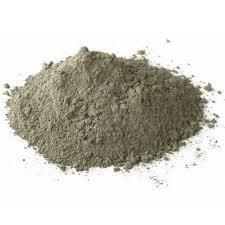
The customary Portland concrete of 53 evaluationsaccessibleinnearbymarketisutilizedinthe examination concrete comes in different kinds and concoction creations. "Standard Portland cement"53 Mega Pascal evaluation of concrete is utilized for concrete. The properties of concrete are utilized for block.
S.NO PROPERTIES VALUES




1 Fineness 9% 2 Initialsettingtime 38min 3 Finalsettingtime 2.30hours 4 Standardconsistency 31.5% 5 Soundness 3mm
Fly debris is finely partitioned buildup coming about because of the ignition of powdered coal and shipped by pipe gases and gathered by electrostatic precipitator.
ASTMextensivelyarrangesflydebrisintotwoclasses:


Fly debris ordinarily created by consuming anthracite or bituminous coal, as a rule has under 5% Cao. Class F fly debris has pozzolanic properties as it were. Fly debris typically created by consuming lignite orsub-bituminouscoal.

Some class C fly debris may have Cao content in overabundanceof10%
Fig 3.2 Fly ash
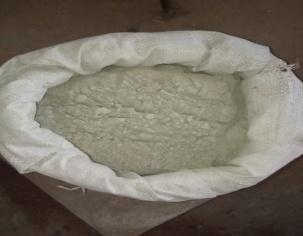
Table No: 3.2 Physical Properties Of fly ash
S.No PROPERTIES VALUES 1 Fineness 6% 2 SpecificGravity 2.6



3.3 Granite dust

Fig 3.1 Cement
Stone residue is a waste material delivered during cutting and cleaning procedure of rock items. This exploration work presents a trial examination on physical, mechanical properties and support consumption obstruction of cement adjusted with rock
e-ISSN:2395-0056
Volume: 09 Issue: 12 | Dec 2022 www.irjet.net p-ISSN:2395-0072
dust.Stoneresidueconcretesubstitutionorexpansionof 5.0%,7.5%,10.0%and15.0%wereutilized.
also. Then crushed debris as sieved in 600 micron. The project includes optimization of the mix, addition of the granite dust with the optimized mix and then tested for compressivestrength,waterabsorptionandweight.The debris is collected from the various locations. Then the debris is crushed manually and the required grain sizes are obtained. Then the blocks are casted in the moulds forthedecidedmixproportionandaretested
The waste building materials, dredging materials, tree stumps, and rubble resulting from construction, remodeling, repair and demolition of homes , commercial buildings and other structures and pavements may All such activities are generating the huge amount of waste, called the Construction and Demolition waste. Disposal of such debris in a safe environment is a big challenge for the builders, developers, and owners. Reduction of this demand is possible only with the reusing or recycling of waste generatedfromtheconstructionactivities.
The brick debris were collected, crushed and sieve d man ually or by usin g mac hine
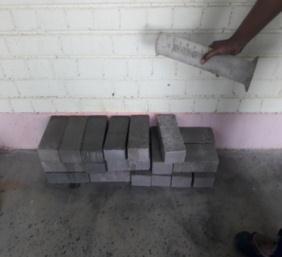
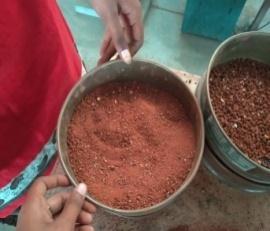
Brick is curing in 7, 14, 28 days. After the second day, waterissprinkledoverthebricksandisdriedfor3days only to sale the bricks. Mostly the bricks are used in buildingconstruction.
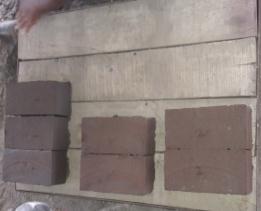
Fig 5.1 Curing of brick
5.2
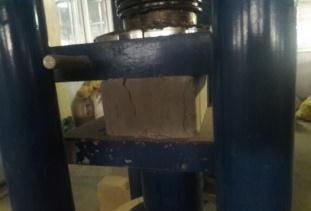
Thepressurequalityofflydebrisblockismultipletimes more prominent than the ordinary dirt block. The base compressive quality of fly debris block is 3.5 N/mm2.So as the fly debris block has compressive quality of 10-12 N/mm2.After the relieving time frame gets over blocks aresavedfortesting.Totesttheexamplestheblocksare putintheadjustedcompressivetestingmachineoflimit 3000KN applied a uniform burden at the pace of 2.9KN/mm2
Fig 5.2 Compressive the brick
International Research Journal of Engineering and Technology (IRJET) e-ISSN:2395-0056
Volume: 09 Issue: 12 | Dec 2022 www.irjet.net p-ISSN:2395-0072
Block is stove dried for 24 hours and weighted. At that point inundated in water for a time of 24 hours. The example are taken out and cleaned with fabric The heavinessofeveryexampleinwetconditionisresolved.
MIX 14 days (%) 21 days (%)
Proportion 1 572 439
Proportion 2 786 556
Proportion 3 7.25 3.36
Proportion 4 995 440
Proportion 5 1095 1014
The present research replicates the effect of products like fly ash, C&D waste added in fly ash oncompressive strength of brick and the following results were obtained.
1) The bricks are tested for both material characteristics and strength. The compressive strength varied from 6 to10 N/mm2 for different mixratios.
2) The significance of C&D waste added in fly ash brick is that the is prepared purely by the waste materials from the industries which will be pollutingtheatmospherewhiledumping.Alsowe can safe guard the top crust of the earth (clay) willbeverymuchnecessaryfortheagriculture.
3) Thus from this study it is concluded that fly ash bricks prepared from waste materials like C&D wasteandGranitewastearealmost equivalentto normal fly ash bricks for mix ratio[Fly ash: C&D waste:Cement:Granitedust]-[50:30:10:10].
1. “An Experimental investigation on Recycling of Bricks ”, Ramkumar .S and Rangaraj .A (2018)
2. Yeotikar V. U.1, Kulkarni G. A. “Experimental Study on Bricks by Using Demolished ConstructionMaterial”(2018)
3. Kathiravan, Ms. Nirmala, Dr. Dhanalakshmi “Performance Of Fly Ash Bricks Using Waste Materials”(2018)
4. Sundharam. R “Experimental investigation by incorporation of fly ash, STP sludge, lime, gypsum and quarry dust in brick making” (2018)
5. Mohit Agarwal, Amit Krishan“ Reusability of Construction & Demolition waste in bricks” (2017)
6. A. Bansal, G. Mishra and S. Bishnoi. “Recycling and Reuse of Construction and Demolition waste”(2016)
7. Appukutty P, Murugesan R, Substitution of Quarry Dust to Sand for Mortar in Brick MasonryWorks,International Journal on Design and Manufacturing Technologies,3(1),2009,59-63.
8. Athijayamani A, Manickam C, Kumar J, Natesan Diwahar, Mechanical and wear behaviors of untreatedandalkali treated roselle fiber-reinforced vinyl ester composite, Journal of Engineering Research, 3 (3),2015.
9. Chandrasekar M, Rajkumar S, Valavan D, A reviewonthethermalregulationtechniquesfor non-integrated flat PV modules mounted on building top, Energy and Buildings, 86, 2015, 692–697.
10. Joseph Ukpata O, Maurice Ephraim E and Godwin Akeke A, Compressive strength of concreteusinglateriticsand and quarry dust as fine aggregate, Journal of Engineering and Applied Sciences, 7 (1), 2012, 81-90.
11. Karthe M, Tamilarasan M, Prasanna S.C, Manikandan A, Experimental Investigation on Reduction of NOX
International Research Journal of Engineering and Technology (IRJET) e-ISSN:2395-0056
Volume: 09 Issue: 12 | Dec 2022 www.irjet.net p-ISSN:2395-0072
12. Emission Using Zeolite Coated Converter in CI Engine, Applied Mechanics and Materials, 854, 2017,72-77.
13. Kartini K, NorulErnida ZA, Noor Fazilla B, Ahmad Farhan H, Development of Lightweight Sand-Cement Bricks using Quarry Dust, Rice Husk and Kenaf Powder for Sustainability, International Journal of Civil & Environmental Engineering,12(6),2012,1-7.
14. Krishnan M, Karthikeyan T, Chinnusamy TR, VenkateshRaja K,Anovelhybrid metaheuristic scatter search-simulated annealing algorithm forsolvingflexiblemanufacturingsystemlayout, EurJSciRes,2012,52-61.
15. ManickamC,KumarJ,AthijayamaniA,KarthikK, Modelingandmultiresponseoptimizationofthe mechanical properties of Roselle fiberreinforced vinyl ester composite, PolymerPlastics Technology and Engineering, 54 (16), 2015,1694-1703.
16. Prabhu T, Ramesh C, Kumar J, Sivakuma S, Hybrid Solar PVT System based on Neural Network Modelsto track optimal Thermal and electrical power, International Journal of Applied Engineering Research, 10 (28), 22075-22081.
17. PrasannaS.C,RameshC,ManivelR,Manikandan A, Preparation of Al6061-SiC with Neem Leaf AshinAMMC’sbyUsingStirCastingMethodand Evaluation of Mechanical, Wear Properties and InvestigationonMicrostructures,
18. Applied Mechanics and Materials, 854, 2017, 115-120. Prasanna S.C, Ramesh C, Property Evaluation of Aluminium Metal Matrix CompositesFabricatedUsingStirCasting
19. Method for Hand Lever In Automobile Applications, International Journal of Applied Engineering Research(IJAER),10(85),2015.
20. Rajakumar S, Balasubramanian V, Balakrishnan M, Friction surfacing for enhanced surface protection of marine engineering components, erosion-corrosion study, Journal of the Mechanical Behavior of Materials, 25 (3-4), 2016,111–119.
21. Ramesh C, Manickam C, Prasanna S.C, Lean Six Sigma Approach to Improve Overall Equipment Effectiveness Performance, A Case Study in the
Indian Small Manufacturing Firm, Asian Journal ofResearchinSocialSciencesandHumanities,6 (12),2016.
22. Ramesh C, Valliappan M, Prasanna S.C, Fabrication of Ammcs By Using Stir Casting MethodForHandLever,InternationalJournalof NewTechnologiesinScienceandEngineering,2 (1),2015.
23. Ramesh M, Karthic KS, Karthikeyan T, Kumaravel A, Construction materials from industrialwastes areviewofcurrentpractices, International journal of environmental research anddevelopment,2014,317-324.
24. Ramesh M, Karthikeyan T, Effect of ReinforcementofNaturalResidue(QuarryDust) to Enhance the Properties of Aluminium Metal, JournalofIndustrialPollutionControl,2013.
25. Ramesh R, Ramesh C, Design, analysis and fabrication of canard wing configuration, International Journal of Research and Innovation in Engineering Technology, 2 (9), 2016.
26. Sethusundaram P.P, Arulshri K.P, Mylsamy K, Biodieselblend,fuelpropertiesand itsemission characteristics Sterculia oil in diesel engine, InternationalReviewofMechanicalEngineering, 7(5),2013.
27. VijayanV,KarthikeyanT,DesignandAnalysisof Compliant Mechanism for Active Vibration Isolation Using FEA Technique, International Journal of Recent Trends in Engineering, 1 (5), 2009