International Research Journal of Engineering and Technology (IRJET) e-ISSN: 2395-0056

Volume: 09 Issue: 12 | Dec 2022 www.irjet.net p-ISSN: 2395-0072
International Research Journal of Engineering and Technology (IRJET) e-ISSN: 2395-0056
Volume: 09 Issue: 12 | Dec 2022 www.irjet.net p-ISSN: 2395-0072
Sai Mukesh Reddy Gutha1 , Laxmi Priyanka Talluri 2 , Akshay Vanaparthi3 , K C Sreedhar4
1,2,3B. Tech Scholars, Department of Computer Science and Engineering, SNIST, Hyderabad-501301, India 4Assistant Professor, Department of Computer Science and Engineering, SNIST, Hyderabad-501301, India ***
Abstract - With increasing in brands, companies and organizations as startups, existing ones as market rulers; Thereisalsoincrementinthe scamsoffake/clonedvariantsof products and services from the existing companies. Users are unable to distinguish between the original and a duplicate variant of the services and products provided from one company or brand. So there comes “Logo Detection Using Machine Learning”, With our detection mechanism, we compare the user provided logo from the original ones and clear the ambiguity of the customers. We also implement service marks such as TM (Trademark), © (Copyright) symbols and slogan/quote verification with the original brands or companies in order to provide the best accuracy as possible to the users depending on our detection mechanism.
Key Words: IndexTermsFeatureExtraction,kNNSearch Tree, Logo Recognition, Nearest Neighbor, SURF, SURF Features
Logos are a critical aspect of business marketing. The Marketingofbusinessmustincludelogos.Acompany'slogo, which serves as its primary visual expression, serves to anchoritsbrandandelevatesitaboveallothersintheeyes ofitstargetaudience.Thismakesaqualitylogoanimportant componentofanybusiness'sentiremarketingplan.There aremillionsofbusinessesandmillionsoflogosintheglobe. To differentiate their brands from those of competitors, businesses often invest a lot of effort and money into creatingdistinctivelogos.Inordertosatisfytheircustomers' requestsandmaintainthelogo's quality,itbecomesfairly difficult for logo designers. Features of a logo are a huge concern when defining the requirements for developing a logo,andforthisreason,logorecognitionplaysalargerole.
Corporate logos are used to represent the "face" of an organisation.Theyarevisualrepresentationsofacompany's distinctive identity that use colours, fonts, and pictures to conveyvitaldetailsaboutthebusinessandhelpclients'core brandsberecognisedbytheirtargetaudiences.Additionally, logos serve as a convenient abbreviation for the company name in marketing and advertising materials. They also serveasaunifyingelementforthenumerousfonts,colours, and design options used in all other corporate marketing materials.Thegoalofthethesisistovisualisetheassociated, comparable elements that previously belonged in the current logos, which will aid the designer in creating a matching,distinctivelogoforafirm.Itwillalsobeusefulfor
the customers of the logo to acquire accurate information about whether the logo was created as a master work or whether it was copied by any other party. designed as a ma s te r pi ec e o r it i s co p ie d byanyotherlogos.
• Dr. Kazi A. Kalpoma is working as Associate ProfessoratFacultyofSci-enceandInformationTechnology in American International University- Bangladesh (AIUB), Bangladesh, PH-+880-1819127854. E-mail: kalpoma@aiub.edu
• Umme Marzia Haque is working as Lecturer at FacultyofScienceandInformationTechnologyinAmerican International University-Bangladesh (AIUB), Bangladesh, PH-+880-1685116227.E-mail:marzia@aiub.edu
Aconsumer'sabilitytoaccuratelyidentifyacertainitemor service based only on its logo, tagline, packaging, or marketingcampaignisknownaslogorecognition.
Researchers have used string-matching techniques [4-6], templatematching[7],combinedmeasure[8],algebraicand differential invariants [1], positive and negative form features[2],Zernikemoments[3],andinteractivefeedback [9]toworkondetectinglogos.Wemaybuildanddevelopa system for detecting logos of various corporations and organisationsbyusingmethodspreviouslyutilisedforface detection,identification,andfingerprintdetection.
Previously, a car logo could be recognised using SIFT characteristics[13][14].
In this study, SURF characteristics are used to offer a technique of logo recognition. SURF: "Speeded Up Robust Features" is a functioning interest point detector and descriptorthatisscale-androtation-invariant.
A mix of innovative description, matching, and detection stagesareproduced by SURF.Itisshownin experimental findings[16]onimagestakeninthecontextofareal-world objectrecognitionapplicationandonastandardevaluation set.BothexhibitSURF'soutstandingperformance.Because ofthis,SURFcharacteristicsareusedtoidentifylogos.
This study uses a kNN search tree to find the closest neighbours of the matched characteristics in order to identifyalogo.Itwasutilisedinfacialrecognitionpreviously [17]. A straightforward algorithm called kNN categorises newinstancesbasedonasimilaritymetricafterstoringallof
International Research Journal of Engineering and Technology (IRJET) e-ISSN: 2395-0056
Volume: 09 Issue: 12 | Dec 2022 www.irjet.net p-ISSN: 2395-0072
the existing data (e.g., distance functions). Statistical estimationandpatternrecognitionbothrequirekNN[18].
SURF properties are taken into account in our suggested approachforrecognisinglogos.Understandingwhatafeature is,how featuresare categorised,and whichcharacteristics are deemed SURF features are all necessary for understanding SURF features. Understanding how SURF characteristics may be recognised after understanding the principlesbehindthemiscrucialtocomprehendingthislogo recognitionmethod.
Thedistancebetweentwoclosestneighboursofthefeatures isdeterminedusingakNNsearchtreeinthismanner.
SURFisaperformingscaleandrotation-invariantinterest point detector and descriptor which outperforms repeatability, distinctiveness and robustness, yet can be computedandcomparedmuchfaster.
Itisaccomplishedby
- usingintegralimagesinimageconvolutions
- enhancing the effectiveness of the best existing detectors and descriptors (using a distribution-based detector and a Hessian matrix-based measure for the detector)
-Reducingthisapproachtoitsbareminimum
The detectSURFFeatures function, which employs the Speeded-UpRobustFeatures(SURF)techniquetolocateblob features,isusedtofindSURFfeatures.
AKDTreeSearcherobjectdepictsakNN(k-closestneighbour)
searchusingakd-tree.KDTreeSearchermodelobjectshold results of a nearest neighbours search using the Kd-tree algorithm. The data utilised, the distance metric and parameters,andthemaximumnumberofdatapointsineach leafnodeareallsavedbysearchobjects.Sparseinputdata cannotbeusedtobuildthisobject.Whencomparedtothe ExhaustiveSearcherobject,thisobjectoftenperformsbetter for lower dimensions (10 or less) and worse for bigger dimensions.
Twoclosestneighboursinthedatasetarediscoveredforeach featureinthepicture,andthedistancetoeachneighbouris
calculatedusingthekNNSearchfunction.Evenifnoneofthe characteristics are a close match, the kNNSearch method nonethelessreturnstheclosestneighbours[11].
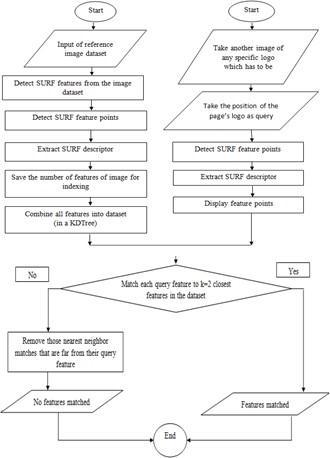
In this work of ours, a dataset of logo images is used, and fromtheimagesofthelogos,featurepointsarediscovered andshown.ByinitialisingaKDTreeSearcherObject,allofthe image's features from the dataset are integrated into a featuredataset.Aquerypictureisonethathastheitemtobe identifiedloadedintoit,andtheobjectischosenbydefining aboundingboxthatenclosestheobject.Thequeryimage's feature points are identified and shown. Two closest neighboursarelocatedinthedatasetforeachfeatureinthe query picture, and the distance to each neighbour is calculated. Even if none of the characteristics are a close match,thekNNSearchfunctionisutilisedtoyieldtheclosest neighbours. To exclude the poor matches, a ratio of the distancesbetweenthetwonearestneighboursiscalculated. Asa result, the wholeprocedureisbroken downintotwo portionsthatareeachdetailedindepth,stepbystep,inthe ProposedAlgorithmsection,andthenvisuallyrepresented byaflowchart.
Step1: Assembling the database of photographs for the searchThecollectionofreferencephotographsisseen,each of which has a unique logo. To capture obscured or concealed regions, this collection might comprise many perspectivesofthesameitem.
Step2:FindingthefeaturepointsinaseriesofimagesThe first image's feature points are identified and shown. Utilizing local characteristics serves two objectives. The quantity of data that has to be kept and evaluated is decreased as a result of making the search process more resistanttochangesinsizeandorientation.
Ama-trixiscreatedbyaddingalloftheattributesfromeach picture together. The Statistics ToolboxTM's KDTreeSearcherobjectisinitialisedusingthismatrix.This object enables quick closest neighbour searches for highdimensional data. In this situation, an SURF descriptor's closestneighbourmightbeanotherviewpointofthesame location.
Thelogoischosenbydefiningaboundingboxthatencloses theitemafterloadingapicturethatincludesthelogo.
Step 5: Finding feature points in the requested picture Feature points in the requested picture are found and shown.
Step6:Searchingtheimage'sclosestneighbours
International Research Journal of Engineering and Technology (IRJET) e-ISSN: 2395-0056
Volume: 09 Issue: 12 | Dec 2022 www.irjet.net p-ISSN: 2395-0072
Twoclosestneighboursarelocatedinthedatasetforeach featureinthequerypicture,andthedistancebetweeneach neighbouriscalculated.Evenifnoneofthecharacteristics areaclosematch,thekNNSearchmethodreturnstheclosest neighbours.Aratioofthetwonearestneighbourdistancesis utilisedtodiscardsuchpoormatches.Moreinformationon thismethodisprovidedin[11].Thenumberoffeaturesfrom eachpicturethatmatchedaretalliedusinghistc.Eachpairof indicesthatcorrespondstoapictureintheindexintervals below makes up an index interval. Every picture in the collectioniscomparedtothequeryimagetodeterminehow closelyitmatches.Eachpicturebelowisscaledaccordingto thequantityofmatchingcharacteristics.Itisshownthatthe desk-containing picture is still regarded as a good match. Thenextstepeliminatesitasananomaly.
Step7:Distancetestsareusedtogetridofoutliers.
Thedatasetdoesnothaveanyfeaturesthatmatchseveralof theSURFfeaturesfoundinthequerypicture.Itiscrucialto exclude closest neighbour matches that are distant from their query characteristic in order to avoid false matches. Whencomparingthedistancesbetweenthefirstandsecond closest neighbours, it is possible to identify the poorly matched characteristics. The match is disqualified if the distancesarecomparableasdeterminedbytheirratio[1]. ignorematchesthatarefarapartarealsoprohibited[12].
Matlabisusedtocarryoutthistask.Herearesomeofthe findings.Thisexperimentmakesuseof manydatasets. To demonstratehowthisexperimentwasgenuinelyconducted, justonedatasetfromthesesourcesisprovided.
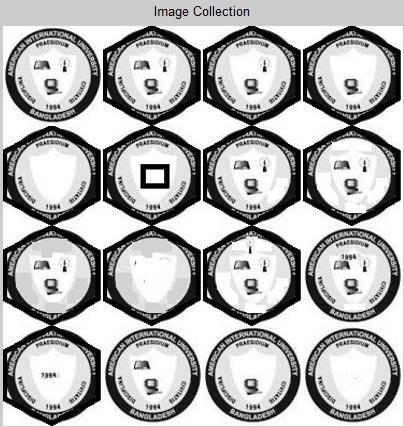
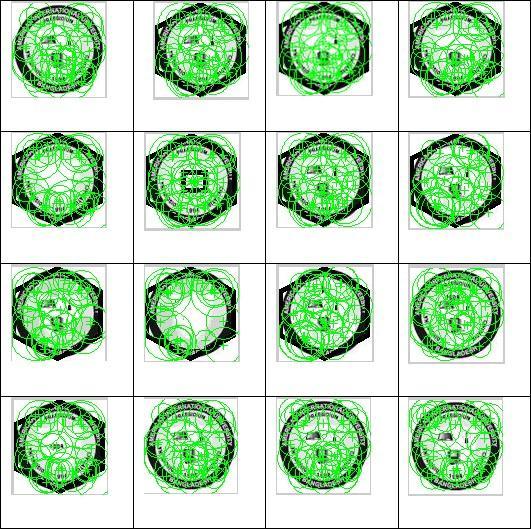
This implementation starts with a selection of AIUB institution logo pictures, all of which include both the originalinstitutelogoandanalteredversionoftheoriginal copytotheleftofthem.Attheconclusionofthistrial,the original AIUB logo iseffectively identified. Some elements fromtheoriginaleditionaremissingorhavebeenreplaced inthe altered versions. In Table 1, it is shown. TheoriginallogofromTable1ispositionedinthefirstrow, furthesttotheleft.Itisapparentthattheotherphotosonthe left are altered versions of the original logo that include otherelementsthataremissingfromtheoriginalimage.One ormoreelementsaremissingfromthealteredcopiesofthe originalpicture,ortheremaybemorethanoneelementthat wasabsentfromtheoriginalcopy.
Table -1: REFERENCEIMAGEDATASETI
SamelogomodifiedinTable1by:
Removal of one, two, or more elements from the originalcopyofthereferencepicture.
The addition of a square shape within the logo, a hexagonoutsidethelogo'sroundedborder,andthe copyingandinsertionofalogocomponent.
Theidenticallogohasitscomponentsremovedand a hexagonal form added outside of its circular border.
Fig -1:showstheflowchartofourproposedmethod description
Strongest SURF feature points of each picture collectionarefoundusingthesuggestedapproach after collecting the reference image dataset, as showninTable2.
International Research Journal of Engineering and Technology (IRJET) e-ISSN: 2395-0056
Volume: 09 Issue: 12 | Dec 2022 www.irjet.net p-ISSN: 2395-0072
Amatrixiscreatedbycombiningalloftheattributesforeach pictureinTable2.InordertocreateanSURFfeaturedataset, thismatrixisutilisedtoestablishaKDTreeSearcherobject from the Statistics ToolboxTM. This object enables quick searchesforhigh-dimensionaldata'sclosestneighbours.
Thelocationofthelogo'soriginalpictureisthencapturedin animage.Arectangularbox,asillustratedinFig.2,isusedto specifythelocationwherethepicturecontainsthelogo.
Fig -3:AIUBwebpagecontainingAIUBlogoattheleft corneroftheimagedefinedbyasquare
Thequeryimage'sstrongestSURFfeaturepointsarefound. Foreveryofthecharacteristicsinthequerypicture,thekNN searchalgorithmisusedtolocatethetwoclosestneighbours in the dataset. Each neighbor's distance is calculated. Thenumberofcharacteristicsthatmatchedfromeachimage inTable2istalliedusingtheMatlabfunctionhistc(which stands for Histogram Count). Each pair of indices in the index intervals below makes up an index interval that is showninFig.4andcorrespondstoapicture.
Fig. 3. AIUB webpage containing AIUB logo at the left corner of the image defined by a square
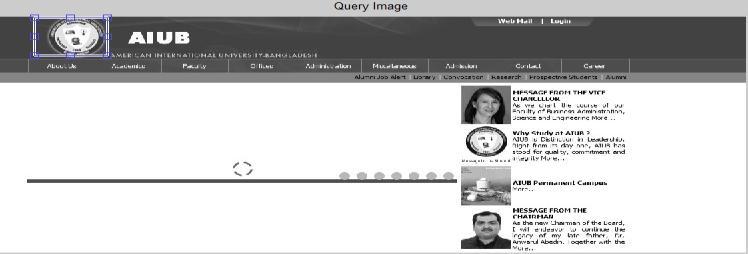
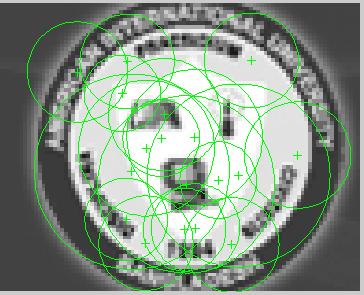
Fig -2:AIUBwebpagecontainingAIUBlogoattheleft corneroftheimagedefinedbyasquare
Fig.3isregardedasasearchpicture.StrongestSURFfeature pointsfromthequestionpicturearefoundusingthesame methodasforthereferenceimage,asillustratedinFig3.
Fig. 2. AIUB webpage containing AIUB logo at the left corner of the image defined by a square
Fig -4:Thenumberoffeaturesiscountedthatmatched from
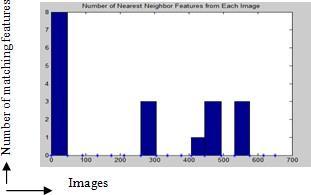
Theproportionofeachpictureinthecollectionthatmatches thesearchimageinTable3helpstoillustratethestrength. FromFig.4andTable3,itisclearifthequerypicturehasthe features or how much of it resembles the stored feature datasetfromTable2.Theproportionofeachpictureinthe collectionthatmatchesthesearchimageinTable3helpsto illustratethestrength.FromFig.4andTable3,itisclearif the query picture has the features or how much of it resemblesthestoredfeaturedatasetfromTable2.
Fig. 4. The number of features is counted that matched from
International Research Journal of Engineering and Technology (IRJET) e-ISSN: 2395-0056
Volume: 09 Issue: 12 | Dec 2022 www.irjet.net p-ISSN: 2395-0072
Even if none of the characteristics are a close match, the kNNSearch function is used to get the closest neighbours withk=2.
Nearestneighbordistanceratiomeans:
1) Distancesbetweenthedescriptorinonepictureand itsfirstandsecond-closestneighboursinthesecondimage arecalculated.
d1 = d (desc1_img1, descA_img2); d2 = d (desc1_img1, descB_img2).
2) Distance ratio calculation R = d1/d2. Match is probablyexcellentifR0.6.Itisdonebecause,regardlessof howawfulthesecondpictureis,the"nearest"descriptorwill beobtainedfromitdueofratiochecking.Toavoidthefractionalsection,ratiosareshownbymultiplyingby100.
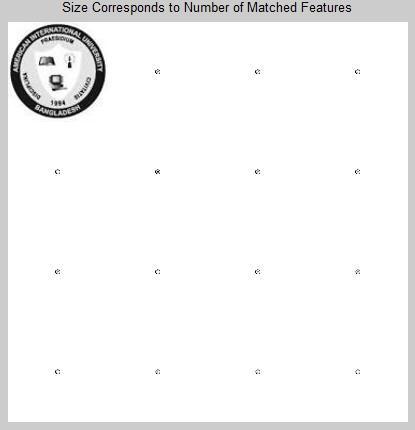
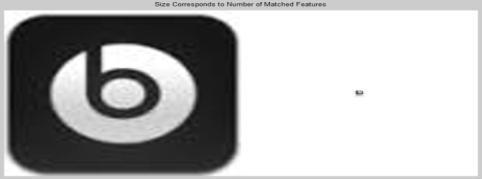
Aratioofthetwonearestneighbourdistancesisutilisedto discard such poor matches. By comparing the distances betweenthefirstandsecondclosestneighbours,thepoorly matched characteristics are discovered. The match is disqualifiedifthedistances,asdeterminedbytheirratio,are comparable.Furthermore,far-offmatchingfeaturesarenot taken into account.ThefinalresultisshowninFig.5 by displaying the biggest icon for the matching characteristics and demonstrating how the logo is recognised if the query picture is already in the image collectioninTable1.
Fig -5:Thematchednearestneighborsthatarefarfrom theirqueryfeatureareremoved
Thisresultdemonstratesthatthereferenceimagedataset's firstlogopicturefromTable1canbeidentifiedastheAIUB logo.

For the purpose of evaluating our performances, the implementedsuggestedapproachisusedonanewexample usingtheidenticalprocessesasbefore.
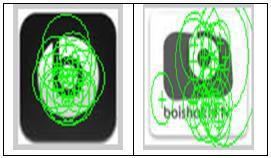
Fig -6:CollectionofreferenceimagesdatasetII
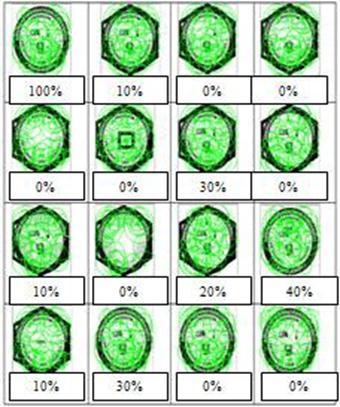
Fig -7:DetectionoffeaturepointsfromFig6
Fig. 7. Detection of feature points from Fig 6
International Research Journal of Engineering and Technology (IRJET) e-ISSN: 2395-0056
Volume: 09 Issue: 12 | Dec 2022 www.irjet.net p-ISSN: 2395-0072
Theresultsofthissuggestedapproacharetestedusingthe logosoftheBeatsmusiccompanyandBaisakhiTVbecause ofhow similar they both seem to be. Tocompare,findtheaspectsthatarecomparable.Anylogo that is compared to other logos may have certain design elementschangedtoimprovethebrand'squalityandvalue and give the logo a grade.Twologos (Beats,BaisakhiTV)areusedasareferenceimagecollection inFig.6.Thereferencephotos'characteristicsareidentified. Fig. 7 displays the reference picture collection's feature points.
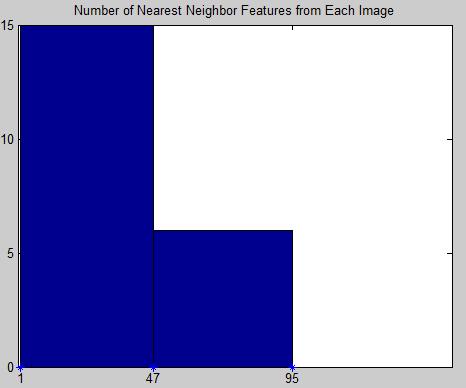
TheBeatslogoisderivedfromtheBeatswebsite,whichis used to contrast the picture collection. The Beats logo is chosenfromthewebsitebydefiningaboundingboxaround the logo in Fig. 8 and treating it as the query image. The queryimage'sfeaturepointsareidentifiedandshowninFig 9 as features. Using histc, Fig. 10 counts the number of characteristicsfromeachpicturethatmatched.Eachpairof indices in the index intervals in Fig. 11 together form an indexintervalthatcorrespondstoonepicture.
Fig -8:ChoosequeryimagefromBeats’swebsite
Fig. 8 Choose query image from Beats’s website
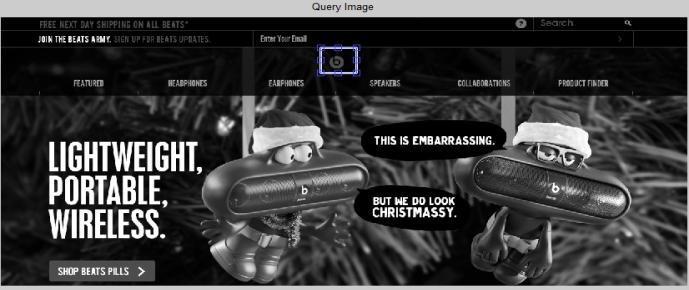
Fig -9:Detectionoffeaturepointsfromqueryimage
Fig -11:Logocompletelymatchedtothestoredfeatures aftereliminatingfalsematches
IOnlygrayscalephotographsaretakenintoaccountinthis study.Fewlogopicturesareincludedinthereferenceimage collection used in our investigation. In a big reference picture, the proportion of matching features may be improved.
Inordertoassessthedegreeofuniformityintheuseofthis logo recognition technology, logos are compared. It is determined by the degree of similarity between the collection of logos, or roughly the proportion of correctly matching a certain logo with another group of logos. Furthermore,ifwehaveahugereferencepicturecollection, eachorganization'slogomaybeidentifiedwithoutadoubt. Better recognitionresults wouldarise from more training examples. Only SURF characteristics are taken into consideration for the proposed technique at this time; hereafter,morefeaturesmaybeincluded.Inthispaper,the distanceisdeterminedusingthekNNsearchingalgorithm; other algorithms may be employed, and a comparison of suchalgorithmsmaybeconductedinfuturework.
Fig -10:Matchednumbersoffeatures
Inthisworkanewtechniqueoflogorecognitionisprovided.Ourtechniquecanunderstandthesimilaritiesamongthe setoflogosclearly.OnlytheSURFfeaturesareconsidered inthisworkwhichgivesaclearconceptthathowcanalogo be recognized. It measures the matching percentage of a specificlogobasedontheseSURFfeatureswithothersetof logossuc-cessfully.Itwillbeabletoassistthedesignersto createanewconceptfor logo designing by this technique. Italsocanbehelpfulforlogoevaluationandmaintainingthe standardleveloflogodesigning.
International Research Journal of Engineering and Technology (IRJET) e-ISSN: 2395-0056 Volume: 09 Issue: 12 | Dec 2022 www.irjet.net p-ISSN: 2395-0072
[1] D. Doermann, E. Rivlin, I. Weiss, Applying algebraic anddiferential invariants for logo recognition,Mach.VisionAppl.9(1996)73–86.
[2] A. So#er, H. Samet, Using negative shape features forlogosimilarity match- ing, Proceedings of the FourthInternationalConferenceonPatternRecognition,Brisbane,Australia,1998,pp.571–573.
[3] Y.S. Kim, W.Y. Kim, Content-based trademarkretrievalsystem using a visual- ly salient feature, ImageVisionComput.16(1998)931–939.
[4] T.A. Twan, Linear document processing, Ph.D. Thesis, Schoolof Computer Engineering, Nanyang TechnologicalUniversity,1998.
[5] H.L. Peng, S.Y. Chen, Trademark shape recognition usingclosed contours, Pattern Recognition Lett. 18 (1997)791–803.
[6] G. Cortelazzo, G.A.Mian, G. Vezzi, P. Zamperoni, Trademarkshapes descrip- tion by string-matching techniques,PatternRecognition27(8)(1994)1005–1018.
[7] A.K.Jain,A.Vailaya,Shape-basedretrieval:acasestudywith trademark image database, Pattern Recognition 31 (9)(1998)1369–1390.
[8] B.M.Mehtre,M.S.Kankanhalli,W.F.Lee,Shapemeasuresfor content based image retrieval: a comparison, Inf. Process.Manage.33(3)(1997)319–337.
[9] G. Ciocca,R. Schettini,Content-basedsimilarityretrieval oftrademarksusingrelevancefeedback,PatternRecognition 34(2001)1639–1655.
[10] F.Cesarini,M.Gori,S.Marinai,G.Soda,Ahybridsystemfor locating and recognizing low level graphic items,International Conference on Graphic Recognition, LectureNotes in Computer Science, Vol. 1072, Springer, Berlin,1996,pp.135–147.
[11] D.Lowe,"DistinctiveImageFeaturesFromScale-Invariant Keypoints,"Inter-nationalJournalofComputerVision,60,2 (2004).
[12] K.MikolajczykandC.Shmid,,APerformanceEvaluationof LocalDe-scriptors,IEEEPAMI,27,10(2005).
[13] L.Xia;Dept.ofComput.Sci.&Technol.,ShanghaiJiao Tong Univ., Shanghai ;Feihu Qi ; QianhaoZhou,A learning-based logo recognition algorithm using SIFT and efficient correspondence matching (2008).
[14] P.,A.P.;DEPT.OFELECTR.&COMPUT.ENG.,NAT.TECH. UNIV. OF ATHENS, ATHENS, GREECE; ANAGNOSTOPOULOS,C.-N.E.;KAYAFAS,E.,VEHICLELOGO RECOGNITION USING A SIFT-BASED ENHANCED MATCHINGSCHEME(2010).
2022, IRJET | Impact Factor value: 7.529 | ISO 9001:2008 Certified Journal |