International Research Journal of Engineering and Technology (IRJET) e-ISSN: 2395-0056

Volume: 09 Issue: 12 | Dec 2022 www.irjet.net p-ISSN: 2395-0072
International Research Journal of Engineering and Technology (IRJET) e-ISSN: 2395-0056
Volume: 09 Issue: 12 | Dec 2022 www.irjet.net p-ISSN: 2395-0072
1
, Prof. Sagar Korde2
1Student, Dept of Information Technology, K.J. Somaiya College of Engineering, Mumbai, India
2Faculty,Dept of Information Technology, K.J. Somaiya College of Engineering, Mumbai, India ***
Abstract – Verifying a candidate's CV is crucial when recruiting for a company or accepting students for education. In all circumstances, we must ensure that the applicant supplies the system with accurate and legible data. The forgery of certificates and papers is a big roadblock in this procedure. Also, handling applicants' constant requests for copies of their academic certificates or other documents, and exchanging documents like transcriptsbetweenorganizations can be a tedious task for the organizations.Weareattempting to overcome these obstacles and simplify the procedure through this initiative. This paper's objective is to provide a full explanation of the application. It will describethesystem's goal and characteristics, its interfaces, the limitations it must work under, and how the system will respond to external inputs. Along with that, we strive to make the task easier for the students or applying employees and for the educational institution and organization. The current system takes a lotof time and energy to process these documents. The new blockchain system based on Hyperledger Fabric will make the process much more streamlined.
Key Words: Hyperledger fabric, Blockchain, Education, Credential Verification, Verified Documents.
One of the greatest challenges in today’s world when it comes to appointing someone in any position of responsibilityisensuringthatpersonhastherightskillset forthejob.Usually,thisisdonebylookingatanindividual’s past records like his education, experience, and any other credentialthatmightberelevanttotheposition.
However, in recent times with the advent of technology it has become very easy to produce documents like degree certificates, score results, experience letters, or any other typeofachievementorcertificatewhicharenotauthentic. Thisposesahugeproblemfororganizationsthatpaylarge sums of money for an individual to occupy a position of responsibility and for educational institutions that accept students for advanced education based on their previous accoladeswhenthatpersonmightnothavetheaptitudefor thepositionatall.Inbothcases,weneedtoverifythatthe candidate provides correct and legible information to the system.Certificateanddocumentsforgeryisamajorhurdle, inthisprocess.
Under the existing system, organizations are not able to efficientlydifferentiatebetweentrueandforgeddocuments whichmaybesubmittedbysomeapplicants.
Inordertotacklethis,someorganizationsdirectlycontact the institution which has issued the credential for verification, but this processislongandcumbersome and ofteninvolvesmonetarycompensation.Anotherdrawback alsoincludestheamountofpaperworkandtimerequiredfor anyprocesslikeadmissions,orrecruitment,whichinvolves the exchange of documents. Through this project, we are tryingtoleveragetheadvantagesofblockchaintechnology like data integrity and immutability to overcome these hurdlesandstreamlinetheprocess.Wehavemadeanonline platformbasedonHyperledgerFabricwhichoffersaneasy way to issue, check and verify academic certificates by various organizations like schools, colleges, universities, onlinecertificationsplatforms,companies,etc.Italsohelps organizationstoreducetheimmenseamountofpaperwork, savemoney,aswellasprovidetheapplicantswithalltheir documentsinasingleplacearoundtheclock
Bitcoin's decentralized architecture, which uses Blockchain technology and the proof-of-work consensus method,increasedtransactiontransparency,trust,andhence verifiability.(refertobitcoinpaper).Yetitlackedawayto implement business logic into the system. Vitalik Buterin publishedawhitepaperinlate2014thataddressedBitcoin's flaws,andasaresult,hedevisedanddevelopedthethen-new conceptofsmartcontracts.Thesmartcontractwasanovel approach to applying business logic, but the Ethereum platformwasbasedoncryptocurrencies andminingandit alsowas a public blockchain on top of that. (refer to Ethereumpaper).Organizationsneededsomethingwherethe addingofentitiesintheblockchainispermissioned.Thiswas achievedbyHyperledgerFabricwhichgavemanyperkslike fastertransactionspeed,andmultiplelanguagesupport.
(Privacy-preserving transparent supply chain management through Hyperledger Fabric Deebthik Ravi, Sashank Ramachandran, Raahul Vignesh, Vinod Ramesh Falmari,M.Brindh).Thegoalofthisstudyistolookintohow Blockchain might help improve supply chain management standards.ThisarticlealsoexplainshowtouseHyperledger
International Research Journal of Engineering and Technology (IRJET) e-ISSN: 2395-0056
Volume: 09 Issue: 12 | Dec 2022 www.irjet.net p-ISSN: 2395-0072
Fabric,a permissionedblockchainplatform,toexecutethe proposedconcept.Inthispaper'sscope,currentsupplychain concerns such as data integrity, provenance transparency, privacy,andsecurityareaddressedmorespecificallyinthe contextofthecoffeesupplychainbusiness,whilealsoseeking togeneralizethesolutiontoeffectivelyhandleothersupply chainactivities.
(Securityanalysisofablockchain-basedprotocolforthe certification of academic credentials Marco Baldi, Franco Chiaraluce,MigelanKodraandLucaSpalazziDipartimentodi Ingegneria dell’Informazione Universita Politecnica delle Marche`Ancona,Italy,60131).ThestudylooksatBlockcerts, a blockchain-based protocol for certifying academic credentialsthatiscurrentlybeingutilizedaroundtheworld tovalidatedigitalcertificatesofcompetencethatcomplywith the Open Badges standard. It investigates the certification stagesusedbytheBlockcertsprotocoltocertifyacertificate and discovers that they are vulnerable to impersonation attacksofacertainsort.Inmoredetail,authenticationofthe issuing institution is accomplished by retrieving an unauthenticated issuer profile from the internet and comparing some of the data reported there with the data containedintheissuedcertificate.Itdemonstratesthatan attacker can impersonate a legitimate issuer and produce certificatesthattheBlockcertsvalidationmechanismcannot distinguish from originals by constructing a false issuer profileandgeneratinganappropriatelychangedcertificate. Wepresentsomepossibledefensestosuchanassault,which entail the usage of either a traditional public key infrastructure or a decentralized identity system that is connectedwiththeBlockcertsprotocol.
(Eductx: A Blockchain-Based Higher Education Credit PlatformBy(MuhamedTurkanović,MarkoHölbl ,Kristjan Košič, Marjan Heričko, Aida Kamišalić.))It is a globally trusted, decentralizedhigher educationcreditand grading system that can provide a globally united viewpoint to students, higher education institutes (heis), and other potentialstakeholderssuchascorporations,institutions,and organizations.Oneoftheissueswiththeapproachdescribed above is that it excludes corporations and educational institutions,makingthesolutionuntrustworthybecausethe decisionauthorityisathirdparty.
(Blockchain,academicverificationusecaseby(Federico Bond, Franco Amati, Gonzalo Blousson)). Since blockchain technologyprovidesbettertransparency,lowermaintenance, andlowercostthantraditionaloptions,weproposeusingit to verify the legitimacy of academic certificates using techniquessuchasdigitalsignaturesandtimestamps.Based on discussions made on the stage of the inaugural Bitcoin forum hosted by the administration of Ciudad de Buenos AiresonJuly31,2015.
Apermissionedblockchaincouldbeusedtoclosethese loopholes. Permissioned blockchains, in addition to the benefitsofapublicblockchain,providevariouscapabilities suchasprivatedatasharing,completeanonymity,andmore, potentially making it the ideal choice for businesses. Hyperledger Fabric and other permissioned blockchain systemsprovideapluggableconsensusmechanismaswellas cutting-edgeblockchainsecurity.Inthissituation,themajor researchquestionswouldbe:
(i) What would be the paradigm transition froma centralized to a decentralized education and hiringsystem?
(ii) Howcanweovercometheflawsofclassicnonblockchainsystems?
(iii) Furthermore, howcan one go beyond a public blockchain to address issues like privacy, scalability,andmodularity?
(iv) Whatwouldbethebestmethodforbridgingthe importantgapofcompleteanonymity?
(v) How can a network built on permissioned blockchain technology produce a stable and balanced system that meets all of the above criteria?
Candidates’CVverificationisamajortaskforhiringan organization and accepting students for higher education. Thistaskisoneofthemosttimeandresourceconsumptive undertheexistingsystem.Manyofthemethodsusedhere areoutdatedandinvolveunnecessarymanualwork,which canbeeasilyreplacedbyfasterandmoresecuremethods
This manual method involves contacting the issuing authorityforverificationwhichisatediousprocessandmay takevaryingamountsoftimeandeffortdependinguponhow cooperative the issuing authority is, as there is no standardized procedure for this. Also, the process of organizationsrequiringtohandletheapplicants’requestsfor copiesoftheirdocuments,andtheexchangeofdocuments when changingthe organization requiresa lot of timeand tremendous paperwork and also involves monetary compensation.
Apartfromthis,thetraditionalnon-blockchainsystemalso has many other fundamental flaws in its system. These includebutarenotlimitedto
a. Non-transparency.
b. Data tampering and falsification which can be causedbyhumanintervention.
International Research Journal of Engineering and Technology (IRJET) e-ISSN: 2395-0056
Volume: 09 Issue: 12 | Dec 2022 www.irjet.net p-ISSN: 2395-0072
c. Limitedscalability.
These issues mainly arise from the use of a centralizedsystemandthuscanbeeasilysolvedifa privatepermissioneddecentralizedblockchain-like systemisputinplaceinstead.Someofthefeatures of a private blockchain network that make it a perfectcandidateforreplacingtheexistingsystem are–
Transparency.
DataIntegrityandImmutability.
Nosinglepointoffailure.
Scalableforverylargenetworks. Nomanual/humanintervention.
Onlytrustedorganizationswillbeaddedto aprivatepermissionednetwork.
Why Hyperledger fabric?
ForEducationalandEmployment,wehavetoconsider thefollowingrequirements.
Network needed to be Permissioned
Hyperledger fabric is a distributed ledger technologythatispermissionedinnature.It means that all the organizations which are added to the network are known to each other. In blockchains like ethereum, bitcoin theparticipantsarenotknowntoeachother whereas in the case of the Education and Employment sector organizations should know each other and should be enrolled by sometrustedauthority.InHyperledgerFabric the Membership Services serves as the authority, which enrolls the trusted and verified organizations and gives them a cryptographiccertificate.
Hyperledger Fabric provides pluggable consensus which means that you can use consensus mechanisms as per your need. In blockchains like bitcoin and ethereum only ProofofworkandProof ofStakealgorithms can be used for consensus. The small organizations don't have sufficient computational power for mining and other stuffsoEthereumandotherblockchainscan be used for this purpose whereas in Hyperledger Fabric we can implement our own consensus algorithm which makes it suitableforourpurpose.
PrivacyandConfidentialityoftheapplicant’s data are of utmost importance in the EducationandEmploymentsector.Thedataof all the students and employees need to be secured. To store the applicant’s data HyperledgerFabricprovidesalargevarietyof cryptographyalgorithmsandprotocols.
Large Programming Language support Chaincode in Hyperledger Fabric can be written in a variety oflanguagessuchas go, nodejs,java,python,etc.Theselanguagesare very general, the developer won't have to learnanewsetoflanguagesfordevelopment.
Unlike Ethereum and Bitcoin blockchain, Hyperledger fabric does not use any cryptocurrency.FortheEducationblockchain thereisnorequirementofcryptocurrencyor fuel for running the smart contracts and for anytransactionprocessing.Educationsector shouldnotinvolveanycurrencywhichmakes Hyperledgerbestsuitforourproject.
Any representative of the organization who wantstojointheconsortiumcancontactthe Membership Service Provider (MSP) or the concernedauthoritysendingthedetailsofthe organization.TheMSPcanverifythedetails, genuineness and other necessary security checks of the organization in order to maintain and increase the credibility of the consortiumbynotallowingfakeordoubtful organizationstobeapartofthenetwork.The MSPcanlatersendtherequiredconfiguration details like the required scripts and keys in ordertomaketheorganizationsetupitspeer andjointhenetwork.Theadminwhowillbe representingtheorganizationhastolaterrun the configurations on a server or computer which will be later recognized as the
International Research Journal of Engineering and Technology (IRJET) e-ISSN: 2395-0056
Volume: 09 Issue: 12 | Dec 2022 www.irjet.net p-ISSN: 2395-0072
representative peer of the organization. The organization then uses the configurations, identifies itself in the network and also performsoperationsintheblockchain.
Theapplicantwhowantstojointhenetwork can contact the applicant organization of his/herregion.He/shecansendtherequired details to the organization. The applicant organizationcanthenaddtheapplicanttothe network.Theapplicantthenbecomesapartof the network and is also eligible to perform his/her permissioned operations on the network. A temporary password will be shared with him via mail. He can login and changethepasswordimmediatelyassoonas heisregisteredtothenetwork.
Therearemainly3charactersinthesystem namelyAdmin,registrarandApplicant.
An admin is created for each organizationthatjoinsthenetwork. The details of the admin must be present during the addition of the organization to the network. The admin details (username and password)arepresentinthefabricca-server-config.yaml of the respective organization CA configuration. The admin can add a registrar for their organization and theadmincanviewalltheregistrars oftheorganization.
The registrar can view the Organizationdashboardwhereallthe documents issued to the applicants by that organization are displayed. Registrarcanalsoviewallthecurrent andpreviousapplicantsbelongingto theirorganization.Registrarcanview the personal details and academic recordsoftheapplicantiftheyhave grantedthepermission.Registrarcan verifytheselfuploadeddocumentsof anapplicantandafterverificationthe statusofthedocumentgetschanged to verified. The registrar can also
updatethecurrentorganizationofan applicant. Applicant:
Theapplicantgetshiscredentialsfromthe applicant organization. The applicant can viewhisdashboardwherealltheacademic and other certificates are visible to him. Applicants can view their profile, update their personal details. The applicant can create self uploaded documents, this feature allows them to add their existing nondigitalcertificatestothenetworkand get them verified by the concerned organization (Only the organization who has previously provided the hardcopy of the document is allowed to verify the document).Theregistrarcanthanviewthe document,confirmthegenuinenessofthe documentandthenverify(changethestatus of the document to verify). The applicant hastherighttograntorrevoketheaccess to/from the organization. When an applicantgrantsaccesstotheorganization only then the organization can view applicants personal details and all his documents.
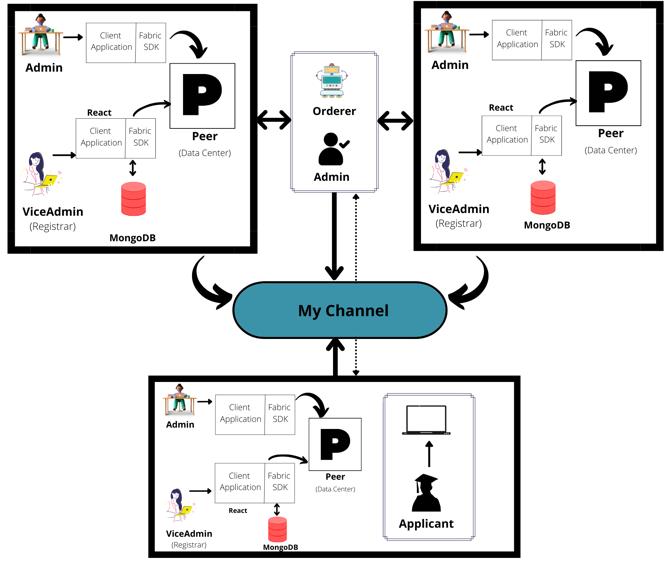
Figure1showstheproposedarchitecture ofthenetwork.Belowarethecomponents ofthehyperledgernetwork:
MembershipServiceProvider:
AMSPmanagesthehierarchyofthenetwork andalsotheidentities.Itprovidestheidentity fororganizations,i.eforthepeers,orders,etc. ItincludestheTLScryptomaterialsforsecure communication. There can be one or more MSPsinanetwork.
International Research Journal of Engineering
Technology (IRJET) e-ISSN: 2395-0056
Volume: 09 Issue: 12 | Dec 2022 www.irjet.net p-ISSN: 2395-0072
FabricSDK:
FabricSDKcanbeconfiguredtoaserver(built using NodeJS and ExpressJS for our application)toconnecttopeers,interactwith thechaincodeandalsoholdthebackendand certificatesoftheusersoftheapplication.
A client application is a front end application(builtusingReactJSinourcase).It usestheFabricSDKNodeServertoconnectto channels/channels, interact with the peer node,andreceiveeventsfromthepeernode.
Figure:1NetworkArchitecture
Peer:
A peer is the necessary element of the networkwhichholdsalltheassetslikesmart contracts(chaincode), the ledger which includestheworldstateandblockchain,and allotherconfigurationdetails.Itistheelement which connects to the channel, performs operations in the blockchain, and interacts withtheclientapplication.
Channel:
A channel is the part that brings the consortium together, maintains privacy between organizations. A public blockchain consistsofasinglechannel,buthyperledger enables organizations to maintain different private channels if they want to exchange shared data privately. The ledgers and the chaincodeareboundtochannels,i.e.thereisa commonledgerandacommonchaincodeper channel and peers can connect to multiple channels thereby holding more than one ledgersandsmartcontracts.
Chaincode:
Chaincodeisthesameconceptasthatofsmart contracts,whichholdsthebusinesslogic,the functionswithpredefinedoutputforaninput. The organizations wanting to be the part of the channel, agrees upon the common chaincodeforthechannelthroughconsensus.
An ordering service is a collection of one or moreorderers,wheretheordererconnectsto channels, takes the transactions from the peers,ordersandpackagesthemandsendsit again to the peers. There are many configurationsfororderingservicelikesolo, kafkadependingonthenumberofordersand thefaulttoleranceofthesystem.
In the network representing our system, every single organizationmustcontaincomponentslikepeer,FabricSDK server,aclientapplication,apersonalizedMongoDBdatabase in order to store the registration details as well as for authenticationandauthorization. Theremustbean administratorwhichrepresentstheorganization,aregistrar. The admin representing the organization receives the configurationdetailsandkeysfromthemembershipservice provider. He can then manually set up the peer node. The peercanbeconsideredasaserverordatacenterwhichholds all the databases, chaincode, certificate and every other necessaryconfiguration.Theprocessofconfiguringthepeer nodeisaonetimeprocess.Hecanalsoregistertheregistrars usingtheclientapplicationprovided. Theregistrarscan be considered as one or more persons who manage the documentsonbehalfoftheorganization.Theregistrarsare alsoprovidedwithaclientapplicationwhichallowsthemto perform various operations like login into the system, sendingandverifyingthedocumentsetcasdiscussedabove.
The applicant organization helps to register the applicants into the system, authorizing them to perform operations on the network. It can be considered as a standaloneorganizationoritcanevenbefurtherdividedinto departmentsthatareallowedbyfabric.Itcanbeconsidereda governmentorganizationwhosesolepurposeistoregister applicants in order to maintain the genuineness of the applicants. After being registered to the network, the applicantscanusetheclientapplicationtointeractwiththe
International Research Journal of Engineering and Technology (IRJET) e-ISSN: 2395-0056
Volume: 09 Issue: 12 | Dec 2022 www.irjet.net p-ISSN: 2395-0072
network and perform operations like login, sending documentsforverification,etc.
All transaction data goes through the orderer organization.Alltheorganizationsareconnectedtoasingle channelnamed“mychannel”andsharethesameledgers.The datastoredintheblockchainisencryptedhencerestricting anyorganizationtoviewthedatawhichisnotauthorizedfor themandtheprocessofencryptionisdiscussedfurther
When a request is posted from frontend, it goestothenodeapi(FabricSDK).FabricSDK is used to connect to the network. To call a smart contract, the network configurations areloaded,Anewfilesystembasedwalletis created if it is not present to manage the identities.Thentherolebasedauthentication oftheuserhappens.Afteranetworkiscreated thenewgatewayissetupforconnectingtothe network.Thenetworkdetailsarefetchedand channeldetailsarefetched.Thenthecontract detailsarefetchedandthespecifictransaction issubmittedandtheresponseissentbackto fabric sdk and through sdk the json data is fetchedtothefrontend.
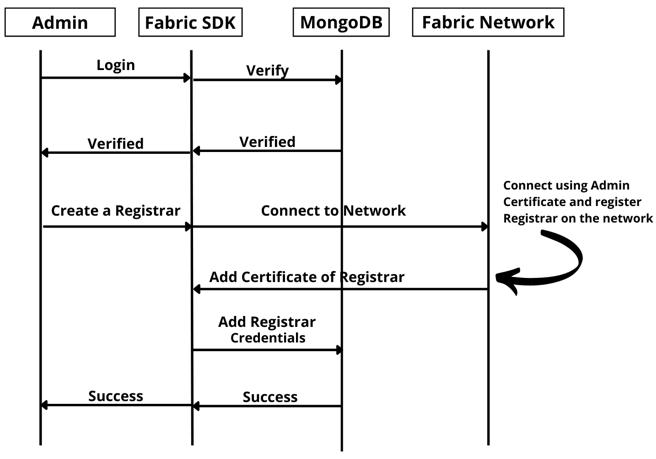
Theadminiscreatedforalltheorganizations thatjointhenetwork.AdminscancreateVice Admins (registrars) for their organization. Admintriestologin,itsrequestgoestoFabric SDK, then the login credentials are verified through Mongo Database. If the credentials arevalidtheadminloginssuccessfully.After theadminiscreatedandadminlogintothe network, admin can create a registrar. He enters the details of the registrar, through fabric sdk tries to connect to a network via gateway.Afterconnectingtothenetwork,the adminconnectstoachannelandregistersthe registrar.Thewalletandx509certificategets created for the registrar and the registrar credentials is inserted into the mongo database.
Forregistrationoftheapplicant,theapplicant needs to send the required details and documents to the registrar of the applicant organizationofhis/herregion.Theregistrar can then login into the system. He can now createan applicant by fillingthe details ina providedformhenceregisteringtheapplicant to the network. As soon as the applicant is registered, he/she is provided with a temporary password with which they can login.Latertheycanchangethepassword.If thelogincredentialsarecorrect,theapplicant isprovidedwiththecertificatewhichisstored in his local storage and is later utilized for performingtheauthorizedoperationsonthe network.
International Research Journal of Engineering and Technology (IRJET) e-ISSN: 2395-0056
Volume: 09 Issue: 12 | Dec 2022 www.irjet.net p-ISSN: 2395-0072
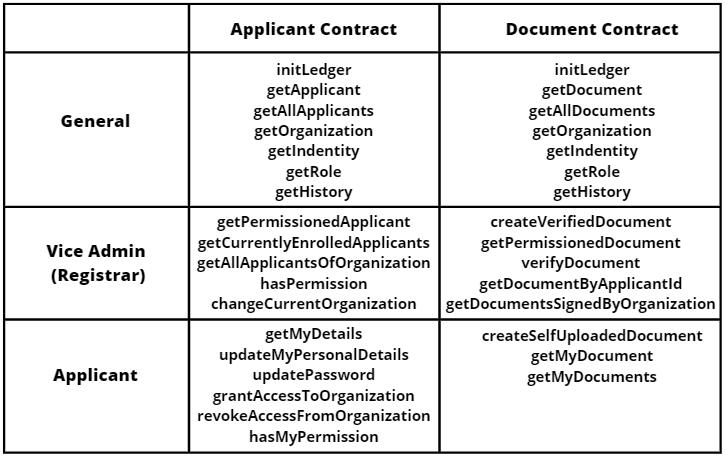
Therearetwocontractsimplementedforour system considering two assets, i.e the applicant and the document which will be transferredortobemorespecificwhosedata will be changed. Below are the chaincode functionsofthetwochaincodes.
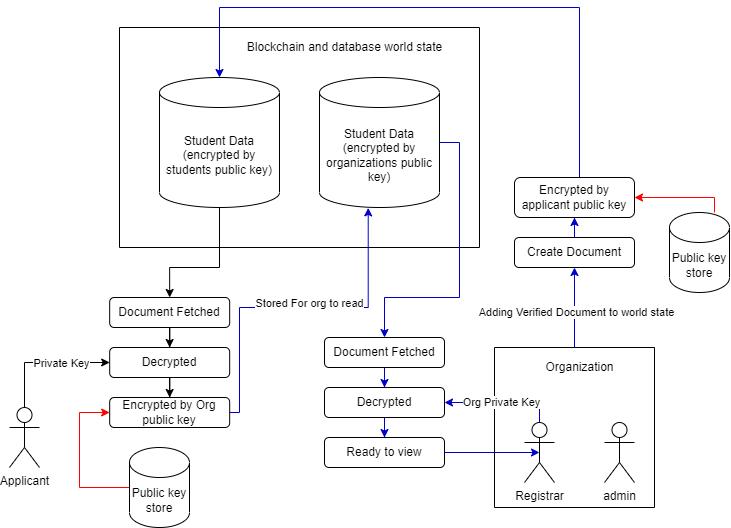
Despite the fact that blockchain is a highly effectivetoolfordatapersistenceandsecurity, there is still an issue. Everyone in the consortiumhasacopyofthedata,aswellas theblockchain,whichhasallofthetransaction detailswiththeinformationoftheapplicant filledin.Wearestrivingtoremedythisissue, sothedataisonlyavailabletothosewhohave permission to see it. This is accomplished through the use of public and private key cryptography.Thedataisencryptedusingthe applicant'spublickey,ensuringthatonlythe applicant with the private key may decrypt andviewtheinformation.
Thisraisesanewissue:theapplicantmust provideaccesstotheorganizationinorderto provide them with the applicant's information; how will he or she do so and make his or her data available to the organization?Thecurrentoptionistomakea duplicate of the data that will be encrypted usingtheorganization'spublickey.Asaresult, theorganizationcanusethatcopyforviewing, confirming,andotherfunctions.Thebackend server will decrypt the data using the applicant's private key. The server will also retrieve the organization's public key and encryptthefreshlycopieddata,makingitonly available through the organization's private key.
How does the organization include certificates, transcripts, grade sheets, and otherdocumentsintotheapplicant'sfile?
Theanswertothischallengewillbetoencrypt each document using the applicant's public key and add it to the world state while also adding transactions to the blockchain. As a result,everyonepossessesthedata,butonly thosewithaccesstoitcanseeit.
Documentverificationandsecurestorage isatourcore.Westrivetomaketheprocess effortless for the applicant as well as the organization. We achieve this by using document hash generated while uploading fromatrustedsourceaswellasstoringitin immutable blockchain. No-one has the authorityortherightstochangethedocument
International Research Journal of Engineering and Technology (IRJET) e-ISSN: 2395-0056
Volume: 09 Issue: 12 | Dec 2022 www.irjet.net p-ISSN: 2395-0072
hash uploaded in the blockchain as the chaincode agreed and defined during the inceptiondoesn’tallowit.
Once the document is uploaded in the distributed secure storage, everytime the documentisaccessedthedocumenthashwill be generated and compared with the hash retrievedfromtheblockchain,thus,ensuring that even a single pixel isn’t changed of the document. This provides a secure and effortless way of managing, storing and retrievingthedocuments.
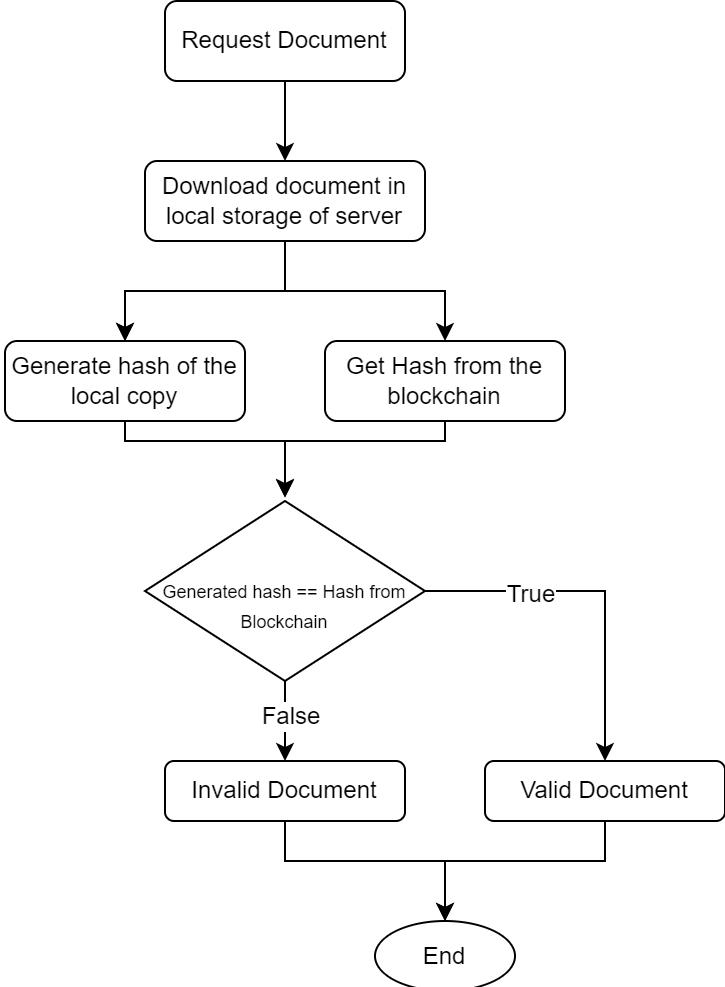
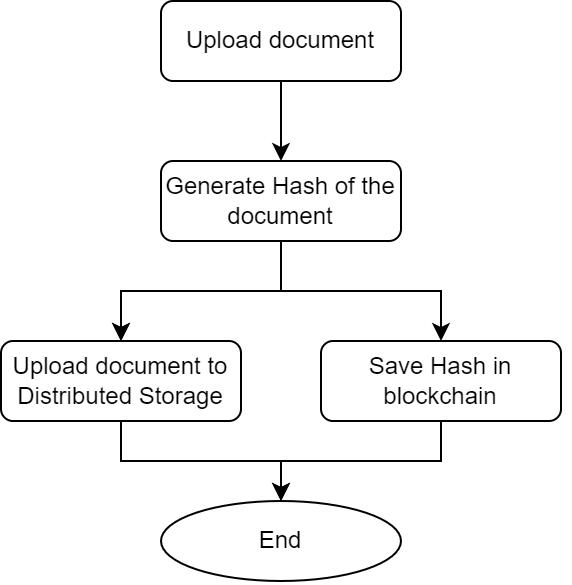
Thediagrammaticalrepresentationofthe flowofhowthedocumentswouldbestored and retrieved using two diagrams. The documentsareuploadedandrequestedasper therequirementsoftheuser.
Wecandecentralizethecloudstoragewhere all the documents are stored. The current implementation involves Microsoft Azure storage because of its established security. Later, it can be decentralized and the documents can be stored on personalized more secure servers throughout the demographics.
The applicant organization can be later separated into countrywide single organizationwithvariousdepartmentsbeing thestateswhicharesupportedbyfabric.
Theapplicantscanbelaterdividedintoyearwisebatchesfortheeaseoforganizationsto view the applicants according to the year in whichtheywereenrolled.
Later,thelistofdocumentsofapplicantscan beusedtocreateapersonalizedresumewith a common template making it much more easier for recruiters to find important achievements as well as hiring platforms whichtakestheresumeandautofillthefields.
International Research Journal of Engineering and Technology (IRJET) e-ISSN: 2395-0056
Volume: 09 Issue: 12 | Dec 2022 www.irjet.net p-ISSN: 2395-0072
The issue with the current procedures was that it was exceedingly challenging for businesses or recruiters to distinguish between authentic and falsified documents. A significant quantity of paperwork and money were also involved with the current systems during the admissions process as well as other procedures like the issue of transcripts.
Itinvolvesanumberofissues,includingconfirmingthe applicant's background, the given documents' originality, theirarrangement,storage,consistencyoftherecords,etc. Additionally,foranyofficialtask,theapplicantshadtocarry andsubmiteachdocumentseparately.
Thissparkedarequirementtodigitisetheentiresystem inordertoaddresstheseissues.However,digitizationraises securityconcerns,like the possibilityofdocumentcontent changes, all documents being accessible to hackers in one location, etc., if they are all held by a single centralised institution.
Blockchain was the ideal platform to address these securityanddecentralisationchallenges.However,themain worrywasthatanyonemightusetheresourcesandoperate ontheblockchain.
Thus,hyperledgerfabricemergedasthestructurethatmet all the requirements. Due to the application's use of the hyperledger platform, which only permits permissioned companies and users to operate, it has far higher security thanotherblockchainplatforms.Giventhateverydocument's stateisvisibletotheuser,thisplatformaidsorganisationsin distinguishing between authentic and fake documents. Organizationsmayaccesstheapplicant'swholeacademicand professionalhistoryinonelocation,givingthemasenseofa CV that follows a standard format. Additionally, our programmeeliminatestheneedforcandidatestosubmitthe samedocumentsrepeatedlyandallowsthemtosharetheir profiles with any organisation by giving that organisation permissionwithjustoneclick.Thebenefitsofthisapplication alsoincludetheefficientmigrationofthecurrentsystemto ourapplication,theabilityofsmallerorganisationstoafford thesetupduetotheeliminationoftheneedforlocalstorage of the images of documents using cloud services, and improved security against unauthorised access to or tampering with data. Smaller groups can even join an umbrellaorganisationiftheycan'taffordtheestablishment.
[1] SatoshiNakamoto,``Bitcoin:APeer-to-PeerElectronic CashSystem'',March2009.
[2] DeebthikRavi,SashankRamachandran,RaahulVignesh, VinodRameshFalmari,M.Brindh,"Privacypreserving
transparent supply chain management through HyperledgerFabric",Elsevier100072,16March,2022
[3] MarcoBaldi,FrancoChiaraluce,MigelanKodraandLuca Spalazzi, "Security analysis of a blockchain-based protocol forthe certification of academic credentials", October2019.
[4] Muhamed Turkanovic , Marko Holbl, Kristjan Kosic, MarjanHericko,AidaKamisalic,"EduCTX:ABlockchainBasedHigherEducationCreditPlatform",IEEEAccess PP(99),October2017.
[5] Federico Bond, Franco Amati, Gonzalo Blousson, "Blockchain,academicverificationusecase",31August, 2015.
[6] Sandner, P., Nägele, T. and J. Gross, "Liechtenstein Blockchain Act: How can nearly any right and therefore any asset be tokenized based on the Token ContainerModel?",Medium,October 7,2019.
[7] Office of Ed Tech, "Education have a problem? Put a blockchainonit!",Medium,26February,2020.
[8] Mara-Florina Steiu "Blockchain in Education: Opportunities, application and challenges", First Monday,Volume25,Number9,7September2020.
[9] Maryville University, "How Blockchain Is Used in Education".
[10] RajeevSakhuja,"HyperledgerFabric2.xNetworkDesign &Setup",Udemy,July2020.
[11] Aditya Joshi, "The Complete Guide on Hyperledger Fabricv2.xonKubernetes",Udemy,May2021.
[12] HyperledgerWhitePaper.
[13] HyperledgerDocumentation.
[14] InterPlanetaryFileSystemDocumentation.