International Research Journal of Engineering and Technology (IRJET) e-ISSN:2395-0056

Volume: 09 Issue: 12 | Dec 2022 www.irjet.net p-ISSN:2395-0072
International Research Journal of Engineering and Technology (IRJET) e-ISSN:2395-0056
Volume: 09 Issue: 12 | Dec 2022 www.irjet.net p-ISSN:2395-0072
1Vanshika Pandey, Dept. Of Computer Science, Nowrosjee Wadia Junior College of Arts and Science, Pune, Maharashtra, India
2Assistant Professor Shagufta Farzana, Dept. Of Computer Science & Engineering, Dr. C. V. Raman Institute Of Technology, Kota, Bilaspur, Chhattisgarh, India
***
Abstract - Deep brain stimulation has revolutionized the therapeutic management of treatment-resistant movement disorders and is now being used to treat a growing number of neurological and psychiatric conditions. This paper briefly describes how electrical stimulation, which has been used to modulate the nervous system since antiquity, became a fundamental tool of neurophysiologic investigation in the second half of the eighteenth century and was later used for therapeutic purposes in the earlytwentiethcentury. Wetakea quick look back at the history of deep brain stimulation, focusing on the last 200 years, which have witnessed remarkable advancements in the safety and efficacy of the procedure. Lastly, we discuss the impact of the future technological, methodological, and research improvements in deep brain stimulation.
Key Words: Deepbrainstimulation,Movementdisorders, Psychiatric conditions, Neurophysiologic investigation, Electricalstimulation,Researchimprovements
Deepbrainstimulation(DBS)isasurgicalprocedurethat involves inserting electrodes into particular regions of the brain.Electricalimpulsesaregeneratedbytheseelectrodes and are used to modulate abnormal brain activity. Additionally, electrical impulses can correct chemical imbalances in the brain, which can lead to a variety of ailments.Aprogrammablegeneratorisinsertedunderthe skinintheupperchestandcontrolsthestimulationofbrain locations.
Deepbrainstimulation(DBS)hasemergedasapromising treatment option for a variety of illnesses over the last 20 years. For the most part, ablative methods have been supplanted by advances in technology and surgical techniques. The ventralis intermedius nucleus of the thalamus has been demonstrated to significantly enhance tremor control in patients with essential tremor and Parkinson's disease-related tremor. Patients with Parkinson's disease can dramatically alleviate their symptoms of bradykinesia, tremor, gait instability, and stiffness.Asa resultoftheseadvancements,areductionin
medication may be helpful in lessening the debilitating effectsofdyskinesiasinthesepatients.
DBS of the globus pallidus internus has been demonstratedtobeeffectiveintreatingprimarydystonia.[1] Because of the efficacy of these operations, they are now being used to treat a variety of other severe illnesses, including neuropsychiatric disorders, intractable pain, epilepsy, camptocormia, headache, restless legs syndrome, and Alzheimer's disease. This review will look at how deep brainstimulationhasprogressedtoitscurrentstate,where the research is headed, and the potential dangers that may arisealongtheroad.
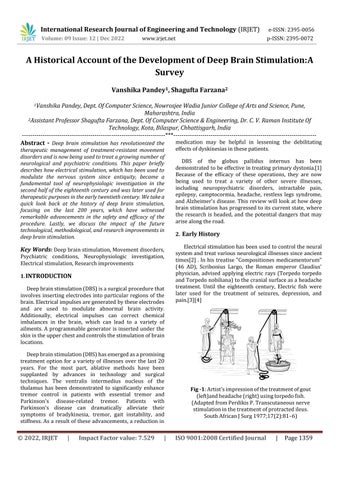
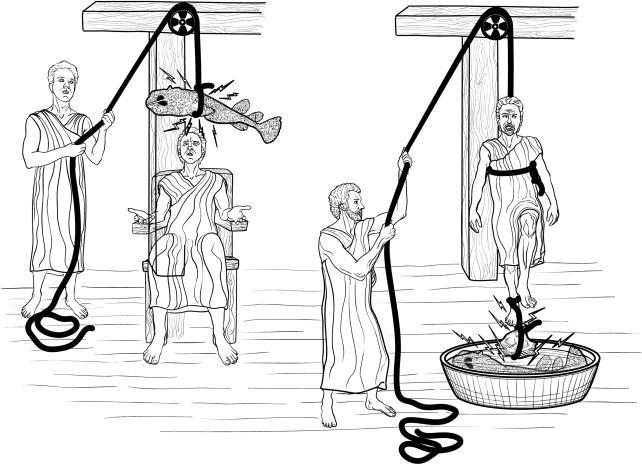
Electricalstimulationhasbeenusedtocontroltheneural systemandtreatvariousneurologicalillnessessinceancient times[2].Inhis treatise "Compositiones medicamentorum" (46 AD), Scribonius Largo, the Roman emperor Claudius' physician, advised applying electric rays (Torpedo torpedo andTorpedonobiliana)tothecranialsurfaceasaheadache treatment. Until the eighteenth century, Electric fish were later used for the treatment of seizures, depression, and pain.[3][4]
Fig -1:Artist’simpressionofthetreatmentofgout (left)andheadache(right)usingtorpedofish. (AdaptedfromPerdikisP.Transcutaneousnerve stimulationinthetreatmentofprotractedileus. SouthAfricanJSurg1977;17(2):81–6)
e-ISSN:2395-0056
Volume: 09 Issue: 12 | Dec 2022 www.irjet.net p-ISSN:2395-0072
In 1804, Giovanni Aldini (1762–1834), a professor of PhysicsattheUniversityofBolognaandnephewofanimal electricitydiscovererLuigiGalvani(1727–1798),performed electricalstimulationsontheexposedhumanbraincortexof newly decapitated convicts. Cortical stimulation elicited awful facial grimaces, according to Aldini. This discovery led himtobelievethatthecorticalsurfacecouldbeelectrically activated, implying that electricity may be used to treat a variety of neuropsychiatric illnesses.[5][6] Aldini's experimentsandhypothesesledtothedevelopmentoftwo strands of research in the nineteenth and twentieth centuries:ontheonehand,theuseofbrainstimulationfor neurophysiologic investigation (first on animals, then on humans)tounderstandthefunctioningofthebrain,andon theotherhand,theuseofbrainstimulationtechniques for therapeuticpurposes.LuigiRolando(1773–1831)wasthe first to use galvanic current to spark the cortical cortex of creaturesin1809[7],highlightingthebrainarea'sfunctions.
RobertBartholow(1831–1904),anAmericanphysician, was the first to disclose findings from experiments of electrical stimulation of the cerebral cortex in an awake human in 1874. Ezio Sciamanna (1850–1905), an Italian neuropsychiatrist,conductedaseriesofsystematicelectrical stimulation studies on a trepanned patient with a severe braininjuryin1882.
In 1883, the Italo-Argentine surgeon Alberto Alberti (1856–1913) undertook an 8-month trial of brain stimulation in a woman who, like Bartholow, had an eroding tumouroftheskullthatprovidedsimpleaccesstothedura matersurface.Unfortunately,thesestudies'contributionto defining the motor topography of the human brain has been underappreciated, with the exception of confirming the cortex's electrical excitability and demonstrating the contralateral cortical hemisphericrepresentationofmotor activities. Furthermore, British surgeon Victor Horsley (1857–1916) published more accurate and systematic findingsonthegeographyofthebrainin1887.[8]
The discovery of electroencephalography (EEG) by GermanpsychiatristHansBergerin1929wasawatershed momentinmedicalhistory,introducinganewneurologicand psychiatricdiagnostictool.Voltadiscoveredthebatteryafter Galvanidiscovered"biologicalelectricity"byaccident(voltaic pile). Rolando was the first to use it to activate the brain surface.Asaresult,Fritsch,Hitzig,andFerrierwereableto create the concept of brain localization (Jackson, Gowers, Gotch, and Horsley). Although it was obvious that brain electricalstimulationcausesacontralateralmotorresponse, it was unclear if a spontaneous (intrinsic) brain electrical currentcouldbemeasured.Catonwasthefirsttodescribe the"currentinthebraingreysubstancesontoopenbrain" phenomenon. Berger produced the first EEG
(electrocorticogram) recording on July 6, 1924, during a neurosurgical procedure on a 17-year-old boy done by neurosurgeon Nikolai Guleke, based on Caton's discoveries and those of Beck, Danilevsky, Prawdicz-Neminsky, and others.In1929,hepublished apaperonthesubject,usingthe terminology alpha and beta waves. The "spike and waves" (Spitzenwellen) were first described by an American group of EEG pioneers (H. and P. Davies, F. and E. Gibbs, Lenox and Jasper) shortly after, although Berger had seen them but dismissed them as artifacts. The development of electroencephalography,especiallyforpatients withseizures, wasawatershedmomentinneuroscienceandneurologicand neurosurgicalpractice.
The earliest modern example of therapeutic application of brainstimulationforthetreatmentofseverepsychosiswas electroshock, which was invented in 1938 by Ugo Cerletti (1877–1963).[9][10] An epileptic seizure was induced by applying an electric current to the skull, which "approximately" rebuilt the brain connections, resulting in clinicalimprovementforthepatients.
In1947,ErnstSpiegelandHenryWyciscreatedthefirst humanstereotactic frame,modifying the original apparatus of Clarke and Horsley (1906) to determine Cartesian coordinates of structures around ventricles (basal ganglia) foridentifyingthepreciselocalizationoftargetsthathadto be destroyed by radiofrequency[11][12] . Intra-operative electrical stimulation of these tissues was employed to explore and localize the deep brain nuclei, as well as to confirm target location[13][14] . These findings lead to the hypothesis that deep cerebral nuclei stimulation could be employed not just for diagnostic purposes, but also as a treatment. As a result, the progression from lesional to stimulatingfunctionalneurosurgerywasestablished.[15]
Before brain stimulation of the human cortex could produce a truly realistic picture of human brain functions, includingmotorandsomatosensoryareas,theneurosurgeon Wilder Penfield (1891– 1976) published his fundamental studiesin1950.[16][17]Afteraninitial experimental phase, the"gatecontrol theory" published by Melzachand Wall in 1962 explained brain stimulation for pain management, which had been employed with good results as early as 1950 with temporary electrodes implanted into the brain areas.[18] Previous research laid the groundwork for the development of new neurostimulation techniques such as transcranial magnetic stimulation, cortical brainstimulation, anddeepbrainstimulation(DBS).Thediscoveryoftheeffects of electrical stimulation of deep brain areas during stereotacticlesional functional neurosurgery to identify the correctpositionofcoagulantelectrodes forthetreatmentof dyskinetic disordersandtremors inParkinson'sdiseaseled tothedevelopmentofthistechnique.[4]Variousstudieshave shown that while "low-frequency stimulation" (5–10 Hz) can improve tremor and other linked symptoms, "high-frequency stimulation" (50–100 Hz) can reduce symptoms.[19][20][21][22] Sem Jacobsen (1965), and
International Research Journal of Engineering
Technology (IRJET) e-ISSN:2395-0056
Volume: 09 Issue: 12 | Dec 2022 www.irjet.net p-ISSN:2395-0072
Cooper(1965)wereDBSpioneers(1978).Deepelectrical stimulation of brain areas was first developed as a treatmentforbehavioraldisordersandchronicpain.
Based on his experience with deep neurophysiologic electricalstimulationinanimals,theSpanishneuroscientist JoséM.Delgadofirstdescribedthetechniqueofimplantation ofintracranialelectrodesinhumansin1952,indicatingthe importance of this method for diagnosis and its potential therapeutic role in patients with mental disorders.[21] NataliaPetrovnaBekthereva,aneuroscientistattheInstitute of Experimental Medicine and the Academy of Medical Sciences in Leningrad, was the first to employ persistent depth stimulation as a treatment for motor problems. She publishedapaperin1963onthetreatmentofhyperkinetic diseases with numerous electrodes implanted in sub-cortical areas[22].Herpapers,however,werenotgenerallyknown aroundtheworldbecausetheywerewritteninRussian.She used "electric stimulation with high-rate pulses of suprathreshold current" in her "therapeutic electrostimulation,"asshecalledit,andhadoutstandingresults[22].
Dr. Jose Manuel Rodriquez Delgado of Spain demonstratedthecapacitytocontrolbulls'violentbehavior withabrainimplantin1965.CarlWilhelmSem-Jacobsen,a Norwegianneurophysiologistandpsychiatrist,wasthefirst to employ depth electrodes implanted in patients with epilepsy and psychiatric illnesses for recording and stimulation. In order to find the optimal lesional site in Parkinson's disease, he successfully implanted numerous electrodes in the thalamus to stimulate the targets. These electrodes were frequently left in the patient's brain for monthsatatime,withnoadverseeffects."Theseelectrodes mightthenbeutilizedtogenerategradualstagedlesionsin the target area, following stimulation responses," he said. [23][24][25]
Dr.Delgadousedelectrodestoimplantin25people,the majorityofwhomwereschizophrenicsorepileptics.Inthe book‘PhysicalControloftheMind:TowardaPsychocivilized Society’, published in 1969, he outlined his brain stimulation research and explored crucial elements and ethical implications,demonstratingboththeimmenseprospectsand thegreatrisksposedbyneurotechnology.[21]
TheAmerican neurosurgeonIrvingS.Cooperhasmore extensive and continuous experience inserting electrodes over the cerebellum and into the deep thalamic nuclei for centralpalsy,spasticity,andepilepsy.Hepublishedhisgood resultsfrompersistentcerebellarstimulationinmorethan 200patientsin1977.[26]
In 1982, Howard J. Leonhardt's commercialization company, H.J. Leonhardt & Co., established Leonhardt Ventures.Dr.RobertO.Beckerpublishedtheseminalbook ‘TheBodyElectric’threeyearslater.
Dr. Race Kao and Dr. George Magovern, members of the Leonhardtresearchteam,completedthefirstcasesoflarge
animal organ restoration with stem cells, which were published in The Physiologist in 1989. In Sunrise, Florida, Leonhardt founds World MedicalManufacturingCorporation to develop and market cardiovascular organ monitoring, regeneration, and recovery devices. Working with Dr. Ivan Casagrandeat LabcorinBrazil, the Leonhardt team creates the first percutaneous heart valve. In 1997, the invention was patented. Both the Benabid and Blond and Sigfried groups published their findings on thalamic DBSs for tremors in 1991.[27][28]
Levin, Michael, Ph.D. published Current and potential applications of bioelectromagnetics in medicine in 1993, layingthe groundwork for modern bioelectric regeneration research.Hegoesontopublishover50papersonthesubject.
Leonhardt leads a team in Australia in 1995 that completesthefirstnon-surgicalrepairofanaorticaneurysmin aclinicalsettingwithDr.KenThomsonandDr.PeterField. Dr. Doris Taylor, a member of the Leonhardt research team, published a report in Nature Medicine on myoblast cell healinginananimalheart.Dr.ShinichiKanno,amemberof theLeonhardtresearch team,publishes thefirstpublication on bioelectric limb regeneration via regulated production of proteins like VEGF in CIRCULATION, the Journal of the AmericanHeartAssociation.
Intheyear2000,HowardLeonhardtbeganfilingaseriesof patentsfororganregenerationbasedonbioelectricstemcell homing,proliferationanddifferentiationcontrol,controlled protein expressions, and in some cases, repeat deliveriesof stemcells,growthfactors,nutrienthydrogel,andotherorgan regeneration-promoting patents. In the followingyear, with Dr. Patrick Serruys, Leonhardt leads a team that completes the primary non-surgical somatic cell restoration of a person'sheartwithintheNetherlands.Workingwith33sites in the United States and 6 centers in the United Kingdom, theteamcompleted,published,andpresentedPilot,PhaseI, PhaseII,andPhaseII/IIIstudydata.
84percentofpatientswhoweretreatedimprovedordid not deteriorate. Only 16% of those who were given treatment declined. In the same research, 69 percent of control or placeboindividualshadimpairedcardiacfunction.
In 2007, Howard Leonhardt and renowned bioelectric regeneration researcher Dr. Jorge Genovese, previously of the UniversityofUtah,teamedtogetherasco-inventorsandfileda slew of patent claims for bioelectric-based organ regenerationandrecovery. Since2011, theLeonhardtteam has led somatic cell and bioelectric limb salvage trials with partners within the Czech Republic, Switzerland, Germany, and Mexico, involving 70 patients with positive outcomes. Sixty-sixofthe70individualstreatedhadtheirlegsrescued fromamputations.
International Research Journal of Engineering
Technology (IRJET) e-ISSN:2395-0056
Volume: 09 Issue: 12 | Dec 2022 www.irjet.net p-ISSN:2395-0072
SinceDBSwasfirstintroducedabout20yearsago,therehas beenahugespikeininterestintheneurosurgicalprocedure forthetreatmentofavarietyofneurologicalandpsychiatric diseases.Thereversibleaspectofthestimulationtechnique is appealing, and clinical disorders that were previously thought to be surgically tractable are now considered candidatesforDBStherapy.
DBShasshowntobeeffectiveinthetreatmentofrefractory Parkinson'sdisease,butpromisingfindingsarestillawaited for other motor diseases (primary tremor, dyskinesias, medically resistant Tourette's syndrome). Major psychiatric diseases (refractory depression, obsessive-compulsive disorder), cluster headache, epilepsy, eating disorders (obesity), and drug-resistant hypertension are among the emerging areas where DBS appears to have promising therapeuticpotential.
In the case of the "psychiatric" indications (refractory depression and obsessive-compulsive disorder), the evidence of organic alterations underlying these events providesasufficientexplanationforthefactthatrebalancing specific neurophysiologic substrates via DBS can improve these behavioral disorders, harmonizing the physical and psychologicalexpressionsofthesesubjects.
[1] Reese,R.and Volkmann, J., DeepBrainStimulation for the Dystonias: Evidence, Knowledge Gaps, and Practical Considerations. Movement Disorders Clinical Practice, 4(4), pp.486-494 (2017)M. Young, The Technical Writer’sHandbook.MillValley,CA:UniversityScience, 1989.
[2] Rossi,U.,andB.A.Simpson."Electricalstimulationand thereliefofpain.":5-16p(2003).
[3] Kellaway,P.“Thepartplayedbyelectricfishintheearly historyofbioelectricityandelectrotherapy.”Bulletinof thehistoryofmedicinevol.20,2:112-37(1946)
[4] Schwalb, Jason M, Clement Hamani. “The history and future of deep brain stimulation.” Neurotherapeutics: the journal of the American Society for Experimental NeuroTherapeutics vol 5,1: 313.doi:10.1016/j.nurt.2007.11.003(2008)
[5] Boling, Warren, André Olivier. "Historical contributions tothemodernunderstandingoffunctioninthecentral area."Neurosurgery50.6:1296-1310(2002)
[6] Parent,Andre.GiovanniAldini:FromAnimalElectricity to Human Brain Stimulation. The Canadian journal of neurologicalsciences.Lejournalcanadiendessciences neurologiques. 31. 576-84. 10.1017/S0317167100003851(2004)
[7] Rolando, Luigi. Saggio sopra la vera struttura del cervello dell'uomo e degl'animali e sopra le funzioni del sistemanervosodiLuigiRolando..No.2.nellastamperia daSSRMprivilegiata,(1809).
[8] Vilensky,JoelA.;Gilman,Sid;"LesionsofthePrecentral Gyrus in Nonhuman Primates: A Pre-Medline Bibliography." International Journal of Primatology 23(6): 1319-1333. <http://hdl.handle.net/2027.42/44566>(2002)
[9] Bini, L., and U. Cerletti. "L'elettroshock." Arch. gen. di neural.Psichiat.epricoanal19:266-68(1938)
[10] Kalinowsky,LB.,“Historyofconvulsivetherapy.”Annals of the New York Academy of Sciences vol. 462: 1-4. doi:10.1111/j.1749-6632.1986.tb51233.x(1986)
[11] Spiegel EA, Wycis HT, Marks M, Lee AJ. Stereotaxic apparatus for operations on the human brain. Science. 1947;106(2754):349–50.(1947)
[12] Zonenshyn M., Rezai A.“Stereotactic surgery,” in Principles of Neurosurgery, eds Rengachary S. S., EllenbogenR.G.(Edinburg:Elsevier;),785–817(2005)
[13] Guiot G., Hardy J., Alabe-Fessard D., Delimitation precise des structures sous-corticales et indentification de noyuax thalamiques chez l’homme par l’electrophysiologie stereotaxique. Neurochirurgia (Stuttg.)5,1–18(1961)
[14] Gildenberg P. L., Evolution of neuromodulation. Stereotact. Funct. Neurosurg. 83, 71–7910.1159/000086865(2005)
[15] PortaM.,SironiV.A.,Ilcervelloirriverente.Storiadella malattia dei mille tic. Roma Bari: Laterza, 136–143 (2009)
[16] Penfield W., Boldrey E., Somatic motor and sensory representation in the cerebral cortex of man as studies by electrical stimulation. Brain 60, 389–44310.1093/brain/60.4.389(1937)
[17] PenfieldW.,RasmussenT.,TheCerebralCortexofMan.A Clinical Study of Localisation of Function. New York: MacMillan(1950)
[18] Rezai A. R., Lozano A. M., “Deep brain stimulation for chronic pain,” in Surgical Management of Pain, ed. BurchielK.J.(NewYork:Thieme;),565–576(2002)
[19] Fessard D. A., Arfel G., Guiot G., Derome P., Herran D., Korn H., Hertzog E., Vourch G, Aleonard P.,“Activit'es 'electriques caract'eristiques de quelques structures c'er'ebrales chez l'homme” [characteristic electric activities of some cerebral structures in man]. Annales dechirurgievol.17:1185-214.(1963)
International Research Journal of Engineering and Technology (IRJET) e-ISSN:2395-0056
Volume: 09 Issue: 12 | Dec 2022 www.irjet.net p-ISSN:2395-0072
[20] Blomstedt, Patric, and Marwan I Hariz. “Deep brain stimulation for movement disorders before DBS for movementdisorders.”Parkinsonism&relateddisorders vol. 16,7: 429-33. doi:10.1016/j.parkreldis.2010.04.005 (2010)
[21] Delgado, J. and Anand, B. Increase of Food Intake Induced by Electrical Stimulation of the Lateral Hypothalamus.AmericanJournalofPhysiology-Legacy Content,172(1),pp.162-168.(1952)
[22] BektherevaN.P.,GrachevK.V.,OrlovaA.N.,IatsukS.L. Utilisation of multiple electrodes implanted in the subcortical structure of the human brain for the treatmentofhyperkinesis.Zh.Nevropatol.Psikhiatr.Im. SSKorsakova63,3–8(1963)
[23] Sem-Jacobsen C. W., Depth electrographic stimulation and treatment of patient with Parkinson’s disease includingneurosurgicaltechnique.ActaNeurol.Scand. Suppl.13,365–377(1965)
[24] Sem-Jacobsen C. W., Dept-electrographic observations relate to Parkinson’s disease. Recording and electrical stimulation in the area around the third ventricle. J. Neurosurg.24,388–402(1966)
[25] Blomstedt P., Hariz M. I., Deep brain stimulation for movement disorders before DBS for movement disorders. Parkinsonism Relat. Disord. 16, 429–43310.1016/j.parkreldis.2010.04.005(2010)
[26] Cooper I. S., Cerebellar Stimulation in Man. New York: RavenPress(1978)
2022, IRJET | Impact Factor value: 7.529 | ISO 9001:2008 Certified Journal | Page