1
International Research Journal of Engineering and Technology (IRJET) e-ISSN:2395-0056

Volume: 09 Issue: 12 | Dec 2022 www.irjet.net p-ISSN:2395-0072
1
International Research Journal of Engineering and Technology (IRJET) e-ISSN:2395-0056
Volume: 09 Issue: 12 | Dec 2022 www.irjet.net p-ISSN:2395-0072
B.E Student, Dept. of Electronics and Telecommunication, Vidyalankar Institute of Technology, Maharashtra, India
2Assistant Professor, Dept. of Electronics and Telecommunication, Vidyalankar Institute of Technology, Maharashtra, India ***
Abstract - Presently, approximately 25 billion people are connectedworldwide,andthesenetworksareconnectedthrough routers. IPv4 had some deficiencies like Address depletion problem, Lack of Encryption, and authentication of data features, which led to the development of IPng/IPv6. The development of IPV6 and deploymentof thesame is in process worldwide using various deployment techniques. These techniques enable the upgradation of networks to IPv6 deployed networks with little or no intervention of IPv4 services. Greater deployment efforts from a number of small networks could result in an increasing measure of global IPv6 deployment.
Keywords IPv4, IPv6, Routing, NAT, Protocols
The third layer of the Open System Interconnections model (OSI)istheNetworklayer,whichisresponsibleforproviding anIPaddresstopackets,Routing,Inter-networking,andsource todestinationdelivery.Also,itreceivesframes fromthedata linklayer(secondlayerofOSImodel)anddeliversthemtotheir intended destination based on the address contained within theframe.TheInternetProtocols(IPs)providethelogicaladdress tothenetworklayertotracethedestination.IETFstartedtowork onthesuccessorofIPv4,intheearly1990s,which would solve address exhaustion problems. IPV6 also known as Next Generation IP or IPng, was designed and developed as a replacementforIPv4,in1994byIETFwithitsformaldescription underRFC1883publishedin1995.IPV6wasapromisingformat forIPbecauseofitsadvantagessuchaslargerAddressSpacethan IPv4sinceitincreasesIPaddresssizefrom32bitsto128bits.It providesabetterheaderformat,droppingsomeheaderfields of IPv4. This simplifies and accelerates the routing process, new options to permit additional functionalities, provides support for more security by Encryption and Authentication ofdata,providingconfidentialityandintegritytothepackets. This paper documents the detailed comparison of IPv4 and IPv6 Protocols. Also reviews the various implantation methodologiesofIPv6
Functions that work in IPv4 were kept in IPng (nextgeneration IP i.e., IPv6) and which did not work were
removed. IPv6 supports the same QoS (Quality of Service) featuresasIPv4,includingtheDiffServindication,aswellasanew 20- bit traffic flow field [1]. IPv4 has a variable header field lengthof20-60bytes whereastheIPv6headerisfixedsize(40 bytes), which allow routers to process IPv6 packets faster resulting in traffic that can be forwarded at higher information rates, giving higher performance, and can be used for high bandwidth applications [2]. IPv4 uses manual configurationorDynamic Host ConfigurationProtocol(DHCP) whereasIPv6 supports functionalities like auto configuration as wellasplugandplay[3].IPv6providessimplerencapsulationthan IPv4 increasing routing efficiency. Few functions that IPv4 lacks, like IPsec security protocols, ESP (encapsulating securityprotocol),andAH(authenticationheader),areadded to it for developing IPv6. Unlike IPv4, new generation protocolIPngusesmulticastoranycastaddresses.
An illustrative comparison based on the limitations of IPv4 and solutions to these limitations of IPv4 in the new generationprotocolIPv6isshownintheTableI.
TABLE -1: COMPARISONBASEDONFEATURESOFIPv4AND IPv6[3]
Sr No .
IPv4 drawbacks overcome by IPv6 Features of IPv4 (Limitations)
IPv4 features explanation Solution by IPv6
1 IPv4Address space
IPv4hasalmost usedupits addressspaceof around4billion with4,294,967, 296addresses.
IPv6eliminates theaddress exhaustionissue byreplacing4 octetsof8bits andusesa hexadecimal numberfield. Itprovidesan addresssizeof 128bits(16 bytes)and2128 addressblocks.
2
IPv4 Congestion inthe
IPv4usesits Broadcast functionalityand
IPv6reducesthe network congestionand
Sr No .
International Research Journal of Engineering and Technology (IRJET) e-ISSN:2395-0056
Volume: 09 Issue: 12 | Dec 2022 www.irjet.net p-ISSN:2395-0072
IPv4 drawbacks overcome by IPv6
Features of IPv4 (Limitations)
IPv4 features explanation Solution by IPv6
Network Integrated HeaderFormat (IHF)forpacket transmission.It transmitsthe packetbefore checkingthe addressofthe endpoint,this floodsthewhole network resultingin congestion.
overcrowdingby packetssentasit usesSimple HeaderFormat (SHF)thatchecks andidentifiesthe destinationofthe packetsbefore sendingthem.
ThoughIPv6providesmanyadvantagesoverIPv4,ithasstill not been deployed completely by many ISPs as it needs full path participation. Therefore, different transition mechanisms have been implemented to avail the features of both IPv4 and IPv6. These protocols cannot be merged but canruninparallelusingthetransitionmechanisms.Basedon APNIC data at present only 31% of Internet users are IPv6 capable. The adoption rate of IPv6 varies from high number ofusersinIndia(76%)toabove50%numberofusersinfive countries namely, Germany, Vietnam, Belgium, Greece, and Malaysia. Table II below gives an overview of change in numberofusersfrom2021to2022fortop10economies.
3 IPv4Packet Loss
TheTime-ToLive(TTL) protocolinthe IPv4fragmented packetallocates atimeframefor eachpacketthat determinesthe timespanofeach packetinthe header,andit cannotbeused forreal-time applicationsas heavydata trafficmaycause delayin transmission.
IPv6routers makeuseofhop limitfieldwhich givesthenumber oflinksthepacket cantravelbefore gettingdiscarded. Thisminimizes thechancesof losingthepacket during transmission.
Rank
IPv6 Users 2021 2022 Chang e Users (est ) Country
1 164,45 9,081 274,01 9,342 109,56 0,261 820,328, 035 China
2 420,25 8,878 439,31 2,401 19,053, 523 574,511, 661 India
3 9,616,9 19 15,677, 224 6,060,3 05 32,204,9 86 Saudi Arabia
4 783,66 0 6,587,0 84 5,803,4 24 113,054, 932 Indonesia
5 34,839, 061 38,584, 943 3,745,8 82 89,811,6 43 Mexico
4 IPv4Security
TheInternet Protocol Security(IPSec) onIPv4is optional
IPv6supports IPSecand Authentication Header(AH)for encryptingand authenticatingthe packets transmitted betweentwoend points Itprovides secure transmission.
5 IPv4Data Priority
IPv4doesnot providepriority functionalityfor prioritizingthe streamingdata.
IPv6usesQuality ofService(QoS) toprioritizethe delaysensitiveor heavytraffic packetsbeing sentoverthe network.
6 58,410, 683 61,762, 731 3,352,0 48 161,217, 993 Brazil
7 23,995, 676 26,879, 572 2,883,8 96 53,010,3 41 Vietnam
8 4,140,1 35 6,647,4 17 2,507,2 82 34,549,1 12 Colombia
9 872,27 9 3,359,0 80 2,486,8 01 9,004,54 7 Guatemala
10 141,52 8 2,435,1 68 2,293,6 40 16,308,2 08 Chile
Major Operating System (OSs) are IPv6-capable. Therefore,deployingIPv6attheuserandedgesiteiseasier, using methods allowing distinct IPv6 domains to communicate with each other by carrying IPv6 traffic over the existing IPv4 infrastructure before the network completely gets deployed with IPv6 backbone. The five key techniquesfordeployingIPv6are:
e-ISSN:2395-0056
Volume: 09 Issue: 12 | Dec 2022 www.irjet.net p-ISSN:2395-0072
2. AutomaticIPv4-Compatibletunnels
3. GenericRoutingEncapsulation(GRE)
4. Automatic6to4tunnels
5.
In tunneling, routers between two IPv6 nodes need not beIPv6-capable,thisdecreasesdependencies.Thetunnelhas twoIPv4routersconnectedwithavirtualpoint-to-pointlink, routing IPv6 packets held by an IPv4 packet over the IPv4 network. Various tunneling technologies have been developed to support IPv4 over IPv6 tunnel as well as IPv6 over IPv4 tunnel. These technologies are generally categorized as configured or automatic tunnels, the latter tunneltypeispredefined,andtheformeris createdandtorn down "on the fly" [5]. In configured tunnels, configuring tunnel endpoints is required to configure the devices to transmit packets based on the destination, and other tunnel configuration parameters like Maximum Transmission Unit (MTU). WhereasinAutomatictunnels,tunneling is based on information contained in the IPv6 packet, such as source or destination IP address. Tunneling of IPv6 packet over IPv4 packetisshowninFig.1below
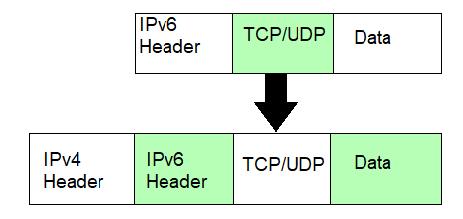
The major limitations of all tunneling mechanisms are a single point of failure, crossing the firewall is not possible, and the need for up-gradation and changing of CPEs [6]. Tunneling can be preferred over NAT-PT or Translation mechanisms because of higher throughput of 23.27 kb/sec, Bandwidth of 51.2 kb/sec and Average Round Trip Time of 5ms. These observations based on a study done by Sheetal Singalar in [7] proves tunneling to be a better migration techniquethantranslationbutlessdesirablethandualstack.
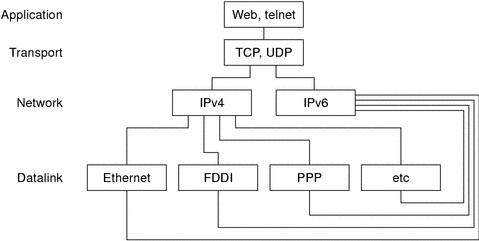
It allows migration of networks, end nodes, and applications by running IPv4 and IPv6 independently, coexisting in a dual IP layer backbone for routing. A dual stack is a protocol stack containing both IPv4 and IPv6 having an identical stack remainder. This allows the same applicationsandtransportprotocolslikeTCP,UDP,etctorun overversion4and6protocols[5].
In dual stack, configured on a single interface or multiple interfaces, the transmission decision is made by the device depending on the traffic at the destination address. The packet sent reaches the destination over a dual-channel providedbydual-stack.
The existing IPv4 infrastructure is used for routing IPv6 traffic with the help of a tunneling technique selected based on the mechanism used by the encapsulating node to determine the address of the tunnel end node. IPv6 datagrams can be tunneled using IPv6 or IPv4 hosts, and routers over regions of IPv4 routing topology by encapsulating them inside IPv4 packets. The resulting tunneled packet size is managed by the tunneling encapsulatorendpoint,withrespecttothetunnel’smaximum transmission unit (MTU) or packet size and inform the sourceifthepacketistoolargeforthetunnel.
TherearefivemethodsoftunnelingIPv6traffic:
1.
This simple strategy allows the same end system to support different applications not supporting the new generation protocol stack to coexist with the upgraded applications. Also, it enables the upgraded nodes to interoperate with IPv4-only by using IPv4 and vice versa by selecting and configuring suitable routing protocols for both the IP versions [8]. Dual Stack protocols are shown in Fig. 2. The Dual-stack backbone assigns addresses to endpoints based on protocol enabled by the network administrator either DHCPv4 or DHCPv6 [6]. The dual stack has two routing tables and provides the least Round-Trip Time of 2ms and high throughput of 64 kb/sec [7]. But increased resource requirement for providing high bandwidth is a limitation of thisapproach[9].
e-ISSN:2395-0056
Volume: 09 Issue: 12 | Dec 2022 www.irjet.net p-ISSN:2395-0072
NAT-ProtocolTranslation(NAT-PT)
TCP-UDPrelay
Bump-in-the-Stack(BIS)
SOCKS-basedgateway
3.4.1
Fig -2:Dual-stackprotocolsthroughtheOSIlayer[5]
Multi-Protocol Label Switching (MPLS) allows to tunnel IP, Ethernet, IPv6, PPP, Frame relay, etc. In the MPLS backbone, IPv6 nodes communicate with each other using packets which are forwarded based on the labels, used for identifyingthedestination,overanIPv4MPLSinfrastructure. The main drivers for deploying an MPLS based forwarding mechanism for IPv4 include Layer 2 and Layer 3 Virtual Private Networks, and Traffic Engineering and Fast Reroute [10].IPv6ProviderEdge(6PE),andIPv6VPNProviderEdge (6VPE) over MPLS, allow the service providers running an MPLS over IPv4 infrastructure offering IPv6 services with minorchangesinthearchitecture.6PEand6VPEtechniques were evaluated by Alex Leonel Yautibug Coro [11] for three parameters jitter, delay, and average packet size. The study concluded that 6PE technique was better than 6VPE for transmissionandreceptionofstreamingdatabyadifference of8%.
ProtocolTranslationMechanismsallowIPv4-onlyorIPv6onlydevicestocommunicatedirectlywithIPv6-onlyorIPv4only devices, via some bi- directional protocol translation process. This often involves replacing and/or modifying the addresses/port numbers in packet headers. It performs the translationjobbymaintaining the IPv4 protocol suite inside the enterprise and translating the address of source and destination to the equivalent IPv6 addresses of the packets sentovertheIPnetwork.Anotherapproachwouldbewhere an enterprise has transitioned to IPv6 internally but uses their limited public IPv4 addresses on the outside of a protocol translator. In this case, the internal IPv6 will be translated to external IPv4 for transmission of packets over the Internet. Translation-based mechanisms do not support multicastandembeddedaddresses.Also,theyhavedifficulty translating APIs and cannot combine with secure DNS [6]. TheIETFv6OpsWorkingGroupconsidersthefollowingIPv6 toIPv4translationmethods-
NATtechnologyisusedtotranslatesa privateaddressin an internal network into a legal public address to prolong IPv4availability.ItallowsIPv4-onlyhoststocommunicatewith IPv6-onlyhostsandviceversa. It combines address mapping, protocol translation (SIIT), and a DNS_ALG supporting a bidirectional communication between IPv4 and IPv6 hosts. Though NATs promote reuse of the private address space, they often violate the fundamental design principle of the Internet which states to have all nodes a unique, globally reachable address. Thereby, preventing true end-to-end connectivity for all types of networking applications [2]. NAT-PT has high latency for all traffics due to additional overheadandprovideslowthroughput[9].Therefore,itisan undesirablemigrationtechnique.
3.4.2 TCP-UDP relay
TCP-UDPrelaymechanismworksbysettingupseparate connections for IPv4 and IPv6 hosts at the transport layer andrunsonadedicatedserver.Thentransferstheinformation betweentwo.NochangesareneededtoIPv4andIPv6hosts.
3.4.3
TheBISmechanismintegratesthreecomponents,namely “extension name resolver”, an “address mapper” and a “translator module”, into the network operating system. These three components are based on SIIT Algorithm. IPv4 hostcommunicateswithIPv6-onlyhostusingextralayersfor mapping an IPv6 address into an IPv4 address. BIS uses transition protocol between TCP/IP module and Network card driver for snooping data flow and translating the packetseithertoIPv6orIPv4[6].
3.4.4
SOCKSisanInternetprotocolthatoperatesatlayer 5 of the OSI model and is used for exchanging network packets through a proxy server between a client andserver. At the application layer, the SOCK-based IPv4/IPv6 gateway relays the two “terminated” IPv4 and IPv6 connections. It advances the native SOCKS and connection relay mechanisms.
International Research Journal of Engineering
Technology (IRJET) e-ISSN:2395-0056
Volume: 09 Issue: 12 | Dec 2022 www.irjet.net p-ISSN:2395-0072
IPv6provideshigherQoS,andsecurityascomparedtoIPv4. Differentmigrationtechniquesareappliedtonetworksbased on various performance metrics. A dual-stack backbone providing low jitter and delay is a superior mechanism. But, tunneling can be used in situations where dual stack cannot beimplemented.ThoughNATwaswidelyusedas a solution fortheextinctionofIPv4addresses,ithasseveraldrawbacks likelowthroughput,bandwidth,andhighRTT.Thetransition ofIPv6deploymentisinevitableasthewholeworldisfacing the same issue of IPv4 address blocks shortage. Meeting the needs of a new market, IPv6 is a durable solution to the growing internet challenges, providing several flexible transition mechanisms. More efforts are required to seek significant levels of IPv6 deployment in major industrialized nations.
[1] AmerNizarAbuAli,“ComparisonstudybetweenIPV4& IPV6,” IJCSI International Journal of Computer Science, vol.9,pp.314-317,May2012.
[2] J Deka Ganesh Chandra, Margaret Kathing, and Das Prashanta Kumar, “A Comparative Study on IPv4 and IPv6,” Proc. - 2013 Int. Conf. Commun. Syst. Netw. Technol.CSNT2013, pp.286-289,June2013.
[3] SamsonIsaac, “Comparative Analysis of IPV4 and IPV6,” (IJCSIT)InternationalJournalofComputer,vol.7(2),pp. 675-678,2016.
[4] Geoff Huston, “Another Year of the Transition to IPv6,” 2022, [online] Available: https://blog.apnic.net/2022/02/21/another-year-ofthe-transition-to-ipv6/.
[5] Sun Microsystems IPv6 Administration Guide(2003), “Making the Transition From IPv4 to IPv6,” [online] Available:https://docs.oracle.com/cd/E19683-01/8170573/817-0573.pdf.
[6] AlaHamershehandYazanAbdAlaziz,“TransitiontoIPv6 Protocol,WhereWeAre?,”Proc.IEEEInt Conf Comput. Inf Sci (ICCIS),vol.24,pp.2291-2304,April2019.
[7] Sheetal Singalar and R M Banakar, “Performance Analysis of IPv4 to IPv6 Transition Mechanisms,” 2018 Fourth International Conference on Computing CommunicationControlandAutomation(ICCUBEA),pp. 1-6,2018.
[8] MallikTatipamula,Patrick GrosseteteandHiroshiEsaki, “IPv6 Integration and Coexistence Strategies for Next-
GenerationNetworks,”IEEECommunicationsMagazine, vol.42,pp.88-96,January2004.
[9] Luke Smith, Mark Jacobi and Samir Al-Khayatt, “Evaluation of IPv6 transition mechanisms using QoS service policies,” 2018 11th International Symposium on Communication Systems, Networks and Digital SignalProcessing(CSNDSP),pp.1-5,2018.
[10]Wim Verrydt and Ciprian Popoviciu, “Study of IPv6 Multicast Deployment in MPLS Netw,” 2006 International Multi-Conference on Computing in the GlobalInformationTechnology-(ICCGI’06),2006.
[11]Alex Leonel Yautibug Coro, Diego Avila-Pesantez and Alberto Arellano-Aucancela, “Evaluation of 6PE and 6VPE techniques in MPLS-VPN networks for video streaming,” 2021 IEEE International Conference on Machine Learning and Applied Network Technologies (ICMLANT),December2021.