International Research Journal of Engineering and Technology (IRJET) e-ISSN: 2395-0056

Volume: 09 Issue: 12 | Dec 2022 www.irjet.net p-ISSN: 2395-0072
International Research Journal of Engineering and Technology (IRJET) e-ISSN: 2395-0056
Volume: 09 Issue: 12 | Dec 2022 www.irjet.net p-ISSN: 2395-0072
1ME Student, Civil Engineering and Applied Mechanics Department, Shri G.S. Institute of Technology and Science, Indore (M.P.)
2Assistant Professor, Civil Engineering and Applied Mechanics Department, Shri G.S. Institute of Technology and Science, Indore (M.P.)
***
Abstract - Transportation is an important indicator of a country'sdevelopment.India,beingadevelopingcountry,need well-developed highways for improved connectivity, which encourages faster growth. A bituminous mix requires aggregates,binder,andfiller,with95%oftheaggregatebeing used to create the full bituminous mix. Reclaimed asphalt pavement is increasingly being used as a replacement for natural aggregates in order to conserve the natural aggregates. RAP substitution in bituminous concrete lowers the cost of flexible pavement construction while also gives satisfactory results. This review paper's goal is to provide information on the suitability and application of reclaimed asphalt pavement in bituminous mixes, as well as PET (Polyethylene Terephthalate) as a bitumen modifier. Researchers conducted laboratory studies to examine the Marshallstability,durability,fatigue,andruttingperformance of Hot Mix Asphalt (HMA) with varying percentages of RAP and PET. According to the comprehensive studies the maximum Marshall stability, rutting, and fatigue achieved at 30%-50% RAP and PET at 7% and 8%.
Key Words: Reclaimed Asphalt Pavement (RAP), Polyethylene Terephthalate (PET), Rutting, Fatigue, Marshall stability, Durability.
Themostcommonformofroadpaving,utilizedalloverthe worldisasphaltpavement.Duetodegradationandfailures in the form of fatigue,rutting, and moisture damage, maintainingasphaltpavementsplacesasignificantfinancial strain on transportation authorities. One of the most frequent failures in asphalt pavements is rutting or deformation [1].Intermsofconstructingtheroads,itmostly pertainstotheingredientsofmineralasphaltmixturesare natural aggregatesand bitumen(madefrom crudeoil).In ordertopreservenaturalresources,itisessentialtolookfor ways to use waste materials in asphalt pavement and to createcirculareconomicsystemsthatuserecycledmaterials likeReclaimedAsphalt Pavement(RAP),steelslagetc [2]. Pavement recycling is a logical and practical way to conservesourdiminishingofconstructionsupplymaterials and to reduce the cost preserving our existing pavement network. Recycling of pavements by re-using the existing
materials will protect natural resources for future generation [3]. RAP materials have proved to be a costimpactiveandusefulresourceduetorisingconstructionand pavement maintenance costs [5]. To utilize such wastes, pavementresearchersandengineershavestrivedtodevelop novel ideas to apply and recycle the industrial-pavement wastesinconstructingnewpavements,rehabilitationworks, trenches,embankmentfillings [6]. Thewastegenerationof PETisincreasesduetothehighlyuseofwaterbottle,juice bottle, shampoo container and other plastic storing PET container. The use of polymer, fiber and other waste can enhancethepropertyofvirginbinder.Theadditionofwaste plasticmaterialssuchaspolyethyleneterephthalate(PET) into asphalt pavement may potentially improve the durability and overall performance of pavement mixtures [7]. Polymer modification of asphalt binders is becoming morecommoninthedesignofhigh-performancepavements. Theadditionofpolymerstobitumenhasasignificantimpact ontheengineeringqualitiesofasphaltbinders [8].
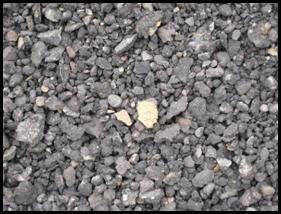
Asphalt and aggregate containing removed and/or reprocessed pavement components are referred to as reclaimed asphalt pavement (RAP). These materials are created when asphalt pavements are removed for construction, resurfacing or to gain access to subsurface systems. After being meticulously crushed and screened, highquality,wellgradedaggregatesareusedtocreateRAP. Asphaltpavementremovaltypicallyinvolvesmillingorfull depth removal. A milling machine is used to remove the pavement surface during milling, and it is capable of removing up to 50 mm of pavement thickness in a single pass. The pavement may be broken and shattered using a bulldozer's rhino horn or pneumatic pavement breakers duringfull-depthremoval.Afront-endloadertypicallypicks up the broken pieces, loads them onto haul trucks, and transfers them to a processing facility. This facility uses a variety of techniques to handle RAP, including crushing, screening, conveying, and stacking [U.S. Department of Transportation, Federal Highway Administration Research and Technology]. RAPimageisshowninFigure 1.Thetable1belowshowsthephysicalpropertiesofRAP aggregates [9].
International Research Journal of Engineering and Technology (IRJET) e-ISSN: 2395-0056
Volume: 09 Issue: 12 | Dec 2022 www.irjet.net p-ISSN: 2395-0072
Table 1 PhysicalpropertiesofRAPaggregates [9]
Property Reclaimed asphalt pavement
Moisturecontent(%) 0.23 Specificgravity(SSD) 2.12 Waterabsorption(%) 1.0
LosAnglesabrasion(%) 33.6
Molecularweight - 192(gmol-1)
Density - 1.41(gcm-3)
Meltingtemperature (DSC) 265(oC)
TensileStrength - 1700(MPa)
Yieldstrain Tensile 4(%)
Impactstrength ASTMD25686 90(Jm -1)
Waterabsorption - 0.5(%)
Fig 1 Reclaimed Asphalt Pavement
Therearevariouspolymersthatcanberecycledinbitumen [10]. These include low and high density polyethylene (LDPE,HDPE),whicharefrequentlyusedinpackagingand plasticbottles;andpolypropylene(PP),whichiscommonly used in straws, sweet wrappers, textile, vehicle, and furnituresectors [11].Polyvinylchloride(PVC)isutilizedin plumbing pipes and fittings; polyethylene terephthalate (PET)iscommonlyusedinwaterandsoftdrinkbottles;and acrylonitrilebutadienestyrene(ABS)isusedinelectronic equipment such as laptop computers and mobile phones. Some of these elements would be ineffective in the productionofrecycledpolymermodifiedbitumen [12].
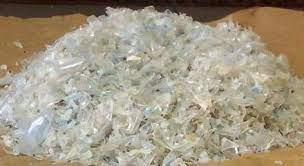
PET is a thermoplastic polymer that is widely utilized throughouttheworld.PETgarbageincludesitemssuchas bottles,foils,andcables.RecyclingleftoverPETplasticscan help reduce environmental pollution, conserve natural resources,andsaveenergyandmoney [13] VirginPETisa superior material for certain applications. This material offers a high tensile strength, adequate thermal stability, chemicalresistance,processingcapability,colorcapability, andclarity [14].Itcanbecreatedundernormalpressures and temperatures. PET can be made from petroleum hydrocarbonsbyreactingethyleneglycolwithTerephthalate acid [15]. The basic physical and chemical properties of commercially-used PET plastics are indicated in Table 2 [14]. Figure2showsanimageofPETinshreddedform
T. A. Pradyumna, et.al. (2013) investigatedthemechanical characteristicsofhot mixasphaltwithincorpationofRAP (20%) to improve the performance of mix. Various tests were conducted such as Modulus test, moisture content, resilenceruttingtest,susceptibilitytestanditwasfoundthat mixes which was prepared with 20% RAP gave higher resultsthantheconventionalmixesundersameconditions [16]
R Izaks, et.al. (2015) conducted study on mixtures with highRAPcontenttofulfillocalvolumetricpropertieswith andwithoutRAP(30%and50%RAP)andfatigueandrutting characteristicswereinvestigated.Theresultsshowedthat there was a minor improvement in rutting and fatigue resistancewhencomparedtostandardmixes,butnovisible changesinflow,henceitwassuggestedthatupto50%RAP may be used to meet the volumetric characteristics and performancerequirements [17].
Mahendra S. P., et.al. (2016) evaluatedtheperformanceof asphalt mixes with varying amounts of PET waste as a bitumenmodifier(2%,4%,6%,8%,and10%).Laboratory testssuchastheMarshalltestwereperformedwithvaried percentagesofbitumenand8%PETwasfoundtobeoptimal basedonMarshallstabilityandflow.ExceptforPET10%,
2022, IRJET | Impact Factor value: 7.529 | ISO 9001:2008 Certified Journal | Page1202
International Research Journal of Engineering
Technology (IRJET) e-ISSN: 2395-0056
Volume: 09 Issue: 12 | Dec 2022 www.irjet.net p-ISSN: 2395-0072
Marshall stability improved by 25% as compared to conventional mix. It was discovered that increasing PET percentage decreased flow value,% air void and voids in mineralaggregates,andincreasedthenumberofvoidsfilled withbitumen [18]
Anand Sreeram, et.al. (2018) evaluatedtheperformanceof asphaltmixpreparedwithPET andRAPat15%,30%and 50%andmixtureswereundergoneforMarshallstabilitytest andindirecttensilestiffnessmodulustest,itwasdiscovered that mixtures containing 2% PET and RAP showed enhancementinMarshallstabilityandMarshallquotientas wellasgreaterresiliencetopermanentdeformation [7].
Ponnnada Sudheer, et.al. (2019) examinedtherheological parameters of asphalt mixes with PET incorporation to improvebitumenproperties. Todeterminetheoptimal%of PET, various laboratory tests such as softening point, ductility value, elastic recovery, specific gravity flash, fire point,penetration,andMarshallstabilityweredone.Itwas discoveredthat5%and7.5%PETcanbeutilizedtoimprove therheologicalpropertiesofbitumen [19].
Umar Hayat, et.al. (2020) studied the use of PET in percentages (2%, 4%, and 6%) and recycled asphalt in percentages (20%, 30%, and 40%) in asphalt mix. Penetration and softening point tests were carried out to determinetheoptimumcontentofPETandmarshall
stability, and DSR tests were carried out on samples prepared with the above contents to determine their properties. It was concluded that 4% PET and 30% RAP improvedruttingresistanceandMarshallstability [20]
Prabhakar Kumar, et.al. 2019) incorporatedtheRAPinto asphaltmix,sampleswith15%and25%RAPwereprepared andoptimumbindercontentwasdetermined.Testsuchas Marshall stability was conducted and results showed the incrementinMarshallstabilityat15%RAP [21].
P. Gireesh Kumar, et.al. (2020) StudiedtheeffectofRAP material overvirginmaterialinasphaltmix.Amarshalltest wasperformedonmixturespreparedwithRAPat0%,30%, 40%, 50%, and 100%. Marshall stability was found to be increased by 13.71% with 50% RAP as compared to a standardmixmadewithoutRAP.Itwasalsodiscoveredthat usingRAP100%leadsinweakandunstablepavementsince theflowandtotalstabilityvaluesaresignificantlylowerthan thelimitationvalue [22].
Tuleshwar Choudhary, et.al. (2022) investigatedtheuseof RAPmixedwithplastictrashasaroadpavementmaterial. RAP was used as coarse aggregate, and plastic (6%, 8%, 10%,and12%byweightofbitumencontent)and25%RAP content were used to make the mix. According to the requirements, the maximum Marshall stability value was increased by 20% at 8% plastic content and at 25% RAP [23].
Fatigue resistance increased by 67 2%, Rutting resistance increased by 7.14%
Mullapudi et al 2015
Ponnanda Sudheer et al 2019 PET0%, 2.5%, 5%, 7 5%10% 7.5% PET Marshall stability Marshall stability increased by 19 22%
International Research Journal of Engineering and Technology (IRJET) e-ISSN: 2395-0056
Volume: 09 Issue: 12 | Dec 2022 www.irjet.net p-ISSN: 2395-0072
In this review paper, different laboratory tests were conductedbyresearcherstoevaluatethecombinedeffectof PET and RAP in asphalt mix. On the basis of literature reviewsandstudies,theconclusionsareasfollows.
1. The use of RAP in conventional mix could solve the problem of disposal of RAP and using RAP in certain percentagesreducestheuseofnaturalaggregatesand also reduces the cost of construction of flexible pavement.
2. ThepartialreplacementofPETatcertainpercentages enhancesthemechanicalandrheologicalpropertiesof virginbinder.TheadditionofPET(wasteplasticbottle) canbeanalternativestrategyfordecreasingpavement deteriorationandincreasingasphaltmixproperties.
3. The use of RAP up-to 30% shows positive results towardsfatigueresistanceinasphaltmixandRAPupto 50% gives satisfactory results towards rutting resistance.Ruttingresistanceincreasesaspercentageof RAPincreases.
4. ItwasfoundthattheuseofRAPupto50%couldbeused inasphaltmixtoachievesatisfactoryresultsofMarshall stability,rutting,resistanceandfatigueresistance.
5. Plastic addition to bitumen should be limited to the optimumamount;overthislevel,rheologicalqualities and stability value decreases, which is not recommendedforappropriatepavementdesign.
6. The use of PET as a bitumen modifier up to 8% improves the Marshall stability as well as rutting resistanceofasphaltmix.
7. When combined with RAP, PET provides excellent rutting resistance up-to 66% and increases Marshall stabilityupto38%.
AccordingtotheliteraturecomparisoninTable3,theoverall performance of asphalt mix has improved with the incorporation of RAP as a partial replacement of natural aggregatesandPETasabitumenmodifier.UsingRAPand PET enhances the Marshall stability by 6% to 57%, the rutting resistance increased by 6% to 66% and fatigue resistancewasincreasedby20%to67%.
[1] A. Foroutan, S. Amid, I. Hoff, S. Dessouky, and C. Ho, “Performanceevaluationofasphaltmixturescontaining high-RAP binder content and bio-oil rejuvenator,” Constr. Build. Mater., vol. 227, p. 116465, 2019, doi: 10.1016/j.conbuildmat.2019.07.191.
[2] M. Wróbel, A. Woszuk, M. Ratajczak, and W. Franus, “Propertiesofreclaimedasphaltpavementmixturewith
organicrejuvenator,” Constr. Build. Mater.,vol.271,no. xxxx,2021,doi:10.1016/j.conbuildmat.2020.121514.
[3] D.C.MONTGOMERY,“RecyclingofAsphaltPavements,” no.January2014,pp.2017–2019,2018.
[4] S. Kodippily, G. Holleran, and T. F. P. Henning, “Improvingtheperformanceofrecycledasphaltmixes using rejuvenation additives,” 8th Int. Conf. Maint. Rehabil. Pavements, MAIREPAV 2016,no.July,pp.369–378,2016,doi:10.3850/978-981-11-0449-7-058-cd.
[5] R.McDanielandR.MichaelAnderson, NCHRP REPORT 452 - Recommended Use of Reclaimed Asphalt Pavement intheSuperpaveMixDesignMethod:Technician’s Manual TRANSPORTATION. 2001. [Online]. Available: http://www.national-academies.org/trb/bookstore
[6] S.Magar,F.Xiao,D.Singh,andB.Showkat,“Applications ofreclaimed asphaltpavement in India – A review,” J. Clean. Prod., vol. 335, no. December, p. 130221, 2022, doi:10.1016/j.jclepro.2021.130221.
[7] Z. Leng, A. Sreeram, R. K. Padhan, and Z. Tan, “Valueadded application of waste PET based additives in asphalt mixtures containing high percentage of reclaimedasphaltpavement(RAP),” J. Clean.Prod.,vol. 196, pp. 615–625, 2018, doi: 10.1016/j.jclepro.2018.06.119.
[8] Z. Niloofar KALANTAR, M. Abdel Aziz, and M. Rehan KARIMProfessor,“EffectoftheWastePlasticbottleson propertiesofasphalt,” Proc.East.AsiaSoc.Transp.Stud., vol.8,2011.
[9] R.Taha,A.Al-Harthy,K.Al-Shamsi,andM.Al-Zubeidi, “Cement Stabilization of Reclaimed Asphalt Pavement AggregateforRoadBasesandSubbases,” J. Mater. Civ. Eng., vol. 14, no. 3, pp. 239–245, 2002, doi: 10.1061/(asce)0899-1561(2002)14:3(239).
[10]M.Murphy,M.O’Mahony,C.Lycett,andI.Jamieson,“R EcycledPOlymersAs,” J. Mater.Civ.Eng.,no.August,pp. 306–314,2001.
[11] Y.Zheng,Z.Shen,C.Cai,S.Ma,andY.Xing,“Thereuseof nonmetalsrecycledfromwasteprintedcircuitboardsas reinforcingfillersinthepolypropylenecomposites,” J. Hazard.Mater.,vol.163,no.2–3,pp.600–606,2009,doi: 10.1016/j.jhazmat.2008.07.008.
[12] D. Casey, C. McNally, A. Gibney, and M. D. Gilchrist, “Developmentofarecycledpolymermodifiedbinderfor useinstonemasticasphalt,” Resour.Conserv.Recycl.,vol. 52, no. 10, pp. 1167–1174, 2008, doi: 10.1016/j.resconrec.2008.06.002.
[13] T.E.Group,“IMPROVEMENTINTHEPROPERTIES OFASPHALT,”vol.247667,pp.1–8,2016.
International Research Journal of Engineering and Technology (IRJET) e-ISSN: 2395-0056
Volume: 09 Issue: 12 | Dec 2022 www.irjet.net p-ISSN: 2395-0072
[14] F. Awaja and D. Pavel, “Recycling of PET,” Eur. Polym. J., vol. 41, no. 7, pp. 1453–1477, 2005, doi: 10.1016/j.eurpolymj.2005.02.005.
[15] A. Farzi, A. Dehnad, and A. F. Fotouhi, “Biodegradation of polyethylene terephthalate waste usingStreptomycesspeciesandkineticmodelingofthe process,” Biocatal. Agric. Biotechnol.,vol.17,pp.25–31, 2019,doi:10.1016/j.bcab.2018.11.002.
[16] T. A. Pradyumna, A. Mittal, and P. K. Jain, “CharacterizationofReclaimedAsphaltPavement(RAP) for Use in Asphalt Road Construction,” Procedia - Soc. Behav. Sci., vol. 104, pp. 1149–1157, 2013, doi: 10.1016/j.sbspro.2013.11.211.
[17] R.Izaks,V.Haritonovs,I.Klasa,andM.Zaumanis,“Hot MixAsphaltwithHighRAPContent,” Procedia Eng.,vol. 114, pp. 676–684, 2015, doi: 10.1016/j.proeng.2015.08.009.
[18] S. P. Mahendra and K. V. R. Prasad, “COMPARATIVE STUDY ON IMPROVEMENT IN THE PROPERTIES OF ASPHALTMIXESUSINGPETWASTE,”pp.0–6,2016.
[19]S.PonnadaandV.K.K,“MaterialsToday :Proceedings Experimental investigation on modification of rheological parameters of bitumen by using waste plasticbottles,”no.xxxx,2020.
[20] U.Hayat,A.Rahim,A.H.Khan,andZ.UrRehman,“Use ofplasticwastesandreclaimedasphaltforsustainable development,” Balt. J. RoadBridg. Eng.,vol.15,no.2,pp. 182–196,2020,doi:10.7250/bjrbe.2020-15.479.
[21] P.P.Kumar,P.R.Kumar,andP.M.Aslam,“Designof AsphaltMixusingReclaimedAsphaltPavement(RAP),” pp.3614–3618,2019.
[22] P. Gireesh Kumar, “A Study on Effect of Reclaimed Asphalt Pavement Material over Virgin Material in AsphaltMix,” IOPConf.Ser.Mater.Sci.Eng.,vol.1006,no. 1,2020,doi:10.1088/1757-899X/1006/1/012042.
[23]T.Choudhary,“UTILIZATIONOFRECLAIMEDASPHALT PAVEMENT(RAP)WITHPLASTICWASTE(DryProcess) AS ROAD PAVEMENT MATERIAL IN FLEXIBLE PAVEMENT USING HOT MIX ASPHALT (H.M.A.) TECHNIQUE(MarshallStabilityMethod),” Interantional J. Sci.Res.Eng.Manag.,vol.06,no.05,pp.1–8,2022,doi: 10.55041/ijsrem15267.
2022, IRJET | Impact Factor value: 7.529 | ISO 9001:2008 Certified Journal