International Research Journal of Engineering and Technology (IRJET) e-ISSN: 2395-0056

Volume: 09 Issue: 12 | Dec 2022 www.irjet.net p-ISSN: 2395-0072
International Research Journal of Engineering and Technology (IRJET) e-ISSN: 2395-0056
Volume: 09 Issue: 12 | Dec 2022 www.irjet.net p-ISSN: 2395-0072
Kashish Nair1 , Dr. Suman Mundkur2 , Anju Tulshyan3
1Student 2Associate Professor 3Associate Professor
Dept. of textile and apparel designing, Sir Vithaldas Thackersey College of Home Science (Autonomous), Juhu, SNDT Women’s University, Mumbai, Maharashtra, India ***
Abstract - Consumer shopping behaviour deals with consumer’s attitudes, preferences, intentions and decisions regarding the consumer’s behaviour in a marketplace, when purchasing a product. A lot of studies have beenconducted on shopping behaviour of Americanmen and women but this has been under research in India. To examine and compare the shopping behavior of menandwomenasconsumersofvarious products, a quantitative methodology with a survey design was used. Data was collected using an online structured questionnaire with closed-ended questions. A comparative study was done to analyse the difference in shopping behaviour of genders. Sample size of 111 young men and 110 young women were selected through a convenience sampling method. The numerical data was statistically analyzed Analysis helped in understanding shopping behavior of undergraduate young men and women from various cities of India. It helped to explaintheir shoppinginterestsandchoices. The study revealed that most men and women have similar interests and attitudes or behaviour towards shopping. However, there were some significant differences observed in the expenditure per trip and kind of shopper.
Key Words: attitude; expenditure; malls; shopping; utilitarian
It should come as no surprise that men and women shop very differently. People will shop in order to satisfy their requirements.Peopleallovertheworldgoshoppingevery dayforeverythingfromlow-costgoodstohigh-endgoods.
Themajorityofpeoplebelievethatwomenspendmoretime shopping than men do. Men, on the other hand, prefer to walkintoastore,lookforaspecificitemtheywant,buyitas quickly as possible and then leave. Whereas women patientlylookforthekindofproducttheywantinallofthe brandsthatareavailable,comparethedesigns,lookforany offersthatmightbeavailable,bargain,andultimately buy theproductthatmakesthemhappy.
Gender plays a crucial roleinpurchasingdecisions. There are numerous psychological and physiological differences between men and women. Men and women behave very differentlywhenmakingpurchasesofgoodsorservices.
Everyday,consumersmakepurchasingdecisions,andmany of them are unaware of the factors that influence them. Cultural,social,personal,orpsychologicalfactorscanallplay aroleinmakingabuyingdecision.Therearedimensionsin eachofthesefactorsthatcanbeusedinmarketing. These factorscanbeusedbymarketersthatcustomersmightnot evennotice.
The digitalization of retail shops is increasingly changing consumerbuyingpatterns.(Marg,2016).Theambianceof thestoreisoneoftheelementsthatinfluencesaconsumer's frequency of shopping. Women were found to be more recreation-conscious, fashion-conscious, and perfectionist shoppers than men when comparing their behaviour in shoppingmalls(Wesley,LehewandWoodside,2006).Along with consumer purchasing behaviour and motivations, utilitarianandhedonisticvalueshavealsofrequentlybeen studied (O'Brien, 2010). Shopping is typically associated withwomen.
Onlyafewstudieshaveshownthatmenmightrepresentthe majorityofonlineshoppers.ConsumersfromSaltLakeCity (Utah), Madison (Wisconsin), and Spokane (Washington) wereaskedhowfrequentlytheyvisitamall,howlongthey staythere,andhowmuchmoneytheyspendonaverageper mallvisit.HuH.andJasperC.(2004)investigatedthegender differences in mall shopping behaviour. According to the findings, customers purchase not just for clothes and distinctivegoodsbutalsoforenjoymentandentertainment. Thisstudydisprovedthenotionthatmalesdonotshopas frequentlyaswomenandthatthereisnodifferencebetween thetwointermsofspendingpertriporfrequency.Theonly difference is that on an average men spend about half an hour less than women. Male shoppers tend to be goal oriented.Thestudyalsoshowedthatunlikewomen,mendo not consider the mall as a place for relieving stress or providing relaxation. The study also shows that men are utilitarian shoppers i.e. They have a rational approach towards buying and do not just buy for fun. Khusaini, Ramdani,H.,Ambarumanti,R.(2019)analyzedtheinfluence ofshoppingandgenderorientationononlineshopping,and thedifferencesinshoppingorientationandonlineshopping betweenmenandwomen.Inshoppingorientation,theyused
International Research Journal of Engineering and Technology (IRJET) e-ISSN: 2395-0056
Volume: 09 Issue: 12 | Dec 2022 www.irjet.net p-ISSN: 2395-0072
shopping enjoyment indicators, fashion/conscious, price conscious, shopping confidence, time conscious, in-home shopping tendency, brand/store loyalty. The findings demonstrated that while gender did not influence online shopping,shoppingorientationhadasignificantimpactonit in part. Nagar, D. and Shukla, R. (2019) identified factors leadingtocustomersexperienceinofflineretail storeand analyzetheassociationbetweenconsumerdemographyand offline retail experience. The study revealed that male respondentswereinfluencedmorewithstoreatmosphere whereas female respondents were more influenced by services.AstudybyAzad,S.,Meraj,Q.andGupta,R.(2019) studiedthefactorsinfluencingonlineandofflineshoppingin SrinagarCity,JammuandKashmir.Itshowed48.8%ofmale go for the shopping while 51.3% female do the shopping. Findings showed that more female were involved in the shoppingthanmale.
Mmari,W.andKazungu,I.(2019)exploredhowshopping orientation affect consumer purchase decision in their genderperceptive.Theconceptualframework(i.e.utilitarian shopping, recreational shopping, window shopping, convenientshoppingandconsumerpurchasedecision)was tested using structural equation modelling (SEM). The findingsrevealedthatcustomershavedifferentbehaviourin shoppingorientatedbasedontheirgender.Cross-sectional research design was used in the study. Structured questionnairewasadministeredamongstaccidentalsample consisting of customers in 11 shopping malls in Dar es Salaam.Findingsofthisstudyrevealedthatthemajorityof women have fun when shopping, like to spend time by shoppingbutalsomovearoundwhenshopping.Menonthe other side usually carry out what they have planned, act deliberately and goal focused as possible. They also save time when shopping, make shopping less time consuming andalsotheyprefershoppingthatwouldallowthemtoshop whenever they choose. Do, Q. (2019) aimed to explore whethertherearegenderdifferencesintheonlineconsumer decision-making process. Some of the most important factorsimpactingonpurchasedecisionsofcustomersduring analysed.TheresultsdemonstratedthatyoungVietnamese consumers'onlineshoppingbehaviorswerenotgendered differently.PradhanaF.andSastionoP.(2018)studiedhow thedifferenceofgenderinfluencedthepreferenceinonline shopping.Despitethefactthatmenspendmoreoverallthan women, this study found that women shop online more frequentlythanmen.Formen,itisonlytheleveloftrustthat canaffectspendinginonlineshopping,whileforwomen,in addition to the level of trust, the level of practicality also affectsonlineshoppingexpenditure.Ontheotherhand,for men, risk aversion factors affect online shopping expenditure, where when men are more risk averse then theirspendingwillbesmaller,whereasforwomentherisk aversion factor does not affect their online shopping expenditure.
Katrodia,A.,Naude,M.andSoni,S.(2018)studiedtheroleof gender on consumers' buying behavior in select shopping mallsinDurbancity,tocomparebuyingcapacityofmaleand female consumers at selected shopping malls and study genderdifferencesinshoppingexperienceatselectedmalls. The study concluded that there is gender difference in shoppingbehavior.Averagetimespentbyfemaleishighas compared to male which also affect their average money spent at shopping mall. Psychological, cultural and social factors have a significant impact on shoppers' purchasing decisionsatshoppingmalls.Maleandfemalecustomershave almost similar views on influencing factors for shopping behaviorexceptforfewfactorslikemallimage,information boothandevacuationpath.Kuruvilla,S.,Joshi,N.andShah, N. (2009) explored the mall-shopping habits in India and attempted to identify and contrast possible differences between genders using a sample of 2721 mall consumers across seven cities. It was found that the visitors who patronizethemallduringtheweekdaysandweekendscould differsubstantiallyalongthevariablesofinterest;therefore data were collected on equal number of weekends and weekdaysateverydestination.Thefactorsgeneratedwere the utilitarian shopper, the economic (or price-sensitive) shopper,thewindow-shopperandfourthlytherecreational shopper.Accordingtothefindings,womenaremorelikely thanmentopurchasefashion-relateditemsandhaveamore positiveattitudetowardmallshopping.However,menvisit more frequently and spend more money and time. Men reported spending more time and visiting the mall more frequently than women, who typically spend 2 to 4 hours there. A study of this kind was necessary, especially with youngIndianmenandwomenwhowereplanningtoattend college.
Tostudythedifferenceintheshoppingbehaviourfocusing onshoppinginterestsandshoppingattitudesofIndianmen andwomen.
Thequantitativemethodologywithasurveydesignwasused tostudytheinterestsandattitudesofcollegegoingmenand women in India. The participants were contacted mostly through social media platforms. Although most of the responsesweresatisfying,therewere2maleand1female whichhadtobediscardedduetoinappropriateresponses. Thesurveywasconductedonlinewithyoungundergraduate menandwomenfromvariouspartofIndia.Thesamplesize consisted of 111 men and 110 women. Non- random samplingwithsnowballtechniquewasfoundmostsuitable. The tool was a close-ended questionnaire using Google forms. The questionnaire included questions related to frequency of shopping, shopping items and preference of shoppingformatsandexpenditure.Thecomparativestudy ondifferenceintheconsumershoppingbehaviourbetween
International Research Journal of Engineering and Technology (IRJET) e-ISSN: 2395-0056
Volume: 09 Issue: 12 | Dec 2022 www.irjet.net p-ISSN: 2395-0072
thegenderswasstatisticallyanalysedtotestthehypothesis. Datawasstatisticallyanalysedtotestwhetherornotthereis statisticallysignificantdifferenceintheshoppingbehavior,a nullhypothesiswasassumed.
H0-thereisnodifferencebetweentheshoppingbehaviorof undergraduatemenandwomen.
H1- thereisa significantdifferencebetween theshopping behaviorofundergraduatemenandwomen.
Thedatawascollectedthroughonlinequestionnaire.Data wasanalysedusingSPSSsoftwareforWindows(version25). Data presented as frequency (%). Cross-tabulations were computedandfrequencieswerecomputedusingChi-square test. If the value of was p <0.05, it was considered to be statisticallysignificant.
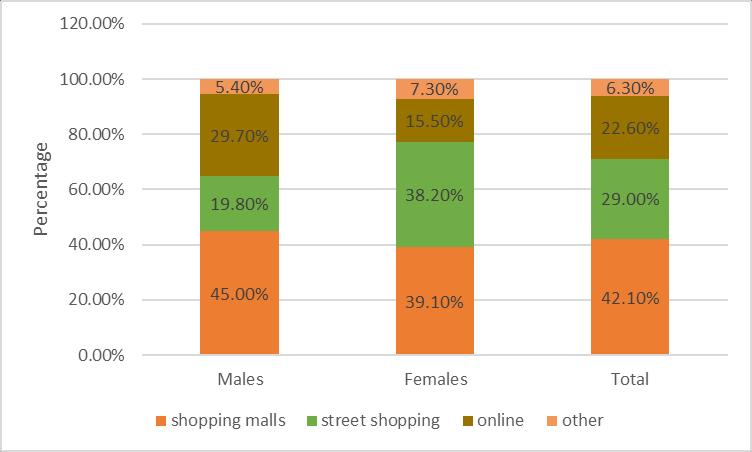
Womenliketoshopmonthlyascomparedtomenwhereas, higher percentage of men shopped yearly as compared to women. There was a significant association of place of shopping and gender. Chi-square test showed that higher percentageofmenwereutilitarianshopperswhereas,higher percentage of women were hedonistic shoppers. The motivationforshoppingwascategorisedintoutilitarianand hedonicmotivations(HuangandYang,2010;Monsuweetal., 2004). Utilitarian motivation tends to have a rational approach and was also considered as a traditional buying decision process. The benefits of purchasing (e.g., time saving,detailedinformation ofproduct,pricecomparison, greater option and cheaper price) was considered as utilitarian motivation because the person purchases rationally (Sarkar, 2011; Veronika, 2013). Hedonic motivationhasemotionalapproach.Itmeansthatcustomers aredrivenbyemotionsandfeelingsbecausetheyenjoyand feel excited in the shopping experience. It was also found that women enjoyed street shopping whereas higher percentage of men prefer shopping in malls (χ2=12.178, p=0.007).Therewasasignificantassociationfoundbetween theplaceofshoppingandgenderhencehypothesisH1can beaccepted.
Womencheckpricetagsalwayswhereashigherpercentage ofmenreportedthattheynevercheckedpricetags.Higher percentageofmenspentmorethanINR2000asexpenditure per trip whereas higher percentage of women spent only INR 1000-2000. Thus, there was significant association between expenditure per trip and gender (χ2=7.665, p=0.053).Hence,hypothesisH1canbeaccepted.
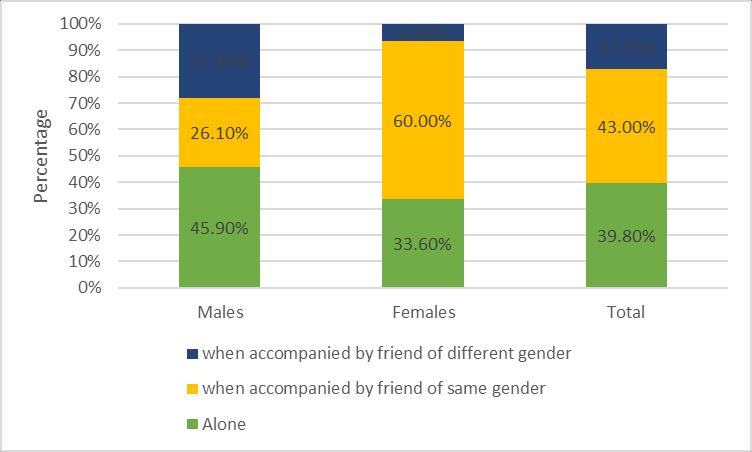
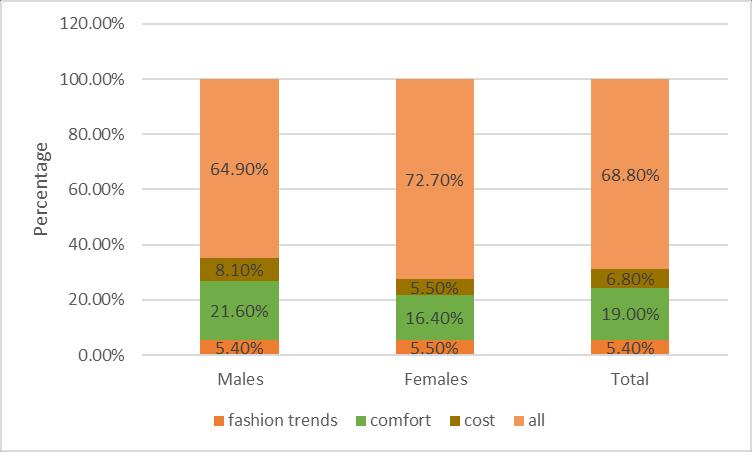
There are several factors which affect shopping attitude. Higherpercentageofmenpreferredcomfortwhereashigher percentage of women considered fashion trends, comfort and cost. A Chi-square test also found that there was a significant association between the amount spent on shopping and shopping while in company (χ2=31.792, p=0.000).Menclaimedthattheyshoppedmorewhenthey were alone while women shopped more when they are accompaniedbysomeoneofsamesex.Thismaybedueto thefactthatmostwomengenerallyseekapprovalfromtheir friends or family before buying whereas; men were less confused and clear with what they had to buy. Higher percentageofmenopinedthattheirshoppingfrequencyhad increasedwithplasticpayment.Plasticpaymenthasbecome more convenient these days. It includes payment through credit/debitcards,Paytm,PayPal,etc.Thestudyalsofound that women mostly shopped more during sales; whereas, men shopped less frequently during sales. There was in general, a tendency of women to shop more during sales because according to fashion psychology, shopping gives pleasure to women. Shopping during discount sales gave themhappiness,calmnessandmadetheirmoodbetter.
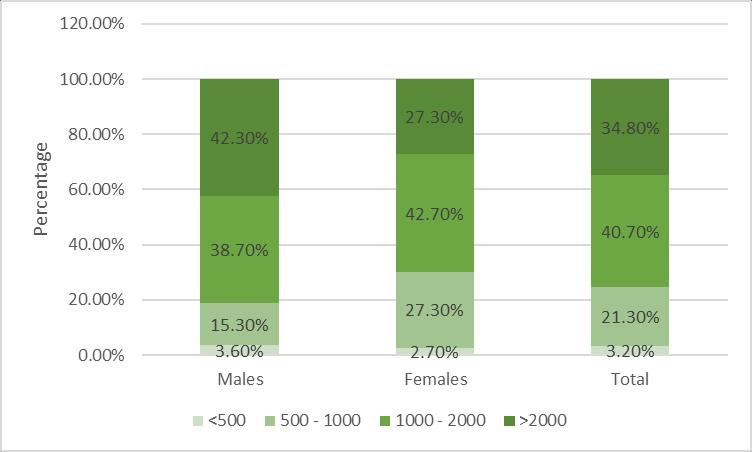
The above study has been carried out to understand the difference in shopping behaviour of men and women. ContrarytothestudydonebyHu,H.andJasper,C.(2004), this study shows that there is difference in terms of expenditurepertriporshoppingfrequencyasinFigure1. MostparticipantsspendmorethanINR1000butlessthan INR2000.HigherpercentageofmenspendmorethanINR 2000pertripwhereashigherpercentagewomenspendless than INR 1000 per trip. However, there was a significant associationof expenditurepertripandgender(χ2=7.665, p=0.053).
UnlikethefindingsbyDo,Q.(2019)whichsaysthatthereis no significant gender disparity in young Vietnamese consumer behaviors regarding online shopping, in India
International Research Journal of Engineering and Technology (IRJET) e-ISSN: 2395-0056
Volume: 09 Issue: 12 | Dec 2022 www.irjet.net p-ISSN: 2395-0072
there is significant gender disparity for online shopping. Pradhana,F.andSastiono,P.(2018)foundthatwomenenjoy onlineshoppingmorethanmenbutthepresentstudyfound asseeninFigure.2,thatmenpreferonlineshoppingmore than women. Most participants preferred shopping malls, whereas very small percentage preferred online. Higher percentageofwomenwerestreetshoppers;whereashigher percentage of men shop online. There was a significant association between genders with the place of shopping (χ2=12.178,p=0.007).
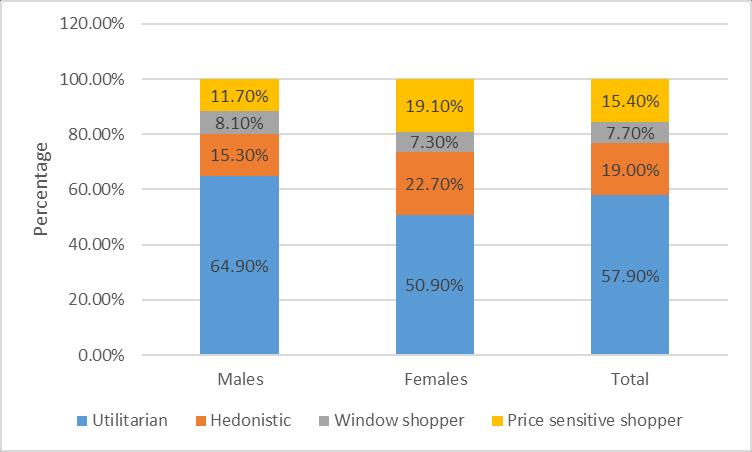
shoppingbutalsomovearoundwhenshopping.Menonthe otherside,usuallycarriedoutwhattheyhadplanned,acted deliberatelyandweregoalfocusedaspossible.Thismeans women take shopping as leisure activity i.e., they are hedonisticshoppers.AsseeninFigure.4,higherpercentage ofmenwereutilitarianshopperswhereashigherpercentage ofwomenwerehedonisticshoppers.Asignificantdifference wasseenintheamountofspendingincreasedwiththeuse ofplasticpaymentinmen;whereasalotofwomendidnot agreetoincreasetheirspendingwithcreditcardsordebit cards.
Kuruvilla,S.,Joshi,N.andShah,N.(2009)foundthatwomen hadamorepositiveattitudetomallshoppingandthatthey purchase fashion related categories more often than men. Similarly,inthepresentstudyasinFigure.3,itwas found found that women preferred to buy more fashion related itemsascomparedtomenwhereasmenpreferredcomfort more than fashion. Higher percentage of men preferred comfort whereas higher percentage of women considered fashion trends, comfort and cost. However, there was no significant association of gender and factors determining choiceofshopping.
Anothersignificantdifferencewasobservedinthefactthat, mostwomenshoppedmorewhentheywereaccompanied by a female friend. While most men shopped more when they were alone as seen in Figure. 5. Most participants shoppedmorewhenaccompaniedbyfriendofsamegender. Higher percentage of women shopped more when accompanied by friend/friends of same gender whereas higher percentage of men shopped more when they were alone. However, there was a significant association of shoppingfrequencyandgender.(χ2=31.792,p=0.000).Thus, hypothesis H1 may be accepted. There is a significant difference between shopping behavior of undergraduate menandwomeninIndia.
SupportingthestudyofMmari,W.(2019)andKazungu,I. (2019) this study finds that majority of women have fun when shopping, not only do they like to spend time by
International Research Journal of Engineering and Technology (IRJET) e-ISSN: 2395-0056
Volume: 09 Issue: 12 | Dec 2022 www.irjet.net p-ISSN: 2395-0072
Itmaybeconcludedthatmostmenandwomenhavesimilar interests and attitudes or behaviour towards shopping. Undergraduate men like to shop yearly whereas women preferredshoppingmonthly.Menmostlybuyaccordingto needsandnecessity,thustheymaybeclassifiedasutilitarian shoppers. Most men prefer malls for shopping whereas, womenpreferstreetshoppingmore.Fashion,cost,comfort andpricearethemajorfactorswhichaffecttheirshopping frequency.Majorityofmenshopmorewhentheyarealone. With the increase in digitalization and plastic money, the amount of money they spend on shopping has increased. Men and women both usually shop for clothing more as comparedtoaccessories.Mostyoungmendonotgenerally buyinsalesanddiscountswhereasfemalespreferto.Most men spend more expenditure per trip as compared to women.Thisstudywaslimitedtoonlineresponses.Personal interviews with large sample would generate substantial dataforfurtherresearch.
[1] Azad, S., Meraj, Q. F., and Gupta, R. C., “Factors InfluencingOnlineAndOff-lineShopping:ACaseStudy Of Srinagar City In Jammu & Kashmir,” International JournalofManagement,IT&Engineering,Vol.9,Issue5 (1),2019
[2] Do,Q.,“Isthereanygenderdifferenceinonlineshopping decisions among consumers. An exploratory study on youngVietnameseconsumers”,AaltoUniversity,2019 https://aaltodoc.aalto.fi/handle/123456789/40665R
[3] Hu, H., and Jasper, C. R., “Men and Women: A Comparison Of Shopping Mall Behaviour”. Journal of ShoppingCenterResearch.11(1).113-131,2004
[4] Huang, J. H., and Yang, Y. C., “Gender differences in adolescents’ online shopping motivations”, African JournalofBusinessManagement.4(6),2010
[5] Katrodia,A.,Naude,M.J.,andSoni,S.,“ConsumerBuying Behavior at Shopping Malls: Does Gender Matter?”, Journal of Economics and Behavioral Studies, 10 (1), 125.doi:10.22610/jebs.v10i1.2095,2018
[6] Khusaini,K.,Ramdani,H.C.,andAmbarumanti,R.,“The InfluenceofShoppingandGenderDifferencesonOnline Shopping.”, Journal Pendidikan Ekonomi Dan Bisnis (JPEB),7(1),22–30.doi:10.21009/jpeb.007.1.3,2019
[7] Kuruvilla, S. J., Joshi, N., and Shah, N. , “Do men and womenreallyshopdifferently?Anexplorationofgender differences in mall shopping in India”, International Journal of Consumer Studies, 33 (6), 715–723. doi: 10.1111/j.1470-6431.2009.00794.x,2009
[8] Marg, B., “Pizza at Urban Outfitters? Tacos at Tommy Bahama? How Retailers Can Rethink the In-Store Experience,” September 19, Marketing, 10¸167-201. http://www.mytotalretail.com/article/howretailerscan-rethink-in-store-experience/
[9] Mmari,W.E.,andKazungu,I.,“Shoppingorientationand consumer purchase decision in shopping malls: A gender perspective in Dar Es Salaam Tanzania”, East AfricanJournalofSocialandAppliedSciences(EAJ-SAS) ,Vol.1,1(1),40–49.
[10] Monsuwe,T.P.,Bellaert,B.G.C.,andRuyterK.,“What drivesconsumerstoshoponline?Aliteraturereview”, InternationalJournalofServiceIndustryManagement, 15 (1), 102-121. doi: 10.1108/09564230410523358, 2004
[11] Nagar, D., & Shukla, R., “Delivering Customer Value throughStoreExperience:AnEmpiricalStudy”,Journal oftheGujaratResearchSociety,Volume21(Issue15), 2019
[12] O’Brien,H.L.,“Theinfluenceofhedonicandutilitarian motivations on user engagement: The case of online shoppingexperiences.InteractingwithComputers,22 (5),344-352,2010
[13] Pradhana, F., and Sastiono, P., “Gender Differences in Online Shopping: Are Men More Shopaholic Online?” Proceedings of the 12th International Conference on BusinessandManagementResearch(ICBMR2018).doi: 10.2991/icbmr-18.2019.21,2019
[14] Sarkar,A.,“Impactofutilitarianandhedonicshopping values on individual’s perceived benefits and risks in online shopping.”, International Management Review, 7(1),58-65,2011
[15] Veronika, S., “Motivation of online buyer behaviour.”, Journal of Competitiveness, 5(3), 14-30. doi: 10.7441/joc.2013.03.02,2013
[16] Wesley,S.,Lehew,W.and Woodside,A.G.,“Consumer decision-making styles and mall shopping behaviour: Buildingtheoryusingexploratorydataanalysisandthe comparativemethod.”,JournalofBusinessResearch,59 (5):535-548,2006