Volume: 09 Issue: 12 | Dec 2022 www.irjet.net p-ISSN:2395-0072

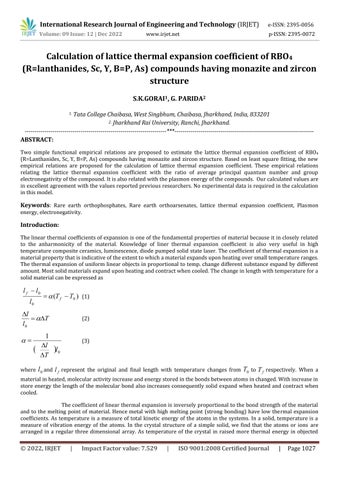
Volume: 09 Issue: 12 | Dec 2022 www.irjet.net p-ISSN:2395-0072
S.K.GORAI1, G. PARIDA2
1. Tata College Chaibasa, West Singbhum, Chaibasa, Jharkhand, India, 833201
2. Jharkhand Rai University, Ranchi, Jharkhand. ***
ABSTRACT:
Two simple functional empirical relations are proposed to estimate the lattice thermal expansion coefficient of RBO4 (R=Lanthanides, Sc, Y, B=P, As) compounds having monazite and zircon structure. Based on least square fitting, the new empirical relations are proposed for the calculation of lattice thermal expansion coefficient. These empirical relations relating the lattice thermal expansion coefficient with the ratio of average principal quantum number and group electronegativityofthecompound.Itisalsorelatedwiththeplasmonenergyofthecompounds. Ourcalculated valuesare inexcellentagreementwiththevaluesreportedpreviousresearchers.Noexperimentaldataisrequiredinthecalculation inthismodel.
Keywords: Rare earth orthophosphates, Rare earth orthoarsenates, lattice thermal expansion coefficient, Plasmon energy,electronegativity.
Introduction:
Thelinearthermalcoefficientsofexpansionisoneofthefundamentalpropertiesofmaterialbecauseitincloselyrelated to the anharmonicity of the material. Knowledge of liner thermal expansion coefficient is also very useful in high temperaturecompositeceramics,luminescence,diodepumpedsolidstatelaser.Thecoefficientofthermalexpansionisa materialpropertythatisindicativeoftheextenttowhichamaterialexpandsuponheatingoversmalltemperatureranges. Thethermal expansionofuniformlinearobjectsinproportional totemp.changedifferentsubstance expandby different amount.Mostsolidmaterialsexpanduponheatingandcontractwhencooled.Thechangeinlengthwithtemperaturefora solidmaterialcanbeexpressedas
where 0l and f l represent the original and final length with temperature changes from 0T to f T respectively. When a materialinheated,molecularactivityincreaseandenergystoredinthebondsbetweenatomsinchanged.Withincreasein store energy thelength of themolecular bond alsoincreasesconsequentlysolid expand whenheatedandcontractwhen cooled.
Thecoefficientoflinearthermalexpansionisinverselyproportionaltothebondstrengthofthematerial and to the melting point of material. Hence metal with high melting point (strong bonding) have low thermal expansion coefficients. As temperature is a measure of total kinetic energy of the atoms in the systems. In a solid, temperatureis a measure of vibration energy of the atoms. In the crystal structure of a simple solid, we find that the atoms or ions are arranged in a regular three dimensional array. As temperature of the crystal in raised more thermal energy in objected
e-ISSN:2395-0056
Volume: 09 Issue: 12 | Dec 2022 www.irjet.net p-ISSN:2395-0072
into the crystal, the ions vibrate with greatest and greater amplitude, and the mean distance of separation of the ion increase, eventually the amplitude becomes sufficiently large to overcome the restraining forces which hold the solids togetherandthesolidmelts.Thecoefficientofthethermalexpansionininverselyproportionaltothebondstrengthofthe material and hence to the melting point of the material. In order to determine the thermal expansion coefficient, two physical quantities displacement and temperature must be measured on a sample that is undergoing a thermal cycle. Threeofthemaintechniqueusedforcoefficientofthermalexpansionmeasurementisdilatometryinterferometermethod by Tian et.al(2016), Lucas et.al(2000), Hikichi et.al (1988,1987), Mullica et.al (1984), Ewing et.al (1991), Clavier et.al (2011)andthermochemicalanalysisbyErrandoneaet.al(2008),Acharyaet.al(2017),Opticalimagingcanalsobeusedat extreme temperature. X-ray diffractioncan be used to studychangesin the lattice parameter but may not correspond to bulk thermal expansion. Theoretically Yilmaz (2004) used finite element analysis software (FEA) to measure the coefficientofthermalexpansion.TheevaluationoflinerthermalcoefficientofexpansionofRBO4 compoundsofmonazite and zircon structure is of considerate importance in material science and geological science. For isotropic solids the coefficient of linear thermal expansion and the specific heat at constant volume v C are related by the Gruneisen (1912) relation. BV C v 3
where B isthe bulk modulus, v C inthe molecularspecific heatcapacity, V in the molar volumeand in the gruneisen parameter. varyingbetween1.00and3.0formostofthematerials.Gruneisenconstantcanalsobe expressed interms ofatomicvolume(V )andthechangeintheatomicvibrationfrequency()bythefollowingrelation. V d d ln ln
(5)
Hencefromthestudyofthermalexpansionofsolids,informationontheinteratomicforcesincrystalcanalsobeinferred, becausethermalexpansioncoefficientinrelatedtothevibrationin s' withthechangeinvolumeandinintimatelywith the vibration spectra which in turn in related with interatomic forces. Rare earth phosphate and arsenate belong the family of rare earth zircons, having high melting point (between 19000c-20000c) and show excellent thermal stability in bothoxidizingandreducingatmospherehasstudiedbyMogilevsky(2003),Marshallet.al(1999),Patweet.al(2009). Rare earth phosphateare synthesized by direct reaction between rare earth oxideand phosphoricacid.Rare earth phosphate havebiologicalroleandtheyhaveshownnontoxicityandbiocompatibilityindifferentbio-medicalapplicationmainlybio imaginephosphor/luminescentlabelitymaterialsforbio-imagine.ThermalpropertiesofRPO4 andRAsO4 compoundsare dependentoritscompositionanditsmolecularand/oratomicarrangement.Thebondingcharacterandnetworkbetween ionsoratomsina molecule orsolidare eventuallyand directlydetermineitsstructure, theatomicor ionicarrangement anditsproperties.Aftertheestablishmentofquantumtheoryofmolecules,itbecameoneoftheimportanttopictoexplore and understand the bonding nature in molecules and solids. The chemical bond in RPO4 and RAsO4 compounds are usuallydividedintotwotypesnamelycovalentandionicdependingontheirelectronicstructure.Althoughtheirnosharp boundarybetweentheionicbondingandcovalentbondingfromquantumchemicalpointofview,yetitisconvenientand effective to consider each of these a separate entity in discussing and interpreting various properties of a molecular or crystal.
As a practical criterion of judging the bonding. Nature, commonly accepted definition of the partial ionic character of a singlebondbetweenatomsAandBwasestablishedbyPaulingin(1932).Heproposedthatanamountofioniccharacter ofabondABinequalto
4 ) ( exp 1 2 B A X X (6) where A X and B X aretherespectivePaulingelectronegativitiesofatomsAandB.
Ionic character of being 50% corresponds to electro negativity difference 1.7 in the Pauling scale. Ionic or covalent character of a bond is a useful concept and thus has been extensively studied in terms of various levels of quantum chemical calculation about the electronic structure of various bonds. Reviews concerning bond covalence and its
International Research Journal of Engineering and Technology (IRJET) e-ISSN:2395-0056
Volume: 09 Issue: 12 | Dec 2022 www.irjet.net p-ISSN:2395-0072
application have been made by dielectric theory of solids by Philips and Van Vechten (PV theory) (1970, 1969) and the bond charge model proposed by Levine (1973). It is known that PVL (Philips, Van Vecten, Levine) theory can deal only with binary crystals. Zhang et.al (1999) has pointed out that the composition of a crystal can be described by chemical bondparametersandanycomplexcrystalcanbedecomposedintodifferentkindsofpseudobinarycrystal.Thesebinary crystalsarerelatedtoeachotherandeverybinarycrystalincludesonlyonetypebondbutthepropertiesofthosepseudo binary crystal are different from those of real binary crystals, although chemical bond parameters can be calculated in a similarway.Duringthelastdecades,fewarticleandreviewsweredevotedforthestudyofphysicalchemicalpropertiesof RBO4 compounds having monazite and zircon structure. Therefore intense interest has been paid on the physical and chemical properties of these materials because of its potential applications. Van Uitert et al. (1977) have shown that the averagethermalexpansioncoefficientofalargevarietyofcubicandclosepackedmaterialsdependupontheconfidenceof preferredorbitalextensionandsitesymmetryaswellasmeltingpoint(mpin 0C).Theexpressionisgivenbelow
have shown in equation (7) that the product p L M
(10)
tend to be constant for a given structure. The product 016 0
p LM isthecharacteristicofmaterialsthathaveclosed-packedstructure,betheyanionclosepack,cationclose pack or close pack metals. For rectilinear anion or anion + cation arrays tend to have product 027 0 p LM .The decreaseinrectilinearityofthearrayaswellasnonmatchingorbitalextensioncanleadtoadecreaseinthermalexpansion incaseofrutilestructure.Fortetrahedralsemiconductors(groupIV,III-VandII-VI)theproductof 0.021 p LM which is between rectilinear array and rutile structure due to the consideration of ionicity and bond length. According to Neumann (1983, 1980) lattice thermal expansion varies inversely on the melting temperature Tm for binary tetrahedral semiconductors,latticethermalexpansionwaybeexpressedas 3 0 ) ( d d B T A m L (11)
where Aand Tm isconstant,Tmisthemeltingtemperatureinkelvinanddisthenearestneighbordistance(inA0).The value of A=0.021 for all tetrahedral coordinated compounds (in A0) as estimated from a hard sphere model based on diamondstructure.Thevalueofdo isequaltothenearestneighbordistanceofdiamond,thatisdo=1.545A0,Thevalueof B are equal to 17.0, 3.3,10.0,16.1 and 4.2 (10-6K-1A03) respectively for AIV , AIIBVI , AIIIBV, AIIBIVC2V and AIBIIIC2VI semiconductorsanddo arerespectively1.549,1.382,1.561,1.573and1.330A0 Kumaretal.(2001,2002)hascalculatedthe linearthermalexpansioncoefficientoftetrahedralcoordinatedAIIBVI andAIIIBV semiconductorsandchalcopyritestructure solids.Heproposedthefollowingexpressionforlinear thermal expansioncoefficientin termsof plasmonenergyofII-VI andIII-Vcompounds. 3 0 2/3 ) 30( 15 021 0 d B T p m L (12) where the bond length of AIIBVI semiconductors, 2/3 ) 15.30( p d ( d in A0 and p in eV). For a compounds, the plasmonenergyinexpressedas M Z p 28.8 where Z intheeffectiveno.ofvalenceelectronstalkingpartinplasmaoscillation, isthespecificgravityand M isthe molecular weight, m T is the melting temperature. The value of B are equal to 3.3 and 10.0 ((10-6K-1A03) and 0d are
International Research Journal of Engineering
Technology (IRJET) e-ISSN:2395-0056
respectively 1.382 and 1.561 A0 respectively. For ternary chalcopyrite of AIIBIVC2V and AIBIIIC2V semiconductors which is consideredassimilartothoseofAIII BV andAIIBIV semiconductors.Thevalueofdhastakenthemeanvalueofbondlength, that is 2 C B C A d d d where C A d and C Bd are the individual bond length of C A and C B bond in the compoundsandthevalueof d iscalculatedbytheexpression 2/3 ) 15.30( p d .ThevalueofBare16.1and4.2(10-6K1A03) respectively and do are 1.573 and 1.330 A0 respectively for AIIBIVCV2 and AIBIIIC2V semiconductors respectively. Omar et al. (2007) Omar et al. (2007) developed a relation based on the valence electron of the lattice of solids for the calculationoflatticethermalexpansioncoefficient( L )ofnormaltetrahedralsemiconductors.Accordingtothemlattice thermalexpansionofthesesemiconductorsmaybeexpressedas 3 5 1/3 1.545)]
( )]}1 ( [ ) {( )} ( ) ( 0.0256{
Latticethermalexpansion
d Z Z T K m L } { 2 1 (14)
m L
} 4 {
5
Z
r r r r r r (16)
The correlation coefficient between and x is very high so equation in highly useful. According to megaw’s work (1968, 1971) the thermal expansion of a crystal structure can be expressed empirically as the sum of bond length
©
International Research Journal of Engineering and Technology (IRJET) e-ISSN:2395-0056
Volume: 09 Issue: 12 | Dec 2022 www.irjet.net p-ISSN:2395-0072
expansion and titlting effect. Bond length expansion coefficient are function Pauling bond strength ( P Z ) where Z is cationchargeand P iscationcoordination.Theempiricalrelationshipisasfollows 2
2 Z P
wherestructuresarelinkedbytheircornersonly,tiltingisconsidered.Thesearecaseswherepolyhedralareoctahedralor tetrahedral, hard enough for change of shape and when linked three dimensionally. In such case tilt angle can change independentlywithtemperatureandoscillationsoftheanglecharacterizeonelatticemode.Ifthereismorethanone‘soft parametere.g.secondindependenttiltaboutanotheraxis,thenbothtiltchangecontinuouslyandastageis reachedthere is a discontinuous jump and will have lower energy. Feng et al. (2013) has calculated linear thermal coefficient of expansion using empirical method. The thermal expansion characterizes the anharmonicity of crystal structure at finite temperature.Intheoreticallythermalexpansioncoefficientcanbecalculatedfromthedifferenceoftwospecificheats: ) ( ) ( ) ( ) ( 0 2 T TB T V T C T C V P (19) where PC and VC are isothermal and isobaric specific heats respectively. refers to volumetric thermal expansion coefficient; ) (T V istheequilibrium,cellvolumeattemperatureT.Thebulkmodulus ) (0 T B canbeobtainedfromeither elasticconstantsortheempiricalfittingofequationofstate.Thetemperaturedependenceofisobaricheatcapacity PC for eachBPO4 compoundwasmeasuredbyPopaandKonings(2006).Theexpressionfor ) (T CP forhighTisgivenbelow 2 6 3 1 1 ) ( 10 0972 3 ) ( 10 7933 12 2371 133 / K T K T mol JK CP (21) andexpressionfor ) (T CV isgivenbelow dx e e x T K nN T CV D x x D B A 0 2
4 3 1) ( ) ( 9 ) ( (22) where n isthetotalnumberofatomsperBPO4 compound, A N and BK areAvogadro’snumberandBoltzmannconstants respectively.YusukuTsuruetal.(2010)investigatedtherelationshipbetweenthermalexpansioncoefficientwithcohesive energy of metal and ceramics using least square analysis. They found that linear thermal expansion coefficient L is inverselyproportionaltothecohesiveenergy CE .Therelationisasfollows C ECOH L (23)
where C is a constant and C values were determined from the experimental values of cohesive energies and the linear thermal expansion coefficient to be 48.14(0.720, 46.7390.68), 57.54(0.62) and 65.04(0.54)[10-6eV/K] at 295,500,1000 and 1200K respectively. The cohesive energy is calculated by the ab-initio method. The calculated cohesive energy per atomisdefinedas N E E E total atom coh )/ ( (24)
where cohE isthecohesiveenergy, totalE isthetotalenergyofthematerialcalculatedbytheBFGSgeometryoptimization method.Eatom isthetotalenergyofaneutralatomandNisthenumberofatomsinthematerial.Kistaiahetal.(1989,1981) determined lattice parameter as a function of temperature from the analysis of X-ray diffraction. From these results he evaluated thermal expansion AgGaS2.The variation of all structural parameter with temperature was described by the polynomialofsecondorderintemperature,
2022, IRJET | Impact Factor value: 7.529 | ISO 9001:2008 Certified Journal | Page1031
International Research Journal of Engineering and Technology (IRJET) e-ISSN:2395-0056
2 CT BT A Q
, theequationsobtainedare 2 9 7 10 0477) 0 8582( 5 10 0520) 0 6172( 5 00013) 0 57488( 0 ) ( T T nm a
(25) 2 9 6 10 0..799) 5.6654( 10 0.0870) 5.8416( 0.00022) 1.03219( ) ( T T nm c
(26) The thermal expansion coefficient Q of a given crystal parameter Q can be determined using the relation as dT dQ Q T Q 0
1 ) (
(27) where 0Q is the value of parameter Q at room temperature. TQ ln can be expressed in terms of parabolic curve 2 ln CT BT A QT
(28)where T is the temperature in degree Celsius. Differentiationofequation(4)givesthecoefficientofexpansion CT B P dT d T T Q 2 ) (ln ) ( (29), So T T a 8 6 10 2.016 10 1.051 ) (
(30) T T c 8 6 10 1.116 10 5.616 ) (
(31) Hazen et al. (1977) has proposed an empirical relation between bond expansion and bonding variables in oxygen based mineralsare 1 6 10 ) 32.9(0.75 C P Z (32) where Z is the cation charge, P is the cation coordination number, is the mean coefficient of linear expansion from 230c to 10000c.Using this empirical relation it is possible to predict bond expansion for other cation polyhedra and thus provideabasisforestimatingstructuralvariationwithtemperatureandpressureformanyoxygenbasedminerals.Zhang et al. (2008) has found the thermal expansion property of inorganic crystal by studying the lattice energy and the structural parameter. They proposed a semi empirical method for evaluation of linear expansion coefficient from lattice energyforbothsimpleandcomplexcrystals.ForANB8-N typecrystal,therelationbetweenthelinearexpansioncoefficient andtheparameter isfittedas ) (10 0.8376 3.1685 6 K (33) wheretheparameter isinverselyproportionaltothelatticeenergyof monocharge andonechemical bondofa crystal as ) / (10 ) ( 6 K AB U N KZ A
CA A (34) where K is Boltzmann constants, A Z , CAN are the number of valence and coordination number of cation A in the chemicalbondrespectively. ) (AB U isthelatticeenergyofthecrystalinKJ/mol. A isacorrectionfactorwhichisgivenin Table1.
Volume: 09 Issue: 12 | Dec 2022 www.irjet.net p-ISSN:2395-0072 © 2022, IRJET | Impact Factor value: 7.529 | ISO 9001:2008 Certified Journal | Page1032
International Research Journal of Engineering and Technology (IRJET) e-ISSN:2395-0056
Volume: 09 Issue: 12 | Dec 2022 www.irjet.net p-ISSN:2395-0072
Table1.Thecorrectionparameterofthepositionofcationinchemicalperiodictable Row 1 2 3 4 5 6 A 1 1 1.23 1.45 1.56 1.74
CA A
mn
(4.36) where A Z isthevalenceofAion, if isthefractionaliconicityofthechemicalbond.
mn mn 8376 0
mn A CA A mn mn U N KZ
) (mn U U (4.38) where
mn U mn U mn U ) ( ) ( ) (
2022, IRJET | Impact Factor value: 7.529 | ISO 9001:2008 Certified Journal | Page1033
International Research Journal of Engineering and Technology (IRJET) e-ISSN:2395-0056
Volume: 09 Issue: 12 | Dec 2022 www.irjet.net p-ISSN:2395-0072
i i c n c n (40)
where GN is the number of atoms in the group formula. u is the number of atoms in the species formula, x is the electronegativityoftheatom.Groupelectronegativityhavebeenderivedbybothexperimentalandcomputationalmethod. In RBO4 compounds the directional character of R-O and B-O bond could be related to the average principal quantum number of all constituent atoms of compound. The directional character of the R-O and B-O bond formed by atomsdelineatesthecovalentcontribution.Theprincipalquantumnumbernofthevalenceshallofanatomisameasure ofthedirectionalcharacterofbondsformedbytheatomsinthecompound.Asnincreasestheatomicorbital’sinvolvedin the bondformationand hencethe bond themselvesgraduallylosetheir directional properties.Therefore weintroduce a suitable average quantum number n to the bond formed between unlike atoms. In this case average principal quantum number( n )isexpressedas i
ii i cn n c 5 29.0815 1414 112484
(41) where GN is the number of atoms in the group formula, v is the number of atoms in the species formula x is the electronegativityoftheatomconstitutingthecompound.ForexampleelectronegativityofLuPO4iscalculatedasbelow x xx
and the elecronegativity is also calculated by the formula G G N v x 5 PO P
x xx
4 4
66 LuPO P L O u
112.5922 1411 52.929.085
Table1.Someimportantphysicalpropertiesofrare-earthelements Name Symbol At.No. Electron Configuration (Core=Xe54)
Ionic* radii (Å)
Electro Negativity Ref.( )
Valence electron Principal Quantum number Lanthanum La 57 5d16s2 1.160 1.13 3 5,6 Cerium Ce 58 4f15d16s2 1.143 1.89 4 4,5,6 Praseodymium Pr 59 4f36s2 1.126 2.92 5 4,5,6
International Research Journal of Engineering and Technology (IRJET) e-ISSN:2395-0056
Volume: 09 Issue: 12 | Dec 2022 www.irjet.net p-ISSN:2395-0072
Neodymium Nd 60 4f46s2 1.109 4.28 6 4,6
Promethium Pm 61 4f56s2 1.093 6.00 6 4,6
Samarium Sm 62 4f66s2 1.079 8.13 8 4,6
Europium Eu 63 4f76s2 1.066 10.71 9 4,6
Gadolinium Gd 64 4f75d16s2 1.053 13.8 10 4,5,6
Terbium Tb 65 4f96s2 1.040 17.4 11 3,4
Dysprosium Dy 66 4f106s2 1.027 21.6 12 4,5
Holmium Ho 67 4f116s2 1.015 26.4 13 4,6
Erbium Er 68 4f126s2 1.004 31.9 14 4,6
Thulium Tm 69 4f136s2 0.994 38.1 15 4,6
Ytterbium Yb 70 4f146s2 0.985 45.1 16 4,6
Lutetium Lu 71 4f145d16s2 0.977 52.9 17 4,6
Scandium Sc 21 4d15s2 0.870 1.18 3 4,5
Yttrium Y 39 3d14s2 1.019 0.868 3 3,4
Phosphorus P 15 3s23p3 1.95 11.2 5 3
Arsenic As 33 3d104s24p3 1.85 11.1 5 4
Oxygen O 8 2s22p4 1.52 48.4 6 2
Electronegativities of Lanthanides,ScandY,takenfromDulalC.Ghoshet.alTheoreticalChem.(2009) 124,295-301
We introduce another parameter as Plasmon energy of RBO4 compounds of monazite and zircon structure for the calculation of lattice thermal expansion coefficient of the compounds. The Plasmon energy is evaluated by the formula givenbelow
p =28.8√ (42)
where n is the no. of valence electrons taking part in plasma oscillation, is the specific gravity and w is the molecular weight. As lattice anharmonicity affects the attractive force between valence electron and nucleus and also the distance between nucleus and valence electron i. e. principal quantum number, therefore, in order to estimate the lattice anharmonicity, principal quantum number as well as electronegativity has been considered in this research work. We determine average principal quantum number from principal quantum number using equation (40) and also group electronegativity from equation (41) from electronegativity of each atom of the RBO4compounds having monazite and zirconstructure.Wefindtheratioofaverageprincipalquantumnumberandgroupelectronegativityandcorrelatedwith lattice thermal expansion coefficient by linear regressional methods and the equation obtained in this method are as follows
thermal expansion
number
is estimated and the estimated values are given in
groupelectronegativitygiveninfig.1and fig.2. Using
2022, IRJET | Impact Factor value: 7.529 | ISO 9001:2008 Certified Journal | Page1035
International Research Journal of Engineering and Technology (IRJET) e-ISSN:2395-0056
Volume: 09 Issue: 12 | Dec 2022 www.irjet.net p-ISSN:2395-0072
table 1 and 2. The percentage average deviation is calculated. We also empirically proposed another linear relation betweenlinearthermalexpansioncoefficientwithPlasmonenergyofRBO4 compoundwithzirconandmonazitestructure. TheplasmonenergyofRBO4 compoundwithzirconandmonazitestructureiscalculatedbytheequation(42)andAgraph isplotted between Plasmon energyandlinearthermal coefficientof expansionofRBO4 compoundshaving monaziteand zircon structure which is given in fig.3 and fig.4 A linear proposed relation between Plasmon energy and linear thermal expansioncoefficientisexpressedbelow:
(106/)5()6 p Kmm (45)RBO4(R=lanthanides;B=P,As)compoundswith monazitestructure (106/)7()8 p Kmm (46)RBO4(R=lanthanides;B=P,As)compoundswith monazitestructure wherem1,m2,m3,m4,m5,m6,m7,m8areconstantsandtheirnumerical valuesaregiveninthetable1(a) Table1(a).Valuesofnumericalconstants.
Crystal Structure m1 m2 Structure m5 m6
RPO4 Monazite 0.5928 7.481 Zircon 0.4197 -4.3735 RAsO4 Monazite 0.3946 7.5125 Zircon 0.4819 -5.3317 m3 m4 m7 m8
4 Monazite 1.8478 5.3735 Zircon 0.5928 7.481
1.6546 5.6831 Zircon 0.3946 7.5125
monazite
International Research Journal of Engineering and Technology (IRJET) e-ISSN:2395-0056
Volume: 09 Issue: 12 | Dec 2022 www.irjet.net p-ISSN:2395-0072
Average Principal quantumno. n Eqn.(40)
n
G
(cal) Eq.(44)
Table3.Latticethermalexpansioncoefficient(LTEC)ofRBO4 crystalswithinzirconstructure S.No Crystal Group Electronegativity x v N G G Eqn.(41)
Ref.[53]
1 ScPO4 3 6.80 0.441 6.95 6.555 2 YPO4 3.33 5.05 0.659 6.7 6.958 3 TbPO4 3.66 65.31 0.056 5.88 5.844 4 DyPO4 3.66 74.36 0.049 5.85 5.832 5 HoPO4 3.66 83.02 0.044 5.82 5.822 6 ErPO4 3.66 91.27 0.04 5.79 5.815 7 TmPO4 3.66 98.95 0.037 5.78 5.809 8 YbPO4 3.66 106.08 0.035 5.75 5.804 9 LuPO4 3.66 112.59 0.033 5.72 5.801 10 ScAsO4 3 6.803 6.87 6.413 6.87 11 YAsO4 3.666 5.056 6.61 6.883 6.61 12 SmAsO4 4 38.12 5.9 5.857 5.9 13 TbAsO4 4 65.2 5.8 5.785 5.8 14 DyAsO4 4 74.22 5.76 5.772 5.76 15 HoAsO4 4 83.03 5.74 5.763 5.74 16 YbAsO4 4 105.1 5.65 5.746 5.65 17 LuAsO4 4 112.3 5.63 5.742 5.63 Table4.Latticethermalexpansioncoefficient(LTEC)ofRBO4 crystalswithinmonazitestructure
International Research Journal of Engineering and Technology (IRJET) e-ISSN:2395-0056
Volume: 09 Issue: 12 | Dec 2022 www.irjet.net p-ISSN:2395-0072
Table5.Latticethermalexpansioncoefficient(LTEC)ofRBO4 crystalswithinzirconstructure S.No. Crystal Mol.Wt.
M Density
PlasmonEnergy(eV)
(cal) Eqn.(46)
Eqn.(42)
7.8
7.7
7.6
7.5
7.4
7.3
7.2
Ref.[53] 1 ScPO4 139.93 3.59 26.1 6.95 7.220 2 YPO4 183.88 4.13 24.42 6.7 6.413 3 TbPO4 253.9 5.67 24.35 5.88 6.379 4 DyPO4 257.47 5.82 24.49 5.85 6.450 5 HoPO4 259.9 5.94 24.63 5.82 6.515 6 ErPO4 262.23 6.06 24.77 5.79 6.581 7 TmPO4 263.9 6.18 24.93 5.78 6.660 8 YbPO4 268.01 5.9 24.17 5.75 6.295 9 LuPO4 269.94 6.44 25.16 5.72 6.772 10 ScAsO4 183.87 4.24 24.74 6.87 5.992 11 YAsO4 227.82 4.62 23.2 6.61 5.347 12 SmAsO4 289.28 6 23.46 5.9 5.458 13 TbAsO4 297.84 6.01 23.14 5.8 5.323 14 DyAsO4 301.42 6.15 23.27 5.76 5.377 15 HoAsO4 303.85 6.27 23.4 5.74 5.432 16 YbAsO4 311.96 6.18 22.93 5.65 5.234 17 LuAsO4 313.88 6.75 23.89 5.63 5.637 y = -0.06x + 9.0298 R² = 0.6398 y = -0.3295x + 15.176 R² = 1 7.1
7.9 0 5 10 15 20 25 30 Linear thermal expansion coefficient(10^6/K)
RPO4-moazite
Plasmon energy(eV)
Figure1. The variation of linear thermal expansion coefficient with the plasmon energy of RBO4(R=lanthanides;B=P,As ) compounds
International Research Journal of Engineering and Technology (IRJET)
e-ISSN:2395-0056
Volume: 09 Issue: 12 | Dec 2022 www.irjet.net p-ISSN:2395-0072
Linear thermal expansion coefficient(10^6/K )
7
6
5
4
3
2
1
y = 0.4197x - 4.3735 R² = 0.281 y = 0.4819x - 5.3317 R² = 0.3408 0
RPO4-zircon RAsO4-zircon
8 22.5 23 23.5 24 24.5 25 25.5 26 26.5
Plasmon energy(eV)
Figure 2. The variation of linear thermal expansion coefficient with the plasmon energy of RBO4(R=lanthanides;B=P,As ) compounds
Linear thermal expansion coefficient(10^6/K)
y = 0.5928x + 7.481 R² = 0.9028 y = 0.5928x + 7.481 R² = 0.9028 y = 0.3946x + 7.5125 R² = 0.8922
RPO4-monazite RAsO4-monazite
y = 0.3946x + 7.5125 7.45 7.5 7.55 7.6 7.65 7.7 7.75 7.8 7.85 0 0.1 0.2 0.3 0.4 0.5 0.6
Ratio of average principal quantum number and group electronegativity of the lanthanides in the RBO4(R=lanthanides;B=P,As)
Figure 3. The variation of linear thermal expansion coefficient with the ratio of average principal quantum number and group electronegativity of the lanthanides in the RBO4(R=lanthanides;B=P,As) compounds
2022, IRJET | Impact Factor value: 7.529 | ISO 9001:2008 Certified Journal | Page1039
International Research Journal of Engineering
Technology (IRJET) e-ISSN:2395-0056
Volume: 09 Issue: 12 | Dec 2022 www.irjet.net p-ISSN:2395-0072
8
Linear thermal expansion coefficient(10^6/K)
7
6
y = 1.8478x + 5.7405 R² = 0.8607
5
4
3
2
1
y = 1.6546x + 5.6831 R² = 0.803 0
RPO4-zircon
RAsO4-zircon
0 0.1 0.2 0.3 0.4 0.5 0.6 0.7 0.8
Ratio of average principal quantum number and group electronegativity of the lanthanides in the RBO4(R=lanthanides B=P,As) compounds
Figure 4. The variation of linear thermal expansion coefficient with the ratio of average principal quantum number and group electronegativity of the lanthanides in the RBO4(R=lanthanides;B=P,As) compounds
Thereisaverygoodlinear relationbetweenlinearthermalexpansioncoefficientandratioofaverageprincipalquantum number with the group electronegativity of RBO4 compounds having monazite and zircon structure. It is revealed that thermalexpansionhasdirectcorrelationwithaverageprincipalquantumnumberaswellasgroupelectronegativity.The principalquantumnumberwhichisthedistancebetweennucleusandoutermostvalenceelectronandelectronegativityis the attractive power of an atom in forming the bond, which ultimately affects the amplitude of vibration and anharmonicity, ultimately affects the linear thermal coefficient of expansion. The coefficient of variation (CV) or relative standarddeviation(RSD)isfoundoutbytheformulagivenbelow (69)
where is the relative standard deviation , s is the standard deviation and is the mean of the data. In case of the lattice thermal coefficient of expansion is estimated by equation (43) and equation (44), the value of coefficient of variation is5.08 and value ofcoefficient of variationof calculatedvaluesis6.53 forRBO4 compounds ofzirconstructure forreportedvalues(53).ForRBO4 compoundsofmonazitestructurethecoefficientofvariationofcalculatedvalueis7.12 usingequation(45)andequation(46)andforreportedvaluesis8.32.
1.Tian Z, Zheng L, Wang J, Wan P, Li J, Wang J. Theoretical and experimental determination of the major thermomechanical properties of RE2SiO5(RE = Tb, Dy, Ho, Er, Tm, Yb, Lu, and Y) for environmental and thermal barrier coating applications.J.Eur.Ceram.Soc. 36:189–202(2016).
2.S.Lucas,E.Champion,D.Bernache-AssollantandG.Leroy,JournalofSolidStateChemistry177(2000).
3.Hikichi,J.Sasaki,S.Susuki,K.Murayama,M.Miyamoto,J.Am.Ceram.Soc.71354–355.04)1312–1320,(1988).
4.Y.Hikichi,T.Nomura,J.Am.Ceram.Soc.70(1987)C252–C253.
5.D.F.Mullica,W.O.Milligan,D.W.Grossie,L.A.Boatner,Inorg.Chim.Acta95231–236(1984).
2022, IRJET | Impact Factor value: 7.529 | ISO 9001:2008 Certified Journal |
International
e-ISSN:2395-0056
6.RodneyC.Ewing,WernerLutze,CeramicsInternational17287-293(1991).
7.NicolasClavier,RenaudPodor,NicolasDacheux,JournaloftheEuropeanCeramicSociety, 31,6,941-976,(2011).
8.ErrandoneaD,ManjónFJ.ProgMaterSci,53(4),711–73(2008).
9.AldredAT.ActaCrystallogr,B40,569–74(1984).
10.PodorR,CuneyM,NguyenTrungC.AmMineral,80(11/12),1261–8,(1995).
11.MullicaDF,GrossieDA,BoatnerLAJSolidStateChem58(1),71–7(1985).
12.MorganPED,MarshallDB,HousleyRM.MaterSciEngAStruct,1–2,215–22(1995).
13.MogilevskyP,HayRS,BoakyeEE,KellerKA.JAmCeramSoc86(10),1767–72(2003).
14.MarshallDB,MorganPED,HousleyRM,CheungJT.JAmCeramSoc,81(4),951–6.(1999).
15.Z.A.Kazei,N.P.Kolmakova, O.A.Shishkina,PhysicaB245164 172(1998).
16.S.N.Achary,S.BevaraandA.K.Tyagi,coordination-chemistry-reviews,340,266-297,(2017).
17.S.J.Patwe,S.N.Achary,A.K.Tyagi,AmericanMineralogist,94(1),98-104,(2009).
18.D.C.GhoshTChakrabortyBMandal,TheorChemAcc124,295–301,(2009).
19.S.V.UshakovandAlNavrotskyaJ.Mater.Res,19,7,(2004)
20.S.V.Ushakov,K.B.Helean,andA.Navrotsky,J.Mater.Res.16,9,(2001).
21.PhillipsJCRev.Mod.Phys.42,317,(1970).
22.PhillipsJCandVanVechtenJAPhys.Rev.Lett.22,705,(1969).
23.LevineBFJ.Chem.Phys.59,1463,(1973).
24.LevineBFPhys.Rev.Lett.22787(1969)
24.LevineBFPhys.Rev.B72591(1973)
25.DongfengXue,SiyuanZhangPhysicaB26278 83(1999)
26.V.Kumar,B.S.R.Sastry,J.Phys.Chem.Solids6699(2005).
27.M.S.Omar,Mater.Res.Bull.42319(2007).
28.V.Kumar,B.S.R.Sastry,J.Phys.Chem.Solids63107(2002).
29.L.G.VanUitert,H.M.O’Bryan,M.E.Lines,H.J.Guggenheim,G.Zydzik,Mater.Res.Bull.12261(1977).
30.L.G.VanUitert,H.M.O’Bryan,H.J.Guggenheim,R.L.Barns,G.Zydzik,Mater.Res.Bull.12307(1977).
31.L.G.VanUitert,Mater.Res.Bull.12315(1977).
32. ASVerma,BKSarkar,SSharma,RBhandari,VKJindal,MaterialsChemistryandPhysics,127,1–2, 74-78,(2011).
33.A.S.Verma,V.K.Jindal,J.AlloysCompd.485514(2009).
34.H.Neumann,Kristall.Technik15849(1980).
35.A.S.Verma,R.K.Singh,S.K.RathiPhysicaB4044051–4053(2009).
36.H.Neumann,P.Deus,R.D.Tomlinsonetal.,Phys.Stat.Sol.8487(1984).
Volume: 09 Issue: 12 | Dec 2022 www.irjet.net p-ISSN:2395-0072 © 2022, IRJET | Impact Factor value: 7.529 | ISO 9001:2008 Certified Journal | Page1041
International Research Journal of Engineering and Technology (IRJET) e-ISSN:2395-0056
Volume: 09 Issue: 12 | Dec 2022 www.irjet.net p-ISSN:2395-0072
37.V.KumarandB.S.R.Sastry,J.Phys.Chem.Solids63107(2002)
38.A.A.Khan,ActaCrystallogr,Sect.A30105(1974).
39.SiyuanZHANG,HuilingLI,ShihongZHOUandTianqiPAN,Jpn.J.Appl.Phys.458801,(2006).
40.HelenD.Megaw,Mat.Res.Bull.6,1007-1018,(1971).
41.H.D.Megaw,ActaCryst.A24,589(1968).
42.J.Feng,B.Xiao,R.ZhouaandW.Pan,ScriptaMaterialia69401-404(2013).
43.JingFeng,XiaoruiRen,XiaoyanWang,RongZhoubandWeiPana,ScriptaMaterialia6641-44(2012).
44.CVishnuvardhanReddy,KSatyanarayanaMurthyandPKistaiahJ.Phys.C:SolidStatePhys.2186345(1988).
45.Regis Jardin , Claudiu C. Pavel ,Philippe E. Raison , Daniel Bouëxière , Hernan Santa-Cruz, Rudy J.M. Konings , Karin Popa,JournalofNuclearMaterials378167–171,(2008).
46. M. Hazen, Am. Mineral. 61 (1976) 266. 47. K. Popa, D. Sedmidubsky´ , O. Beneš, C. Thiriet, R.J.M. Konings, J. Chem. Thermodyn.38825(2006).
48.M.S.Omar,Mater.Res.Bull.42319(2007).
49.SiyuanZhang,HuilingLi,ShihongZhouandTianqiPan,Jpn.J.Appl.Phys 458801(2006).
50.GruneisenE.,Ann.Phys.,39,257(1912).
51.Y.Tsuru,YShinzato,Y.Saito,M.Shimazu,M.Shiono,M.Morinaga,J.Chem.Soc.Japan118(3)241-245(2010).
52.S.Yilmaz,D.C.Dunand,CompositesScienceandTechnology64(2004)1895–1898.
53.HuaiyongLi,SiyuanZhang,ShihongZhou,andXueqiangCao,Inorg.Chem.48,4542-4548,(2009).
54.K.Popa,D.Sedmidubský,O.Beneš,C.Thiriet,R.J.M.Konings,J.Chem.Thermodynamics38,825-829(2006)
2022, IRJET | Impact Factor value: 7.529 | ISO 9001:2008 Certified Journal | Page1042