International Research Journal of Engineering and Technology (IRJET) e-ISSN:2395-0056

Volume: 09 Issue: 12 | Dec 2022 www.irjet.net p-ISSN:2395-0072
International Research Journal of Engineering and Technology (IRJET) e-ISSN:2395-0056
Volume: 09 Issue: 12 | Dec 2022 www.irjet.net p-ISSN:2395-0072
Prof. (Dr) Ajay Talele1, Rushikesh Joshi2, Pratiksha Mandage3, Gayatri Waghmare4, Jenifer Khanvilkar5, Rahul Gaikwad6, Mayur Devle7
1Professor, Dept. of Electronics and Telecommunication, Vishwakarma Institute of Technology, Pune, India 2,3,4,5,6,7Student, Dept. of Electronics and Telecommunication, Vishwakarma Institute of Technology, pune, India ***
Abstract - The traditional manual attendance system is very time-consuming, It is insecure and this system can lead to human errors. This system is ineffective as our valuable time and work get wasted in organizing attendance on pen and paper. Hence to overcome this problem we have used a relational database system to store the real-time data of the students. For this project, we used RFID tags and readers to record the attendance of the students. To manipulate and represent the data based on the unique RFID tags, which get fast and easily scanned on the RFID reader [1].RFID technology is an automatic wireless identification system. This particular system works with active and passive RFID cards and a reader. In this work, we have tried to erase the problem of manually taking attendance with the use of RFID technology. This system is used to help the authority manage the attendance of students in a more organized, efficient, and time-saving manner. This particular system has been implemented in a prototype system that uses RFID tags and a reader to calculate attendance which proves its effectiveness over the normal attendance approach. The design of the system is simple, not expensive, and portable to use which makes it good for candidates and also for commercial and academicpurposes.[2]
Key Words: Attendence, RFID, Google Sheet, NodeMCU,IoT.
This paper focuses on the implementation of a smart attendance management system using Radio Frequency Identifica- tion (RFID ). In recent times technologies have min-imizedthetime-consumingprocesswhichimprovesthe fast response with high reliability. Hence the idea of RFID emerged to compensate for the requirement in terms of automation in real-time applications. The conventional methods are old enough and are still used in taking student attendance in many institutions and schools. This particulartypeofattendancesystemhasmanyloopholeslike a student can give fake attendance to friends. If the list is missed they have to take re- attendance, which is a very inefficient method. Right now most of the researchers basically concentrating on RFID systems. The main advantage and utility feasibility of RFID is access control. This could be working in miscellaneous environments. All
the engineers who are working towards developing their innovative products for real-time applications focus their work on RFID. The conventional methods can also create interrup- tions as a result of passing a sheet of papers aroundduringacademiclectures,conferencespresentations, or workshops. It disturbs both students’ and the teachers’ attentiveness and concentration. This in turn reduces the effectivenessofsuchsessions.[3]
This paper introduces a new approach to utilizing RFID (RadioFrequencyIdentification)totrackstudentattendance that is based on the Internet of Things (IoT). Educational institutions are concerned about student absences. The general academic achievement of a pupil may suffer from truancy. It takes a lot of time and is ineffective to take attendance the old-fashioned way, by calling names or havingpeoplesigntheirnamesonpaper.Oneoftheanswers totheissueisanRFID-basedattendancesystemthatusesan IoT system. The two most well-liked technological research trends IoT and RFID are included in the suggested study [4]. If we look at the state of our educational system right now, we can see that although there are many technologies available,wearestillusingtheconventionalsystem.Whenit comes to the university and school attendance systems, professors handled that work manually. The database was manually updated by lecturers using the attendance data. When it comes to technology, there are several solutions availablethatcanbeusedtolightentheloadoflectures.One illustration of such is the use of RFID. If RFID and IoT (Internet of Things) are used together, they can be done automatically without the need for lectures. For improved speed,weintendtousetheCloudasstorageinthiscase.We can access it at any time and from any location via IoT and the cloud, giving us greater proficiency and flexibility [5].Students are required to be present. The lecturer or teachercannotevaluateastudent’sparticipationwithoutthe attendance procedure. However, the current procedure still involves physically taking attendance on paper. The use of excessivepaperisthefirstissue,anditischallengingforthe administrationtosummarizestudentattendancedatathatis thesecondissue.Thisisduetotheadministrationhavingto review a large number of attendance records. Therefore, a systemfortrackingstudents’attendancethatcangatherdata
e-ISSN:2395-0056
Volume: 09 Issue: 12 | Dec 2022 www.irjet.net p-ISSN:2395-0072
quickly, effectively, and precisely is required. By doing data collecting, system analysis, system design, and system implementation, this student attendance system is carried out.TheprogramminglanguagesPHPandJavaAndroidwere used to construct this system. Ibeacon is also used by the system to identify classrooms. The goal of this project is to create student attendance system applications and class schedule alerts based on BEACON. It is anticipated that by doing this, the attendance process would be more effective and simpler for lecturers and the central administration to monitor[6].This paper mainly tries to describe the implementationofRFIDbasedsmartattendance monitoring system. This RFID system uses RFID cards (tags) to identify student IDs. This particular system monitors attendance using both hardware and software using the Internet of things (IoT). The hardware components include an RC155 RFID reader and RFID tags. The software components include GUI which is mainly used for viewing the students’ attendanceanddatawhichishostedonaserver[7].
Existing systems for attendance are very time-wasting, Not efficient, and ineffective because the lecturers have to take attendance using traditional and manual pen paper work whichisalsonota secureattendance option.Inthis project, we have developed a model which is a secure option for attendance. In this project, we have used RFID tags and readers for taking attendance of students Existing systems for attendance are very time-wasting, Not efficient, and ineffective because the lecturers have to take attendance using traditional and manual pen paper work which is also not secure attendance option. In this project, we have developeda project whichisasecureoptionforattendance. In this project, we have used RFID tags and readers for takingattendanceofstudents
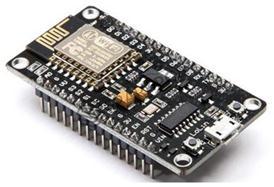
In this project, we have used NodeMcu which is an opensource platform. NodeMcu is based on ESP8266 which can be used to connect objects and transfer data using Wifi. In thisproject,theNodeMCU isusedtosendtheattendanceon the spreadsheet via the wifi module. Whatever the google
spreadsheet code has generated the deployment link, we havetocopythatlinkandpasteitintothecodeandwiththe help,nodeMCUwillsendthedataonthespreadsheet.
TheRFIDtagsaredifferentiatedaspassiveandactivetags.If thedevicedoesn’thaveitspowersupplyitiscalledapassive RFID tag. Thus, The passive tags have to be in very close range of an RFID reader and make use of the radio waves whichare broadcasted by the reader to power the response alternatively if the device has its battery power to perform entireoperationswhicharecalledactiveRFIDtags.
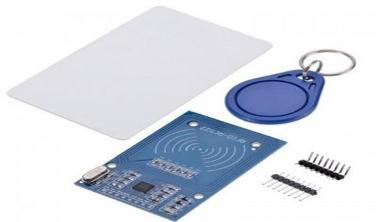
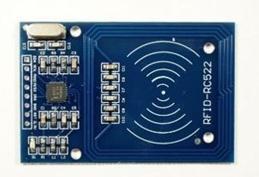
An RFID reader consists of an antenna and a Radio frequency module which basically generates a high-frequency electromagneticfield.AsweallknowanRFIDtagisapassive devicewhichmeansthatitdoesn’thaveapowersupplyora battery.AnRFIDreaderhasamicrochipthatisusedtostore andprocesstheinformation.Andalsoithasanantenna that is used to receive to transmit a signal. To read the information on the RFID tag it needs to be placed in very closerangeofthereader.AnRFIDreaderbasicallygenerates an electromagnetic field that causes electrons to move throughthetagintheantennaanditpowersupthechip.
e-ISSN:2395-0056
Volume: 09 Issue: 12 | Dec 2022 www.irjet.net p-ISSN:2395-0072
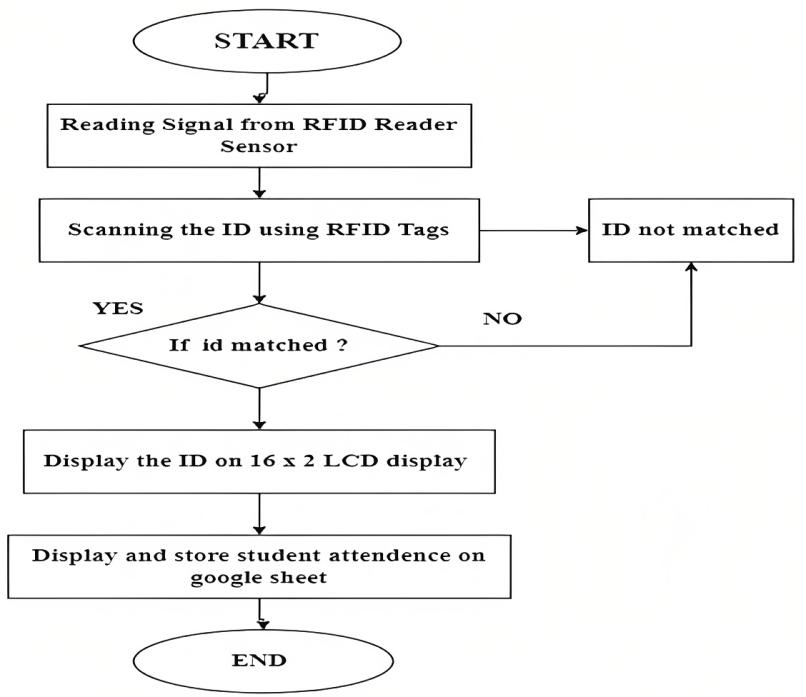
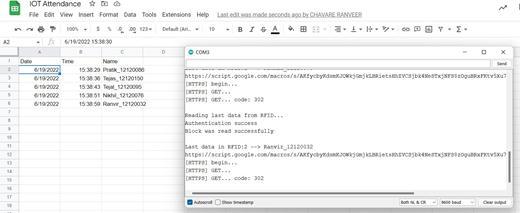
uploadthecodetakeanewfreshcard,andscan.Afterthatin the third code, we have pasted a link to the google spreadsheet which is deployed/generated when we run the google spreadsheet code. So after registering the card we have to just simply upload the third code when the code is successfullyuploadedwehavetotakeour”RegisteredCard” close to the RFID-RC522 module once the card has scanned the buzzer will immediately beep for a few seconds and the serialmonitorwillgiveusthelinkandtheHTTPScode.Ifthe HTTPS code is 302 that means our data is successfully read onthespreadsheet.
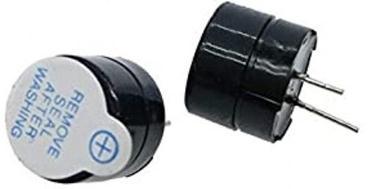
This buzzer also has an important role in this module. Whenever the user will scan his/her card then this buzzer beeps for a few seconds so that the one who scanned the card will know that his card is scanned properly. Without a buzzer,onecanonlyassumethecardhasbeendetectedbut he/shewillnotbesuresothebuzzerisimportanthere.
This system consists of 3 codes. 1) First one is the spreadsheet code which is written on the back end of the spreadsheet 2)Second one is the code in which we will registerthecardbyloadinghis/herinformation.Thatmeans that the card will be permanently assigned to the student/employee. 3) The third code is the code through which wewill scanouridcardand then the attendance will be marked on the spreadsheet via NodeMCU. In the second code,wewillwritetheinformationwhichwewanttosavein the new fresh card. When the information is written in the codewesimplyhavetouploadthecode.Whentheuploading isdonewehavetotakeournewfreshcardclosetotheRFIDRC522moduleoncetheinformationisloadedinthecardthe serial monitor will show that ”The Block is successfully Read” and ”Data is stored in Block No 2”. With this we have registered one card, same process is repeated to create the remaining cards, just change the information in the code,
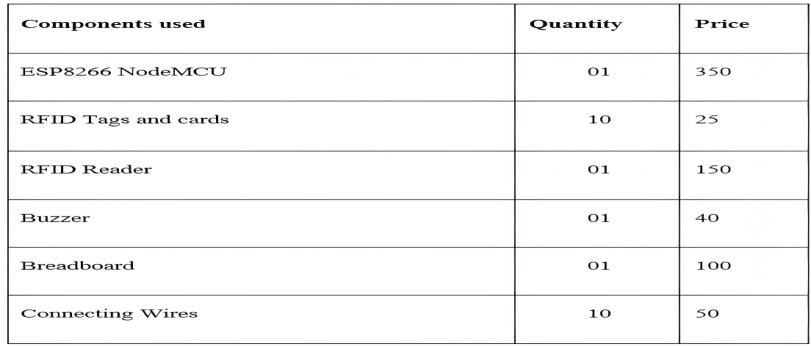
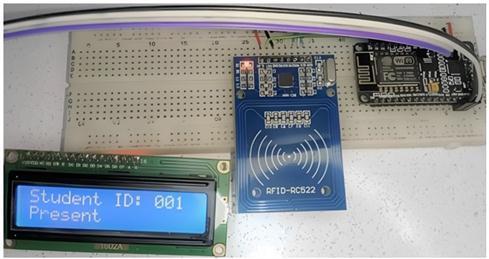
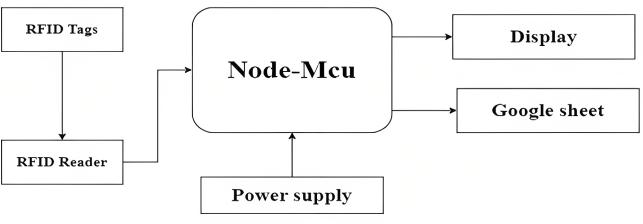
The following fig shows the block diagram for our project SmartattendancesystemusingRFID.Whichmainlyconsists of Node-Mcu (ESP-8266), RFID Cards RFID readers, A breadboard,16 x 2 LCD display. Here Node-Mcu acts as a Cen- tral processing unit (CPU) for controlling all the input/output components. For this project, we have used a 5v power supply to power up the node MCU and other components.RFID reader module is interfaced with NodeMcu to read the data from RFID cards/tags.16 x 2 LCD display is used to display the real- time attendance of the students/employeeandthepermanentattendanceisstored on a google sheet using IoT. In this system, a student or employee has to place /put his card on an RFID reader. WhentheRFIDreaderreadsthedataitdirectlytransfersthe data to Node-Mcu and the real-time attendance will be displayed on a 16 x 2 LCD display and the permanent attendanceisstoredonagooglesheet.
International Research Journal of Engineering and Technology (IRJET) e-ISSN:2395-0056
Volume: 09 Issue: 12 | Dec 2022 www.irjet.net p-ISSN:2395-0072
Ultimately, the system improves academic performance whichencouragestimesavesandaccuracyinattendance
Nothing is perfect in this world. We all are also no exception. Although, we have tried to present the system in modern technology in small scale and smart way. In further future, there can be more enhancement by developing a mobile app. To send SMS for alert notifications, we can also use GSM modules according to the hardware need. Thingspeakcanbeusedfordataanalysis.Toreducethemisuseof RFID tags, biometric technology like iris sensors or fingerprint sensors or image processing can be used for uniqueidentitytoimproveauthorization.
[1] Bhagat, Rinku. ”An MQTT based IoT-RFID Attendance System using NodeMCU Firmware: A Review.” International Research Journal of Engineering and Technology(IRJET)7,no.06(2020):1255-1259.
[2] Lim, T. S., S. C. Sim, and M. M. Mansor. ”RFID based attendance system.” In 2009 IEEE Symposium on Industrial Electronics & Applications, vol. 2, pp. 778-782. IEEE,2009.
[3] Meghana, Inturi, J. D. N. V. L. Meghana, and Ramesh Jayaraman.”SmartAttendanceManagementSystem using Radio Frequency Identification.” In 2020 International Conference on Communication and Signal Processing (ICCSP),pp.1045-1049.IEEE,2020.
[4] Kovelan, P., N. Thisenthira, and T. Kartheeswaran. ”Automated attendance monitoring system using IoT.” In 2019 International Conference on Advancements inComputing(ICAC),pp.376-379.IEEE,2019.
[5]Shah,SoumilNitin,andAbdelshakour Abuzneid.”IoT based smart attendance system (SAS) using RFID.” In 2019 IEEE Long Island Systems, Applications and TechnologyConference(LISAT),pp.1-6.IEEE,2019.
We aimed to get effective and efficient time-saving automated computerized attendance in real-time with a ready excelsheettomaintainattendancerecordsweconcludethat thisuser-friendlyproposedsystemcanbeprovedtobeeasy to use and implement, cost efficient, time-saving, less tedious, and portable. To overcome all the drawbacks, unreliable and inaccurate manual work, this proposed system gets improved with very minimal effort and yet generatestheresultswithmaximalaccuracyandqualitative.
[6] Hidayat, Muhammad Ayat, and Holong Marisi Simalango. ”Students attendance system and notification of college subject schedule based on classroom using iBeacon.” In 2018 3rd International Conference on Information Technology, Information System and Electrical Engineering (ICITISEE), pp. 253-258. IEEE, 2018.
[7] Arunraja, A., G. M. Rajathi, and S. Mathumitha. ”Smart attendance system using esp8266.” International Journal of Scientific and Technology Research 8, no. 9 (2019): 1051-1056.
e-ISSN:2395-0056
[8] Bharathy, Ms GT, Ms S. Bhavanisankari, and T. Tamilselvi. ”Smart Attendance Monitoring System using IoTandRFID.”
[9] Miao, Qianwen, Fu Xiao, Haiping Huang, Lijuan Sun, and Ruchuan Wang. ”Smart attendance system based on frequency distribution algorithm with passive RFID tags.” Tsinghua Science and Technology 25, no. 2 (2019): 217226.
https://drive.google.com/drive/folders/ 15Uix2a8yXDgEztukVh85B0ITeAmM9fa
Volume: 09 Issue: 12 | Dec 2022 www.irjet.net p-ISSN:2395-0072 © 2022, IRJET | Impact Factor value: 7.529 | ISO 9001:2008 Certified Journal | Page984