International Research Journal of Engineering and Technology (IRJET) e-ISSN: 2395-0056

Volume: 09 Issue: 12 | Dec 2022 www.irjet.net p-ISSN: 2395-0072
International Research Journal of Engineering and Technology (IRJET) e-ISSN: 2395-0056
Volume: 09 Issue: 12 | Dec 2022 www.irjet.net p-ISSN: 2395-0072
1Master of Technology in Civil Engineering, Lucknow Institute of Technology, Lucknow, India
2Assistant Professor, Civil Engineering, Lucknow Institute of Technology, Lucknow, India ***
Abstract - Seismic force-resisting devices are often used in the building process of structures that are designed to withstand the effects of earthquakes. The reinforced concrete special moment frame is oneexampleofthiskindoftechnology. Beams, columns, and beam-column connections make up the components of moment frames. These components are proportioned and specified such that they can endure flexural, axial, and shearing movements. These processes take happen whenever a building wobbles through several displacement cycles as a result of strong ground shaking caused by an earthquake. The frame that was produced as a consequence of these particular proportioning andfinishing criteria canresist the extreme shaking that is caused by an earthquake without experiencing a significant loss of stiffness or strength. Because of these extra criteria, which serve to strengthen the seismic resistance of the moment-resisting frames, we call them "Special Moment Resisting Frames." [ On the other hand, Intermediate and Ordinary Moment Resisting Frames have details that aren't as meticulously detailed as Special Moment Resisting Frames do. Special Moment Resisting Frames are more specific in their attention to detail. In this review study, we assessedthe Special Moment Resisting Frame as well as the Ordinary Moment Resisting Frame of the RC construction under different situations. These conditions included the important factor as well as the seismic zone, amongst other things.
Key Words: SMRF, Hard Soil, Medium Soil, Soft Soil, SeismicCondition,ImportanceFactor.
In the process of analyzing and designing structures, it is standard practice to assume that the foundation of the structureisimmovable.However,inpractice,thesupporting soilaffectsthestructuralreaction.Thisoccursbecausethe supportingsoilhastheinherenttendencytodeform,which permits movement to some degree. This may lead to structural issues in buildings. The lessons learned from previous earthquakes, which highlighted the fact that the influenceofthesoilwasignored,demonstratedthenecessity oftakingintoaccounttheinteractionbetweenthesoiland the structure in seismic analysis. This requirement was shownbythefactthatpreviousearthquakeshighlightedthe factthattheinfluenceofthesoilwasignored.Thereactionof thesoilaffectsthemotionofthestructure,andtheactionof thestructureaffectsthereactionofthesoil.Thisprocessis
referredtoasthe"interactionofsoilandstructure."Bothof thesemutuallybeneficialpartnershipsareexamplesofwhat areknownasfeedbackloops(SSI).Thedesignercanconduct anaccurateanalysisofthegenuinedisplacementsthatthe soil-structure system experiences in response to seismic motion if interaction effects between the soil and the structureareused.Theseismicresponseofstructuresasa consequenceoftheeffectofsoilflexibilityisreliantnotonly ontheproperty ofthesoilbutalsoonthe propertyof the structure.Thisisbecausesoilflexibilitymaycausebuildings tomoveasaresultofearthquakes.
Whenitcomestotheconstructionofbuildingstowithstand earthquakes, the consequences of soil flexibility are often overlooked in almost all situations. In their research, Mylonakis et al. [1] and Roy and Dutta [2, 3] revealed the potentialseverityoftherepercussionsthatmayresultfrom disregardingtheeffectsoftheSSI.Theserepercussionsmay come about as a result of ignoring the effects of the SSI. Tabatabaiefar et al. [4] showed a similar study on the implicationofneglectingtheSSIinensuringstructuralsafety by conventional elastic and inelastic design procedures of moment-resistingbuildingframes.Thisstudyfocusedonthe implication of neglecting the SSI in ensuring structural safety.ThesignificanceofignoringtheSSIin thedesignof moment-resistantbuildingframeswastheprimaryfocusof this research. Both Bielak [5] and Stewart et al. [6, 7] providedevidenceoftheeffectofsoilflexibilitycreatinga lengtheningofthelateralnaturalperiodinstructuresasa resultofadecreaseinlateralstiffness.Thiseffectwasseen and recorded. The decrease in lateral stiffness was the primarycontributortothisoutcome.Theydiscoveredthat extendingthedurationofthelateralnaturalperiodaltered the seismic responses of the buildings, which made it a crucialissuefromtheperspectiveofdesignissues.
Todemonstratethesignificanceoflengtheningthenatural periodintheseismicbehaviorofstructures,Bhattacharya and Dutta [8] researched lowrise buildings with a fundamentallateralperiodintheshortperiodregionofthe design response spectrum. These buildings had a fundamentallateralperiodintheshortperiodregionofthe designresponsespectrum.Howtheypresentedtheirresults wasintheformofadesignresponsespectrum.Theresearch was carried out by Saad and colleagues [9] to study the impactthatsoil-structureinteractionhasonthebaseshear, inter-storey shears, and moments of reinforced concrete
International Research Journal of Engineering and Technology (IRJET) e-ISSN: 2395-0056
Volume: 09 Issue: 12 | Dec 2022 www.irjet.net p-ISSN: 2395-0072
buildingsthatcontainsubterraneanstoreys.Tabatabaiefar andMassumi[10]usedathree-dimensionalfiniteelement modeltosimulatetheeffectsofsoil-structureinteractionon reinforced concrete moment-resisting frames. This demonstratesthesignificanceoftakingintoaccountSSIin theseismicdesignofRC-MRFbuildingsthatarehigherthan three and seven storeys and are located on soft soils. Specifically,thesignificanceofthisisdemonstratedbythe fact that Tabatabaiefar and Massumi [10] used a threedimensional Raychowdhury [11] and demonstrated the benefits of accounting for nonlinear soil–structure interactionanalysesincomparisontotraditionalfixed-base and elastic-base models by demonstrating a considerable decrease in the amount of force and displacement that is required.Thisreductioninforceanddisplacementwasone ofhowRaychowdhury[11]demonstratedtheadvantagesof accountingfornonlinearsoil–structureinteractionanalyses.
It is essential to carry out the method of estimating the natural period of vibration of the structure to ensure that structures built of reinforced concrete are conceptualized and evaluated in the most effective manner possible. This uniquenaturalperiodmaysupplyknowledgethatwillaid enhanceunderstandingoftheglobalpressuresthatareput onbuildingswhentheyareexposedtoseismicactivity.Ithas beenshownbyGoelandChopra[12]thatthetimesthatare providedbyseismiccodeequationsare,onaverage,shorter thantheperiodsthatareobserved.Asaconsequenceofthis, theycameupwithamoresophisticatedformulathatmakes useofregressionanalysistoprovideastrongerrelationship withframebuildings.Afterdeterminingtheyieldstiffness using several methods, Crowley and Pinho [13] utilized those methods to create analytical yield period-height equationsforbareframes.Theseequationswerethenused to calculate the yield stiffness. In their evaluation of the existingreinforcedconcretestructures,CrowleyandPinho [14] were sure to take into consideration the existence of infillpanels.Theyfoundthattheuncrackedyieldperiodthat was predicted using eigenvalue analysis for existing reinforced concrete structures of different heights was longerthanthesimplifiedperiodheightequation.Thiswas thecaseevenwhentheheightofthebuildingsvaried.
IS 1893 (Part 1), 2002 outlines the criteria that must be followed when designing buildings to withstand earthquakes.Thefirstsectionprovidesinformationonthe general provisions and structures. Ordinary Moment Resisting Frames (OMRF) and Special Moment Resisting Frames (SMRF) are the two categories that RC frame structures fall under when categorized by the Bureau of Indian Standards (BIS). These two kinds have response reductionfactorsof3and5,respectively.Ifthebuildingisto maintainitselasticitywhilereactingtotheshakingcaused by the Design Basis Earthquake (DBE), then it has to be scaleddowntoacquirethelateralforceresponsethatwas
designedforit.Thereductionfactor,denotedbytheletterR, isthefactorthatdetermineshowtheactualbaseshearsare formed.
Ductility: Thedegreeofentirestructuralbehaviorwasused to calculate the needed ductility, whereas the available ductilitywasderivedviathestudyofthelocalbehaviorof individual nodes (joint panels, connections, or member ends).Inmostcases,theprocessofverifyingtheductilityof columnsisdifficulttodo.Toaccomplishaglobalmechanism usingSMRFstructures,thecolumnsectionsaremadelarger. This additional strength of the column will result in a reduction in the possible ductility of the columns. It's possible that the building won't have enough ductility to preventacollapsewhenithappens.Itwasdiscoveredthat theparametersrelatedtoseismicactivities,suchasvelocity and cyclic loads, decrease the available ductility of the material.Theabilityofcolumnstoundergodeformationmay bedescribedinafewdifferentways,themostcommonof which are curvature ductility, displacement ductility, and drift.
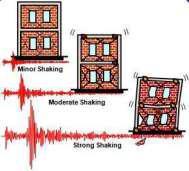
Earthquake Design Philosophy: In the case of an earthquake,themagnitudeofgroundshakingthatoccursat anygivensiteisdependentonthemagnitudeofthequake itself, which may be classified as mild, moderate, or significant.Constructingabuildingthatisstrongenoughto withstand even the most severe shaking caused by an earthquakeisthegoalofstructuraldesignersandengineers. Itisveryuncommontoobserve,anditmayonlytakeplace onceper500or1000yearsonaverage.Therefore,theissue that emerges is whether or not we need to construct the structurestobeearthquake-prooforearthquake-resistant. Because of this, the standard procedure is to strengthen buildingssothattheycanwithstandearthquakes.Inthecase ofanearthquake,thesebuildingscouldsustainsomedamage butwouldnotbebroughtdowncompletely.Therefore,the protection of persons and goods is of the utmost significance;thismaybeaccomplishedwithalowerfinancial outlaywhencompared totheconstructionof earthquakeresistantbuildings.
Figure- 1: Effectonbuildingsduetogroundshaking
International Research Journal of Engineering and Technology (IRJET) e-ISSN: 2395-0056
Volume: 09 Issue: 12 | Dec 2022 www.irjet.net p-ISSN: 2395-0072
Inthisreviewpaper,wehavestudiedthespecial moment resistingframeoftheRCstructureatdifferentparameters suchasthedifferentimportantfactors,seismiczone,etc.The summaryofeachresearchpaperisgivenbelow:
Mukesh, Paliwal: OMRF braced, which is also knownasordinarymomentresistingframebracingat the lintel level, and SMRF, which is also known as special momentresistingframe,wereanalyzedinthisstudywithall seismic zones while taking into consideration a variety of regularandirregularconstructions.Bothofthesetypesof bracing were used at the lintel level. With the use of analytical data, one may arrive at several significant conclusions, some of which are listed below: It was found that buildings with an irregular plaza had the highest amount of bending moment, whilst structures with a standard bare frame had the lowest amount of bending moment. The seismic activity in a region is increasing in intensity, which in turn causes an increase in the rate at whichthebendingmomentisrising.Theordinarymomentresistantbracedtypeframeislesseffectivethanthespecial moment-resisting frame (SMRF), which is more effective becauseitminimizesmoments,whichimpliesthatitreduces theareaofsteel.TheSMRF isalsomoreeffectivethanthe ordinary moment-resistant braced type frame. It became abundantlycleartomeasIwasanalyzingthenatureofthe graphthatwasfoundtobethesameinallseismiczonesthat abareframeisthebestoption,steppedisthesecondbest option,andplazaconstructionisessential.Thisrealization cameaboutasIwasdeterminingthenatureofthegraphthat was found to be the same in all seismic zones. When comparedtoOMRFstructures,SMRFonesprovidegreater degreesofinformationintheirrespectivediagrams.
Prakash, Sanjay: Thefollowingistheinferencethat may be made in light of the results of our investigation: AccordingtothefindingsofRSA,thetaleshearpowerwas regarded to be at its peak position for the first story, and thenitsteadilyreduceduntilitreacheditslowestpointin thepopularnarrative.Thiswasthecaseforallthreestories. According to the findings of RSA, mass sporadic structure outlinesseemtobecapableofcomprehendingbiggerbase shearthancorrespondingstandardstructureoutlinescan. This is the case. The aftereffects of RSM showed that the controlstructurehadmorebaseshear,buttheunexpected firmness structure had less base shear. Additionally, the unexpected firmness structure had bigger entomb story floats. The most significant relocations obtained from the timehistoryexaminationofmathematicssporadicworking atparticularhubswereseenasmoresignificantthanthatif there should happen to be an occurrence of ordinary structure for upper stories, but gradually, as we move to lowerstories,relocationsinbothstructureswouldingeneral combine. This is because upper levels in a geometrically uncertaindesignhavealowerrigidity(asaresultoftheL shape) than lower stories do. The reason for this is as
follows:Whenthedifficultyislowered,agreaternumberof talesareremovedfromthetopspotintherankings.
Anupam et.al: Following an investigation of the structure and a comparison of the findings with those acquired from earlier investigations, the following conclusionswerearrivedat:Whenthestructureinquestion isanOMRF,theaxialloadthatisplacedoncolumnC1,also known as the column that is situated at the corner, is significantlyreducedwhencomparedwiththeaxialloadthat isplacedonanSMRF.Inbotharchitectures,theaxialloadis distributed in the same manner across column C2 in both sets of components. The OMRF system's maximum shear forceonthefloorbeamisabout20–25percentlowerthan theSMRFsystem'smaximumshearforceonthefloorbeam. The SMRF system has between 15 and 20 percent less torsioninitsstructurewhencomparedtotheOMRFsystem. InanSMRFsystem,thebendingmomentthatiscarriedby each floor is 25–30% lower when compared to an OMRF system.OMRFsystemsaremorecommon.Whencompared tothedriftthatiscausedbytheOMRFsystem,thedriftthat iscausedbytheSMRFsystemisapproximatelyfortypercent lesssignificant.Thelateralforcethatisdistributedoneach floor does so in a linear fashion, and the SMRF system displays a lower level of attraction of lateral force. This is because the lateral force is distributed linearly. When comparedtotheOMRFsystem,thebaseshearoftheSMRF systemis40percentlessthanthatoftheOMRFsystem.
Sarafraz et al: Combinedfootingshows23%fewer occurrencesofunevenpressuresascomparedtoPadform footing,whichresultsinrectanglefooting.Thisdifferenceis becauseofrectanglefooting.Inthechapterthatcamebefore thisone,itwasmadeclearthatPadformfootingdistributes the highest amount of axial force compared to other scenarios,whileCombinedfootingdisplaystheleastamount ofthisforce.Combinedfootingalsoshowstheleastamount ofthisforce.Whencomparedtotheothertypesoffooting,it iscleartoobservethatcombinedfootinggivesthegreatest supportresponsepossible;thisisvisible.Acombinedfooting isconsideredtobethefinestandmostsuitablealternative for this distribution of weight since the reaction of the supportrevealsthedegreetowhichitdistributesweightto thesoil.Thevalueofdeflectionisdemonstratedtobeatits largestwhenithappensinapad,butitisshowntobeatits lowestwhenitoccursinacircumstancewithanovalshape. Therefore,onecanstatethattheamountofdeflectionthat will occurasa consequence ofthiscondition will belittle, and the oval shape will be the one that comes in as the runner-upintermsofitsprominence.Thefootingdeflection inanovalshapeisratherminor,cominginataround13% total.Ithasbeendeterminedthatcombinedfootingresults in the most cost-effective type of footing for the same conditions,whereascircularfootingismoreexpensiveand, incomparison,morechallengingtoconstruct.Thisdiscovery was made as quantity estimation is carried out and rate analysisisperformedfollowingS.O.R.
International Research Journal of Engineering and Technology (IRJET) e-ISSN: 2395-0056
Volume: 09 Issue: 12 | Dec 2022 www.irjet.net p-ISSN: 2395-0072
Dongare, Kulkarni: To determine the response reduction factor for each of the 10 distinct types of RC structures,anon-linearstaticanalysisisused.TheResponse ReductionFactorsthatweregainedarestudiedfurtherand compared with many different structural aspects of the buildings. After performing the necessary analyses and makingappropriateinterpretationsoftheobtaineddata,the followingaresomeoftheconclusionsthatmaybederived fromthestudy:Structuresthatdonothavefloatingcolumns haveabaseshearvaluethatisgreaterthanthebaseshear valueofstructuresthatdohavefloatingcolumns.Bringing thefloatingcolumnuptothetopfloorofthebuildingcauses an increase in the base shear of the structure as a whole. However, this impact is contingent on the kinds of soil conditionsthatarepresent,andabuildingthathasafloating column at the ground level can only be constructed in circumstanceswithamaximumofmediumsoilratherthan conditionswithhardsoilconditions.Whencomparedtothe displacementofthestructurethatdoesnothavethefloating column,thedisplacementofthestructurethatdoeshavethe floatingcolumnisjustslightlyhigher.BothOMRFandSMRF haveavaluethatislowerwhenconditionsofhardsoilare present compared to when conditions of medium soil are present. This is indeed the situation. The value of the response reduction factor, designated by the letter R, is lowerforastructurethathasafloatingcolumnthanitisfor astructurethatdoesnothavesuchacolumn.Thisdifference may be seen by comparing the two structures' response reductionfactorvalues.WhencomparedtotheR-valuesof the floating column on the upper levels, which are much greater,thevalueonthegroundlevelissignificantlylower. BothOMRFandSMRFhaveanR-valuethatisgreaterforthe conditionofhardsoilincomparisontotheR-valuethatis foundfortheconditionofmediumsoil.
Abhishek et.al: Thefollowingaresomeconclusions that can be derived from all of the analysis that was done above when the soil conditions are altered but all of the seismic parametersstaythesame.Thisanalysiswasdone before the soil conditions were modified. It has been discoveredthatthebaseshearvalueofthesoftsoilisfound tobemuchgreaterwhencomparedtoboththesoftsoiland thehardsoil.Thetaledriftvalueinsoftsoilisobservedtobe muchgreaterwhencomparedtobothsoftsoilandhardsoil. Therefore,thevalueofstoreydisplacementisatitslargest formodelM1withsoftsoil,anditisatitslowestformodel M2 with hard soil. This is because the value of storey displacement grows as the stiffness property of the soil stratum falls. This is because the value of storey displacement rises as the stiffness property of the soil stratum diminishes. The reason for this is because of the relationshipbetweenthetwo.Thisisbecausethevalueof storey displacement grows as the stiffness of the storeys diminishes,whichisthereasonwhythisisthecase.
S. M. Dhawade: Isolation of the base is an extremelypromisingnewapproachthathasthepotentialto
protect a variety of structures from the consequences of seismic excitation. These structures include buildings, bridges,airportterminals,nuclearpowerplants,andother kindsofinfrastructure.Thebase-isolatedmodelhasamuch lesslevel of variationinthe maximum displacementof its tales when compared to the fixed base model. It has been observedthatthevariationinthemaximumdisplacementof stories will become a great deal more important as the number of stories included inside the structure rises. The factthatbaseisolationresultsinthesuperstructurehavinga stiffmovementisoneofthemostimportantaspectsofthis feature. This in turn demonstrates that the relative story displacement and story drift of structural elements will decrease, which in turn will result in a reduction in the internalforcesexertedbybeamsandcolumns.Inturn,this will demonstrate that the relative story displacement and storydriftofstructuralelementswilldecrease.Thelateral weights that are being applied to the tales are being decreased, which has the effect of slowing down the accelerationsthatarebeingprovidedtothetales.Becauseof this,thetotalquantityofforcesthatarecreatedbyinertia will,intheend,bereduced.Whenabuildingisbase-isolated, theloweringofthestoryoverturningmomentandthestory shearbothhavetheeffectofmakingthesuperstructurethat isplacedabovetheisolationplanemorerigidandstiff.The informationthatwassuppliedearlierallowsonetoconclude that the effectiveness of the performance of isolated buildings in areas that are prone to earthquakes may be supportedbythisevidence.
Abhyuday, Gupta: The seismic risk must be properly analyzed and taken into account before the constructionofmajorandtallstructures.Thisissomething that should not even need explanation. Based on the aforementionedanalyticalinvestigationthatwascarriedout onthreeseparatestructures,onemayderivethefollowing inferences:BSFundoubtedlyprovidesthedesignerswithan increased level of safety, but it also ends up being rather expensive for them to implement. According to the International Standard 1893 (IS:1893), the storey drift is permittedinallofthesystemssolongasitdoesnotexceed the permitted parameters (Part 1). However, when compared to the results achieved by OMRCF, the ones obtainedbySMRCFweremuchbetter.Whencomparedto OMRCF,thequantityofsteelthatisproducedbySMRCFis 18.5% more than what is produced by OMRCF. This is because SMRCF has a larger production capacity. On the other hand, because this has directly resulted in it, the overallquantityofstoreydriftinSMRCFhasdecreasedby 66.12%.TheBSFoffersthebestdegreeofprotectionagainst lateralloadingthatcanbefoundelsewhere.Asadirectresult ofthisfactor,theservicelifeofthisspecificframedesignwill befarlongerthananyother.
The zone is becoming smaller, which indicates that the possibilityofearthquakeswillalsogrowupasaresultofthis change.Inascenariosuchasthisone,aBSForSMRFthat
International Research Journal of Engineering and Technology (IRJET) e-ISSN: 2395-0056
Volume: 09 Issue: 12 | Dec 2022 www.irjet.net p-ISSN: 2395-0072
hasshearwallsinstalledisthemostsuitableoption.Because of the use of lateral bracing, the amount of strain that is placed on the columns of a structure that is constructed using BSF is maintained to an absolute minimum. When calculating the degree to which expenses differ from one another, the Response Reduction Factor is an essential component. Both the OMRCF and the SMRCF are the ones thathavethemostpotentialtodevelopstoreydrifts.Whenit comestoBSF,ithasthelowestvalue.Tofurtherenhancethe building'soverallperformance,constructionstrategiesthat areresistanttoearthquakes,suchasshearwallsandbase isolation, may be used in the building's design and construction.
J. Bhattacharjee: Accordingtothefindingsofthe aforementioned investigation, the structure is in a better state of safety when it is constructed with a Special RC MomentResistingFrameStructureratherthananOrdinary RC Moment Resisting Frame Structure. However, in comparison to an ordinary RC moment resisting frame structure,theSpecialRCMomentResistingFrameStructure callsforagreateramountofreinforcementtobeinstalled. The more interesting fact is that the high rise building displacementvalueiswithinthepermissiblelimitinspecial RCmomentresistingframestructureaswellasinordinary RCmomentresistingframestructure;thepercentageofsteel usedinspecialmomentresistingframeishighatjointsdue to the presence of more tie members near the joints as compared to ordinary moment resisting frame structure; andthefactthatthehighrisebuildingdisplacementvalueis withinthepermissiblelimitinordinaryRCmomentresisting frame structure. The results of this research make it abundantlyevidentthatanSMRFstructurewithdimensions thatarelessthanthoseofanOMRFstructuremaywithstand a greater amount of lateral force. If we create the SMRF structureinzoneII,ratherthantheOMRFstructureinzone III, the SMRF structure will exhibit a less amount of displacement.Asimilarsituationmaybeseenbetweenthe SMRF of zone III and the OMRF of zone IV, as well as betweentheSMRFofzoneIVandtheOMRFofzoneV.
Ambika: In the case of an MRF structure, an increaseintheamountofbaseshearandstoreydriftoccurs asaresultofanincreaseinthenumberofbaysforthesame storeyandthesameseismiczone,anincreaseinheightfor thesamestoreyandthesameseismiczone,andachangein the seismic zone from II to V for the same storey and the same bay. In seismic zones, II and III, the use of SMRF is preferable to that of OMRF from a financial perspective. StoreyDriftandBaseSheararegreaterforMRFstructures without Shear Walls than for MRF structures with Shear Walls (Dual system) for the same storey, same bays, and sameseismiczone,inbareframeandframewithinfillwalls. Thisisthecaseregardlessofwhethertheframeisbareor hasinfillwalls.Thisistrueforbothbareframeconstruction andframeconstructionwhichincludesinfillwalls.TheMRF structurethatincorporatesashearwallandisreferredtoas
the Dual system is more cost-effective than the MRF structurethatdoesnothaveashearwallinseismiczonesIV andV.
Bhavesh, Budhlani: The pushover analysis demonstratesthatthecurveachievedadisplacementthatis biggerthanthedisplacementfortheOMRFstructureinboth theXandYdirections.Thisisthecaseregardlessofwhich directionisbeingconsidered.TheSMRF structuremay be understoodinthismanner.Thebeam-columnconnectionin the SMRF architecture is particularly strong as a consequenceofthisfactor.Thepushoveranalysisindicates thatthecurvehasobtainedadisplacementthatislessthan the intended displacement of 840mm in both the X and Y directions,resultinginacollapsedscenario.Thisisbecause thecurvehasacquiredadisplacementthatislessthanthe planneddisplacementof840mm.Therefore,renovationsare requiredforbothofthestructures.Inaddition,theresponse spectruminvestigationrevealsthattheshearatperformance forbothOMRFandSMRFstructuresislowerthantheshear atthebase;hence,retrofittingisrequired.
After studying the above literature review related to the special moment resisting frame of the RC Structure in differentconditions,thefollowingconclusionisthat,Inthe traditionalfixedbasetechnique,thebasesheargrowsasthe soil's flexibility rises, but in reality, it falls due to the influenceofsoilandstructureinteraction.Comparedtothe traditionalfixedbasetechnique,thevaluesofthespectrum accelerationcoefficientsandthebaseshearderivedwithreal soil-structureinteractionimpactaremuchlower.Structures with shear walls have a greater spectral acceleration coefficientthanbare-framebuildings.Forstructureshaving ashearwallattheircenter,itisthegreatest.
[1] G. Mylonakis, A. Nikolaou, and G. Gazetas, “Soil-pilebridge seismic interaction: kinematic and inertial effects. Part I: soft soil,” Earthquake Engineering & Structural Dynamics,vol.26,no.3,pp.337–359,1997.
[2] R. Roy and S. C. Dutta, “Differential settlement among isolated footings of building frames: the problem, its estimation,andpossiblemeasures,” International Journal of Applied Mechanics and Engineering, vol. 6, pp. 165–186, 2001.
[3]R.RoyandS.C.Dutta,“Effectofsoil-structureinteraction on the dynamic behavior of building frames on grid foundations,” in Proceedings of the Structural Engineering Convention (SEC ’01),pp.694–703,Roorkee,India,2001.
[4]S.H.R.Tabatabaiefar,B.Fatahi,andB.Samali,“Seismic behavior of building frames considering dynamic soil-
International Research Journal of Engineering and Technology (IRJET) e-ISSN: 2395-0056
Volume: 09 Issue: 12 | Dec 2022 www.irjet.net p-ISSN: 2395-0072
structureinteraction,” InternationalJournalofGeomechanics, vol.13,no.4,pp.409–420,2013.
[5]J.Bielak,“Dynamicbehaviorofstructureswithembedded foundations,” Earthquake Engineering&StructuralDynamics, vol.3,no.3,pp.259–274,1975.
[6]J.P.Stewart,G.L.Fenves,andR.B.Seed,“Seismicsoilstructure interaction in buildings. I: analytical method,” Journal of Geotechnical and Geoenvironmental Engineering, vol.125,no.1,pp.26–37,1999.
[7]J.P.Stewart,R.B.Seed,andG.L.Fenves,“Seismicsoilstructure interaction in buildings. II: empirical findings,” Journal of Geotechnical and Geoenvironmental Engineering, vol.125,no.1,pp.38–48,1999.
[8]K.BhattacharyaandS.C.Dutta,“Assessinglateralperiod ofbuildingframesincorporatingsoil-flexibility,” Journal of Sound and Vibration,vol.269,no.3–5,pp.795–821,2004.
[9]G.Saad,F.Saddik,andS.Najjar,“Impactofsoil-structure interaction on the seismic design of reinforced concrete buildings withunderground stories,”in Proceedings of the 15th World Conference on Earthquake Engineering,Lisbon, Portugal,2012.
[10] S. H. R. Tabatabaiefar and A. Massumi, “A simplified method to determine seismic responses of reinforced concretemomentresistingbuildingframesunderinfluence ofsoil-structureinteraction,” SoilDynamics and Earthquake Engineering,vol.30,no.11,pp.1259–1267,2010.
[11]P.Raychowdhury,“Seismicresponseoflow-risesteel moment resisting frame (SMRF) buildings incorporating nonlinear soil structure interaction (SSI),” Engineering Structures,vol.33,no.3,pp.958–967,2011.
[12] R. K. Goel and A. K. Chopra, “Period formulas for moment-resisting frame buildings,” Journal of Structural Engineering,vol.123,no.11,pp.1454–1461,1997.
13]H.CrowleyandR.Pinho,“Period-heightrelationshipfor existingEuropeanreinforcedconcretebuildings,” Journal of Earthquake Engineering,vol.8,no.1,pp.93–119,2004.
[14] H. Crowley and R. Pinho, “Simplified equations for estimatingtheperiodofvibrationofexistingbuildings,”in Proceedings of the 1st European Conference on Earthquake Engineering and Seismology, p. 1122,Geneva, Switzerland, 2006.
[15] C. G. Karayannis, B. A. Izzuddin, and A. S. Elnashai, “Application of adaptive analysis to reinforced concrete frames,” Journal of Structural Engineering,vol.120,no.10, pp.2935–2957,1994.
[16]M.J.Favvata,M.C.Naoum,andC.G.Karayannis,“Limit states of RC structures with first-floor irregularities,”
Structural Engineering and Mechanics,vol.47,no.6,pp.791–818,2013.
[17]W.Pong,Z.H.Lee,andA.Lee,“Acomparativestudyof seismicprovisionsbetweeninternationalbuildingcode2003 anduniformbuildingcode1997,” Earthquake Engineering and Engineering Vibration,vol.5,no.1,pp.49–60,2006.
[18]A.Do˘gang¨unandR.Livaoˇglu,“Acomparativestudyof the design spectra defined by Eurocode 8, UBC, IBC and TurkishEarthquakecodeonR/Csamplebuildings,” Journal of Seismology,vol.10,no.3,pp.335–351,2006.
[19]S.K.GhoshandM.Khuntia,“Impactofseismicdesign provisions of 2000 IBC: comparison with 1997UBC,” in Proceeding of the 68th Annual Convention-Structural Engineers Association of California (SEAOC ’99),pp.229–254, SantaBarbra,Calif,USA1999.
[20] Y. Singh, V. N. Khose, and D. H. Lang, “A comparative studyofcodeprovisionsforductileRCframebuildings,”in Proceedings of the 15th World Conference on Earthquake Engineering,pp.24–28,Lisbon,Portugal,2012.
[21] V. N. Khose, Y. Singh, and D. H. Lang, “A comparative study of design base shear for RC buildings in selected seismicdesigncodes,” Earthquake Spectra,vol.28,no.3,pp. 1047–1070,2012.
[22]N.ImashiandA.Massumi,“Acomparativestudyofthe seismic provisions of Iranian seismic code (standard no. 2800)andinternationalbuildingcode2003,” Asian Journal of Civil Engineering: Building and Housing,vol.12,no.5,pp. 579–596,2011.
[23] S. H. C. Santos, L. Zanaica, C. Bucur, S. S. Lima, and A. Arai, “Comparative study of codes for seismic design of structures,” Mathematical Modelling in CivilEngineering,vol. 9,no.1,pp.1–12,2013.
[24] W. Yayong, “Comparison of seismic actions and structural designrequirementsinChinesecodeGB50011 and international standard ISO 3010,” Earthquake Engineering and Engineering Vibration,vol.3,no.1,pp.1–9, 2004.
[25]T.M.Nahhas,“AcomparisonofIBCwith1997UBCfor modal response spectrum analysis in standard-occupancy buildings,” Earthquake Engineering and Engineering Vibration,vol.10,no.1,pp.99–113,2011.
[26] W. Pong, G. A. Gannon, and Z. H. Lee, “A comparative study of seismic provisions between the international building code 2003 and Mexico’s manual of civil works 1993,” Advances in Structural Engineering,vol.10,no.2,pp. 153–170,2007.
[27] S. Malekpour, P. Seyyedi, F. Dashti, and J. F. Asghari, “Seismicperformanceevaluationofsteelmoment-resisting
2022, IRJET | Impact Factor value: 7.529 | ISO 9001:2008 Certified Journal | Page925
International Research Journal of Engineering and Technology (IRJET) e-ISSN: 2395-0056
Volume: 09 Issue: 12 | Dec 2022 www.irjet.net p-ISSN: 2395-0072
framesusingIranian,EuropeanandJapaneseseismiccodes,” Procedia Engineering,vol.14,pp.3331–3337,2011.
[28]H.B.Kaushik,D.C.Rai,andS.K.Jain,“Acaseforuseof dynamic analysis in designing for earthquake forces,” Current Science,vol.91,no.7,pp.874–877,2006.
[29]I.Iervolino,G.Maddaloni,andE.Cosenza,“Eurocode8 compliantrealrecordsetsforseismicanalysisofstructures,” Journal of Earthquake Engineering, vol. 12,no. 1, pp. 54–90,2008.
2022, IRJET | Impact Factor value: 7.529 | ISO 9001:2008 Certified Journal | Page926