International Research Journal of Engineering and Technology (IRJET) e-ISSN: 2395-0056

Volume: 09 Issue: 12 | Dec 2022 www.irjet.net p-ISSN: 2395-0072
International Research Journal of Engineering and Technology (IRJET) e-ISSN: 2395-0056
Volume: 09 Issue: 12 | Dec 2022 www.irjet.net p-ISSN: 2395-0072
E 1,2 ,Vidhya K.1,3 , Revathi S1,2 and Shivasakthivadivelan R A 1,2
1Department of Civil Engineering, Mahendra Engineering college, Namakkal- 637503, Tamil Nadu, India 2 Research scholar, 3Professor ***
Abstract - Bricks and building blocks have played a key role in the construction of buildings and other structures for centuries. Despite their reliability and affordability, it is commonly accepted that the production of burnt clay bricks has historically been an energy-intensive and resource-intensiveoperation.Numerous researchershave carriedoutextensiveresearchonsustainableandcreative bricks,withthegoalofmitigatingthebrickindustry'shigh carbon footprint. An attempt was made to develop sustainable, eco-friendly building blocks using industrial by-productssuchasflyash,lime,gypsum,marblepowder, and crusher dust. The properties of the materials have beenstudied.Thesizeofthesolidblockusedinthisstudy was 230 mm x 230 mm x 75 mm. Cast solid blocks were testedfor compressivestrength, waterabsorption,and so on. The test results were compared with those of conventionalcementsolidblocks.
Key words: Flyash,Marblepowder,Crusherdust,Solid blocks,compressivestrength
Earthen construction techniques have been used for centuries. While it is unknown when or in what century the first earthen houses were constructed, the oldest adobe bricks used in the construction of dwellings were unearthed in the Tigris River Basin and dated to roughly 7500B.C.
Since ancient times, earth has been the primary building material utilised by numerous countries, and it is currently making a comeback as a material for producing construction elements due to its availability and cheap energy demands. Therefore, earthen materials are sustainable raw resources with a reduced carbon footprint.
Theconventionalconstructionmaterials,suchasconcrete block, hollow blocks, solid blocks, pavement blocks, and floor tiles, are produced from naturally occurring resourcesthatarealreadythere.
This causes the ecosystem to become fragmented as a resultof extensive investigation, whichcausesthe natural resources to run out. Researchers have faced a
tremendous task in recent years trying to recycle waste materialsintousefulcontemporaryconstructionmaterials becauseoftherisingdemandforhighstrengthlightweight buildingmaterials.Thisstudyfocusesontheutilizationof industrial waste products like fly ash, marble powder, lime, and crusher dust. Fly ash is a residue of the coal combustion process and is utilised in a variety of applications, including cement manufacture, brick and block production, and partial replacement of cement in concretemix.Marblepowderisaby-productoftheseizing processforpolishingmarblestone.
Gypsum and lime are employed as binding materials. Bilginetal.(2012)performedtestsandstudiesontheuse of waste marble powder in the manufacturing of bricks. Theyobservedthataddingmarbledusttoindustrialbricks enhances the chemical, physical, and mechanical qualities of the bricks. Replacements for marble dust ranging from 0% to 80% by weight were evaluated. The results show that 10% by weight of marble powder can be added to a materialwithoutcompromisingitsengineeringproperties. Using more than 10% marble powder, on the other hand, improves porosity, water absorption, and mechanical properties Dhoka (2013) examined the use of industrial wastes such as paper-pulp, marble powder, quarry dust, and wood ash to reduce natural resource and energy consumption,aswellasatmosphericpollution.14to20% ofcementissavedbytheuseofsuchresidualmaterial.
Significant improvements have been made to the concrete's resistance to sulphate attack and alkaliaggregate reaction.Ilangovan et al. (2008) examined the feasibility of utilising quarry rock dust as a replacement for natural sand in concrete. In order to measure the durabilityandstrengthofconcrete,cubesandbeamswere tested with quarry dust. The compressive, durability, and flexuralstrengthsofconcretemadewithquarryrockdust werefoundtobearound10percentgreaterthanthose of normal concrete. Faith and Umit (2001) conducted extensivestudyontheuseoffly-ashasaclaysubstitutein constructing bricks, which were traditionally created by moulding, curing, and kiln burning a combination of clay and sand. The loss of flexibility of brick clay containing a high proportion of fly-ash can be related to the rise in compressive strength of fly-ash bricks with rising temperature and decreasing amount of fly-ash used as an
International Research Journal of Engineering and Technology (IRJET) e-ISSN: 2395-0056
Volume: 09 Issue: 12 | Dec 2022 www.irjet.net p-ISSN: 2395-0072
ingredient. Naganathan et al (2015) A combination of flyash, bottom ash, and cement was utilised to cast bricks withouttherequirementforburningorpressing.
As the percentage of fly ash increased, compressive strength increased. Kavitha and Vidhya (2022) investigatedsolidblocksincludingflyashcoalash,quarry sand, and olivine sand. The results of the tests indicated that the mechanical and durability qualities of the solid blocks are superior to those of typical fly ash blocks. RevathiandVidhya(2021)examinedtheincorporationof municipally burned ash into geo polymer-based bricks. The bricks have more durability than typical clay-burned bricks.
The fly ash was collected from the Mettur thermal power plant in Tamil Nadu, India. Marble powder was obtained fromalocalmarbleprocessingplantinErode,TamilNadu, and India. The gypsum and lime powder were acquired from SSS enterprises in Tirunelveli, India. Crusher dust wastakenfromaquarryunitinErode,India.
ThephysicalpropertiesofmaterialsaregiveninTable 1.Table2liststheproportionsofvariousmaterialsfor 8mixtrails.
Theeightmixtrialswereutilisedtocastsolidblocks.Inall mixcombinations,50%,10%,and5%offlyash,lime,and gypsum are used, respectively. The size of block was 230mmx230mmx75mm.Marblepowderandcrushersand were combined for 35 percent. The proportion of marble powder to crusher sand in mix M1 was maintained at 35%.Marblepowderwasgraduallyreduced by5%,while crushersandwasgraduallyaddedbythesameamount.All ingredients are added to the drum mixer. All ingredients shouldbefullycombinedinadrycondition.Then,wateris added until a uniform mixture is achieved. The wet mixture is subsequently conveyed by conveyor belt. Each mouldwassubjectedtoahydraulicpressure.
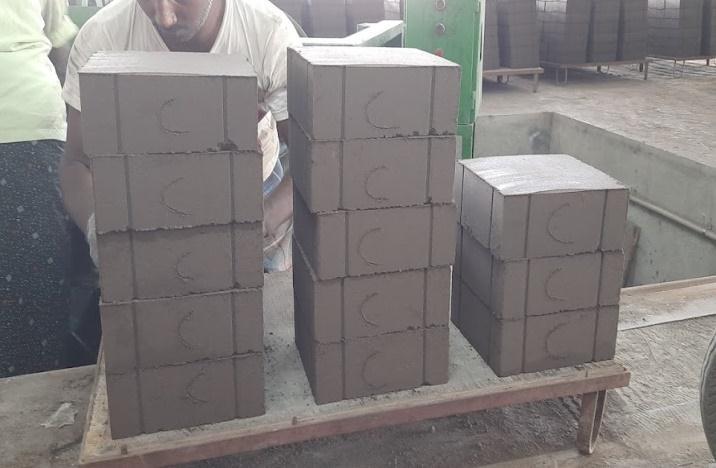
Afterpressing,eachcastgreenblockismovedtoawooden rack for 48 hours of air drying. The solid blocks are then water-cured for a further several days. After curing in water,solidblocksaresun-driedforupto28days.Figure 1depictsthebrickcastingprocessafterremovalfromthe mould.
After curing, the blocks were evaluated for compressive strength, water absorption, density, hardness, and efflorescence. All tests were conducted according to IS 2185- part1: 2005. Compressive strength test of blocks were done by using 200 ton compressive testing machine after 28 days after curing. For the compressivestrengthtest,threesolidblocksampleswere obtained from each combination. Water absorption test was conducted after 28 days of curing. The water absorption value was determined in accordance with the IS: 2185 (Part 1):2005. The sample of dry block was maintained in an oven at 105oC to 115oC until it was completelydry.Themassofeachsolidblockwasrecorded (W1) after being removed from the oven and allowed to coolatroomtemperature.24hourswerespentimmersing the dry blocks in potable water at a room temperature of
International Research Journal of Engineering and Technology (IRJET) e-ISSN: 2395-0056
Volume: 09 Issue: 12 | Dec 2022 www.irjet.net p-ISSN: 2395-0072
27+2oC.After24hours,blockswereremovedfromwater andscrubbedcleantoremoveallresidualwater.
Themassofsoakedblockwasrecorded(W2).Theratioof thechangeinmasstotheinitialmassinpercentageisthe water absorption value of a block. The weight density of the block is the ratio of its weight to its volume. Using an efflorescence test, the presence of alkaline substance in the blocks were determined. The solid block was submerged in water to a depth of 25 mm, and the set is storedinaroomwithadequateventilation.
Thesolidblockspecimensabsorbednearlyallofthewater in the tray, which was replenished to a depth of 25 mm, and the procedure was repeated. The summary of test resultsaregiveninTable3
Mix ID Average Compressive strength @ 28 days (Mpa)
Water absorption (%)
Themaximumcompressive strengthwasachieved withthemixIDM5(15%MP&20%CS)
When the percentage of crusher sand exceeded 20%,thecompressivestrengthdecreased.
ThemixIDM1hasalowerwaterabsorptionvalue thanothermixes.
The CCB has a denser weight of 20.08 kg/m3 , whichis10.22%greaterthanmixM1.
The test results indicate that industrial waste materialssuchasmarbledust,flyash,andcrusher dustcanbeutilisedefficientlyintheproductionof building blocks without compromising their strength.
Weight density (kg/m3)
M1 9.98 8.22 18.22
M2 10.85 8.40 18.30
M3 12.12 8.91 18.37
M4 13.25 9.27 18.54
M5 14.09 9.50 18.71
M6 13.76 9.64 18.85
M7 13.14 9.80 18.92
M8 12.95 9.92 19.01
CCB 10.35 12.06 20.08
The mechanical characteristics of solid blocks formed using marble dust and crusher dust are summarised in Table3.Thecompressivestrengthofthemixturesranged from9.98MPato14.09MPa.ThemixIDM5achievedthe greatest strength compared to all other mixes. When the amount of crusher sand was increased, the strength decreased.Waterabsorptionvaluesrangedbetween8.2% to9.92%.Waterabsorptionvaluesareincreasedwhenthe increasing the amount of crusher sand. Blocks' weight densityrangedfrom18.22kg/m3 to19.01kg/m3 .
Density of typical cement block was 20.08 kg/m3. Weight density increased as the proportion of crusher sand increased. No white patches appeared on the surface of theblocksfollowingtheefflorescencetest.
1. Bilgin, N., Yeprem, H. A., Arslan, S., Bilgin, A., Günay. E., and Marsoglu, M. (2012) Use of waste marblepowderinbrickindustryConstructionand BuildingMaterials,Vol.29,pp.449–457.
2. Ilangovana. R., Mahendrana. N. and Nagamani. K., (2008) Strength andDurabilityPropertiesof Concrete Containing Quarry Rock Dust as Fine Aggregate‖, ARPN journal of Engineering and Applied Sciences, Vol.(5),pp.20–26
3. Fatih, T., and Umit, A. (2001)Utilization offly ash in the manufacturing of building bricks, International Ash Utilization Symposium, Paper 13,UniversityofKentucky,USA
4. Monica C.Dhoka , (2013) GreenConcrete:Using Industrial WasteofMarblePowder, Quarry Dust and Paper Pulp, International Journal of EngineeringScienceInventionVolume2Issue10, pp.67-70
5. Naganathan, Sivakumar and Tan Linda ohamed, (2013) Effect of Fly Ash Fineness on the Performance of Cement Mortar Jordan Journal of CivilEngineering,Volume7,No.3,pp.326-331.