International Research Journal of Engineering and Technology (IRJET) e-ISSN: 2395-0056

Volume: 09 Issue: 12 | Dec 2022 www.irjet.net p-ISSN: 2395-0072
International Research Journal of Engineering and Technology (IRJET) e-ISSN: 2395-0056
Volume: 09 Issue: 12 | Dec 2022 www.irjet.net p-ISSN: 2395-0072
Utkarsh Patil, Manish More, Mayur Kondhalkar, Aniket Sonawane
Ajeenkya DY. Patil Collage of Engineering Lohegaon, Pune, India Guidance : Prof . Sarika.P.Thombare (M.E Construction Management)
Ajeenkya DY. Patil Collage Of Engineering Lohegaon, Pune, India ***
Abstract - Fossilfuelsareburningoutatarapidrate.An alternative source of energy is required and various resourceneedstobefound foruseforhumansassoon as possible. There is no other better alternative than solar energy. it is the one of the main alternative sources for cope up the gap energy crisis.a near-term alternative option for cost-effective solar electric power generation based on a sunlight concentrating technology: integrated high-concentration of photovoltaic cells. The advantages of using Fresnel lens is been well analyzed, but developmentwasresistedbythefactthatthesolarpanels cant withstand the high temperature caused due to focus of Fresnel lens. In this project photovoltaic cells are used byplacingFresnellensoverthem,andforheatreductiona cooling equipment should be attached to maximize the generation of electricity. By using Fresnel lens, the efficiency of photovoltaic cell can brought to maximum andthecostcanbereduced tominimum.TheuseFresnel lens for solar power generation through solar panels in hotareassuchasthosewithequatorialortropicalclimate isgenerallyavoided.
Key Words: photovoltaic cells, Fresnel lens, parabolic solarcollectors,coolingequipment,sunlightconcentrating technology
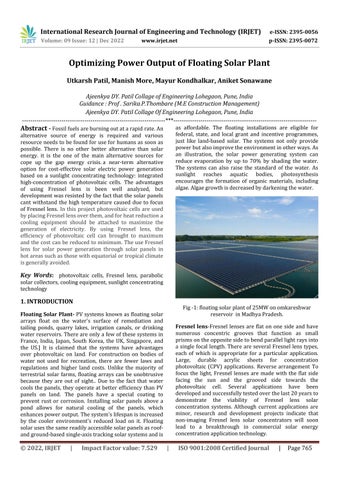
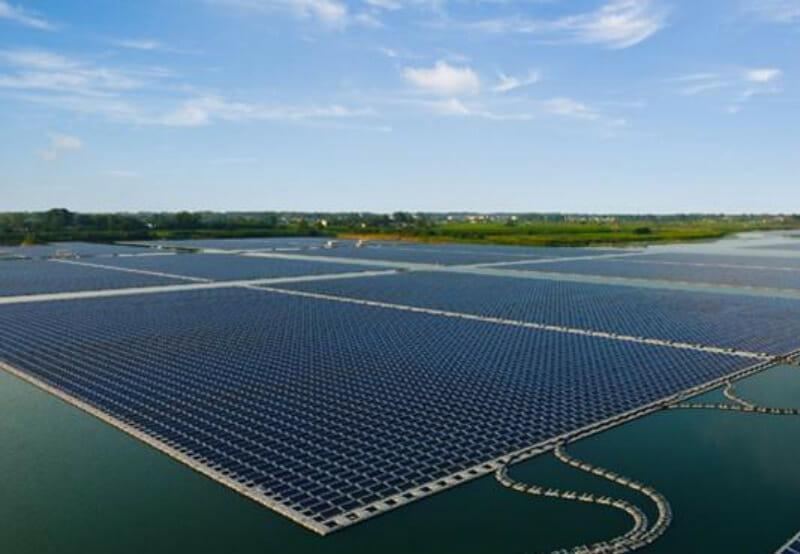
Floating Solar Plant- PVsystemsknownasfloatingsolar arrays float on the water's surface of remediation and tailing ponds, quarry lakes, irrigation canals, or drinking waterreservoirs.Thereareonlyafewofthesesystemsin France, India, Japan, South Korea, the UK, Singapore, and the US.] It is claimed that the systems have advantages over photovoltaic on land. For construction on bodies of water not used for recreation, there are fewer laws and regulations and higher land costs. Unlike the majority of terrestrial solar farms, floating arrays can be unobtrusive because they are out of sight.. Due to the fact that water cools the panels, they operate at better efficiency than PV panels on land. The panels have a special coating to prevent rust or corrosion. Installing solar panels above a pond allows for natural cooling of the panels, which enhancespoweroutput.Thesystem'slifespanisincreased by the cooler environment's reduced load on it. Floating solarusesthesamereadilyaccessiblesolarpanelsasroofandground-basedsingle-axistrackingsolarsystemsandis
value:
as affordable. The floating installations are eligible for federal, state, and local grant and incentive programmes, just like land-based solar. The systems not only provide powerbutalsoimprovetheenvironmentinotherways.As an illustration, the solar power generating system can reduce evaporation by up to 70% by shading the water. The systems can also raise the standard of the water. As sunlight reaches aquatic bodies, photosynthesis encourages the formation of organic materials, including algae.Algaegrowthisdecreasedbydarkeningthewater.
Fig-1:floatingsolarplantof25MWonomkareshwar reservoir inMadhyaPradesh.
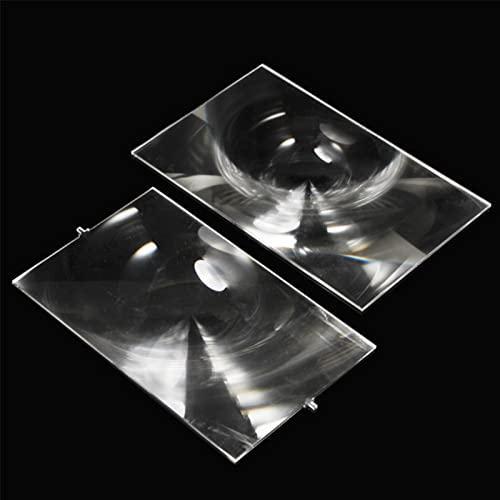
Fresnel lens-Fresnel lenses are flat on one side and have numerous concentric grooves that function as small prismsontheoppositesidetobendparallellightraysinto a single focal length. There are several Fresnel lens types, each of which is appropriate for a particular application. Large, durable acrylic sheets for concentration photovoltaic (CPV) applications. Reverse arrangement To focus the light, Fresnel lenses are made with the flat side facing the sun and the grooved side towards the photovoltaic cell. Several applications have been developedandsuccessfullytestedoverthelast20yearsto demonstrate the viability of Fresnel lens solar concentration systems. Although current applications are minor, research and development projects indicate that non-imaging Fresnel lens solar concentrators will soon lead to a breakthrough in commercial solar energy concentrationapplicationtechnology.
International Research Journal of Engineering and Technology (IRJET) e-ISSN: 2395-0056
Volume: 09 Issue: 12 | Dec 2022 www.irjet.net p-ISSN: 2395-0072
Table -1: literatureReview
A Study on Power Generation Analysis of Floating PV System Considering Environmental Impact
There are some major problems which are interlinked to each other caused due to fitting Fresnel lens panels on floatingsolarplant/othersolarplants:
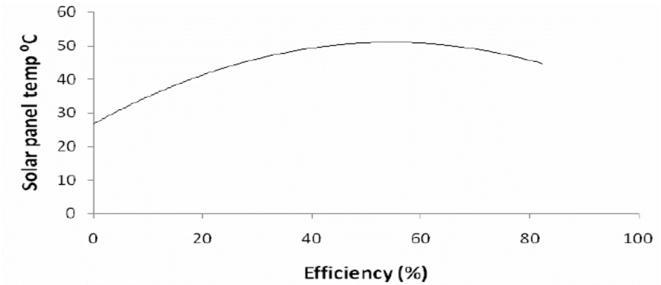
Asthetemperatureincreasesonsurfaceofsolarpanelsthe amountofelectricityproductionalsoincreases.Butaftera specificpointtheenergyproductionstartstodecreasedue toexcessiveheatingcausedduetoFresnellensfocus.
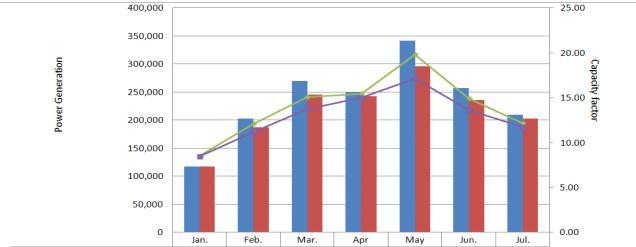
Feasibility analysis of Floating Solar Photovoltaic Plant at Srisailam in Andhra Pradesh:India
YoungKwan Choi The superiority of floating PV systems is demonstrated in the paper through a comparison analysis of the generation amounts produced by floating PV systems installed by K-water, 2.4kW, 100kW, and 500kW. The paper also examines the factors that contributed to this superiority. In order to assesstheimpactofthe environment on the generation efficiency of floatingPVsystems,the effect of wind speed and waves on the construction of the systems was also measured.
P S Kulkarni G Mamatha
In this study, MATLAB is used to examine the performance and properties of the FSPV module with actual meteorological data from the year 2020. The technical performance of the proposed 5MWp FSPV plant at the Srisailam reservoir in A.P., India, wasalsoassessedusing PVSyst and compared to GSPV of the same rating. The findings indicate that compared to GSPV Plant, FSPV generates 4.8% more capacity and reduces 5.45% more carbon emissions annually. Due to the cooling effect, the suggested floating solar PV offers higher performance characteristics in real-
International Research Journal of Engineering and Technology (IRJET) e-ISSN: 2395-0056
Volume: 09 Issue: 12 | Dec 2022 www.irjet.net p-ISSN: 2395-0072
time application than GSPV and prevents the evaporation of 111.09 million litres of water yearly.
research focuses on cutting-edge cooling methods for PV panels as well as upcoming scientificadvances.
AbdulHadi Mohaimin
Md Rakib Uddin
Hasnul Hashim
There are indeed manyways to increase the power output of solar panels. This researchexamineshow the proximity of the Fresnel lens to the solar panel affects the amount of energy generated bythepanel. Fresnel lenses are used to amplify the sun's light intensity in order to boost the solar panel's solar collectability and perhaps increase poweroutput.
A review of photovoltaic cells cooling techniques
Swar A. Zubeer H.A. Mohamm ed Mustafa Ilkan
Inordertoincreasethe efficiency of small household PV systems, this paper focuses on maintaining a uniformly low cell temperature. The effects of the operating temperatureofthecells on the electrical and thermalperformanceof the PV systems have been examined experimentally and numerically using various cooling strategies.
Manoj Gupta CsMalvi
Despite their low yield, photovoltaic systems are frequently used. The productivity of the PV module decreases whenitheatsup,which in turn affects the panel's output, energy efficiency, operation, andlifespan.Therefore, cooling strategies are crucial to lowering the PVpanel'stemperature andmaintainingit.This
Factor value:
A new solar energy method for producing electricity is the floating photovoltaic system. To boost their generation efficiency, the solar panels in the FPV system are placed on water rather than the ground. Due to the water cooling effect, the temperature of the PVpanelswillbelower. Their power temperature coefficient is negative. As a result, power production rises as panel temperature falls. For the chosen site, the energy production and cost of electricity are determined to be roughly 1614 MWh per year and 3 INR/kWh. TheFPVplantwillbein charge of closing the supply-demand energy gap for electrical energy. Compared to solar PV facilities that are ground-mounted, it offers more environmental advantages.
Need For Cooling:- External climate factors including concentrated dust, concentrated sunlight, wind speed, moisture content, and air temperature affect changes in surfacetemperature.Asitismoredifficulttochangeother relevant factors, efficiency can be increased by lowering the operating temperature. Solar radiation is an unpredictable factor, for instance, when constructing photovoltaic panels on the facades of buildings, which are vertical and non-directional surfaces. A range of cooling strategies have been tested and evaluated in a number of papers to increase the efficiency of photovoltaics by preventingtheproblemoftemperaturerise.
International Research Journal of Engineering and Technology (IRJET) e-ISSN: 2395-0056
Volume: 09 Issue: 12 | Dec 2022 www.irjet.net p-ISSN: 2395-0072
of the pipe material for heat transfer has a significant impact on the system's overall efficiency. However, using such a technique incurs substantial installation and material expenses, and as a result we will implement the cooling system composed of radiators and other major parts form scrap vehicles which will play major part in costcutting.
Active and passive cooling methods, which are being developed by scientists, are intended to lower solar cell operating temperatures. the P.V. being cooled properly array has a tendency to lower output loss and boost the PV's dependability. module. In order to increase P.V. performance, passive cooling and active cooling techniquesareused.Modules
The three main passive cooling categories are conductive cooling, passive cooling of the water, and passive cooling of the air. Additional components for passive cooling may include a heat pipe, sink, or exchanger to support natural convection cooling. The material used for the heat sinks wasactuallyhighlythermallyconductive.To maintainthe total flow of heat from the solar panel to the local environment, they are positioned at the bottom of the solar panel. Therefore, it is believed that passive cooling solutions are effective at lowering PV temperature. cells, astheirproductionisverysimpleandaffordable.
Heatsinks,microchannels,heatexchangers,phase-change materials (PCMs), nanofluids, thermoelectric generators (TEGs), or combinations with other systems are some examples of the increasingly complicated techniques that cooling technologies have moved toward. The cuttingedge, innovative field is focused on beam splitting (or spectrum filter) technology, which separates the P.V. wavelengths.cellsdifferentfromthoseutilizedforthePVT system'sthermalconversion.
Technique used in cooling- Forced water circulation:
liquid is utilized as the cooling medium to cool the cells, heat pipes can be adopted on the back side of module panels to reduce the temperature. The excess radiation absorption heat for P.V. modules can therefore be transferred to the circulating coolant and even employed for other purposes. Studies have shown that the capacity
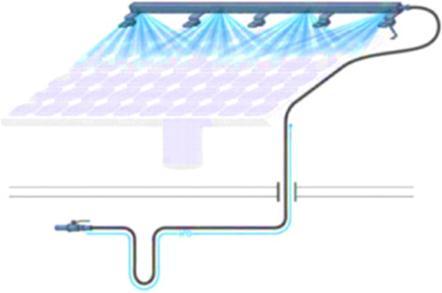
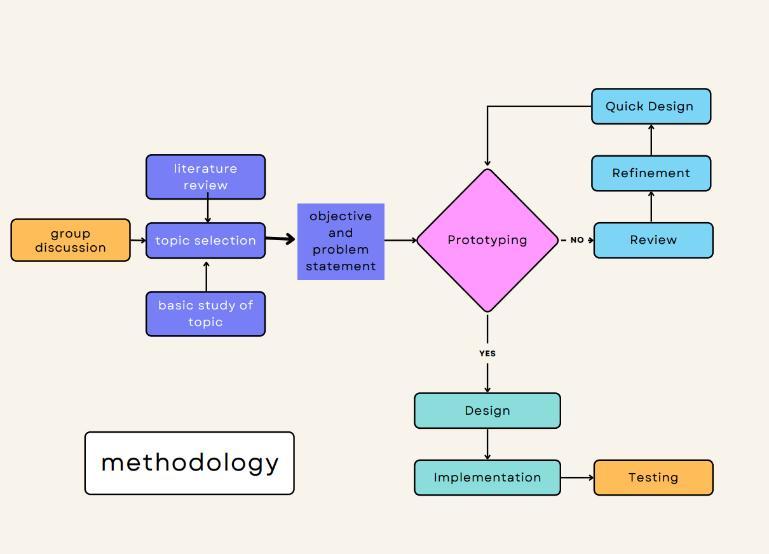
Fig4:-flowchartofmethodologytobefollowed
Water spraying:- The sprinklers on the front of the P.V. squirt water. this system's modules, including the pump and related pipelines (Fig.4). Interesting findings from earlier studies on water spraying demonstrate an up to 15% boost in electricity efficiency in adverse weather conditions. While this water-wasting device, which was putontheoverlandP.V.Intermsofcostandsuitability,it canbeagoodoptionforfloatingsolarsystems.
Fig5:-Reducingtemperatureofsolarpanelbywater spraying
Heat pipe:- A passive cooling system known as a "Heat Pipe"usestheevaporationandcondensationofafluidina
International Research Journal of Engineering and Technology (IRJET) e-ISSN: 2395-0056
Volume: 09 Issue: 12 | Dec 2022 www.irjet.net p-ISSN: 2395-0072
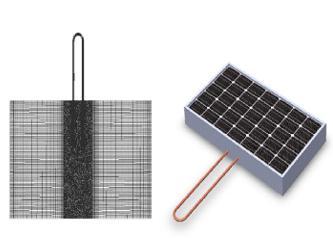
sealedsystemtomoveenergyfromthesourcetothesink. A typical heat pipe has a sealed pipe made of a high thermal conductivity material, such copper or aluminum, at the condenser and the evaporator. Here is a diagram andmodelofaheatpipewithasolarpanel.Theheatpipe can transfer heat from the solar panel to air or water, lower the temperature, and increase the solar panel's effectiveness.
[3] Swar A. Zubeer,H.A. Mohammed, and Mustafa Ilkan " review of photovoltaic cells cooling techniques” , E3S WebofConferences22,00205(2017)
Fig6:-ImageofHeatPipes
The power output of a floating solar plant shall be efficientlyoptimized byuse ofFresnel lenstoconcentrate the light rays form the sun to achieve higher efficiency of of solar panel which may increase the production of electricity. but development was resisted by the fact that the solar panels cant withstand the high temperature caused due to focus of Fresnel lens. Heat pipes can be installed on the rear of module panels to lower the temperature.Liquidisusedasthecoolingmediumtocool the cells. However, utilizing this method results in high installation and material costs. As a result, we will use a cooling system made of radiators and other significant pieces from junk vehicles, which will significantly reduce costs.
[1] .Sampurna Panda, Manoj Gupta, "Comprehensive review on Advanced Cooling Techniques for Photovoltaic Panel", 2022 2nd International Conference on Power Electronics & IoT Applications in Renewable Energy and its Control (PARC), pp.1-5, 2022.
[2] Young-Kwan Choi " A Study on Power Generation Analysis of Floating PV System Considering Environmental Impact” International Journal of SoftwareEngineeringandItsApplication
2022, IRJET | Impact Factor value: 7.529 | ISO 9001:2008 Certified Journal