IoT-Based

Sasindu Mihishan M
Dept.OfComputerSystemsand NetworkEngineering
FacultyOfComputing
Sri Lanka Institute of Information Technology Malabe,SriLanka it19141220@my.sliit.lk
Dept.OfComputerSystemsand NetworkEngineering FacultyOfComputing
Sri Lanka Institute of Information Technology Malabe,SriLanka it19106120@my.sliit.lk
Dept.OfComputerSystemsand NetworkEngineering FacultyOfComputing
Sri Lanka Institute of Information Technology Malabe,SriLanka it19132556@my.sliit.lk
Dept.OfComputerSystemsand NetworkEngineering FacultyOfComputing
SriLankaInstituteofInformation Technology Malabe,SriLanka janaka.w@sliit.lk
Abstract With the complexity of needs, shopping has become an integral part of human life. Due to their busy lifestyles, people are more inclined toward convenient and efficient shopping methods. The shopping cart is an essential tool for shopping in a supermarket. With the rapid development of technology, primarily foreign supermarkets use intelligent shopping carts. The problems that are included in traditional shopping are as follows: customers will receive a receipt after they pay, but it is more likely to disappear in a few days than a physical receipt. Some customers are embarrassed in front of the cashier because the total is higher than they expected. Customers have to take a longer period to shop due to finding products at the supermarket, and it is difficult to push the cart with a heavy load. The newly introduced automated smart shopping cart is a hybrid of a line-following Raspberry Pi-based robotic cart and an Android mobile application built on the Flutter platform and powered by a Firebase cloud database. This novel solution entails making the shopping experience more convenient for customers, particularly those who are accustomed to shopping malls.
Keywords Smart cart, Mobile application, Bar-code scanner,RaspberryPi
Shopping has become a day-to-day activity for many people in the world. There are a few different reasons for this. Most people shop to buy their daily requirements. There are a few different ways to shop, each with its advantages and disadvantages. Online shopping has
Dept.OfComputerSystemsand NetworkEngineering FacultyOfComputing Sri Lanka Institute of Information Technology
Malabe,SriLanka it19197692@my.sliit.lk
Dept.OfComputerSystemsand NetworkEngineering FacultyOfComputing SriLankaInstituteofInformation Technology
Malabe,SriLanka samantha.r@sliit.lk ***
becomemorepopularthanever.Thereareseveralreasons forthis,butoneofthemainreasonsisthatonlineshopping is convenient. You can shop from anywhere in the world, and you don’t have to worry about finding an open store. Online shopping also has a number of benefits over traditionalshopping.Althoughonlineshoppingiseffortless, some peopleare reluctantto doso becausetheymayhave some potential not to get the exact right product. In addition, many of the items needed in daily life cannot be brought online. They should be inspected and purchased. With the busy lifestyle of people, they tend to buy everything in one place, and they go to supermarkets because they can buy everything, they need from food to household items without having to go to multiple stores. Supermarket management also identified this opportunity, and they have taken various steps to make the shopping processstreamlinedandefficient.
Previous research in this field have already implemented systems only focusing on displaying the productsandtheirprices,whichareaddedtothecartona digital screen built in the shopping cart. Through these systems,whatbuyerscanonlyknowistheirproductprices andfinalamount.Butitisnottheonlyproblembuyersface inside the supermarket. Most of the time, buyers go here andthereinsidethesupermarketsearchingexactproducts theyneed.Andalso,inpeaktimes,longqueuescanbeseen at the cashier to pay the bill. Also, it is difficult for older people and pregnant women to push the shopping cart. Also,itisgoodifthereisamethodthatbuyerscanprepare a shopping list and buyers can view their previous bills at home. The proposed system gives solutions to all of the problems mentioned above that customers face inside the supermarket, and also this system centralizes the purchasingprocess.
The developed system gives solutions to all of the problems mentioned above that customers face inside the supermarket, and also this system centralizes the purchasing process. The entire product gives the solution such as no need to push a cart, no worries about the payment,receiveadigitalonlinereceiptaswellasnomore fraud may happen during the shopping.This model mainly contains a modified shopping cart and a mobile app. Customerscanconnecttheirmobilephonetotheshopping cart, and the mobile phone act as a digital screen. The shopping cart has a built-in bar-code reader and weight scale. Also, the cart has the functionality to navigate inside the supermarket automatically. This model solve most of theproblemscustomersfaceinsidethesupermarket.
Thismodel solvesmostoftheproblemscustomersface inside the supermarket. This research paper contains our background study, which we did to find the research gap. Then the research paper includes methodology which is detailed description of our proposed model and four main components of the research. Next, obtained results until now and discussions. After that, the research paper contains the conclusion, acknowledgment, and references. Within this paper we discussed about background, the methodologyandtheresultsoftheresearcharea.
Theconceptofsmartshopping,whichoriginatedinthe United States, has spread across western Europe [1] and has become a system that is needed all over the world in today and consumers want to make their shopping experience easier through the smart technology and more accessible in one place. Then the smart owners of the shopping malls should be responsible to supply a comfortableandhopefulshoppingwaytoalltypesofsmart shoppers[1].Itisseenthatmanysmartsystemshavebeen created which are a challenge to the existing traditional shopping. The majority of existing smart cart is based on IOTtechnology[7],RFID,RaspberrypiandArduino.
Withinsomeexistingsystemscreatedinthisway.Most ofthecurrentlyoperatingsmartsystemsarebasedonRFID technology[2]. Inmostcases,anRFIDtagisattachedtothe product and all the data related to the product is programmed there and the bill must be calculated after readingit[5]. AndthisRFIDcardisgivento thecustomer, and it is interpreted as a membership card, thereby representingtheshoppingtrolleyassmart[9]. Inallthese cases, the scanner procedure is obtained by the RFID readerattachedtothecart[2].Althoughitsconvenienceis somewhat high, it is costly to implement and may experience some errors in its implementation. Thus, when comparing the barcode and the RFID technology, it can be recognized that the barcode reader is very convenient and inexpensive device that can be used simply and smartly. You can read the default barcode of each product and calculate the relevant bills very easily [6]. And in some of
the existing articles, instead of the barcode reader, a scanning procedure has been introduced using the mobile phone[9].
Further a digital screen attached to the cart of many existing articles has been introduced to display it to the customer after scanning using various methods. The location of the items required by the customer, bill calculations,etc.areallshownonthisscreen,butinstalling it on eachcart is quite a costly task [8]. Because of this, as introduced in this research paper, the customer's mobile phoneisusedinstead. Byinstallingthemobileapplication, he can perform any role he wants. Amazon fresh grocery storesandAlibaba’sHemagrocerieshaveintroducedsmart shoppingcartswithvariousfacilities.EveninSriLanka,we canseesmartshoppingcarttechnologycalledscan&goin Keels supermarkets.[3] In addition, Self-Checkout Systems, payfromamobileapplicationareintroducedundertheIOT environment.
In 2020, research was carried out on the design of a smartcartappforautomatedshoppinginsupermarketsby Aida Arvidsson and Lina Hassani to design the application prototype (user interfaces) to give a good user experience tocustomers based onHuman-Computer Interaction(HCI) [14].Thisresearchhasmainlyfocusedontheself-checkout process tosuit Swedish supermarkets to reduce the queue infrontofcashiers.TheyhaveusedIoTtechnologyingiving anRFIDcardtoeverysupermarketuser,andtherestofall things like scanning the barcode had been put into action usingamobilephonecamera.
Ankush Yewatkara , Faiz Inamdarb , Raj Singh , Ayushyad,AmolBrendalehavebeencarriedoutaresearch to create a Smart Cart with Automatic Billing, Product Information, Product Recommendation Using RFID & Zigbee with Anti-Theft [15]. This research aims to reduce thelongqueuesinthesupermarkets,reducethelaborcost, give a complete idea about the product to customers, and attractcustomerstothesupermarket.
The paper published in 2020 by Anitha, Dr.Subburam, Keerthana, K.H.Yoganandarajurs in the domain of smart trollybillingsystems,theyhavemainlyusedIoTtechnology [16]. The solution they have given is not connected with a mobileapp.TheyaretemptedtoinstallanLCDscreenand RFIDscannerintheshoppingcart.Toincreasethesystem's security, they have used RFID technology instead of a barcodereader.
Another smart cart research was carried out by the International Journal Research Culture Society in 2018 on Automated Shopping Trolley System Using Raspberry Pi Device [17]. Their main objective in this research is to provide an efficient customer service by reducing the rush and queues inside the shopping mall. They have used raspberrypitechnologywithLCDandbarcodescanner.
International Research Journal of Engineering and Technology (IRJET) e-ISSN:2395-0056
Volume:09Issue:12|Dec2022 www.irjet.net p-ISSN:2395-0072
In the 2016 Hsin-Han Chiang, Yu-Te Liao, and Yen-Lin Chen published research on the Development of Smart Shopping Carts with Customer-Oriented Service [18]. The mainaimofthisresearchistoreducethemanpowerinside the shopping mall and increase customers' shopping experience. To achieve the target, they have added many new features to the existingshopping cart like recognizing thefaceofthecustomerbytheshoppingcart,accordingto previous bills, suggesting products, attaching an RFID scanner to the shopping cart to scan and add products, attachanLCDscreentoshoppingcarttoviewfinalamount, automatic navigation system inside the supermarket and automatic billing system. They have used local binary patterns histograms (LBPH) algorithm to do face recognition, and they have attached RFID tags to each product forproductidentification.However,theRFIDcard approachismoresecurethan a barcode reader, anditwill have to cost more. Compared with existing articles, can be able to find out how unique the smart cart procedure that introducinginhere.
After referring to mobile application-related surveys, two open-source frameworks were identified to overcome these system requirements and develop the mobile application.Flutterandreactnativearebothcross-platform frameworksthatsupportusingthesamecodebaseforIOS as well as android applications. These cross-platform frameworks are most effective because they give code reusability, reduce cost, provide excellent product maintenance, and hassle-free rapid development. Out of thesetwoplatforms,flutterischosentodevelopthemobile application because it is more adaptive to system updates. When selecting the database, No-SQL databases was identifiedasthebestsolution,anditshouldalsobehosted in a cloud. Considering these facts, Firebase Firestore was selectedasthebestsolutiontogowith.Thedatabasetable is including with Product Category, Product name, Weight, Price,QuantityandBarcodenumber.
Under this android mobile application, user login, Shopping list, display current payment, searching needed products, add products to the database, remove option and collect removed data by the database can be introduced. Two open-source, cross-platform frameworks can be identified throughout the literature survey and analysis to develop the application. They were Flutter and react native.Cross-platformframeworksaremosteffective because they support using the same code base for the AndroidandIOSapplications,givecodereusability,reduce cost, provide great product maintenance, and hassle-free rapid development. When it comes to flutter and react native, Flutter is more adaptive to system updates. According to the above points, Flutter was the best option to go.When selecting the database,NoSQL databases were
identifiedasthebestsolution,andthedatabaseshouldalso be hosted in the cloud. Considering these facts, firebase firestore was selected as the best solution. For this implementation, the mobile application develops only for android users. Supermarket administration adds all the product details to the database, including product name, category,weight,price,quantityavailable,barcodenumber, andproductlocation(racknumber).
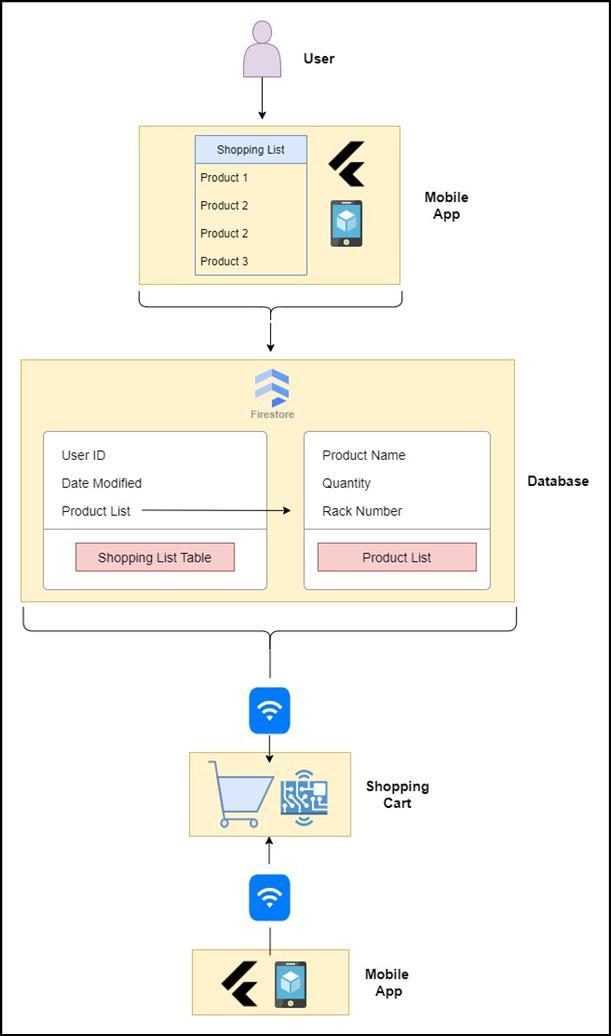
The shopping cart needs a path to move inside the supermarket and stop at the exact product. This component's main target is to give the path the shopping cartshould followinside thesupermarket.In thatcase,we have implemented a shopping list function inside the mobile app. All the products, product details, and rack numberswheretheproductisavailableareinthedatabase. Customers can create a shopping list at home before coming to the supermarket using our mobile app. When a customer creates a shopping list, products and respective rack numbers are stored in a table called "shopping lists" along with the customer's user id. The cart moving component directly accesses these "shopping lists" table records. We have given a QR code for each shopping cart. Customerscangotothesupermarket,scantheQRcodeand connect to the shopping cart using the mobile app. Then they can shop according to their shopping lists. The below systemdiagram(figure1)definesthemethodofhardware andsoftwareimplementationforasuccessfuloutput,which is described in the results section below. The entire procedure describe can identify as a flow using this diagram.
After referring to mobile application-related surveys, two open-source frameworks were identified to overcome these system requirements and develop the mobile application.Flutterandreactnativearebothcross-platform frameworksthatsupportusingthesamecodebaseforIOS as well as android applications. These cross-platform frameworks are most effective because they give code reusability, reduce cost, provide excellent product maintenance, and hassle-free rapid development. Out of thesetwoplatforms,flutterischosentodevelopthemobile application because it is more adaptive to system updates. When selecting the database, No-SQL databases was identifiedasthebestsolution,anditshouldalsobehosted in a cloud. Considering these facts, Firebase Firestore was selectedasthebestsolutiontogowith.Thedatabasetable is including with Product Category, Product name, Weight, Price,QuantityandBarcodenumber.
Under this android mobile application, user login, Shopping list, display current payment, searching needed products, add products to the database, remove option and collect removed data by the database can be introduced.
Two open-source, cross-platform frameworks can be identified throughout the literature survey and analysis to developtheapplication.TheywereFlutterandreactnative. Cross-platformframeworksaremosteffectivebecausethey supportusing thesamecode base for theAndroidand IOS applications, give code reusability, reduce cost, provide great product maintenance, and hassle-free rapid development. When it comes to flutter and react native, Flutter is more adaptive to system updates. According to the above points, Flutter was the best option to go. When selectingthedatabase,NoSQL databaseswereidentifiedas thebestsolution,andthedatabaseshouldalsobehostedin the cloud. Considering these facts, firebase firestore was selected as the best solution. For this implementation, the mobile application develops only for android users. Supermarketadministrationaddsall theproductdetailsto the database, including product name, category, weight, price, quantity available, barcode number, and product location(racknumber).
The shopping cart needs a path to move inside the supermarket and stop at the exact product. This component's main target is to give the path the shopping cartshould followinside thesupermarket.In thatcase,we have implemented a shopping list function inside the mobile app. All the products, product details, and rack numberswheretheproductisavailableareinthedatabase. Customers can create a shopping list at home before coming to the supermarket using our mobile app. When a customer creates a shopping list, products and respective rack numbers are stored in a table called "shopping lists" along with the customer's user id. The cart moving component directly accesses these "shopping lists" table records. We have given a QR code for each shopping cart. Customerscangotothesupermarket,scantheQRcodeand connect to the shopping cart using the mobile app. Then they can shop according to their shopping lists. The below systemdiagram(fig1)definesthemethodofhardwareand software implementation for a successful output, which is described in the results section below. The entire procedure describe can identify as a flow using this diagram.
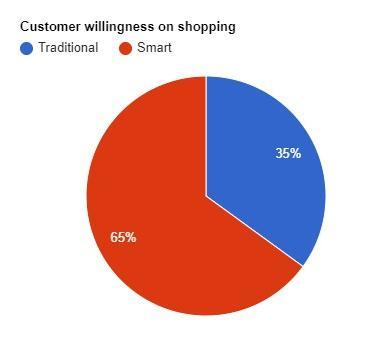
The results obtained from the development and referencesofthissystemarebasedonsurveyexperiments. The results of the survey encourage us to deliberately deploy these functions to create a smart cart system to improve the traditional supermarket procedure. The following pie chart (fig2) display the willingness of the customersforasmartshoppingsystem.Mostofcustomers expecting something new looking functions within the physicalshoppingprocedure.
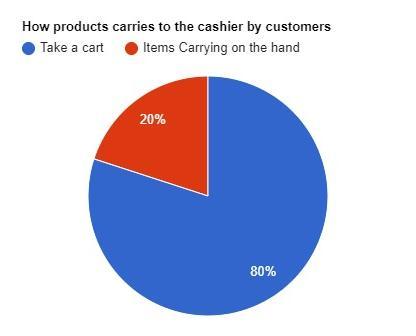
Thesurveydescribesanothersituation:theconsumer's willingnesstocarrygoodsusingacartorbasket(Fig3).Itis a much easier way to express consent. It is easy to multitask,andthereisnoneedtoworryaboutthesafetyof thegoodsifthecustomerusesacartandneedstopushthe load.
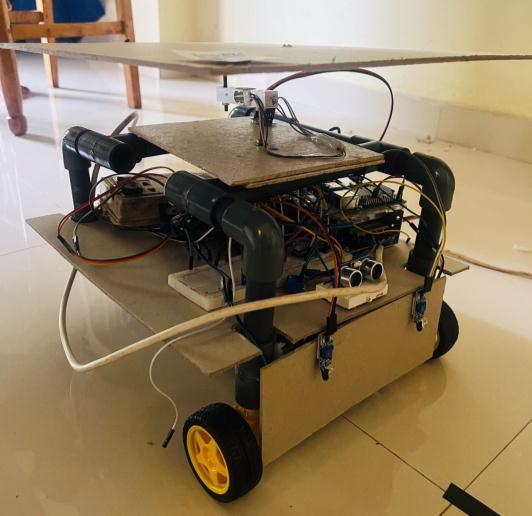
The demonstrated production done by Arduino, RaspberryPi,Flutter,andFirebaseoutputisdiscussedhere. The implemented cart can be able to find relevant needed items by following a specific line at the supermarket. It is possible to take measures to avoid various obstacles encountered by the cart on the way. For that we used ultrasonic sensors, IR sensors and for count distance we usedsteppermotors.
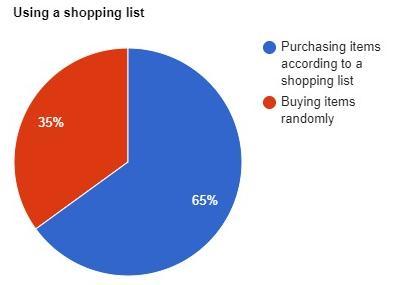
In this research area, customers should install and createanaccountforthemobileapplication.Thefrontend and backend have been created successfully including the interfaces with home page, Sign-In option, Shopping list page, Calculated bill displaying page, removing options, searchingforproductoptions.Customershavetraditionally done their shopping using a shopping list they created at homeorbypurchasingitemsatrandominashoppingmall. The majority of these two types use a shopping list to buy what they need. We have finalized it using survey details (Fig6).
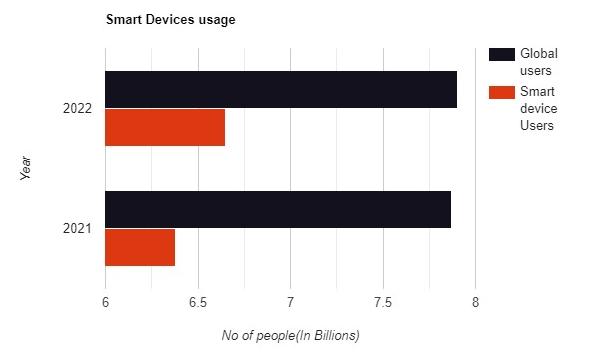
Here we introduce an Android mobile application that supports various functions. Before implementing a mobile application, we had to mention the use of smart devices among people. Although this will improve with smart technology, we need to see how much people can use this smart app using their own smart devices. As a result, we can see that the number of people using smart devices is graduallyincreasing(Fig5).
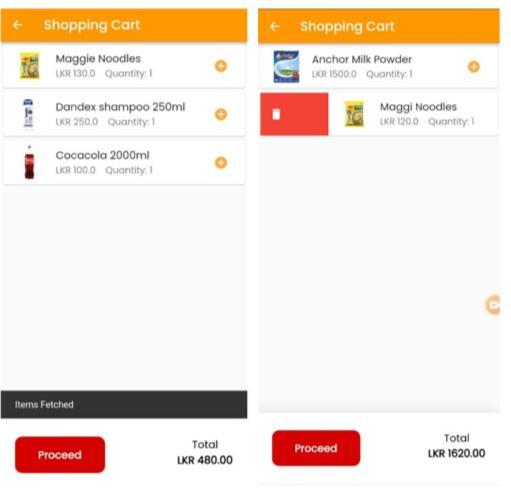
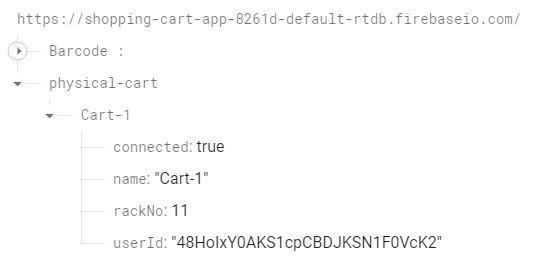
The mobile app was tested before integrating with the shopping cart and after the integration. Fig.7 shows the interfaces after customers add products to a shopping list. Figure 8 shows the real-time database of the mobile app. Theretheconnectionhappensbetweenthemobileappand theshoppingcartandgivingthepathfortheshoppingcart tofollow.
Bymeansofthispaper,theresearchintendstosimplify traditional shopping issues through IOT technology. This will improve the standard of the entire shopping experience.Thisentirepaperdepictstheactofcombininga smart cart and a mobile application. This is an automatic cart, which can be introduced as a line-following robotic shopping cart. There is no need to push carts through the shopping mall like traditional carts, and there is another advantage: no more waiting in front of the billing queue because the mobile application calculates payment automatically. The shopping list has the significant advantage of allowing the customer to estimate the total amountofthebillathome.Thisresearchprovidesanantitheftsystemforavoidingfraudusingaweightscalesystem. The smart power system shows the battery percentage level, and when the level drops below a certain threshold, thebulbturnson.Itisbeneficialtolocatethesupermarket helpersinordertolocatecartswithlowbatterylevelsand charge them before the customer uses them. This is a successful implementation of the intelligent shopping cart systemusingupdatedsmarttechnologies
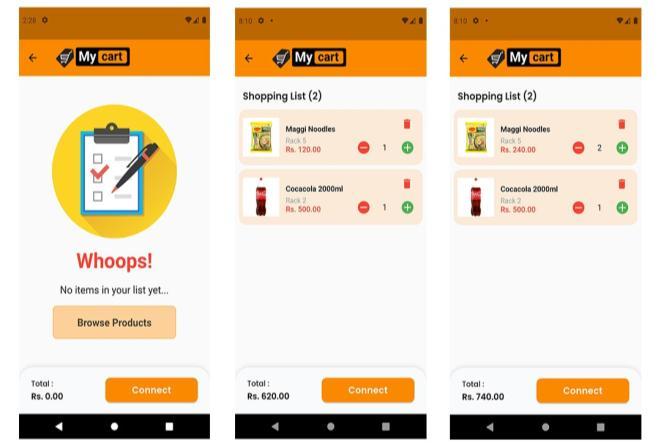
Usingthebarcodereader,thecustomercanmonitorthe purchased products to be aware of the current payment. This barcode reader is programmed to detect the barcode of any item, and it could be able to connect with the database. The interfaces below show (Fig9) how the currenttotalpaymentappearsafterithasbeenreadbythe barcode reader. If customers need to return a purchased item, they can use the remove option by swiping from the application.Inparallel,thetotalpaymentwilldecrease.
[1] A. A. S. Gunawan et al., “Development of Smart Trolley System Based on Android Smartphone Sensors,” Procedia Computer Science, vol. 157, pp. 629–637, 2019, doi: 10.1016/j.procs.2019.08.225.
[2] S.Mclord, “US Smartphone Users, Android vs. iPhone, 2020-2022 (millions),” Insider Intelligence https://www.insiderintelligence.com/chart/244516/ussmartphone-users-android-vs-iphone-2020-2022-millions [Accessed19October2022].
[3] R.S Robinson, “Global Smart Shopping Cart Market By Size, Share, Trends, Growth, Forecast 2025 | TechSci Research,” www.techsciresearch.com https://www.techsciresearch.com/report/smartshopping-cart-market/4661.html [Accessed 19 October 2022].
[4] J. Flynn, “20 Vital Smartphone Usage Statistics [2022]: Facts+TrendsOnMobileUseInTheU.S. –Zippia,” Zippia, Oct. 20, 2022. https://www.zippia.com/advice/smartphone-usagestatistics/[Accessed17October2022].
[5]K.S.Norton“IoTbasedSmartShoppingCartusingRFID and NodeMCU,” iotdesignpro.com https://iotdesignpro.com/projects/iot-based-smartshopping-cart-using-rfid-and-nodemcu, [Accessed 17 October2022].
[6] Z. Lang, L. Jianjun, and H. Fakiri, “Green Internet of Things and Big Data Application in Smart Cities
International Research Journal of Engineering and Technology (IRJET) e-ISSN:2395-0056 Volume:09Issue:12|Dec2022 www.irjet.net p-ISSN:2395-0072
Development,” researchgate.net, May 2021, doi: DOI:10.1155/2021/4922697.
[7]A.Carmin,“GlobalSmartShoppingTrolleySalesMarket by Type (Zigbee, RFID, Bar Code), By Application (Supermarket, Shopping Malls, Others) And By Region (North America, Latin America, Europe, Asia Pacific and Middle East & Africa), Forecast From 2022 To 2030,” Dataintelo https://dataintelo.com/report/globalsmart-shopping-trolley-sales-market/ [Accessed 19 October2022].
[8] [1 I. Shobana, “Intelligence Billing System Using Radio Frequency Identification (RFID) and ZIGBEE,” www.academia.edu, [Online]. Available: https://www.academia.edu/26824462/Intelligence_Billin g_System_Using_Radio_Frequency_Identification_RFID_and _ZIGBEE[Accessed19October2022].
[9] I. I. S. Roy, “Smart Trolley and Automatic Billing.pdf,” www.academia.edu, [Online]. Available: https://www.academia.edu/28898739/Smart_Trolley_and _Automatic_Billing_pdf,[Accessed18October2022].
[10]H.SinghBedi,N.Goyal,S.Kumar,andA.Gupta,“Smart Trolley using Smart Phone and Arduino,” Journal of Electrical & Electronic Systems, vol. 06, no. 02, 2017, doi: 10.4172/2332-0796.1000223. [Accessed 19 October 2022].
[11] J. Serene and K. Middleton, “Intelligent Shopping Cart,” ijesit.com, Dec. 10, 2021. http://www.ijesit.com/Volume%202/Issue%204/IJESIT2 01304_64.pdf(Accessed05january,2022).
[12] T. Faisal , “Smart Cart With Multi-shopping Solutions,” International Journal of Interactive Mobile Technologies (iJIM), vol. 15, no. 24, pp. 77–93, Dec. 2021, doi:10.3991/ijim.v15i24.26397.
[13] IJRASET, “A Review on Smart Shopping Trolley with Mobile Cart Application,” www.ijraset.com https://www.ijraset.com/research-paper/smartshopping-trolley-with-mobile-cart-application [Accessed: 30-Nov-2022].
[14] Anushka, V. Mishra, S. Bhardwaj, and R. Vashisth, “Design and Development of Smart Cart System using Artificial Intelligence,” IEEE Xplore, Oct. 01, 2021. https://ieeexplore.ieee.org/abstract/document/9609507 (accessedMay26,2022).
[15] A. Yewatkar, F. Inamdar, R. Singh, Ayushya, and A. Bandal, “Smart Cart with Automatic Billing, Product Information, Product Recommendation Using RFID & ZigbeewithAnti-Theft,” Procedia Computer Science,vol.79, pp.793–800,2016,doi:10.1016/j.procs.2016.03.107.
[16] M. Bhende, “SMART TROLLEY BILLING SYSTEM,” International Journal for Research in Applied Science and Engineering Technology,vol.7,no.11,pp.918–923,Jun.2020,doi:10.22214/ijraset.2019.6158.
[17] R.N. Jogekar, A. Kadav, R. Ghodeswar, P. Chavhan, P. Kadu, and M. Paunikar, “Automated Shopping Trolley Using Raspberry Pi Device,” International Journal of Scientific Research in Computer Science and Engineering, vol. 6, no. 2, pp. 126–128, Apr. 2018, doi: 10.26438/ijsrcse/v6i2.126128.
[18] H.-H. Chiang et al., “Development of smart shopping carts with customer-oriented service,” 2016 International Conference on System Science and Engineering (ICSSE), Jul. 2016,doi:10.1109/icsse.2016.7551618.
© 2022, IRJET | Impact Factor value: 7.529 | ISO 9001:2008 Certified Journal | Page715