International Research Journal of Engineering and Technology (IRJET) e-ISSN: 2395-0056

Volume: 09 Issue: 12 | Dec 2022 www.irjet.net p-ISSN: 2395-0072
International Research Journal of Engineering and Technology (IRJET) e-ISSN: 2395-0056
Volume: 09 Issue: 12 | Dec 2022 www.irjet.net p-ISSN: 2395-0072
1
, Mr. A. G. Patil2
1PG Student, Department of E&TC, PVPIT Budhgaon.
2Professor, Department of E&TC, PVPIT Budhgaon. ***
Abstract - The Wireless Sensor Networks have advanced morerapidlyandmoreeffectively.Theyhaveendedupthekey source for the progression of IoT. They discover use in almost all areas counting smart network, smart transportation systems, smart home, smart clinics, and so on. Bus transportation service doesn't have a correct framework to trace all buses location and so the actual time of arrival in each stop. These issues occur because current transport companysystemdidn'tapplyrealtimetrackinginnovationto follow on each buses on the road additionally lack of a platform to revive most up-to-date transport activity information to move passengers. This paper presents review onIoTbasedintelligentbustransportationframeworkmodel with Various IoT techniques like Radio Frequency Identification RFID, WIFI module, GPS module etc. for keen Transportation. The most expected benefits emerging due to IoT based transportation framework can be developed by coordination bus scheduling, bus location detection, and payment efficiency of passengers by booking seat system so that constrain congestion and reduce waiting time of the travellers.
Key Words: Bus,GPSmodule,IoT,RFIDWirelessSensor, WIFImodule.
An appropriate and systematic public transport plays a major part in financial growth and well-being of the individualsinanynation.Butpublictransportinmostofthe developingnationsisn'trunningappropriatelysinceofthe needofpreciseplanningandmonitoring.InthisPaper,we arestudyingthemonitoringoperationsofbustransportation systems. Public Transport is one of the critical infrastructures of any nation. In developing nations like India bus transportcomprisesof90% ofpublictransport. However, need of efficient mechanism to monitor and managethebus-networkisleadingtoneedofconsistencyof thetransportnetwork.Itgetsdifficulttodistinguishcauses behind delays, or predict the entry times. Bus transport system faces the ever-expanding issue of traffic and congestion.Theoperationsofbus-transportsystemscanbe significantlyimprovedbyobservingthetransportoperations andanalysingthemtogivingvaluableinformationbothto thetravellersandtransportoperatingauthorities.
Paper Citation: Jayesh Ramesh Chandiramani, Sanjam Bhandari, Hariprasad S.A., “Vehicle Data Acquisition and Telemetry”,2014FifthInternationalConferenceonSignals andImageProcessing:©2013IEEE.[1]
Data Acquisition(DAQ)andTelemetryare Information Securing systems which are the portion of the winning equationofanyracegrouporvehicleproducer.Itiscrucialto the improvement stage of a vehicle, so that design can be approved and tunable parameters adjusted to extend executionandproductivity.ExistingDAQsystemscomeup shortastheyareofuniversalapplicationsortandturnoutto begreatlyexpensiveandpowerconsuming.Too,theneedof filtering stages is an issue for sensor data coming from a moving vehicle. In this paper the system talkedabout was planned particularly for car application, taking into consideration the size,cost and performance, whereas too taking care of the noise factor by counting digital filters. Withinthesetup,thesensorinputsaregiventoanembedded controllerwhichismodifiedtoperformsignalconditioning andanalogtodigitalchangeutilizingtheonboardADCs.Most of the inputs from vehicle sensors are around 0-5V for voltage-basedreadingsand4-20mAforcurrentbased,this wasthepremiseofchoosingtheultimatespecificationofthe framework.TheRealTimeClock(RTC)isutilizedtologthe timinginformationofthedatawithinthelogrecord,whichis storedonthedetachable
SD card in comma separated value (CSV) format. The same data is additionally transmitted over the wireless network for the telemetry part of the framework. The backend GUI part built on LabVIEW is given the CSV informationfromtheDAQandismodifiedtooffertheclient filtering,flagconditioning/calibrationalternativesandthis dataisshowngraphicallyforanalysis.Thesystemwasfound tobe2.2timesmorecosteffectivethancurrentmodules,with adatarateof9600Hzand10bitresolutionforDAQandthe telemetrysystemworkingataserialdatabaudrateof9600 transmittedwirelesslythroughaZigBeenetwork.[1]
Paper Citation: Ahmad Rahmati, Lin Zhong, Matti Hiltunen, Rittwik Jana, “Reliability Techniques for RFIDBasedObjectTrackingApplications”,37thAnnualIEEE/IFIP International Conference on Dependable Systems and Networks. [2]
International Research Journal of Engineering and Technology (IRJET) e-ISSN: 2395-0056
Volume: 09 Issue: 12 | Dec 2022 www.irjet.net p-ISSN: 2395-0072
RFIDinnovationhastheabilitytododrasticallyprogress various industrial processes. But it still faces numerous challenges,countingsecurityandunwaveringquality,which mayconstrainitsutilizationinvariousapplicationscenarios. Inthispaper,theauthorexaminesthereliabilitychallengesin RFID-basedtrackingapplications,whereobjectslikepallets, packages,andpeoplewaslabelledwithlow-costpassiveRFID tagspassbytheRFIDreader’sreadzone.Theapplicationof RFIDinnovationrequiresRFIDtagsjoinedtoobjectsanda frameworkforreadingthetagsandpreparingtagdata.The frameworktypicallycomprisesofantennas, readers,anda back-endsystemwithedgeservers,applicationservers,and databases. Their result shows that the reliability of tag identificationisinfluencedbyafewvariablesliketheintertagdistance,thedistancebetweenthetagandantenna,the orientationofthetagwithregardtotheantenna,andthearea ofthetagontheobject.TheyillustratethatRFIDframework reliabilitycanbealtogetherimprovedwiththeapplicationof simpleredundancytechniques.Thisworkconductedbroad controlled estimations to characterize the reliability of passiveRFIDlabelsfortrackingportableobjectsandpeople. Results uncovered critical insights into how reliability depends on different practical variables, such as inter-tag distances,locationofthetagonanobject,andtagorientation. To improve reliability, they investigated basic and costeffectivereliabilitystrategies,tobespecificrepetitionatthe taglevel,theantennalevel,andthereaderlevel.Theresults state that the high effectiveness of tag-level redundancy, takenafterbyantenna-levelredundancyresultsinincreasing frameworkreliability.[2]
PaperCitation:TareqBinjammaz,AliAl-Bayatti,Ashwaq Al-Hargan, “GPS Integrity Monitoring for an Intelligent Transport System”, 2013 10th Workshop on Positioning, NavigationandCommunication(WPNC)©2013IEEE [3]
Theintegrityofpositioningsystemshasendedupamost vital prerequisite for location-based ITS applications. GPS collectorsareutilizedtosupplyvehiclepositionandspeed information. In any case, GPS cannot give the high-quality positioningdatarequiredbyITSapplicationsduetoclimatic impacts,receivermeasurementerrors,andmultipatherrors. Also,afewITSapplications,suchastrafficlawenforcement systems,havelawfulorfinancialconsequencesandrequire integrityinbothpositionandspeeddata.Subsequently,the integrity of GPS information is required to ensure that navigationsystemswillnotdelivermisleadingorflaweddata. Inthisarticle,amodernmethodforgivinghighintegrityGPS data for land vehicle observing systems is proposed. The proposed strategy gives a three-level integrity check. The integrityalgorithmconsistsofthreestagesofintegritycheck (position,speed,andmapcoordinatingintegrity).Eachlevel usesa diversemethodtocheck theconsistencyoftheGPS data. A receiver autonomous integrity monitoring (RAIM) algorithmisutilizedtomeasurethequalityofGPSpositioning output.GPSDopplerdataisutilizedtochecktheintegrityof vehicle speed, which includes a new layer of integrity and mayimprovetheexecutionofthemapcoordinatingprocess. Thefinallevelwithintheintegritycheckrequiresconfirming
theintegrityofthemapcoordinatingalgorithm.Thesethree levelswillimprovetheintegrityofthecompleteframework, providingenhancedresults [3]
PaperCitation:PengChen,ShuangLiu,“IntelligentVehicle MonitoringSystemBasedonGPS,GSMandGIS”,2010WASE InternationalConferenceonInformationEngineering©2010 IEEE. [4]
To reach the requirements of a few intelligent vehicle monitoringsystem,thecomputerprogramintegratesGlobal PositionSystem(GPS),GeographicInformationSystem(GIS) andGlobalSystemforMobilecommunications(GSM)inthe whole. The structure, network topology, functions, main technical highlights and their execution standards of the system are presented. At that point hardware plan of the vehicleterminalisgiveninbrief.
Communicationprocessanddatatransmissionbetween theserverandtheclientandclientthroughTCP/IPandUDP protocolareexaminedindetailinthispaper.Testingresult utilizing Load Runner software is too analyzed. Practice appearstherobustnessofthesoftwareandachievabilityof object-orientedprogramming.Thispaperhasexaminedthe structure, capacities, main technical highlights and their usagestandardsofavehiclemonitorsystemandgivencases of the utilize of MapX under Visual Studio within the executionofaparticularGISapplication.Itemphasizedthe peculiarity and key plan of the communication computer program,atthesametime,offeredthecomparingstrategies and working process of the client and the server. The research within the paper gives scientific and referenced bases for the improvement of Com GIS in Visual Studio. Experiencesshowthatdevelopingapplicationswithobjectorientedissimple,quickandeffective [4]
Paper Citation: Ganesh Venkat Sundar, Balaji Ganesh Rajagopal, “IoT based Passenger Information System OptimizedforIndianMetros”,International Conferenceon Electronics, Communication and Aerospace Technology ICECA2017©2017IEEE. [5]
Public transportplaysa pivotal partinmeetinga city’s transportation needs. In addition, it makes a difference decreasetrafficcongestionandvehicularcontamination.In India, buses are the preferred mode of travel due to their cheapchargesandextensiveroutes.Themajordeterrentsto their utilization are: 1) overcrowding and 2) instability in entry time. Crowd estimation techniques using cameras, infrared lasers at passages are not appropriate for Indian metros.Thispaperproposesanarrangementleveragingthe Web of Things. The authors have simulated the handheld ElectronicTicketingMachines(ETMS)utilizedbyTamilNadu StateTransportCorporation(TNSTC)conductorsthroughan androidapplication.Crowdestimationisdonebykeepingup alistof“live”tickets(on-boardtravelers)ofeachtransportat theserverside.TheETMscommunicatewiththeserverby meansofanApplicationProgrammingInterface(API).The
International Research Journal of Engineering and Technology (IRJET) e-ISSN: 2395-0056
Volume: 09 Issue: 12 | Dec 2022 www.irjet.net p-ISSN: 2395-0072
GlobalPositioningSystem(GPS)receiverbuiltintotheETMis utilizedforrealtimefollowingofthebusessubsequently. [5]
PaperCitation:Ms.A.DeebikaShree,Ms.J.Anusuya,Dr.S. Malathy, “Real time bus tracking and location updation system”, 2019 5th International Conference on Advanced Computing & Communication Systems (ICACCS) ©2019 IEEE.[6]
Public transportation system plays a significant role in each side of life. it's a bigger impact on economic development of the country. Tracking, monitoring, scheduling,alertservicesaretheforemostchallengesvisage bythissystem.Currently,majorservicesofthissystemare operatedbyhandsthatareapproximateandsimpleaccessis denied to the people. This paper aims in automating the servicesofthesystemwhichwilloffertherealtimetracking expertise of the public transport systems. The buses are having RFID tags among them and RFID readers will be placed in every bus stops. Arduino serves as the central controllerforthissystem.GSMmodulesaregoingtobeused tosendthetrackingmessagestotheauthorizedpersonsfor continuous monitoring. GPS is employed for obtaining the locationofthebuses.Userswillbegettingthebustracking details as notifications in their mobiles through IoT. The inputsfromRFIDreadersareupdatedtoArduinoforprocess the information. The processed data is distributed to the cloudthatistheinterfacebetweentheuserandthereforethe system. [6]
PaperCitation:U.K.Fernando,RuwaniM.Samarakkody, MalkaN.Halgamuge,“Smarttransportationtrackingsystem ontheinternetofthingsvision”FirstOnline14January2020, PublisherNameSpringer,Cham. [7]
This chapter points to look at the IoT-based vehicle trackingframeworks.Forthisreason,authorinvestigates30 publicationsfrom2014to2018.Choicewasbasedoncertain basicparameterssuchas:measuringattributesofthemoving vehicle, sensors and actuators utilized for data getting in tracking gadgets, information exchanging methods for transmission, networks and protocols utilized for communication, utilized stock for information storage, programming language or frameworks, and algorithm utilized for raw information analysis. The investigation illustrated that (i) a huge portion of the IoT sensors and actuators were centered on the primary location tracking systeminclouddatacentersthatcanbedealtwithremotely by retrieving real-time data, (ii) The GPS sensors broadly utilize in vehicle tracking system were based on the RFID innovation, (iii) Wi-Fi systems were the most well-known systemswhereasGSM/GPRSandTCP/UDPprotocolswere thebesttransportlayerprotocols,(iv)mostutilizedstorage method was cloud for smart vehicle tracking system. In addition,theforemostcriticaladvantageofutilizingIoTfor tracking systems was the effectiveness, security, and intrusionofprotectionforthepassenger. [7]
PaperCitation:SaurabhChatterjee,Prof.BalramTimande, “PublicTransportSystemTicketingsystemusingRFIDand ARM processor”, 2012 International Journal of Electronics andComputerScienceEngineering,volume1. [8]
This paper is based on ticketing and identification of the travelerwithinthepublictransport.Withinthemetropolitan citylikeMumbai, Kolkata wehavea seriousbreakdownof public transport and different security issues. This paper proposeauserfriendlycomputerizedticketingframework which is able to automatically deduct the traveler’s fare according to the travelled distance as well as identify the passenger.theauthorsutilizedRFIDticketsandGPSwhich usedtomakethetransactionandfordistancecalculationand identification of the passenger. This paper basically deals withtheidentificationandticketingofthetravelerssitting withinthepublictransport.[8]
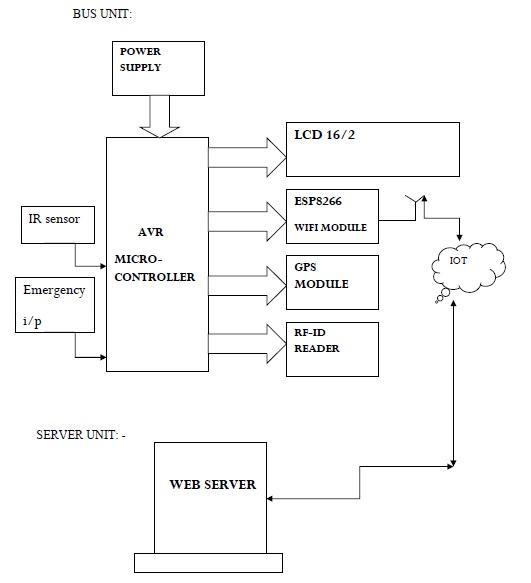
Eachbusisequippedwithanon-boarddevicethatstoresthe servicescheduleinformationandlinkstothesystemonthe bus.Withthison-boardtechnologybusescancomparethe real-time location to the assigned schedule and report the deviations to the Transit Control Center. The “Next-stop” display,passengerswillknowwheretheyareandwhento getoffthebus.Thenextbusstoppassengercanreceiveearly message.
The proposed model consists of an App for bus tracking through GPS trackingunit installed in bus which will send datatoMicrocontrollerandGPStackingwillbecarriedout with help of WIFI Module. The WIFI module is connected withcentralizedserverandthenappwillbeprovidingthe
International Research Journal of Engineering and Technology (IRJET) e-ISSN: 2395-0056
Volume: 09 Issue: 12 | Dec 2022 www.irjet.net p-ISSN: 2395-0072
location so that passengers can monitor the bus which is travellingonthatroute.
AsmartcardistobedesignedlikeRFIDcardreaderwhich havingsomeamountbalancedforticketbooking.Theamount balancewillbedirectlyreducedwhenthepassengerswipes thatcardforticketbooking.
InthismodelthereareIRsensorswhichwillcounttheNo.of passengerstravellingintothatbusaswellasthissystemwill provide an emergency I/P switch with emergency I/P response for any accidental or medical emergency. When emergencyI/Pwillbeprovidedbythedriveraspecificdata will besendtothewebsitesothatemergencyhelpwillbe providedatthatlocationorbus.
The quickly developing populace in today’s huge cities adversely influences the transportation. Subsequently, in smartcity,IoT-basedadministrationsfortransportationare highly requested to supply productive and more secure transportconditionstocitizens.Inthisstudy,itispointedto address smart transportation systems for more secure streetsinsmartcities.Forthisreason,aliteraturesurveyhas been conducted to present the current state of understanding of IoT-based smart transportation systems for payment efficiency, bus scheduling, bus location detection,andtoreducewaitingtimeofthetravelers.RFID technology to public transport businesses could be an appropriate solution for all businesses working in this segment and gives wide scope for information collection. The Smart RFID card helps to reduce chaos and ensure a bettertravelforpassengers.IoTbasedpublicbustransport trackingsystemisanadvancedstrategythatcanlocateand track the buses. It uses GPS, GSM and Google map for trackingthebus. Takingalloftheaboveintothought,it is evidentthattheproposedmodelwillhelpinresolvingthe challengesthatpassengersencounterinpublictransportlike waiting for correct bus, ticket generation, proper time requirefortravel,etc.
[1] Jayesh Ramesh Chandiramani, Sanjam Bhandari, HariprasadS.A.,“VehicleDataAcquisitionandTelemetry”, 2014 Fifth International Conference on Signals and Image Processing:©2013IEEE.
[2]AhmadRahmati,LinZhong,MattiHiltunen,RittwikJana, “Reliability Techniques for RFID-Based Object Tracking Applications”, 37th Annual IEEE/IFIP International ConferenceonDependableSystemsandNetworks.
[3]TareqBinjammaz,AliAl-Bayatti,AshwaqAl-Hargan,“GPS Integrity Monitoring for an Intelligent Transport System”,
2013 10th Workshop on Positioning, Navigation and Communication(WPNC)©2013IEEE.
[4]PengChen,ShuangLiu,“IntelligentVehicleMonitoring System Based on GPS, GSM and GIS”, 2010 WASE InternationalConferenceonInformationEngineering©2010 IEEE.
[5] Ganesh Venkat Sundar, Balaji Ganesh Rajagopal, “IoT basedPassengerInformationSystemOptimizedforIndian Metros”, International Conference on Electronics, Communication and Aerospace TechnologyICECA 2017©2017IEEE.
[6] Ms.A.Deebika Shree, Ms.J.Anusuya, Dr.S.Malathy, “Real timebustrackingandlocationupdationsystem”,20195th International Conference on Advanced Computing & CommunicationSystems(ICACCS)©2019IEEE.
[7] U. K. Fernando, Ruwani M. Samarakkody, Malka N. Halgamuge, “Smart transportation tracking system on the internet of things vision” First Online 14 January 2020, PublisherNameSpringer,Cham.
[8] Saurabh Chatterjee, Prof. Balram Timande, “Public Transport System Ticketing system using RFID and ARM processor”, 2012 International Journal of Electronics and ComputerScienceEngineering,volume1.