International Research Journal of Engineering and Technology (IRJET) e-ISSN:2395-0056

Volume: 09 Issue: 11 | Nov 2022 www.irjet.net p-ISSN:2395-0072
L.E.D (LifeFone for Elderly and Disabled)
Abstract - Constant movement has always been an important part of human life, which does not seem like much of a hurdle for people having no disability but a significant percentage of our global population consists of old people and people with disability. Many people today suffer from paralysis, physical illness, injury or any other disability. They also might have walking difficulties. Hence, to help these people overcome their day-to-day issues and dependency on other family members, we want to combine two essentially developing devices in the field of science –Fall Detection System - which uses accelerometer and gyroscope to detect a human fall accurately along with IFTTT API integrationto get aninstantSMS and Hand Gesture based Wheelchair System - which uses Arduino Mega, Arduino Nano, NODE MCU, MPU 6050 Gyrosensor, GSM Module, HC05 Bluetooth Module, nRF Transceiver, and relay-based HBridge Motor Driver Circuits to design the wheelchair prototype. L.E.D (LifeFone for Elderly and Disabled) is a combined device that would help elder as well as disabled people navigate their day-to-day life with the least amount of difficulties.
A wheelchair (WC) is a power chair that is used while walking due to sickness, injury or impairment becoming difficult or impossible. Wheelchairs come through a wide range of designsto match their users’ unique needs. This wheelchaircanbeoperatedbyhandmovements.Ithasan accelerometer sensor which controls the person's hand motion of the moving stools and clarifies the person's movementandmovesaccordingly.
When we change the ways, the sensor registers values alsochangesandthosevaluesaregiventotheatmega328p controller. Arduino controller controls the wheelchair ways like Left, Right, Forward, and Backward. This depends on the direction of the acceleration. Also, this program has the function of introducing control of Wheelchair direction reorganization of the hand gesture. The proposed wheelchair is used for many applications includingschools,hospitals,oldhomesandairports.
1. INTRODUCTION
Inthepastfewyears,thedevelopmentinthefieldoffall detectionsystemalongwithhand-gesturedwheelchairhas become a widely researched topic. Currently, a lot of assistive and guidancesystems are available out there in the market. These systems make for a more comfortable navigation for the physicallydisabled person. The systems whicharebeingdevelopedareexceptionallycompetitivein replacing the old traditional systems. Though manual wheelchairsandhelphaveturnedouttobevaluableforthe debilitated, it has just filled the need of individuals with minorinabilities.Hence,wehavedividedthesystemintwo sections:
(I)
(II)
Handgesturedwheelchairsystemand
Wearabledevice-basedfalldetectionsystem.
A significant amount of people in the world today are sufferingfromparalysis,physicalillness,injuryoranyother disability. They might have walking difficulties also. A control system is developed with the aid of hand motion recognition for a physically handicapped person with his gesturemovement.
Wearabledevice-basedsystemsarewornbytheuserto detect falls. An integration of both gyroscope and accelerometer that can measure the acceleration and angularvelocityisusedinboththedevices.Themovement and activity of the user result in a temporary variation of the noted acceleration and angular velocity data, leaving different prints for different activities. It is possible to determine the type of activity performed by the user by analyzing the measured angular velocity data and acceleration. Multiple studies have investigated the performanceofwearabledevice-basedsystems.
The biggest advantage of wearable device-based fall detection system is that can recognize human activity without hindering any user privacy. Widely used smartphones with built-in accelerometers and gyroscopes can also be used to measure the acceleration and angular velocity as the user moves around and performs different activities. The falls can be detected by analyzing the measured data inreal time. Thisfalldetection approach is very attractive because it requires no new equipment and isthereforecost-effective.Altogetheraftercombiningthese two we get an effective mechanism for the physically disabled or elderly person. This can also be used for someonewhoiselderbutnotdisabledorboth.Inaddition, theSMSwillbesenttotheguardiansincaseofemergency bypressingasingleswitch.
International Research Journal of Engineering and Technology (IRJET) e-ISSN:2395-0056
Volume: 09 Issue: 11 | Nov 2022 www.irjet.net p-ISSN:2395-0072
2. LITERATURE SURVEY
A lot of time and resources can be saved and it can be redirected to develop more innovative ideas instead of repeatingthesameorexistingsearches.
2.1 Fall Detection
Variouspapersweretakenintoresearch,likethesystem proposed byWala, Altaf, Adnan consists of two modes of operation: 1) fast mode for fall prediction (FMFP) predicting a fall event (300 msec-700 msec) before occurring,2)slowmodeforfalldetection(SMFD)witha1sec latency for detecting a fall event. A nonlinear Support VectorMachineClassifier(NLSVM)-basedFMFPalgorithmis used which extracts 7 discriminating features for the prefall case to identify a fall risk event and alarm the patient. FMFP achieves sensitivity and specificity of 97.8% and 99.1%, respectively, while SMFD achievessensitivity and specificity of 98.6% and 99.3%, respectively, for a total number of 600 measured falls and ADL cases from 77 subjects[1].
2.2 Hand-Gesture Controlled Wheelchair
The paper by Abu Tayab Noman et al. presents the ideologytocreatea cost-effectiveelectronicgesture-based wheelchair which will be easy to operate rather than the joystick input to control awheelchair using the in-built gesture function of a touch sensor and smartphone. This wheelchairusesATMega328asaprocessoralongwiththe L298N motor driver,DC Gear Motor, Ultrasonic Sensor, TTP224CapacitiveTouchSensor,BluetoothModule and IP Camera.
Design and implementation of a low-cost hand gesture controlled automated wheelchair-using Arduino based microcontroller and Node MCU is presented in the paper written by Mufrath Mahmood et al.This paper focuses majorlyonhowtocontrolawheelchairbyusingthehandwrist movement and which can also be controlled via Bluetooth technology. The Bluetooth technology acts a fail-safe method in case of any problemand canalso be used by the caregiver assisting the personin need. The design also has some additional features such as tracking thelocationofthewheelchairthroughGPSfromanywhere in the world and emergency switching system to send messages to the assisting person through sensor-based network. Arduino Mega, Arduino Nano, NODE MCU, MPU 6050Gyrosensor,SonarSensor,GPSModule,GSMModule, HC-05BluetoothModule,nRFTransceiver,andrelay-based H-Bridge Motor Driver Circuits are used to design the wheelchairprototype.
P. Upender et al. present a new and innovative way of gaining controlof a wheelchair. This wheelchair can be operatedbybothquickjoystickandhandmovements.This prototypeconsistsofanaccelerometersensorthatcontrols
the user’s hand movements and clarifies user movement before moving accordingly. ATMega328P controller is given the values that are changed and registered at the sensors.Dependingonthedirectionoftheacceleration,the Arduinocontroller controls the wheelchair ways like Left, Right, Forward, &Backward. This system also consists of ultrasonicsensorsforobstacleavoidance.
3. DESIGN AND IMPLEMENTATION
3.1 Fall Detection
Ourdeviceisbasedonthealgorithmthatduringafall,a person experiences a Freefall or we can say reduction in acceleration, which is then followed by a huge spike in acceleration,andthenachangeinorientationaswell.This algorithmcheckstoseeiftheaccelerationmagnitude(AM) breaksasetlowerthreshold.Thealgorithmcheckstoseeif AM breaks a set of upper threshold within 0.5s if this considered lower threshold breaks, then the algorithm checkstoseeiftheperson’sorientationhaschangedinaset range within 0.5s and if the considered upper threshold breaks, it would indicate that a person has fallen or toppled. Now if the person’s orientation has changed, the algorithm then goes on to examine and see if that orientationremainsthesameeven after10s,whichwould indicate that the person is immobilized in their fallen position on the floor. If this holds true, then the algorithm declaresthisasafallandanimmediatetextwill besentto theconcernedguardian.
According to the algorithm, a program was developed for collecting data. 6DOF MPU6050 accelerometer & gyroscopesensor is being used. This sensor provides data through the I2C serial bus. Arduino wire library is being used to connect with the sensors using ATmega328 microcontroller. We use standalone ATmega chipsinstead ofArduinoboardstokeeptheformfactortinybecauseform factor is a major issue for wearable devices to deal with. MCU is a wifi chip plus a programmable microcontroller. Beforewestartprogramming,weneedtoflashourESP-01 withthelatestNodeMCUfirmware.Oncewehaveuploaded the latest NodeMCU firmware. All we need is to upload init.lua,button.luaandifttt.lua.
LuaLoaderisaWindowsprogramforuploadingvarious files to the ESP8266 and working with the Lua serial interfaceaswellasbeingthesimplestterminalprogram,it has built-in Lua command buttons which makes it easy to experiment and interact with the ESP8266 board. LuaLoader.exe is a simple Windows application that does not require special installation. We can go to the the Settingsmenu,andselectCOMPortSettingsandchoosethe appropriate COM port for our USB to serialadapter. We don'tneedtochangeanyothersetting.Clickingbuttonson LuaLoaderwillsendcommandstotheboard.Andnowyou can power your board and see the initial message. LuaLoader will give you a warning if a firmware build is
International Research Journal of Engineering and Technology (IRJET) e-ISSN:2395-0056
Volume: 09 Issue: 11 | Nov 2022 www.irjet.net p-ISSN:2395-0072
availablelater. After bootingit, theNodeMCU will attempt to run a file called init.lua in flash memory. As we haven't putanythinginthere,itwillreportanerrorandshowthe> prompt. You are now ready to interact with Lua on the ESP8266. Click the Heap button to display the amountof RAM available. LuaLoader will type the command = node.heap() and the ESP8266 will respond with 23016 or someothervalue,followedbythe>promptagain.Oncewe are done with the set up, we are good to go and run the program.
of speed is given to the framework by the situation of the palmsitself.
Thehandmotionsarecomposedinachainofcommand considering the ergonomics, unwavering quality of ID and themethod of activity. The outcomes introducedshow the conduct of the wheelchair in light of manual and guide mode hand signal orders. The framework has been put to test by people of various hand shapes and end up being amazingly solid.[5] in this proposed design power of movementintheWCissplitinto2parts:
1. Controller:Handtransfer
2. Receiver:theWC.
TheunitofgestureconsistsofLPC2138,threeflexsensors, andoneglove-mountedaccelerometersensor,andXBeeS1. The wheelchair assembly is composed of LPC2138, L293DNEdriver.
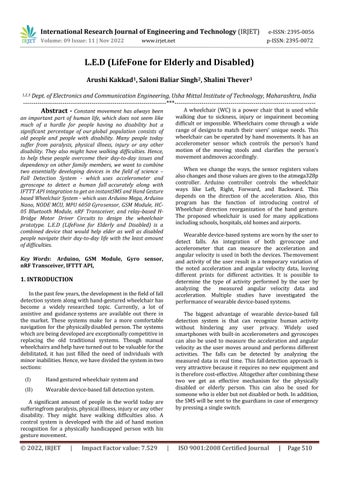
Fig-1: Architecturallayerdiagramofthesystem
Intheabovediagramweareusingastructurethatcan bedivided into four layers, namely Local Communication Layer (LCL), Physiological Sensing Layer (PSL), User application Layer (UAL) and Information Processing Layer(IPL).HerethePSListhefundamentallayerwhich has different sensors which is used to collect physiological and ambient data from the human being monitored. LCL is the layer responsible for sending the signals to the above layers for further processing and analysis. This layer might have both wireless and wired methods of transmission, connected to cloud computing platforms or to local computing facilities. Local Communication Layer typically takes the form of one or more than one communication protocols, including wireless mediums such as ZigBee, Bluetooth, Wi-Fi, or even wiredconnections.IPLisa majorcomponentofthe system. It includes hardware as well as software components, such as micro-controller, to analyse and transferdata fromPSLtothe abovehigherlayers.UALis concerned with applications that assist users. For example, if a fall is detected in the IPL, a notification is initiallysenttotheuserandtheniftheuserconfirmsthe fall or does not answer back, an alarm is sent to the emergencycaregiverwhoisexpectedtotakeappropriate actions.
3.2 Hand-Gesture Controlled Wheelchair
In this designthe wheelchair is divided intotwo major sections,oneisthewheelchairandtheotheristhecontrol section for gesture control. For hand acceleration in three perpendicular directions a MEMS accelerometer is detectedandistransmittedtoaPCviaBluetooth.Thedata
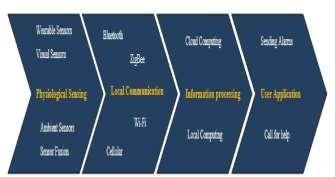
Fig-2: Blockdiagramofthereceiver
It requires both hands to reorganize the hand movement. Individuals needto be able totrack thechair inlimitedspace,asthissetupusesIRsensorsthatarealso useful for object avoidance. In addition, the SMS will be senttotheguardians.
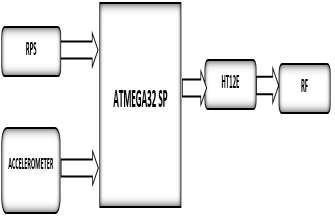
The block diagram is depicted in fig 2. Arduino (ATMEGA328P), LCD display, accelerometer, transceiver are the major components of this system. The actual control sectionis depicted in fig.3 where the RPS and accelerometer are connected to the Arduino itself.
Proposed work uses Atmega3289, Lcd, Sensor, L293d, Hti2d,RegulatedPowerSupply,Ht12e,Accelometer.
International Research Journal of Engineering and Technology (IRJET) e-ISSN:2395-0056
Volume: 09 Issue: 11 | Nov 2022 www.irjet.net p-ISSN:2395-0072
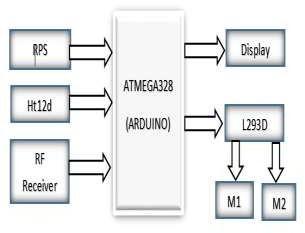
Fig. 5 depicts the flowchart of the transmitter. It first checks the motion of the accelerator upon which will be giventotheencoderforprocessingthissignal.
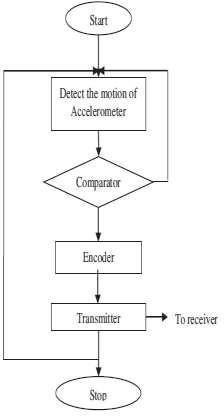
Then it is given from the transmitter to the receiver sectiondepictedinfig6.Whichtakestheanaloginputand process that tothe decoder and microcontroller and the motor drivers. Depending on the accelerometer signal motorwillmovetowardsleft/rightorforward/backward.
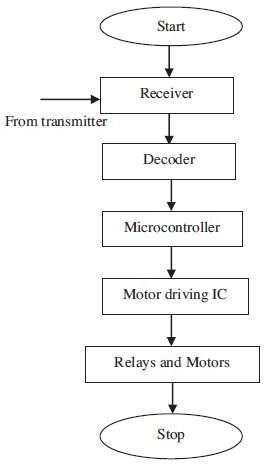
Fig-3: Blockdiagramofcontrolsystem
ThishandgesturecontrolledwheelchairusesanADXL335 accelerometerasadetectorwhichcanprovideananalogue signal on pushing the wheelchair in the X, Y orientation respectively. To transform this analogue signal into a digital signal an operation amplifier LM324 is used as a comparator.
A radio frequency transmitter is used for wireless signal transmission.Thedataisencodedbeforesendingto avoid issues from different computers. This will also eliminateinterferenceandundesirablenoise.Thedetector now sends the message and is then interpreted by the controller so that the signal is decoded further by sending thereceivertoArduinoUnofordata.
The wheelchair will move when the signal is received and the L293D gives the relay signal. A simple wheelchair control scheme based on the user's right arm's understanding of hand movements is developed. The controller puts his right hand in his/ her hand motion circuit to operate in gesture recognition mode. As per directionstheuserperformsthegesture.Thewheelchairis powered by electric motors during gesture recognition mode.
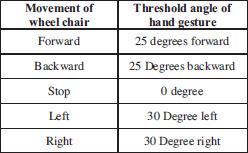
When the arm is in a neutral position the motor does not functionand the wheelchair is in a halted position. By shifting their hand from the relaxed position the user provides the direction for the wheelchair to move. Extending the hand beyond the neutral position causes wheelchair motion, while trying to bend the arm closer to thebodycausesthebendbackwards.Thismakesiteasyto control the direction of the wheelchair by changing the userhand’sposition.Oncethepersonaddshishandtothe stableposition,thewheelchairhalts.
Fig-5: Flowchartfortransmitterprocess
Fig-4: Anglesdetails
Fig-6: Flowchartforreceiverprocess
International Research Journal of Engineering and Technology (IRJET) e-ISSN:2395-0056
Volume: 09 Issue: 11 | Nov 2022 www.irjet.net p-ISSN:2395-0072
3. CONCLUSIONS
This project involves the accomplishment of the task using a fall detection and hand gestured wheelchair. Exchange of frame between accelerometer and gyroscope andhandmovementsensors enablesthedevicetoexecute thegiventask.
In this paper, we have seen that with increasing development in technology, the complexities and constraints based on applicationsare also increasing. The developed system is capable of controlling the wheelchair motion for disabled people using hand gestures and detectingfallssuccessfully.Byusingvariousbodygestures such as eye gaze, leg movement or head movement accordinglywecanmakealotofimprovements.
The switching operation for the mode selection that is either touch pad or accelerometer is separated by using a switch.Thisaddsuptotheefficiencyofthewheelchairand reduces the cost and size of the entire system. The proposed L.E.D can be used in many applications such as hospitals, old age homes andairports etc. In future, voice monitoring helps the disabled person to determine the obstacle by acknowledging with alarm signals with slight modification in power section by monitoringthe battery voltage levels toenhance the speed andestimatethedelay for action to be taken to enhance the speed of the wheelchairdcmotorscanbereplacedbyservomotors.
ACKNOWLEDGEMENT
Foremost, we would like to express our sincere gratitude to Professor Dr Nema Shikha, Head of Department (Electronics) and our guide and also Mrs. Arundhati Mehendale for their valuable guidance and continuous support through her patience, motivation, enthusiasm, and immense knowledge. We would also like to thank all the teaching and non-teaching staff for their valuablesupport.Lastbutnotleastwewouldliketothank ourparentsandfriends.
REFERENCES
[1] W. Saadeh, S. A. Butt and M. A. B. Altaf, ”A PatientSpecificSingle Sensor IoT-Based Wearable Fall Prediction and Detection System,” in IEEE Transactions on Neural Systems and Rehabilitation Engineering,vol.27,no.5, pp. 995-1003,May2019.
[2] L.Rachakonda,S.P.MohantyandE.Kougianos,,”GoodEye:A Device for Automatic Prediction and Detection of Elderly Fallsin Smart Homes,” 2020 IEEE International Symposium on SmartElectronic Systems (iSES) (Formerly iNiS),2020.

[3] M. Bundele, H. Sharma, M. Gupta and P. S. Sisodia, 3. M. Bundele, H. Sharma, M. Gupta and P. S. Sisodia, ”An ElderlyFallDetection System using Depth Images,” 2020 5th IEEE International Conference on Recent Advances andInnovationsinEngineering(ICRAIE),,2020.

[4] S. M. Riazul Islam, Daehan Kwak, MD. Humayun Kabir, Mahmud Hossain “The Internet of Things for Health Care: A Comprehensive Survey”, IEEE Access (Volume:3),,2015.
[5] Ali Chelli, Member, IEEE, and Matthias Patzold, “A MachineLearning Approach for Fall Detection and Daily Living Activity Recognition”, Vol 7 Journal Article IEEE,, 2019.
[6] Mingmin Zhao, Tianhong Li Mohammad, Abu Alsheikh,Yonglong Tian, Hang Zhao, Antonio Torralba, Dina Katabi, “Through-Wall Human Pose Estimation UsingRadioSignals”,IEEE/CVFConferenceonComputer VisionandPatternRecognition,,2018.
[7] A.TayabNoman,M.S.Khan,M.EmdadulIslamandH. Rashid, ”A New Design Approach for Gesture Controlled Smart Wheelchair Utilizing Microcontroller,”2018 International Conference on Innovations in Science, EngineeringandTechnology(ICISET),2018.
[8] Mufrath Mahmood, Md. Fahim Rizwan, ”Design of a low-cost Hand Gesture Controlled Automated Wheelchair”,IEEE,,2020.

[9] P. Upender Department of ECE Vignan Institute of Technology and Science,”A Hand Gesture Based Wheelchair for Physically Handicapped Person with Emergency Alert System”,2020 5th International Conference on Recent Trends on Electronics, Information, Communication Technology (RTEICT2020), November12th13th2020.
BIOGRAPHIES
Author1

Author2 Author3