
N.K.SaneandJ.G.Kulkarniet.al[1]:Thestudyinvestigatedthefreeconvectionheattransferofverticaltaperedfin arrays.Itwasperformedbyvaryingthefinspacingandthebaseareaofthearrays.The resultsindicatedthatdownward tendedfinsaremoreeffectivethanupward tendedfinsinachievingthesamefreeconvectionheattransfer.Baskayaetal. [2]:Variousgeometricalfactorssuchasheight,width,andfinspacingwereexaminedtostudythenaturalconvectionheat transfer using horizontal fin arrays. The results indicated that the varying heights and lengths of the fin can affect the overallheattransferfromthearrays.Edlabadkaret.al.[3]:AnexperimentonasingleV typepartitionplatewasperformed toinvestigatetheairflowoverabaseplatewithvaryinganglesinairasanambience.TheVshapefinwasattachedtothe plate.Thecomputational fluiddynamicssimulations were performed to determine theoptimal configurationsfortheair flow. The study revealed that the 90° V partition plate provides the smallest struggle to flow departure than the other partitionplates.Inthedownstreamzone,italsoprovidesthemostefficienthighheattransmissionarea. V.WankarandS. Taji et al. [4]: Under natural convection, flow patterns on rectangular fin arrays were investigated and tested experimentally.Thepurposeoftheexperimentistoinvestigatetheeffectsofnaturalconvectiononarectangularfinarray. Lampblackcoatingisusedtoaccomplishthis.Sableetal.[5]:MultipleV typepartitionplatesadjacenttoaverticalheated plateareusedintheauthors'proposedheattransferaugmentationtechnique.Thekeycomponentsthatcontributetothe heatedplate'sthermalconductivityareverticalfinsthatactasflowtabulatorsandexpandedsurfacepartitionplates.
II. LITERATURE REVIEW
INTRODUCTION
III. EXPERIMENTAL SETUP
Thesystemisdesignedandmanufacturedforthemeasurementofheattransferparametersforwhichthedetails are as follows: Aluminium is used to manufacture plain base plate and fin patterns for experimentation work. The aluminiumbaseplateusedforresearchworkhavingthedimensionsas200mmX200mmX20mm. Thetotalsurfacearea
International Research Journal of Engineering and Technology (IRJET) e-ISSN: 2395-0056 Volume: 09 Issue: 01 | Jan 2022 www.irjet.net p-ISSN: 2395-0072 © 2022, IRJET | Impact Factor value: 7.529 | ISO 9001:2008 Certified Journal | Page818 “Comparative Study of Performance of Rectangular Fins and V Fins on a Vertical Base Plate under Free Convection Heat Transfer” Suman B. Surve1 , Prof. U. S. Patil2 1M Tech Student, Department of Chemical Engineering, Padmabhooshan Vasantraodada Patil Institute of Technology Budhgaon, Sangli; Maharashtra; 2Associate Professor, Department of Chemical Engineering, Padmabhooshan Vasantraodada Patil Institute of Technology Budhgaon, Sangli; Maharashtra. *** Abstract : Naturalconvectionheattransferisgenerallyenhancedbyprovisionofvariousshapesoffinssuchasrectangularfins,pinfins, perforatedfinsorVshapefinsetc.Inthiswork,theexperimentsareperformedtodeterminethevariousheattransferparametersusing rectangularfinsandVfins.Fromexperimentalobservations,variousparametersarecalculatedandgraphsareplottedbetweenvarious parameterssuchasaverageheattransfercoefficient,baseheattransfercoefficientandNusseltnumberversusheatinput.Theresults revealedthattheVshapefinsproducedabetterperformancethantherectangularshapefinsThecalculationofthebasecoefficientofheat transferiscarriedouttowardsestablishmentoftheidealtemperaturerangeforthebasematerial. Keywords “Heattransferenhancement,naturalconvection,rectangularfins,Vfins". I.
Advanced technologies are needed to improve performance in heat transfer equipment. Methods used for enhancingtheheattransferrateareclassifiedasactive andpassivemethods. Inthedesignpointofview,activemethods aresometimescomplexandcostlybecausetheyrequiresomeexternalpowerinputfornecessaryflowadjustmentsandto improve the heat transfer rate and thus applications are limited. On the other hand, passive methods require some geometrical or surface adjustments to the flow passage by adding additional devices. The amount of conduction, convection, and radiation of an object shows the amount of heat it transfers.“The heat transfer rate is enhanced by increasing the temperature difference between the object and the environment or by enhancing the coefficient of convectiveheattransferorbymaximizingthesurfaceareaofthebody.Insomecases,itisnotappropriateorcosteffective toalterthefirsttwo Introducingoptions.afintoa body,however,expandsthesurfaceareaandsometimesthis isacosteffectivesolutionfor heat transfer problems. Extended surfaces or fins are examples of passive methods that are generally used in different industrial applicationsfortheenhancement ofheattransferbetweentheprimary surfaceand thesurroundingfluid.The easiestandcheapestwaystodissipateunwantedheatistackledbytheuseoffins.”Rectangularfinsarethemostpopular type of fins because of their low production costs and high effectiveness. Natural convection heat transfer is augmented usually by provision of rectangular fins on horizontal or vertical surfaces. As a result, energy saving and cost effective solutioncanbeachievedbytheuseofVshapefinsalso.[1 2]

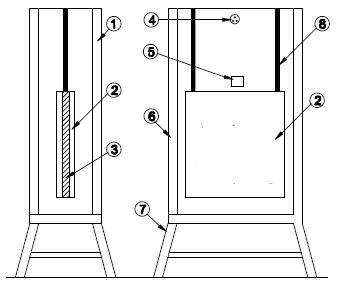
International Research Journal of Engineering and Technology (IRJET) e-ISSN: 2395-0056 Volume: 09 Issue: 01 | Jan 2022 www.irjet.net p-ISSN: 2395-0072 © 2022, IRJET | Impact Factor value: 7.529 | ISO 9001:2008 Certified Journal | Page819 ofrectangularfinsand thetotal surfacearea ofV fins is keptequal.Finsoftwodifferent patternsareutilizedtoconduct experimentswhichareasfollows; 1]Rectangularfinpattern 2]Vtypefinpattern Fig.No.1: SchematiclayoutofExperimentalSystem 1) Enclosure2)HeatedPlate,3)Heater,4)HeaterSocket5)ThermocoupleSocket 6)AcrylicSheet,7)Stand,8)Hanger IV. EXPERIMENTATION The wholesystemiskeptundernatural convectionconditionsand All measurementswere takeninsteadystate Incircumstancesthepresentdissertationwork,followingdifferentconfigurationsaretested: 1)PlainVerticalPlate 2)VerticalPlatewithVerticalfins 3) VerticalPlatewithHorizontalfins 4)VerticalPlatewithV fins(Apexdownwards) 5)VerticalPlatewithV fins(Apexupwards) 6)VerticalPlatewithV fins(ApexonLeftHandSide) 7)VerticalPlatewithV fins(ApexonRightHandSide) Byvaryingheaterinputsthroughdimmerstatatregularintervaloftime,wattmeterreadingswererecordedasQ watt. The temperatures of base plate surface, ambient temperature (Tamb) and fins were recorded using digital temperature indicator. The experimental results were obtained for different heater inputs as 50, 75, 100, 125, 150, 175 and200watts. V. RESULTS AND DISCUSSIONS Fromexperimentalobservations,variousparameterssuchas“averagecoefficientofheattransfer,Basecoefficient of heat transfer, Nusselt number, Grashoff number, Prandtl number, and Rayleigh number were calculated. All the fluid propertiesarecalculatedatmeanfilmtemperatureandaretakenfromstandardtables.Thegraphsareplottedtoshowthe differenttrends. Thebelowmentionedaretheresultsobservedafterexperimentation
International Research Journal of Engineering and Technology (IRJET) e-ISSN: 2395-0056 Volume: 09 Issue: 01 | Jan 2022 www.irjet.net p-ISSN: 2395-0072 © 2022, IRJET | Impact Factor value: 7.529 | ISO 9001:2008 Certified Journal | Page820 No.Sr. (W)InputHeater Average heat transfer coefficient h W/m2 K PlateVerticalPlain FinsVerticalplateVerticalwith Vertical plate FinsHorizontalwith V DownwardsApexwithFins V-Fins UpwardsApex (ApexV-Fins on L.H.S.) V-Fins Apex on R.H.S. 1 50 8.66 8.97 8.78 9.64 9.56 8.63 9.07 2 75 8.70 9.23 9.18 9.68 9.97 8.76 9.14 3 100 8.72 9.37 9.36 10.30 10.15 9.04 9.45 4 125 8.76 9.54 9.50 10.65 10.36 9.65 9.99 5 150 8.81 9.68 9.62 10.67 10.59 9.77 10.17 6 175 8.82 9.86 9.79 10.92 10.76 10.19 10.39 7 200 8.85 9.98 9.90 11.34 10.80 10.48 10.69 Graph 1 Variation of Heater Input vs Average Heat Transfer Coefficient (CombinedGraphforallDifferentConfigurations) Graph no 1. Shows the combined graph of variation of average heat transfer coefficient with heater input. The average heattransfercoefficientforV finswithapexdownwardrangesfrom9.64to11.34W/m2 K. Itisfoundfromthedatathat V fins with apex downward arrangement have the highest value of the heat transfer coefficient, and thereby has more betterperformanceincomparisonwiththeotherconfigurations. No.Sr. (W)InputHeater Base heat transfer coefficient hb W/m2 K PlateVerticalPlain FinsVerticalplateVerticalwith Vertical plate FinsHorizontalwith V Fins with DownwardsApex V Fins UpwardsApex V (ApexFins on L.H.S.) V Fins Apex on R.H.S. 1 50 8.66 13.89 13.59 14.93 14.80 13.36 14.05 2 75 8.70 14.29 14.21 14.99 15.43 13.57 14.15 3 100 8.72 14.51 14.49 15.95 15.72 14.00 14.59 4 125 8.76 14.77 14.71 16.49 16.04 14.95 15.47 5 150 8.81 14.98 14.91 16.46 16.41 15.14 15.74 6 175 8.82 15.26 15.16 16.72 16.67 15.78 16.10 7 200 8.85 15.46 15.33 17.40 16.73 16.24 16.55
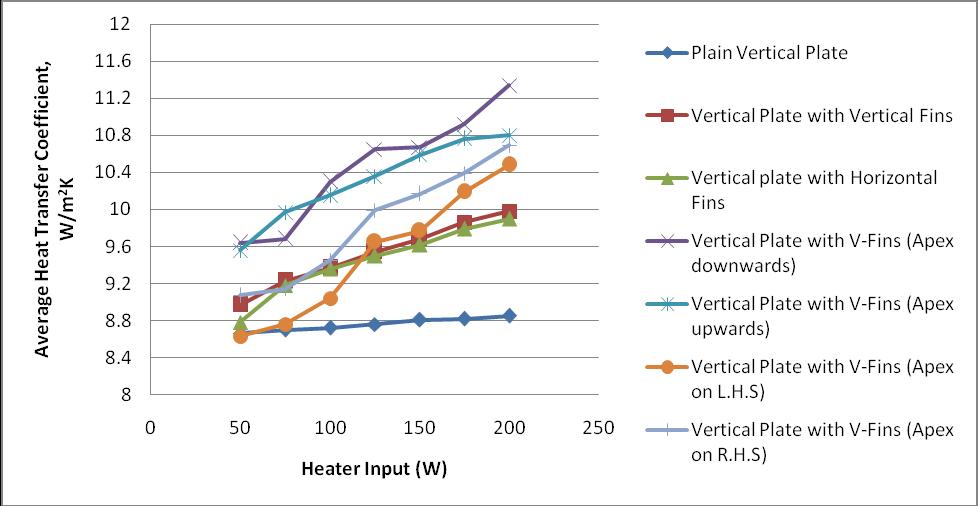
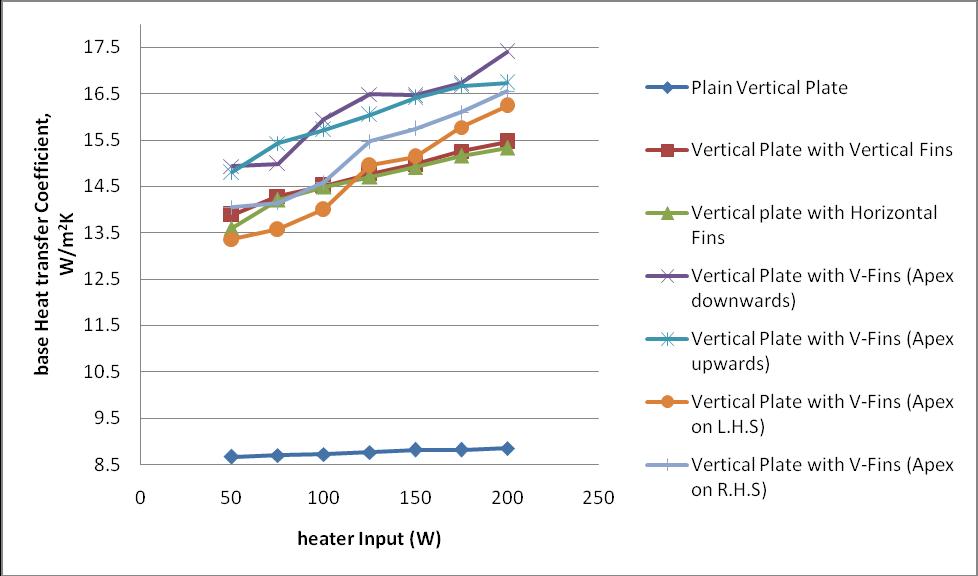
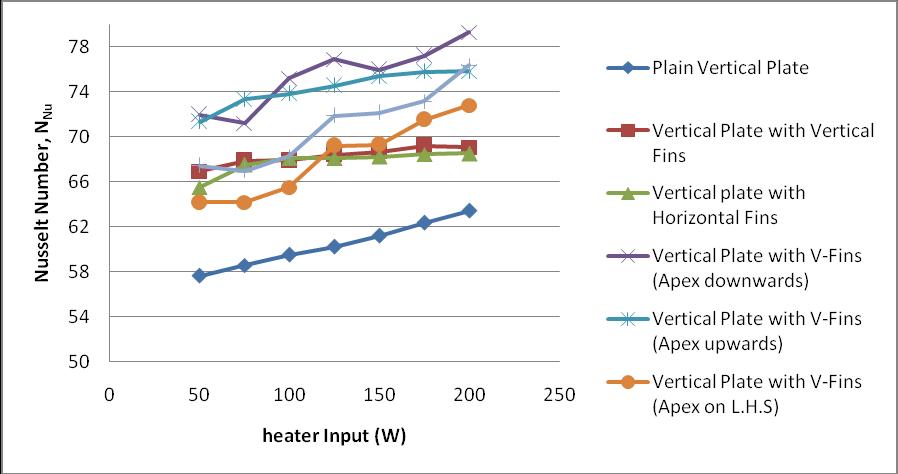
International Research Journal of Engineering and Technology (IRJET) e-ISSN: 2395-0056 Volume: 09 Issue: 01 | Jan 2022 www.irjet.net p-ISSN: 2395-0072 © 2022, IRJET | Impact Factor value: 7.529 | ISO 9001:2008 Certified Journal | Page821 Graph 2 Variation of Heater Input vs Base Heat Transfer Coefficient (CombinedGraphforallDifferentConfigurations) Forallsetups,graphno.2showsthecombinedgraphoffluctuationofbaseheattransfercoefficientwithheaterinput. For“V finswiththeapexdownwards”,thebasalheattransfercoefficientrangesfrom14.93to17.40W/m2K.According to the findings, the base coefficient of heat transfers for “V fins with apex downwards” arrangement is higher than the otherdesigns. No.Sr. (W)InputHeater Nusselt No. NNu PlateVerticalPlain FinsVerticalplateVerticalwith Vertical plate FinsHorizontalwith V Fins with DownwardsApex V Fins Apex Upwards V (ApexFins on L.H.S.) V R.H.S.ApexFinson 1 50 57.65 66.94 65.52 71.94 71.34 64.16 67.43 2 75 58.6 67.87 67.50 71.18 73.31 64.18 66.96 3 100 59.53 67.89 68.07 75.18 73.82 65.51 68.26 4 125 60.21 68.39 68.10 76.89 74.53 69.18 71.87 5 150 61.19 68.65 68.23 75.94 75.37 69.29 72.13 6 175 62.37 69.19 68.46 77.17 75.77 71.51 73.17 7 200 63.44 69.07 68.51 79.30 75.80 72.78 76.36 Graph 3. Variation of NNu with Heater Input (Combined Graph for all Different Configurations) TheNusseltnumberforV finswithapexdownwardsrangesfrom71.94to 79.30,which ishigherthantheother configurations.
12]Toshiyuki Misumi and Kenzo Kitamura: ‘Natural Convection Heat Transfer from a Vertical Heated Plate with a HorizontalPartitionPlate’;JapaneseResearch,Vol.19,No.1,1990
13]ToshiyukiMisumiandKenzoKitamura:‘HeatTransferEnhancementofNaturalConvectionandDevelopmentofaHigh PerformanceHeatTransferPlate’;JSMEInternationalJournal,SeriesB,Vol.36,No.1,1993.
14]StarnerK.E.andMcmanusH.N.:‘AnExperimentalInvestigationofFreeConvectionHeatTransferfromRectangularFin Arrays’;JournalofHeatTransfer,TransASME,SeriesC,851983.
15]N.K.Sane and J.G.Kulkarni: ‘Free Convection Heat Transfer from Vertical Tapered Fin Arrays’; 7th National Heat and MassTransferConference,Kharagpur,Dec28 30,1983.
16] Wankhede et.al.: ‘Experimental Investigation of Heat Transfer from Inverted Notch Fin Arrays (INFA) Under Natural and Forced Convections’; IOSR Journal of Mechanical and Civil Engineering (IOSR JMCE) ISSN: 2278 1684, pp: 14 22,2008.
International Research Journal of Engineering and Technology (IRJET) e-ISSN: 2395-0056 Volume: 09 Issue: 01 | Jan 2022 www.irjet.net p-ISSN: 2395-0072 © 2022, IRJET | Impact Factor value: 7.529 | ISO 9001:2008 Certified Journal | Page822 VI. CONCLUSION When compared to other configurations, the average heat transfer coefficient value for V Fins with apex downwards is larger. V Fins showed 20% improvement in average heat transfer coefficient when compared to Plain VerticalPlate.WhenV FinswerecomparedwithverticalplatewithverticalFins,Vfinsshowed10.33%improvement. For V FinswithApexfacingDownwardsconfiguration,thebaseheattransfercoefficientisintherangeof14.93 17.40W/m2 K.TheNusseltnumbervalueforV FinswithApexfacingdownwardsconfigurationisintherange71.94to79.30,whichis thehighestascomparedtootherconfigurations. Results from the present theoretical analysis clearly show that the V Fins arrangement has good heat transfer performancethanallotherconfigurationsbecauseitdisturbstheflowandduetothistheflowofheatbecomesturbulent, therebyincreasingtheheattransferrate. REFERENCES 1] Baskaya, S, Sivrioglu, M, and Ozek, M: ‘Parametric Study of Natural Convection Heat Transfer from Horizontal RectangularFinArrays,’;InternationalJournalofThermalSciences,39,pp.797 805,2000. 2] Sable, S. J. Jagtap, P. S. Patil , P. R. Baviskar, and S.B. Barve: ‘Enhancement of Natural Convection Heat Transfer on VerticalHeatedPlatebyMultipleV FinArray’;IJRRAS,5(2),November,2010 3] Geankoplis, Christie John (2003). Transport Processes and Separation Principles (4th Ed.). Prentice Hall. ISBN 0 13 101367 X 4]YunusA.Cengel,“HeatTransferAPracticalApproach”Secondedition 5] Mahesh Jadhav , Rahul Awari , Diksha Bibe , Amol Bramhane, and Mayura Mokashi “Review on Enhancement of Heat Transfer by Active Method” International Journal of Current Engineering and Technology E ISSN 2277 4106, P ISSN 2347 5161 6]K.M.Stone(August1996),“ReviewofLiteratureonHeatTransferEnhancementinCompactHeatExchangers”,Vol38, pp.1 2. 7]Prof.MinZeng(2005),TechniquesofHeat Transfer EnhancementsandTheirApplications,principal of enhancedheat transfer,Vol2,pp.26 30. 8]M.Bahrami“NaturalConvection”ENSC388(F09) 9]Mr.TejasSonawane,Mr.PrafullaPatil,Mr.AbhayChavhan,Prof.B.M.Dusane“AReviewOn HeatTransferEnhancement By Passive Methods” International Research Journal of Engineering and Technology (IRJET) Volume: 03 Issue: 09 | Sep 2016 10] NPTEL, IIT Kharagpur, Prof. Saikat Chakraborty, Department of Chemical Engineering “Comparative Study of PerformanceofRectangularFinsandVFinsonaVerticalBasePlateunderFreeConvectionHeatTransfer” 11]S.A.Wani,A.P.Shrotri,A.R.Dandekar,“ExperimentalComparisonofNaturalConvectionHeatTransferfromaBlackened V FinArray”,InternationalJournalofModernStudiesinMechanicalEngineering(IJMSME)Volume4,Issue1,2018,PP11 16ISSN2454 9711