International Research Journal of Engineering and Technology (IRJET) Volume: 09 Issue: 11 | Nov 2022
www.irjet.net
e-ISSN: 2395-0056 p-ISSN: 2395-0072
Risk Management Methodologies in Construction Industries Mohammed Danish Hasnain Graduate, Department of Civil Engineering, Jamia Millia Islamia, New Delhi, India ---------------------------------------------------------------------***-------------------------------------------------------------------
Abstract: Modern construction projects are getting
use the risk management method that is outlined in this paper.
more and more complicated, which increases unpredictability throughout the entire process. Most project stakeholders do not consistently implement the risk management procedure in building projects. Construction projects are the most prevalent environment in which some "rules of thumb" based on the knowledge and judgement of stakeholders are applied. Unfortunately, it is considered that risk management in construction projects is no more than insurance management, with the goal of locating the best insurance coverage for insurable hazards. Risk management encompasses far more than just "insurances," as we will see in this research paper.
Keywords:
Construction projects, Stakeholders, Building projects, Risk Management, Insurance Management.
1. INTRODUCTION The basis of any company or organisation is risk management, and the construction sector and its businesses are no exception. No matter the size, type of organisation, or industry, this is essential. Failure to recognise and assess risk in a timely manner can result in significant financial losses for construction companies. If risks are not identified in a timely manner, businesses may even miss out on the chance to take advantage of opportunities that may arise during their operations. Therefore, preventing, or minimising losses is just as important as looking forward to spot potential new chances. The advantages of systematic risk identification and management include:
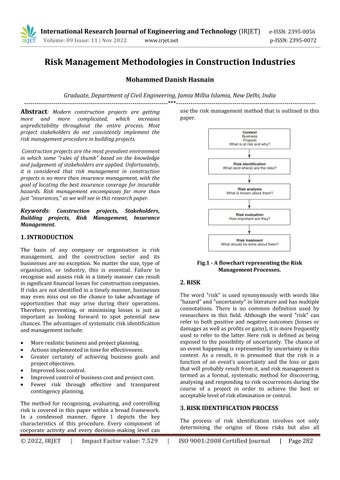
Fig.1 - A flowchart representing the Risk Management Processes.
2. RISK The word "risk" is used synonymously with words like "hazard" and "uncertainty" in literature and has multiple connotations. There is no common definition used by researchers in this field. Although the word "risk" can refer to both positive and negative outcomes (losses or damages as well as profits or gains), it is more frequently used to refer to the latter. Here risk is defined as being exposed to the possibility of uncertainty. The chance of an event happening is represented by uncertainty in this context. As a result, it is presumed that the risk is a function of an event's uncertainty and the loss or gain that will probably result from it, and risk management is termed as a formal, systematic method for discovering, analysing and responding to risk occurrences during the course of a project in order to achieve the best or acceptable level of risk elimination or control.
More realistic business and project planning. Actions implemented in time for effectiveness. Greater certainty of achieving business goals and project objectives. Improved loss control. Improved control of business cost and project cost. Fewer risk through effective and transparent contingency planning.
The method for recognising, evaluating, and controlling risk is covered in this paper within a broad framework. In a condensed manner, figure 1 depicts the key characteristics of this procedure. Every component of corporate activity and every decision-making level can
© 2022, IRJET
|
Impact Factor value: 7.529
3. RISK IDENTIFICATION PROCESS The process of risk identification involves not only determining the origins of those risks but also all
|
ISO 9001:2008 Certified Journal
|
Page 282