International Research Journal of Engineering and Technology (IRJET) Volume: 09 Issue: 11 | Nov 2022
www.irjet.net
e-ISSN: 2395-0056 p-ISSN: 2395-0072
Effect of Biodiesel Blend on a Zirconium Nano-Coated Diesel Engine 1K.
Leela Dhanush Naidu, 2Dr.S.Ganesan
1Student,
Dept. Of Mechanical Engineering, Sathyabama Institute Of Science and Technology, Chennai, India of Mechanical Engineering, Sathyabama Institute Of Science and Technology, Chennai, India ---------------------------------------------------------------------***--------------------------------------------------------------------150 m-thick Mg-coated piston and a 50 m-thick NiCrAlY[3]. Abstract - All living things are adversely affected by 2Department
Following the experimental results, the BTE was predicted to have increased, whereas CO2, NOx & UHC were all predicted to have decreased. CO2, CO, and UHC emissions over the diesel baseline [4-6].
pollution, which is a worldwide issue. Minimizing auto emissions is crucial since it pollutes the atmosphere. Several studies found several approaches to lessen pollution. In this study, clean diesel engines without any biodiesel blend are contrasted with diesel engines that have biodiesel percentages of 20%, 40%, and 60%. The engine features 24 degrees before TDC injection timing and 220 bar designed pressure. A 500 mm thick piston head is used. Zirconium oxide serves as the foundation layer for constant-speed diesel engines. We measured the emissions from on-road diesel engines. SFC and NOx levels are affected under all load conditions. When contrasted with other blend fuel proportions, the test engine with B60 had the highest CO emission. Due to its lower viscosity and higher heating, clean diesel fuel reduces CO.
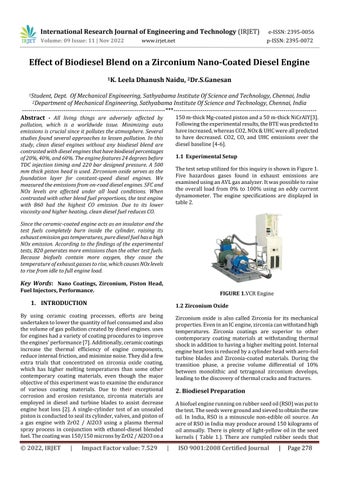
1.1 Experimental Setup The test setup utilized for this inquiry is shown in Figure 1. Five hazardous gases found in exhaust emissions are examined using an AVL gas analyzer. It was possible to raise the overall load from 0% to 100% using an eddy current dynamometer. The engine specifications are displayed in table 2.
Since the ceramic-coated engine acts as an insulator and the test fuels completely burn inside the cylinder, raising its exhaust emission gas temperatures, pure diesel fuel has a high NOx emission. According to the findings of the experimental tests, B20 generates more emissions than the other test fuels. Because biofuels contain more oxygen, they cause the temperature of exhaust gasses to rise, which causes NOx levels to rise from idle to full engine load.
Key Words: Nano Coatings, Zirconium, Piston Head, Fuel Injectors, Performance.
FIGURE 1.VCR Engine
1. INTRODUCTION
1.2 Zirconium Oxide
By using ceramic coating processes, efforts are being undertaken to lower the quantity of fuel consumed and also the volume of gas pollution created by diesel engines. uses for engines had a variety of coating procedures to improve the engines' performance [7]. Additionally, ceramic coatings increase the thermal efficiency of engine components, reduce internal friction, and minimize noise. They did a few extra trials that concentrated on zirconia oxide coating, which has higher melting temperatures than some other contemporary coating materials, even though the major objective of this experiment was to examine the endurance of various coating materials. Due to their exceptional corrosion and erosion resistance, zirconia materials are employed in diesel and turbine blades to assist decrease engine heat loss [2]. A single-cylinder test of an unsealed piston is conducted to seal its cylinder, valves, and piston of a gas engine with ZrO2 / Al2O3 using a plasma thermal spray process in conjunction with ethanol-diesel blended fuel. The coating was 150/150 microns by ZrO2 / Al2O3 on a
© 2022, IRJET
|
Impact Factor value: 7.529
Zirconium oxide is also called Zirconia for its mechanical properties. Even in an IC engine, zirconia can withstand high temperatures. Zirconia coatings are superior to other contemporary coating materials at withstanding thermal shock in addition to having a higher melting point. Internal engine heat loss is reduced by a cylinder head with aero-foil turbine blades and Zirconia-coated materials. During the transition phase, a precise volume differential of 10% between monolithic and tetragonal zirconium develops, leading to the discovery of thermal cracks and fractures.
2. Biodiesel Preparation A biofuel engine running on rubber seed oil (RSO) was put to the test. The seeds were ground and sieved to obtain the raw oil. In India, RSO is a minuscule non-edible oil source. An acre of RSO in India may produce around 150 kilograms of oil annually. There is plenty of light-yellow oil in the seed kernels ( Table 1.). There are rumpled rubber seeds that
|
ISO 9001:2008 Certified Journal
|
Page 278