International Research Journal
of Engineering and
Technology (IRJET) e-ISSN:2395-0056

Volume: 09 Issue: 11 | Nov 2022 www.irjet.net p-ISSN:2395-0072
International Research Journal
Technology (IRJET) e-ISSN:2395-0056
Volume: 09 Issue: 11 | Nov 2022 www.irjet.net p-ISSN:2395-0072
1Dept. of Computer and Information Systems, University of the Cumberlands, Williamsburg, KY USA 2Dept. of Computer and Information Systems, Lewis University, Romeoville, IL USA 3Dept. Of Computer and Information Systems, Lewis University, Romeoville, IL USA ***
Data analytics continuous to drive positive change by enhancing internal operations and external relationships betweenorganizationsandcommunities.Dataanalyticsistheuseofscientificandmathematicaltechniquestoderivemeaning fromfactualinformationthusgainbetterinsights.Patientcareencompassesthehealthcareservicesthatarerenderedforthe benefit of patients. It is important to note that patient care systems around the world have focused on improving the health and experience of the individual by leveraging various inputs such as modern technology. This study sought to conduct a systematicreviewtheapplicationofdataanalyticstowardsimprovingpatientcare.
The specific objectives were to investigate the concept of data analytics and its applications, understand the applicationofdataanalyticsinhealthcare,determinetheimplicationsofdataanalyticsinimprovingpatientcare,andestablish the challenges and opportunities of data analytics towards enhancing patient care. The study employed a number of theoretical frameworks as foundation for understanding the relationship between data analytics and patient care. These theories were the Magical Thinking Theory, the Lightweight Theory, and the Classical Mathematics Theory. The study employedsystematicreviewsthatcollatetheoutcomesofresearchstudiesthusobtainacollectiveestimateoftheintervention effect.
Theeligibilitycriteriafortheresearchstudiesincludethestudypopulation,time,typeofintervention,studyvariables, qualityoftheresearchmethodologyandlinguisticandculturalrange. Thefindingsfromthesystematicreview werethatdata analyticshadasignificantimpactonthehealthcaresectorespeciallywhenitcomesimprovingpatientcare.Thestudyrejected the null hypothesis and thus accepted the alternative hypothesis that stated the importance of data analytics in improving patientcare.
Keywords:DataAnalytics,PatientHealth,Prisma,DataCleaning,InterpretationofData,DigitalHealth.
Dataanalyticsisregardedasatechnologicalrevolutionthatcontinuoustodrivepositivechangeacross organizations by enhancing both internal operations and external relationships with individuals and communities. Data can be defined as informationintermsofstatisticsormeasurementsthatcanbeusedasabasisandfoundationsforcalculations,reasoningand discussion (Shekarian, Ramirez, & Khuntia, 2020) There are two types of data that include qualitative data that is usually expressedinanarrativeorverbalformandquantitativedatathatispresentedinnumericalform. Dataanalyticsreferstothe utilizationofvariousscientificandmathematicalmethodstoderivemeaningfromfactualinformationthusgainbetterinsights aboutobjects,people,processesororganizationalunits(IFAC,2018).Itisimportanttoincorporatedataanalyticsasitreduces costs, enables faster decision making and minimizes risks especially within healthcare. Below is an image illustrating the processofdataanalytics:
e-ISSN:2395-0056
Volume: 09 Issue: 11 | Nov 2022 www.irjet.net p-ISSN:2395-0072
Ontheotherhand,patientcarereferstotheservicesthatarerenderedbyhealthcareprofessionalsincludingdoctors, nurses, and management personnel for the benefit of patients (Yorke, 2017). The concept has been widely discussed in the fieldofhealthcareandresearchwiththeaimofhighlightingthemostappropriatedefinition.Insomeinstances, theprovision of patient-centered care has been fronted as a more elaborate explanation of services rendered to patients with the terminology describing patient care as the provision of health services that improves the health and experiences of the individual. Patient care systems around the world have focused on improving the health and experience of the individual by leveraging various inputs such as modern technology (Lewis, 2019) Therefore, it is important to understand the different technologies that can be applied in the field of healthcare thus improve patient care and thus achieve the most sought-after patientcenteredhealthcaresystem.
According to Shekarian, Ramirez and Khuntia (2020), data analytics as a process of transforming, managing, and modeling data towards deriving meaningful information plays a critical role in improving hospital performance. The study revealedthesparsenatureofevidencerelatedtotheinterplaybetweendataanalyticsandoperationsinhealthcare.However, theresearchsoughttoclose thegapbyevaluatingtheimpactofdata analyticsinhealthandclinical operations. Thefindings were that the relationship between data analytics and hospital performance tend to be highly complex hence the lack of similarevidence.AstudybyWangandAlexander(2019)revealedthatbigdataanalyticshasthepotentialtoimprovepatient outcomes while advancing and personalizing care. The research also highlighted the capability of data analyticsenhance the performanceofhealthcaresystemsbyimprovingrelationshipsbetweenhealthcareprovidersandpatientsaswellasreducing medicalspending.
Furthermore, Dash et al., (2019) investigated the conceptualization of big data in healthcare with regards to overall management,analysis,andthefuturepossibilities.Thestudysoughttounderstandtheimpactofbigdataanditsanalyticsin thefieldhealthandclinicalmedicinebyassessingtheroleplayedbytheconceptinbothhealthcareoperationsandresearch. The authors revealed that big data analytics leveraged the perceived gap that exists within structured and unstructured sourcesofdatathusenablingashifttotheproblematicintegrateddatasystemthataffectstheprovisionofqualityhealthcare. Gemson and Durga (2015) conducted a study to understand the background and techniques of big data analytics that have been applied in healthcare. The research reviewed the application of big data analytics in health systems as well as the platforms,algorithms,prosandconsofthetechnologicalconceptwhileprovidingadiscussionofthefutureareasofinterest.
International
(IRJET)
e-ISSN:2395-0056
Volume: 09 Issue: 11 | Nov 2022 www.irjet.net p-ISSN:2395-0072
The study comprised of both general and specific objectives. The general objective was to review the application of dataanalyticstowardsimprovingpatientcare. Thespecificobjectiveswere:
i. Toinvestigatetheconceptofdataanalyticsanditsapplications.
ii. Tounderstandtheapplicationofdataanalyticsinhealthcare.
iii. Todeterminetheimplicationsofdataanalyticsinimprovingpatientcare.
iv. Toestablishthechallengesandopportunitiesofdataanalyticstowardsenhancingpatientcare.
2.3. Thestudystatedbothanullandalternativehypothesisthatguidedtheimplantationofthesystematicreview.The hypothesisforthestudywere:
H0 –Thereisnosignificantimpactofdataanalyticstowardsimprovingpatientcare.
HI –Thereisasignificantimpactofdataanalyticstowardsimprovingpatientcare.
This section discussed the theoretical frameworks that provide the basis for understanding the link between data analytics and patient care. The study sought to review the application of data analytics towards improving patient care. The theories identified as a foundation for understanding the relationship between data analytics and patient care included the Magical Thinking Theory, the Lightweight Theory, and the Classical Mathematics Theory. The Magical Thinking Theory postulates that we are inclined towards seeking and interpreting connections between the events that take place around us alongwiththedisinclinationtoreviewourbeliefsfollowingdeeperobservation (Diaconis,2016) Thetheoreticalframework illustratesthatinsomeinstances,asinglemanifestationmaybebelievedtobeasignandthatagivenritualofferthemethod ortechniquetounderstanding.Therefore,theunderlyingbelieftendstopersistdespitetheexistenceoffactualcircumstance.
Secondly,theLightweightTheoryofdataanalyticsemphasizesonmakingpredictions basedontheconsolidationand acceptance of theoretical frameworks (Elragal & Klischewski , 2017). The theory is related to the domain of making predictionswherebigdata analytics deliverspredictionsthatrelyontheexecutionofsequentialdata processingtechniques. However, there are sentiments that propose the shift from a theory-driven prediction to a process-driven one that analyzes thestepswithintheutilizationofbigdata.Thetheoryoughttoguidetheanalysisofbigdatathroughacquisition,processing, analytics and finally the interpretation of the data (Rai, 2016). Therefore, the scientific theory provides a reliable school of thoughtintermsofhowtheinterrelationofthedatacanbedonethusofferexplanationandprediction.
Thirdly,theClassicalMathematicalTheoryofStatisticsoffersahighlydiverseapproachintermsofthedescriptionof whatshouldbedonewhenanalyzingorexaminingdata(Diaconis,2016).Thetheoryseekstoprovideaninterpretationofthe patterns as the number of chances fluctuate. We should note that the theoretical framework postulates the decision on the models and hypothesis that can be developed before interacting with the data. Therefore, classical statistics provides the much-needed antidote for computing estimates and conducting tests based on the scientists’ assumptions while solving the problems that may arise within the context of magical thinking. According to Kyburg (2014), the Classical Mathematical Theoryof StatisticsoffersvaluessuchastheP-valueandthe standard errorthatarecritical towards makinginterpretations thatarevalidandinteresting.
This section described the research design employed by the researcher to collect, analyze and interpret the informational data required to answer the study question. Since the study was a review, the researcher employed the systematic review which is defined as the research design that summarizes the outcomes or results of a number of primary studies (Ranganathan & Aggarwal, 2020). Systematic reviews utilize meta-analysis that is regarded as a statistical tool that
e-ISSN:2395-0056
Volume: 09 Issue: 11 | Nov 2022 www.irjet.net p-ISSN:2395-0072
mathematicallycollatestheoutcomesofdifferentresearchstudiesthusobtainacollectiveestimateoftheinterventioneffect. It is important to note that a systematic review entails methodologically and comprehensively synthesizing literature that is focused entirely on a well-formulated study question (Siddaway, Wood, & Hedges, 2019). The design usually aims at identifyingandsynthesizingtheavailablescholarlyresearchonthestudytopic,conductingunbiasedandreproductivesearch ofevidence,andinvolvesameta-analysis.
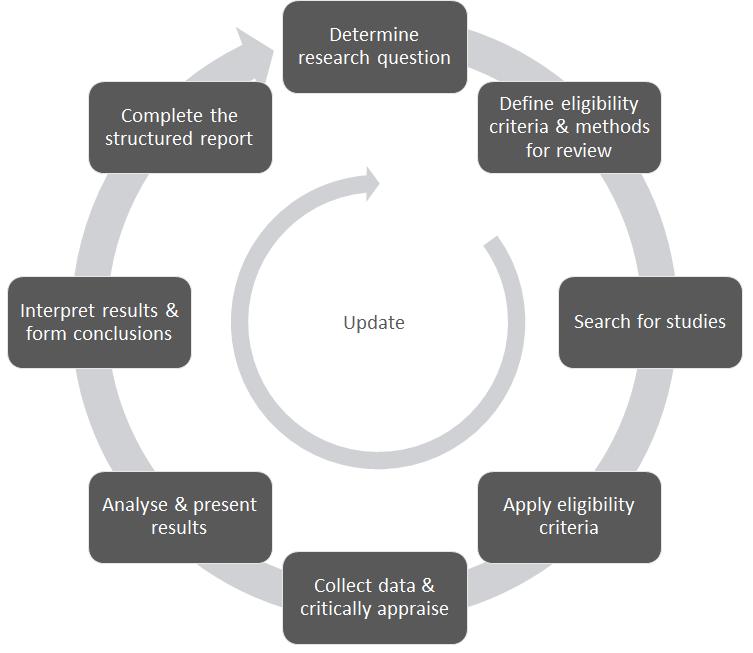
According to Hanley and Winter (2013), systematic reviews are research methods that involve critically appraising, summarizing, and reconciling evidence. The technique entails comprehensively reviewing literature in a methodological manner using a pre-selected protocol thus minimizing bias thus synthesizing the retrieved informational data. This research design is characterized by having clearly stated objectives along with pre-defined inclusion and exclusion criteria for the studies. Also, systematic reviews have a reproducible and explicit methodologies, identify studies that meet the eligibility criteria, Ansari (2022) assess the validity of the study findings, and present and synthesize the characteristics as well as findingsofthestudiesincludedinasystematicway(Ranganathan&Aggarwal,2020).
Furthermore,theuseofsystematicreviewsenabledtheresearchertolocatetherelevantpublishedandunpublished researchstudiesthataddressedtheresearchquestionswhileprovidingasystematicpresentationandsynthesisofthefindings and characteristics of included research studies. Livinski at al. (2015) agree that the rationale for conducting systematic reviews involves making informed decisions, planning for future research agendas, establishing policies, preventing unnecessary studies and enabling the conducting of comparative effectiveness studies. Therefore, it is important to note the underlying differences between a systematic review and a narrative review in terms of their respective aims, structures and modelsthatresultsindifferentoutcomeswithinanygivenstudy (Hanley&Winter,2013).Also,thereisareportingguidefor systematicreviewsthatincludesPreferredReportingItemsforSystematicReviewsandMeta-Analyses(PRISMA),andPRISMA +HealthEquityReporting(PRISMA-E).
The inclusion and exclusion criteria for the research studies to be included in the study was methodologically considered and developed. According to Meline (2016), searching for research studies across multiple databases requires a concreteeligibilitycriterion thatenhancestheidentification,locations,and retrievalofinformationaldata thataddressesthe research problem. This process specifies the studies that shall be included or excluded from the systematic review and is fundamental to the collectionof defensibleand rigorous data.Therefore, the researcherutilized an eligibility thatwasbased on the following categories: study population, time period, type of intervention, study variables, quality of the research methodologyandlinguisticandculturalrange(Patino&Ferreira,2018).Usingthetitlesandabstractsoftheselectedresearch studies,theresearcherwasabletoincludeandexcludestudiesthatmetordidnotmeettheeligibilitycriteria.
International
e-ISSN:2395-0056
Volume: 09 Issue: 11 | Nov 2022 www.irjet.net p-ISSN:2395-0072
This section includes a report of the systematic review based on the Preferred Reporting Items for Systematic Reviews and Meta-Analyses or PRISMA statement. The PRISMA statement addresses the poor reporting of most systematic reviews by providing a checklist comprising of twenty-seven (27) items that are recommended to ensure quality reporting (Page, et al., 2021). The study searched from several databases including PubMed, JSTOR, ScienceDirect, Public Library of Science, BioMed Central, Cochrane Open Access and PLOS. The search from these databases resulted in a combined 180 hits relatedtothestudytopicandthustheresearchernarrowedto21researchstudiesthatmettheeligibilitycriteria.Theselected studies were then analyzed based on the PRISMA checklist and the findings were summarized below based on the study objectivesandhypothesis(Ansari2022).
The concept of data analytics and its applications.
The objective sought to find out the conceptualization of data analytics and the major applications especially in healthcare. From the 21 research studies, a total of 19 described the concept of data analytics and various applications. For example,WangandAlexander(2019)intheirstudy “Big Data Analytics in Healthcare Systems” investigatedtheconceptofbig datainthehealthcaresystembycomparingthevarioustoolsthatareusedtoanalyzedataandtheirrespectivefeaturesthat determine their performance. The study focused on the big data analytics with respect to the operational concept and the applications such as disease surveillance, supporting clinical decisions, managing population health, and controlling epidemics. However, the study was non-experimental thus relied on secondary data to answer the research questions and addressthestudyproblem.Asresult,thestudyprovidedtheimplicationsforfutureresearchwhilerevealingthesignificance ofdataanalyticsinimprovingpatientcareandoutcomes.
Understanding the application of data analytics in healthcare.
This objective sought to understand the various applications of data analytics in healthcare by investigating the specific case scenarios where the technique has been utilized within health systems. The search result of this objective from the selected studies was 10 with the articles comprising of both published and unpublished studies. Most of the studies highlighted the distinct areas within healthcare where data analytics were used. An example was the study by Batko and Ślęzak(2022)thatrevealedthemovebyhealthfacilitiestowardstheprovisionofdata-basedcarethathadsignificantbenefits. Inaddition,AbboandSuchithra(2021)providedabriefideaofthevalueaddedtohealthinformationthroughtheuseofdata analytics and its processes. The study revealed the various applications of big data analytics in healthcare that included modelling for research and development of drugs, analysis of illness patterns and the tracking of diseases, and the efficient developmentofvaccines.
This objective sought to understand the different implications of data analytics in healthcare. As a result, the search based on this objective resulted in 5 published studies that revealed the implications of data analytics in healthcare. An example was a study by Galetsi et al, (2020) that described big data analytics in the healthcare sector with regards to the underlying theoretical frameworks, techniques or methods and future prospects. The theoretical framework adopted by the studywastheresource-basedviewtheorythatfocusesonhowresourcesrelatedtobigdatacanbeutilizedbyorganizations thus creating capabilities or values. As a result, the research presented various pragmatic scenarios that highlighted the advances that had been made possible due to the integration of data analytics in healthcare. The findings were that data analyticstechniqueshelpedhealthcarepersonnelandscholarstomakemeaningfulinterpretationswithregardstomodelling, visualizations,andclinicalanalysis.
Theobjectivesoughttoestablishthevariouschallengesandopportunitiesthathavebeenpositedbytheadoptionand use of data analytics in healthcare. As a result, the researcher searched for studies that described the underlying problems associated with the application of data analytics within medical processes and the potential opportunities that exist with
International Research Journal
Engineering
Technology (IRJET) e-ISSN:2395-0056
Volume: 09 Issue: 11 | Nov 2022 www.irjet.net p-ISSN:2395-0072
regards to the use of data analytics techniques. The search resulted in the selection of 12 studies that provided the basis for establishing the challenges and opportunities of data analytics in healthcare. An example was the study by Shekarian et al. (2020) that revealed the need for the healthcare industry to harness the potential of data analytics towards improving administrativeandpatientcare. Byclosingthegapintermsofresearchrelatedtotheuseofdata analyticsinhealthcare,the researchprovidedinsightsintotheeffectoftheconceptinimprovingclinicaloperations(Dashetal.,2022).
Based on the outcomes of the systematic review, it was evident that data analytics had a significant impact in the healthcaresectorwithregardstoimprovingpatientcare.Fromthesearchedstudies,bigdataasaconceptisrelevanttohealth systemsasithadbeenfoundtoimprovepatientoutcomes.UsingthePRISMAmodeltoreporttheoutcomesofthesystematic review, the study addressed the selected research studies that included investigating the concept of data analytics and its applications, understanding the application of data analytics in healthcare, determining the implications of data analytics in improving patient care and establishing the challenges and opportunities of data analytics towards enhancing patient care (Dashetal.,2022).
Furthermore, the outcomes of the systematic review provided a basis for answering the research problem and declining the nullhypothesis.Therefore,thestudyacceptedthealternativehypothesisthatstatedthatdataanalyticshassignificantimpact towardsimprovingpatientcare.Thisassumptionwassupportedbyfindingssuchas variousapplicationsofbigdataanalytics in healthcare including analysis of illness patterns and the tracking of diseases. The study suggested deeper research in this areathusprovideanin-depthunderstandingoftheimplications.
Abbo,I.B.,&Suchithra,R.(2021).BigDataAnalyticsinHealthcare. International Journal of Engineering Research & Tehcnology (IJERT),4(27),22-30.
Ansari, M. F. (2022). A quantitative study of risk scores and the effectiveness of AI-based Cybersecurity Awareness Training Programs. International Journal of Smart Sensor and Adhoc Network., 1–8. https://doi.org/10.47893/ijssan.2022.1212
Batko,K.,&Ślęzak,A.(2022).TheuseofBigDataAnalyticsinhealthcare. Journal of Big Data,9(3),21-33.AI
Dash, B., Ansari, M.F. (2022). Self-service analytics for data-driven decision making during COVID-19 pandemic: An organization’sbestdefense. Academia Letters,Article4978.
Dash, B., Ansari, M. F., Sharma, P., & Ali, A. (2022). Threats and Opportunities with AI-based Cyber Security Intrusion Detection: A Review. International Journal of Software Engineering & Applications, 13(5), 13–21. https://doi.org/10.5121/ijsea.2022.13502
Dash, B., Sharma, P., & Ali, A. (2022). Federated learning for privacy-preserving: A review of PII data analysis in Fintech. International Journal of Software Engineering & Applications, 13(4),1-13.
Dash,S.,Shakyawar,S.K.,Sharma,M.,&Kaushik,S.(2019).Bigdatainhealthcare:management,analysisandfutureprospects. Journal of Big Data,6(54),14-25.
Diaconis,P.(2016). Theories of Data Analysis: From Magical Thinking through Classical Statistics. StanfordUniversity.
Elragal, A., & Klischewski , R. (2017). Theory-driven or process-driven prediction? Epistemological challenges of big data analytics. Journal of Big Data ,4(19),34-47.
Galetsi, P., Katsaliak, K., & Kumar, S. (2020). Big data analytics in health sector: Theoretical framework, techniques and prospects. International Journal of Information Management,50,206-216.
International Research Journal of Engineering and Technology (IRJET) e-ISSN:2395-0056
Volume: 09 Issue: 11 | Nov 2022 www.irjet.net p-ISSN:2395-0072
Gemson,A.E.,&Durga,S.(2015).BigDataAnalyticsinHealthcare:ASurvey. APRN Journal of Engineering and Applied Sciences ,10(8),3645-3651.
Hanley,T.,&Winter,L.A.(2013). What is a systematic review? Manchester:TheBritishPsychologicalSociety.
IFAC. (2018). Data Analytics: An Information Resource for IFAC Members. Retrieved from International Federation of Accountants:https://www.ifac.org/system/files/publications/files/Data-Analytics-Resource-updated.pdf
Kyburg,H.E.(2014).ClassicalStatisticalTheory.In The Logical Foundations of Statistical Inference (pp.22-60).Springer.
Lewis,S.(2019). Patient-Centered Care: An Introduction to What It Is and How to Achieve It. BritishColumbia:OxfordPress.
Livinski,A.,Joubert,D.,&Terry,N.(2015,October). Undertaking a Systematic Review: What You Need to Know.Retrievedfrom NationalInstitutesofHealth:https://www.nihlibrary.nih.gov/sites/default/files/SR_Training_oct2015.pdf
Meline, T. (2016). Selecting Studies for Systematic Review: Inclusion and Exclusion Criteria. Contemporary Issues in Communication Science and Disorders , 33(1), 21-27. Retrieved from The University of Texas Pan American, Edinburg,TX:https://pubs.asha.org/doi/pdf/10.1044/cicsd_33_S_21
Page, M. J., McKenzie, J. E., Bossuyt, P. M., Boutron, I., Hoffmann, T. C., Mulrow, C. D., . . . Moher, D. (2021). The PRISMA 2020 statement:anupdatedguidelineforreportingsystematicreviews. Systematic Reviews ,10(89),43-52.
Patino, C. M., & Ferreira , J. C. (2018). Inclusion and exclusion criteria in research studies: definitions and why they matter. Brazilian Journal of Pneumology,44(2):84-95.
Rai,A.(2016).Synergiesbetweenbigdataandtheory. MIS Q,40(2),3-9.
Ranganathan, P., & Aggarwal, R. (2020). Study designs: Part 7 – Systematic reviews. Perspectives in Clinical Research , 11(2): 97–100.
Shekarian, N., Ramirez, R., & Khuntia, J. (2020). The Impact of Data Analytics on Hospital Performance. Data Analytics and Operational Performance,1-6.
Siddaway,A., Wood,A.M., &Hedges,L.V.(2019).How toDoa SystematicReview: ABestPracticeGuideforConductingand ReportingNarrativeReviews,Meta-Analyses,andMeta-Syntheses. Annual Review of Psychology,70(1),40-53.
Wang, L., & Alexander , C. A. (2019). Big Data Analytics in Healthcare Systems. International Journal of Mathematical, Engineering and Management Sciences , 4(1), 17-26.Yorke, D. (2017). Patient care: what it? Journal of Patient Care, 2(2),14-27.
Sharif,MdHarisUddin,andMehmoodAliMohammed."Aliteraturereviewoffinanciallossesstatisticsforcybersecurityand futuretrend." World Journal of Advanced Research and Reviews 15.1(2022):138-156.
2022, IRJET | Impact Factor value: 7.529 | ISO 9001:2008 Certified Journal | Page203