International Research Journal of Engineering and Technology (IRJET) Volume: 09 Issue: 11 | Nov 2022
www.irjet.net
e-ISSN: 2395-0056 p-ISSN: 2395-0072
Influence of Diverse Aggregates on Concrete Characteristics Sonu Patel1, Gulshan Meena2 M.Tech Scholar, Civil Engineering Department, SAGE University, Bhopal, Madhya Pradesh, India 2 Professor, Civil Engineering Department, SAGE University, Bhopal, Madhya Pradesh, India ---------------------------------------------------------------------***--------------------------------------------------------------------1
Abstract - The characteristics of ingredients used for
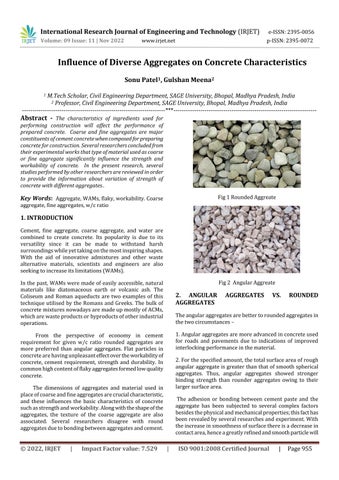
performing construction will affect the performance of prepared concrete. Coarse and fine aggregates are major constituents of cement concrete when composed for preparing concrete for construction. Several researchers concluded from their experimental works that type of material used as coarse or fine aggregate significantly influence the strength and workability of concrete. In the present research, several studies performed by other researchers are reviewed in order to provide the information about variation of strength of concrete with different aggregates.. Fig 1 Rounded Aggreate
Key Words: Aggregate, WAMs, flaky, workability. Coarse aggregate, fine aggregates, w/c ratio
1. INTRODUCTION Cement, fine aggregate, coarse aggregate, and water are combined to create concrete. Its popularity is due to its versatility since it can be made to withstand harsh surroundings while yet taking on the most inspiring shapes. With the aid of innovative admixtures and other waste alternative materials, scientists and engineers are also seeking to increase its limitations (WAMs). Fig 2 Angular Aggreate
In the past, WAMs were made of easily accessible, natural materials like diatomaceous earth or volcanic ash. The Coliseum and Roman aqueducts are two examples of this technique utilised by the Romans and Greeks. The bulk of concrete mixtures nowadays are made up mostly of ACMs, which are waste products or byproducts of other industrial operations.
2. ANGULAR AGGREGATES
Impact Factor value: 7.529
ROUNDED
1. Angular aggregates are more advanced in concrete used for roads and pavements due to indications of improved interlocking performance in the material. 2. For the specified amount, the total surface area of rough angular aggregate is greater than that of smooth spherical aggregates. Thus, angular aggregates showed stronger binding strength than rounder aggregates owing to their larger surface area.
The dimensions of aggregates and material used in place of coarse and fine aggregates are crucial characteristic, and these influences the basic characteristics of concrete such as strength and workability. Along with the shape of the aggregates, the texture of the coarse aggregate are also associated. Several researchers disagree with round aggregates due to bonding between aggregates and cement.
|
VS.
The angular aggregates are better to rounded aggregates in the two circumstances –
From the perspective of economy in cement requirement for given w/c ratio rounded aggregates are more preferred than angular aggregates. Flat particles in concrete are having unpleasant effect over the workability of concrete, cement requirement, strength and durability. In common high content of flaky aggregates formed low quality concrete.
© 2022, IRJET
AGGREGATES
The adhesion or bonding between cement paste and the aggregate has been subjected to several complex factors besides the physical and mechanical properties; this fact has been revealed by several researches and experiment. With the increase in smoothness of surface there is a decrease in contact area, hence a greatly refined and smooth particle will
|
ISO 9001:2008 Certified Journal
|
Page 955