Condition Estimation through UPV

Page 1

International Research Journal of Engineering and Technology (IRJET) Volume: 09 Issue: 11 | Nov 2022

www.irjet.net

e-ISSN: 2395-0056 p-ISSN: 2395-0072

Condition Estimation through UPV Ashutosh Chouhan1, Sanjeev Kumar Verma2 M.Tech Scholar, Civil Engineering Department, SAGE University, Bhopal, Madhya Pradesh, India 2 Professor, Civil Engineering Department, SAGE University, Bhopal, Madhya Pradesh, India ---------------------------------------------------------------------***--------------------------------------------------------------------1

Abstract - One of the most common and effective non-

In many different industrial areas, NDT techniques are widely employed. With the help of quick and trustworthy testing techniques, aircraft, chemical plants, electronic equipment, nuclear facilities, and additional protection important assets are periodically tested. For metallic or composite materials, a number of advanced NDT techniques are available.

destructive methods for determining the characteristics of concrete in constructions is testing ultrasonic pulse velocity (UPV). In addition to crushing power, other uncontrolled aspects like weather conditions or exposure are equally important for the service life of buildings. Failure of concrete structures created an unsettling scenario for researchers who were focused on the durability impacting parameters. In order to design, repair, and replace structures, it is crucial to evaluate the current state of reinforced concrete structures.

The term "quality control technique" refers to nondestructive testing (NDT). Without causing harm to the substance being tested, it may be utilised to find information about a system, component, or material's qualities. Infrared radiation, radiography, ultrasound, x-rays, and many more methods are used in non-destructive testing to examine the material's characteristics, structural faults, and other types of material defects. The procedures used in NDT testing are often simple, quick processes that don't need a lot of waiting and computations. These methods might be used in high-risk locations including gas and oil pipelines, nuclear and seashore buildings, and coastal environments. Since they may be used to regulate production procedures, guarantee product integrity, cut production costs, and maintain the material quality standard, non-destructive tests are seen to be highly beneficial. Here are some examples of nondestructive testing techniques from a wide range available: Ultrasonic Testing, Laser Testing Methods, and Ground Penetrating Radar (UT). Compared to other non-destructive procedures, the ultrasonic pulse velocity technique is the most convenient and takes least time to use. It also has the lowest cost of usage.

Key Words: Compressive strength, Durability, Service life, Non destructive testing, rebar’s, UPV Test, Nuclear Facilities, pulse velocity, depassivation time

1. INTRODUCTION Determination of the present condition of concrete requires different actions such as highly skilled visual inspection for monitoring the cracks, finding pattern of cracks, investigating causes of cracks, finding corrosion activity under the concrete near rebar’s, investing other properties which influences the durability of concrete. In addition to these techniques, a number of destructive and non-destructive techniques are available to evaluate the state of structures while they are still in place. The UPV test is one of the most widely used non-destructive methods for evaluating the concrete qualities of buildings. Although the UPV test is pretty straightforward and simple to use, interpreting the test findings is quite challenging since UPV scores are affected by a variety of circumstances.

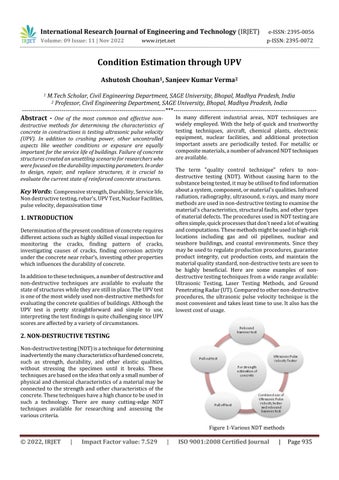
2. NON-DESTRUCTIVE TESTING Non-destructive testing (NDT) is a technique for determining inadvertently the many characteristics of hardened concrete, such as strength, durability, and other elastic qualities, without stressing the specimen until it breaks. These techniques are based on the idea that only a small number of physical and chemical characteristics of a material may be connected to the strength and other characteristics of the concrete. These techniques have a high chance to be used in such a technology. There are many cutting-edge NDT techniques available for researching and assessing the various criteria. Figure 1-Various NDT methods

© 2022, IRJET

|

Impact Factor value: 7.529

|

ISO 9001:2008 Certified Journal

|

Page 935


Turn static files into dynamic content formats.
Create a flipbook