International Research Journal of Engineering and Technology (IRJET) e-ISSN:2395-0056

Volume: 09 Issue: 11 | Nov 2022 www.irjet.net p-ISSN:2395-0072
International Research Journal of Engineering and Technology (IRJET) e-ISSN:2395-0056
Volume: 09 Issue: 11 | Nov 2022 www.irjet.net p-ISSN:2395-0072
1Engineer, Directorate of Information and Communication Technology, ATBU Bauchi, Nigeria 2Lecturer, Department of Computer Science, FCT-College of Education, Zuba, Abuja, Nigeria. 3Lecturer, Department of Information Technology, Federal University Dutse, Nigeria ***
Abstract - This paper Examines the maximum data throughput performance of a wireless network 802.11b&g Usingiperf forsendingUDPdatastreamsacrosseachnetwork thereby computing the experimental and theoretical parameters such as Throughput values, data loss and round trip time. The results were displayed in Graphical formats for comparative analysis which showed that theoretical throughput is higher than the experimental throughput in both802.11b&g.Andthat802.11ghascomparativelygreater throughput metric than 802.11b
Key Words: Throughput,payload,802.11,WLAN,
Wireless networking is considered to be an accepted complementary to the Ethernet wired Networking [1]. It involveswirelessequipmentfortransmissionofdataandfor effectivecommunication.Itsimportanceledtothefactthat most current mobile and portable devices are currently empowered with wireless fidelity(Wi-Fi) capabilities , allowingenduserstoconnecttoaccesspointsinproximity for internet access or to setup Ad-hoc Networks for file sharing etc due to its low cost , easy setup and deployment.[2]
WirelessNetworksaremadebyconfiguringWirelessaccess points. There 802.11 x standards which guide the descriptionofWi-Fiandare802.11a,802.111b,802.11gand 802.11n.802.11ahasatypicaldatarateof25Mbpsandreach 54Mbpswith100asindoorrangewithoperatingfrequency of5GHz.802.11bhasatypicaldatarateof6.5Mbpsthatcan extendsto11Mbspswiththesame100feetofindoorrange butwith2.4GHzoperatingfrequency.802.11g,ontheother hand,hasadatarateof25Mbps,peakrateof54Mbpsand indoor range of 100 feet having operating frequency of 2.4GHz. Note that 802.11b&g are mostly compatible with mostwireless/routercardsreferredthesestandardasb/g or802.11b/g.Furthermore,802.11nhasatypicaldatarate of200Mbpsthatextendsto540Mbpswith160feetindoor rangeoperatingateither2.4GHzor5GHz.Finally,Overhead hasbeendescribedasthefundamentalproblemofMedium AccessControl(MAC)inefficiency[3]
As more and more daily activities are carried out via Internet-basedservicesandsystems,moderncivilizationis
becoming increasingly reliant on powerful and efficient communicationnetworks.[3].TheIEEEproducedthe802.11 seriesofspecificationsforwirelessLANtechnology.In1997, IEEEapprovedthe802.11specification.Duetotheeaseof installationandthegrowingpopularityoflaptopcomputers, wirelesslocalareanetworks(WLAN)havebecomepopular inthehome.WLANstandsforWirelessFidelityandisbased ontheIEEE802.11standard.The802.11workinggroup's taskshaveonlygeneratedafewextensionstotheoriginal specifications.Theseextensions'productsarenamedbythe taskgroupandtheoriginalstandard;forexample,802.11bis a task group b extension. 802.11b, 802.11a, 802.11g, and 802.11narethemostwidelyused802.11extensions[5]
IEEE802.11bisan802.11extensionthatusesjustDSSSand cantransmitupto11Mbps(withafallbackof5.5,2,and1 Mbps)inthe2.4GHzrange.IEEE802.11bisalsoknownas wirelessfidelity(WiFi)or802.11high rate.). The802.11g standardusesthe2.4GHzbandandcandeliverspeedsofup to54Mbps(withafallbackto48,36,24,18,11,5.5,2,and1 Mbps).The802.11gvariesfromthe802.11binthatitcan employOFDM(the802.11gdraftdemandstheuseofOFDM forratesgreaterthan20Mbps).[4]
The IEEE 802.11 family is the most widely used standard thathasnumerous extensions whileothersareunderway. IEEE802.11standards,whichwerefirstpresentedin1999, werelargelydevelopedwiththehomeandofficecontextin mind for wireless local area connectivity. With the implementationofIEEE802.11b[2],themaximumdatarate per AP rose from 2Mbps to 11Mbps. Newer IEEE 802.11g andIEEE802.11aextensionsprovidedamaximumdatarate of54MbpsperAPusingavarietyofapproachestoraisethe maximum data rates [3-5]. Currently, WLAN equipment basedonIEEE802.11gsupportdataratesof100-125Mbps [6]
Networksteganographyisnowrecognizedasanewdanger to network security that can be utilized for a variety of purposes, including data exfiltration and network attacks. TheIEEE802.11standardsdidnotregardwirelesslocalarea networks (WLANs) as a serious area for data concealing, owingtotheirrestrictedrange(therangefor802.11a/b/gis 30mindoorsand100moutdoors).,therangeof802.11nis increased). IEEE 802.11 was, nevertheless, used to communicate secret data among Russian agents
International Research Journal of Engineering and Technology (IRJET) e-ISSN:2395-0056
Volume: 09 Issue: 11 | Nov 2022 www.irjet.net p-ISSN:2395-0072
apprehendedintheUnitedStatesinJune2010[1].WLANis also one of the various means of communication among soldiersonthebattlefieldfromamilitarystandpoint.[7]
In July 1999, IEEE added the 802.11b specification to the original802.11standard.802.11ballowsforabandwidthof upto2.4GHz.11Mbps,comparabletotraditionalEthernet. The original 802.11 standard uses the same uncontrolled radio signaling frequency (2.4 GHz) as 802.11b. Vendors frequentlywanttousethesefrequenciesinordertoreduce their production costs. Because 802.11b equipment is unregulated, it may cause interference with microwave ovens, cordless phones, and other 2.4 GHz-based gadgets. However,byplacing802.11bequipmentatasafedistance fromothermachines,interferencecaneasilybeevaded.[8]
WLAN solutions supporting a newer standard known as 802.11g first appeared on the market in 2002 and 2003. 802.11gtriestointegratethegreatestfeaturesof802.11a and802.11b.802.11gprovidesupto54Mbpsofbandwidth and uses the 2.4 GHz frequency for increased range. Backward compatibility between 802.11g and 802.11b meansthat802.11gaccesspointswillfunctionwith802.11b wirelessnetworkadaptersandviceversa.[9]
ThroughputofaCommunicationprotocolcanbedefinedas thenumberofinformationbitstransmittedpertransmission cycle(inbps).
Henceitcanmathematicallybesimplifiedas;
Throughput(Mb/s)=Amountofdata(bits) (1) TransmissionTime(μS)
The iperf tool sends UDP data packets of 1470bytes (applicationdata)bydefault.
Carrier Sense Multiple Access /Collision Avoidance (CSMA/CD)isaschemedefinedbyDistributionCoordination Function(DCF)whereeachmobilenodehasafairchanceto access the wireless medium in 802.11MAC. Short InterFrame Spacing (SIFS) is used in 802.11 to transmit high priorityframesjustlikeRequest-to-Send(RTS),Clear-ToSend(CTS)aswellasAcknowledgement(ACK)[8]
DistributedcoordinatorFunctionInterFrameSpace(DIFS) thisnormallydifferentiatesbetweentwotransmissions.The time associated with DIFS is given according to (MicheleSegataetal,2009)as;
TDIFS =TSIFS +2+TSLOT=10μS+2*20Μs=50μS. (2)
SlottimeisContentionWindow(CW)sizeis definedasthe multiple of time slot and plays major role during back-off Procedure which has to be executed by each mobile node beforetransmission[9]
Transmission Control protocol (TCP) is an Example of responsiveprotocolprovidingresponsivetrafficwhileUser datagramProtocol(UDP)isanExampleofnon-responsive protocolprovidingnon-responsiveTraffic[10]
More than 9.5 billion devices, which are IEEE 802.11 compliant are pervasive with United States alone having about fifty million Wi-Fi networks extensive IEEE 802.11 infrastructuredevices. Internet of Things(IoT) challenges canbeaddressedbyIEEE802.11eventhoughitcomeswith highconsumptionofpowersuchthatithastopoweredvia batteries or harvesting the power which was later solved throughtheintroductionofpowersavingmode(PSM)that’s hibernate the radio most of the time with the purpose of energy reduction. In order not to lose frames during hibernation period, the access point (AP) in the network stores those frames that were directed to the sleeping station(STA)whichcanbeutilizedduringwakeupprocess. [11]
Marcovchainisamathematicalmodelwhichisoneofthe mostpopulartechniquesthatanalysestheperformanceof IEEE802.11DistributedCoordinationFactor(DCF).Markov chain is normally classified in to three dimension as 1Dimension,2-dimensionand3-dimensionthatsummarizes theircharacteristics.Theideaistochoosetheappropriate dimension in relation to complexity of the desired MAC protocolwithrespecttocommunicationscenarios.Wireless LANandMediaandAccesslayersnormallygettheirdetailed specificationfromIEEE802.11Standardwhichdirectsthe schedulingprocessesefficientlyviatwotechniquesnamed; DCFandPCF(pointcoordinationfactor.)[12]
ThefirstreleaseofIEEE802.11StandardwasinJune1997 bytheIEEE/MANcommitteeandsubsequentlyupgradedto drawneartheadvancesincommunicationtechnologies. The protocols started by 11a, 11b , 11g then upgraded 11n beforecomingupwith11ac.11nprovidesimprovedfeatures overthea,b&c while11acisbetterthan11n [13]
The IEEE802.11b, otherwise known as High rate (Wi-Fi), offers 11Mbps transmissions in the 2.4GHz band. Throughputistheaveragerateofvictoriousmessagerelease overachannelofcommunication.In1999approvalrelease of the IEEE802.11b standard facilitated the frame fragmentation which is the procedure that allows 802.11 frames to be partitioned into lesser fragments to spread individually to the target destination where the frame reassemblytakesplaceattheMAClayer.[14]
Transmissioncontrolprotocol(TCP)accountsforover80% ofwholeinternettraffic.TounderstandtheWLANsystems capability to utilize TCP in accessing the internet, it quite
International Research Journal of Engineering and Technology (IRJET) e-ISSN:2395-0056
Volume: 09 Issue: 11 | Nov 2022 www.irjet.net p-ISSN:2395-0072
necessary to forecast TCPs throughput. (Aziz, O.A., etal 2020). Maximum throughput can be passed across a passageway which is known as bandwidth capacity, Availablebandwidthistheamountofunusedcapacityatthe samepassageway.[15]
Eventhoughitisnotnewtechnologypersay,IEE802.11b WLANsystemremainsthetopcommonlyusedtechnology that equally offers the widest range in the wireless equipment deployment. Where IEEE802.11b is used in a networkalongsideothertechnologies,especiallywhenthe covered distance is favored over high throughput or bandwidth,IEEE802.11bisnormallypreferredovernewer technologiesbecausetheyareforcedtomakeuseoflower dataspeeds.[16]
For 802.11b
Themaximumthroughputcanbeachievedunderbestcase scenariobysettingupanerrorfreechannelwhichisideal forexperimentation.Therehastobeonlyoneactivestation forsendingandacceptingpacketstoanotherstationwhich must acknowledge receipt. It also worth noting that maximum throughput should be higher than an ordinary throughputwhereasMinimumdelayshouldbelowerthan anordinarydelay.
MT= 8LDATA
TD_DATA+TD_ACK+2τ+TDIFS +TSIFS+CW (3)
Maximumdelayinequation(3)isafunctionofpayloadsize inbytesmultipliedbyeight,theresultofwhichtobeallbe dividedbyasummationoftransmissiontimeforthepayload ( TD_DATA),acknowledgementtransmission time(TD_ACK), twicethepropagation delay(2τ)andSIFStime(TSIFS)aswell ascontentionwindow(CW).
TD_DATA=TP +TPHY+8LH_DATA + 8LDATA (4)
100000RDATA
Transmission time for the payload (TD_DATA) in (3) can furtherbehighlightedasasummationoftransmissiontime ofphysicalpreamble(TP)addedtothetransmissiontimeof thePHYheader(TPHY)whichisthensummedalongwiththe MACoverheadinbytes(LH_DATA )pluspayloadsizeinbytes (LDATA)andthesummationtobedividedbydatarate(RDATA) resultingtotheformationofequation(4).
Theotheraspectofmaximumthroughput(MT)equationis the Acknowledgement transmission time (TD_ACK) in (4) which is the result of the acknowledgement size in bytes (LACK) by the 100,000th value of control rate (RACK) to be addedwiththesummationofTPandTPHY.Thisishow(5)was formed.
TD_ACK=TP+TPHY+ 8LACK (5)
100000RACK
Thegeneralizedformulacanbesimplifiedasshownbelow;
T= 8Psize (6) 756+8*(42+Psize) 11
Fromtheabovewecanformthetableforpayloadagainst
Thefollowingnotationswereused:
T: Throughput, Psize: Payload size, DIFS: Distributed coordinatorFunctionInterFrameSpace,PHY:Physicallayer header,FCS:FluorescenceCorrelationSpectroscopy,TAIL: Tailbits,PAD:Padbits,ACK:AcknowledgementandMAC: MediumAccessControl.
Thethroughputisgivenfromthegeneralizedformulagiven in equation (7) below, which presents throughput as the function of Payload size in respect of the summation of parametersincluding:TDIFS,TBACKOFF,TPHY,TSERVICE,TFCS,TTAIL, TPAD,TACKandTMAC.
T= Psize (7) TDIFF+TBACKOFF+TPHY +TSERVICE +TFCS+TTAIL+TPAD+TACK+TMAC
Substituting forthetheoretical valuesfromthe paperand varyingmypacketsizevaluesfrommyexperimentleadsto (8);
NOTE
(TDIFF=28μS, TBACKOFF=138.5μS, TPHY =20μS, Tservice=0.3μS, TFCS=0.59μS TTAIL=0.11μS, TPAD=0.33μS, TACK = 30μS, TMAC= 3.56μS)
T = Psize (8) 28μS+138.5μS+20μS+0.3μS+0.59μS +0.11μS+0.33μS+30μS+3.56μS
The formula can further be generalized as shown in (9) below; T= 8PSIZE (9) 231.39+8PSIZE 54
International Research Journal of Engineering and Technology (IRJET) e-ISSN:2395-0056
Volume: 09 Issue: 11 | Nov 2022 www.irjet.net p-ISSN:2395-0072
2No. Computer Laptop: The Computer laptop with a runningWindowsOperatingSystem(OS)wasused.Itwasa HP Elite book E50 G2, 2.60GB processor and 64-bit Operatingsystem. Wealsousedanotherlaptoptorun the iperfgenerationsoftwaretool.ItwasaMacBookPro,Inteli5, 4GRAM,IOS.
1No. Access Point: (LinksysWRT10NWirelessrouter):The Accesspoint(AP)wasusedforconnectingthetwolaptops (serverandclient).
Iperf traffic generation software: Iperf3 is a tool for actively measuring the maximum bandwidthachievableonIPnetworks.Itallowsyoutofinetuneavarietyoftiming,buffer,andprotocoloptions(TCP, UDP, SCTP with IPv4 and IPv6). It reports the bandwidth, loss,andotherparametersforeachtest.Thisisabrand-new implementationwithnocodeincommonwiththeoriginal iPerf,anditisalsonotbackwardscompatible.
Spectrum Analyzer (Chanalyser 4):
Chanalyser4isasoftwareprogrambyMetaGeekthatgather data from two sources. The wireless adapter from a computerandthespectrumanalysisfromtheWi-Spywork togetherinordertogivecomprehensivelookatourwireless environment.
The experiment was carried out using two laptops and LinksysWRT10NAccessPointsetatafrequencyof2.4GHz atchannel6.AlaptopwasusedasserverusingDHCPserver for automatically assigning IP address to the Laptops in connectiontotheAccessPointwhiletheotherlaptopserves as client. We thereby sent out data using iperf traffic generatingsoftwarewhichwasrunonbothlaptopsand also used chanalyser 4 Spectrum Analyser for monitoring the behaviouroftheNetwork.
DataPacketsweresentbyrunningiperfonthetwolaptops tocollectthedatafortheselectedspeed.Anypacketsenton the iperf based client Laptop will be monitored on the server’s laptop running the same iperf while the output resultsoftheseven(7)testedpayloadswererecordedfor analysis.Thesevenpayloadstestedintheexperimentwere 100, 250, 500, 750, 1000, 1250 and 1400 respectively measuredinbytes.Andthesummarisedthroughputsresults areaccordinglynotedinthetableformatsforplottingunto graphs.
Theresultsobtainedfromourexperimentalandtheoretical work.
Throughput analysis of 802.11b and 802.11g standards is hereby presented in graphs shown hereunder with supplementarysnapshotsof the outputsgenerated by the spectrum analyser. The vertical and horizontal axis of the graphs represents throughput in bits per seconds and Payloadsinbytesrespectively.Discussionontheresultsis describedintheNextsectionofthistechnicalpaper
Table1: 802.11 b ThroughputagainstPayload
Payload (Bytes) Theoretical Throughput Experimental Throughput Differential
100 0.93 0.45 0.48
250 2.07 1.48 0.59
500 3.48 2.48 1.0
750 4.51 3.26 1.25 1000 5.28 3.95 1.33 1250 5.90 4.26 1.64
1400 6.21 4.57 1.64
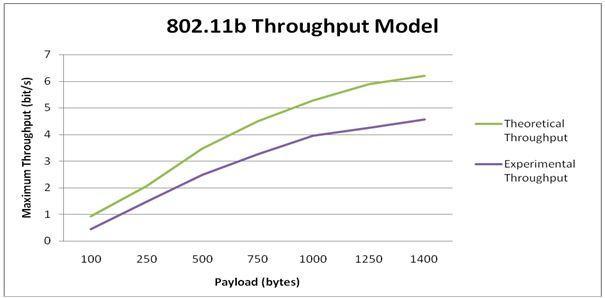
Figure1a: 802.11 b ThroughputagainstPayload
International Research Journal of Engineering and Technology (IRJET) e-ISSN:2395-0056
Volume: 09 Issue: 11 | Nov 2022 www.irjet.net p-ISSN:2395-0072
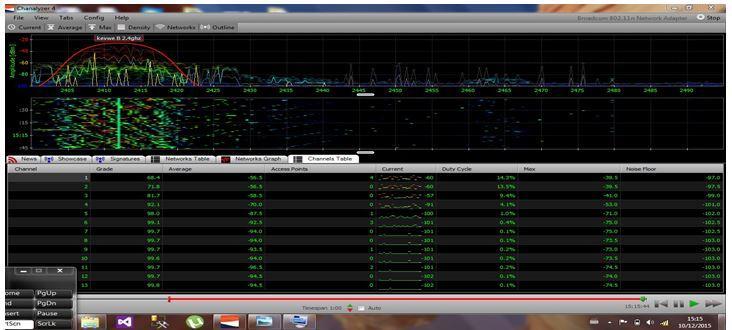
Figure1b:Chanalyseroutputfor 802.11 b
Table2: 802.11g ThroughputagainstPayload
Payload (Bytes)
Theoretical Throughput Experimental Throughput Differential
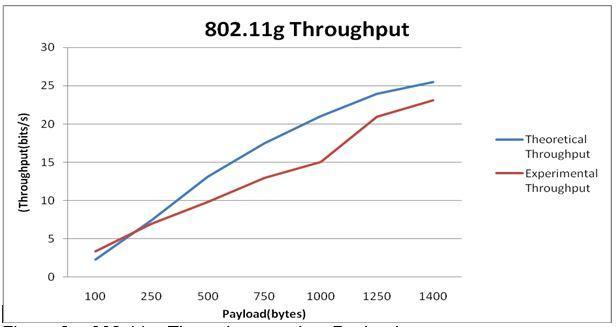
100 2.28 3.35 -1.07 250 7.45 6.95 0.5 500 13.10 9.79 3.13 750 17.51 13.00 4.51 1000 21.08 15.07 6.01 1250 24.01 20.96 3.05 1400 25.52 23.14 2.38
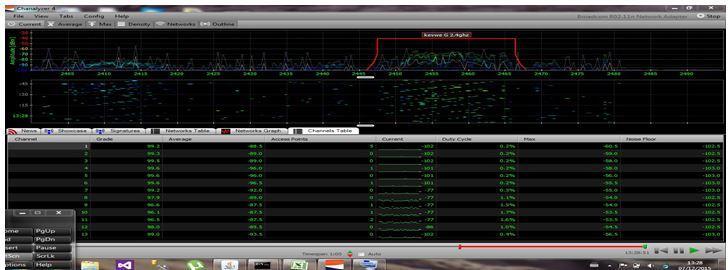
Figure2b:Chanalyseroutputfor 802.11 g
Table3: 802.11b & g ThroughputagainstPayload
Payload (bytes)
Theoretical Throughput –b
Experimental Throughputb
Theoretical Throughput -g
Experimental Throughputg
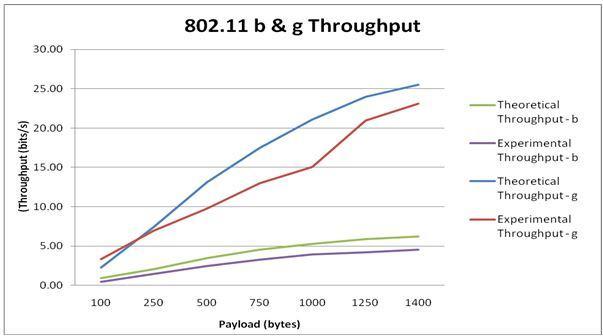
100 0.93 0.45 2.28 3.35 250 2.07 1.48 7.45 6.95 500 3.48 2.48 13.10 9.79 750 4.51 3.26 17.51 13.00 1000 5.28 3.95 21.08 15.07 1250 5.90 4.26 24.01 20.96 1400 6.21 4.57 25.52 23.14
Figure3: 802.11 b&g ThroughputagainstPayload.
Figure2a: 802.11 g ThroughputagainstPayload.
2022, IRJET | Impact Factor value: 7.529 | ISO 9001:2008 Certified Journal | Page890
International Research Journal of Engineering and Technology (IRJET) e-ISSN:2395-0056
Volume: 09 Issue: 11 | Nov 2022 www.irjet.net p-ISSN:2395-0072
After plotting the throughput graphs for both the two standardsthatare802.11band802.11g,Iobservedthatin thecaseof802.11bthereexistfairlythesamepatternforthe theoreticalandexperimentalthroughputespeciallyatlower payloads as seen in figure1a. For the 802.11g, both the theoreticalandexperimentalthroughputexhibited similar manner but the experimental throughput at 100bytes is highercausinganoverlapwherethereissuddendropofthe experimentalvalueslightlyat1000bytesofpayloaddueto possibleinterferencefromthesurroundingwirelessdevices as depicted in table 2. Generally 802.11g has higher throughputperformanceinboththeatricalandexperimental values compared to 802.11b as shown in Table 3 just as 802.11gtrafficisalsogreaterthan802.11bascapturedby chanalyserin Figure1b and Figure 2b respectively.
While table 1 showed the comparative values of both theoretical and experimental throughput associated with 802.11b, Table2 showed the comparative values of both theoreticalandexperimentalvaluesof802.11g. Figure 1a showed how theoretical throughput is higher than the experimentalthroughputin802.11bwhereasin802.11g,the experimental throughput appeared higher in much lower payloadbutassoonasthepayloadstartedincreasing,the experimental throughput maintained the dominance over theexperimentalthroughputasin Figure 2a.Thebroader picturedwasshownin Figure 3 thatdepictedthegeneral overview, comparing both the 802.11b and 802.11g such thatthe802.11gwaspictoriallyshowntobemuchhigher than the 802.11b in both theoretical and experimental scenarios.
The paper presents the calculation of Maximum data Throughput by considering both the theoretical and experimental values of 802.11b and 802.11g Networks therebygraphicallyshowinghow802.11gstandardishigher than 802.11b in terms varying payloads. Effects of interference have been considered and all timing and frequency settings for calculating the throughput were accordinglyimplemented