International Research Journal of Engineering and Technology (IRJET) Volume: 09 Issue: 11 | Nov 2022
www.irjet.net
e-ISSN: 2395-0056 p-ISSN: 2395-0072
A Review on Performance Analysis of High performance EV Powertrain model Aishwarya S. Sharma1, Prasad D. Kulkarni2 1PG
Student [EPS], Dept. of EE, KCES’S College Engineering. And Management, Jalgaon, Maharashtra, India, Assistant Professor, Dept. of EE, KCES’S College Engineering and Management, Jalgaon, Maharashtra, India ---------------------------------------------------------------------***--------------------------------------------------------------------as input and output can be used to classify electrical Abstract — The main goal of this research project is to 2
machines.
capture the transient behaviour of the entire powertrain while using true physics-based dynamics rather than conventional charts and maps. A thorough description of the longitudinal car's multi-body model is provided, along with mathematical representations of the vehicle's suspension, aerodynamic behaviour, and continuous variable transmission (CVT). The d q frame models the PMSM and PMSG as well as DC/AC and AC/DC. It is suggested that a novel frictional torque function be used to forecast all mechanical and electrical losses aside from resistance loss. The proposed frictional torque function's findings are in good agreement with those found in empirical sources. To guarantee the simplicity and viability of the simulation in a reasonable amount of time, average models for AC/DC, DC/AC, and DC/DC converters are utilised. To model the transient operation of the series HEV powertrain during various modes of operation, a unique DC-link control technique is presented. The supervisory control is put into place to satisfy the driver's need for traction power while also preventing over-discharging of the battery below a predetermined level and optimising the efficiency of the drive train, fuel consumption, and emissions. The present work proposes a novel "load follower" supervisory control approach based on thermostat control and power follower. The performance of a driver model based on PI controllers appears to be sufficient when tracking the typical NEDC cycle. Energy balance calculations, accessible transient and steady state data points for individual components, as well as the simulation results are used to confirm.
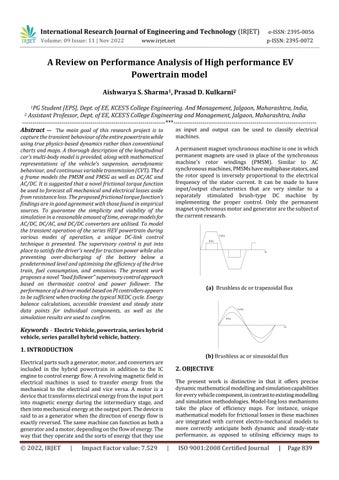
A permanent magnet synchronous machine is one in which permanent magnets are used in place of the synchronous machine's rotor windings (PMSM). Similar to AC synchronous machines, PMSMs have multiphase stators, and the rotor speed is inversely proportional to the electrical frequency of the stator current. It can be made to have input/output characteristics that are very similar to a separately stimulated brush-type DC machine by implementing the proper control. Only the permanent magnet synchronous motor and generator are the subject of the current research.
(a) Brushless dc or trapezoidal flux
Keywords - Electric Vehicle, powertrain, series hybrid vehicle, series parallel hybrid vehicle, battery.
1. INTRODUCTION
(b) Brushless ac or sinusoidal flux
Electrical parts such a generator, motor, and converters are included in the hybrid powertrain in addition to the IC engine to control energy flow. A revolving magnetic field in electrical machines is used to transfer energy from the mechanical to the electrical and vice versa. A motor is a device that transforms electrical energy from the input port into magnetic energy during the intermediary stage, and then into mechanical energy at the output port. The device is said to as a generator when the direction of energy flow is exactly reversed. The same machine can function as both a generator and a motor, depending on the flow of energy. The way that they operate and the sorts of energy that they use
© 2022, IRJET
|
Impact Factor value: 7.529
2. OBJECTIVE The present work is distinctive in that it offers precise dynamic mathematical modelling and simulation capabilities for every vehicle component, in contrast to existing modelling and simulation methodologies. Model-ling loss mechanisms take the place of efficiency maps. For instance, unique mathematical models for frictional losses in these machines are integrated with current electro-mechanical models to more correctly anticipate both dynamic and steady-state performance, as opposed to utilising efficiency maps to
|
ISO 9001:2008 Certified Journal
|
Page 839