International Research Journal of Engineering and Technology (IRJET) e-ISSN:2395-0056

Volume: 09 Issue: 11 | Nov 2022 www.irjet.net p-ISSN:2395-0072

International Research Journal of Engineering and Technology (IRJET) e-ISSN:2395-0056
Volume: 09 Issue: 11 | Nov 2022 www.irjet.net p-ISSN:2395-0072
Application Development Associate, Accenture Senior Executive, Vodafone Intelligent Solutions IT Manager, RBL Bank Application Development Analyst, Accenture ***
Abstract - Domain of project is Internet of Things (IoT). This system can be used in healthcare sector. NodeMCU is used as microcontroller, other than that several sensors are used to collect data like MAX30100 Pulse oximeter, DS18b20 sensor, Dht22 sensor, AD8232 ECG sensor and Thingspeak platform is used for monitoring the patient health. With an advancement in the emerging technologies and miniaturization of sensors, efforts have been made of using new technologies in healthcare areas to improve the overall quality life. The healthcare industry is a significant field of study that has seen the introduction of technologies. It is enormously expensive for those in need of health care facilities, which is especially the case in developing countries. The health monitoring system has seen tremendous growth in hospitals and many other health centers, and portable health monitoring systems of new technologies are also being of great interest to many countries around the world. The emergence of the Internet of Things ( IoT) technology makes it possible for healthcare to shift from face-to - face appointment to telemedicine. As a result, this effort is an attempt at addressing a health issue that society is currently facing. The primary aim of the project is to design a framework for remote healthcare. This project proposes an intelligent IoT healthcare system that will monitor the health related parameters of a patient and the condition inside this room where patients are presently in real time. In this framework, some sensors are used to collect the data, like heartbeat sensor, body temperature sensor, room temperature sensor, Blood oxygen sensor, ECG sensor, and Room humidity sensor from the patient and area. The status of the patients is communicated to the medical personnel through online platform, where they can process and interpret the patients' current state. The prototype will be well suited for healthcare monitoring that is proved by the effectiveness of the system. The system is very effective in the case of infectious disease including a novel coronavirus (COVID-19) treatment. The system will enhance the current healthcare infrastructure, which will protect more lives from death.
Key Words: MAX30100, Thinkspeak, AD8232 ECG Sensor, DS18B20 Sensor, Healthcare, Monitoring.
Thehealthcareindustryisasignificantfieldofstudythathas seen the introduction of technologies. It is enormously expensiveforthoseinneedofhealthcarefacilities,whichis
especially the case in developing countries. The health monitoringsystemhasseentremendousgrowthinhospitals and many other health centers, and portable health monitoring systems of new technologies are also being of great interest to many countries around the world. The emergenceoftheInternetofThings(IoT)technologymakes it possible for healthcare to shift from face-to - face appointment to telemedicine. As a result, this effort is an attemptataddressingahealthissuethatsocietyiscurrently facing.
Theprimaryaimoftheprojectistodesignaframeworkfor remotehealthcare.ThisprojectproposesanintelligentIoT healthcare system that will monitor the health related parametersofapatientandtheconditioninsidethisroom wherepatientsarepresentlyinrealtime.Inthisframework, some sensors are used to collect the data, like heartbeat sensor,bodytemperaturesensor,roomtemperaturesensor, Bloodoxygensensor,ECGsensor,andRoomhumiditysensor from the patient and area. The status of the patients is communicated to the medical personnel through online platform,wheretheycanprocessandinterpretthepatients’ current state. The prototype will be well suited for healthcaremonitoringthatisprovedbytheeffectivenessof the system. The system is very effective in the case of infectiousdiseaseincludinganovelcoronavirus(COVID-19) treatment.Thesystemwillenhancethecurrenthealthcare infrastructure,whichwillprotectmorelivesfromdeath.As inputdatalikeHeartbeat,Bodytemperature,ECG,Oxygen level,Roomtemperature,Roomhumidityaretaken.
Acutehealthconditionsmightleadtosuddendeath.Many people die suddenly around the world because of dysfunctioninoneormorebodyorgans.Beforethathappen, these organs produce abnormal signs. These signs, which called bio-signals, can be detected and are collected via sensors. The remote healthcare systems based on IoT technology depends on microcontroller and gateway to uploaddata.Arduinomicrocontrollerfamilyisusedmorein this field. Some projects use NodeMCU which is ESP8266 basedboard.WhileothersuseArduinoUNOwithESP9266 module . Other projects make matching between one of ArduinoboardsandRaspberryPiboard.
TherearevarioustypesofIoTplatforms.Someofthemare createdviadevelopersfromscratchusingwebdesignskills such as Node.js server and WebSocket library also, HTTP
International Research Journal of Engineering and Technology (IRJET) e-ISSN:2395-0056
Volume: 09 Issue: 11 | Nov 2022 www.irjet.net p-ISSN:2395-0072
serverandthedevelopedwebbasedGUIinterface.Onthe otherhand,AndroidStudioprovidesagoodopportunityto mobile application developers where you can build your own Healthcare application NodeMCU is used as microcontroller,otherthanthatseveralsensorsareusedto collect data like MAX30100 Pulse oximeter use for heartbeats, DS18b20 sensor, Dht22 sensor is used for temperature and humidity, AD8232 ECG sensor is use for ECG graph and pulse count and Thingspeak platform and mobile application such as blynk or own developed application in android studio is used for monitoring the patienthealth.
Weallarewarethatinhospital,eitherthenurseorthedoctor has to visit physically from one person to another for checkupsandmonitoringtheconditionsofpatient,whichis notpossibletomonitortheirconditionscontinuously.Thus, any critical situations cannot be found easily unless any doctorornursecheckstheperson’shealthatthatmoment. Thiscanbeahecticforthedoctorswhohavetotakecareofa lot number of patients in the hospital. Also, in case of any medical emergencies to the patient, they are often unconsciousandunabletopressanEmergencyAlertButton orcannotaskforanyhelpfromthenurseordoctor.Thedata can be transferred through Hyper Text Transfer Protocol (HTTP)forgeneralcommunicationoverInternet.However, when this technology is applied to communication in IOT, protocoloverheadandresultingperformancedegradationis a serious problem. Moreover, IP addressing depends on physicallocation,whichcausestheproblemofcomplexityof network control. Our proposed system continuously monitoringpatient’svitalsignsandsenseabnormalities.The monitored data is shared with the medical staff. Upon encounteringanyabnormalities,thesystemcansendalerts tothemedicalstaffabouttheabnormalparameter.Thus,it canreducetheneedformanualmonitoringwhichcurrently isdonebythemedicalstaff.Ourproposedsystemsendthe datafromsensorstocloudplatformthatisthingspeakand androidapplication.Anynumberofuserscanseethemedical record recorded on the thing speak using the thing speak accesskey.
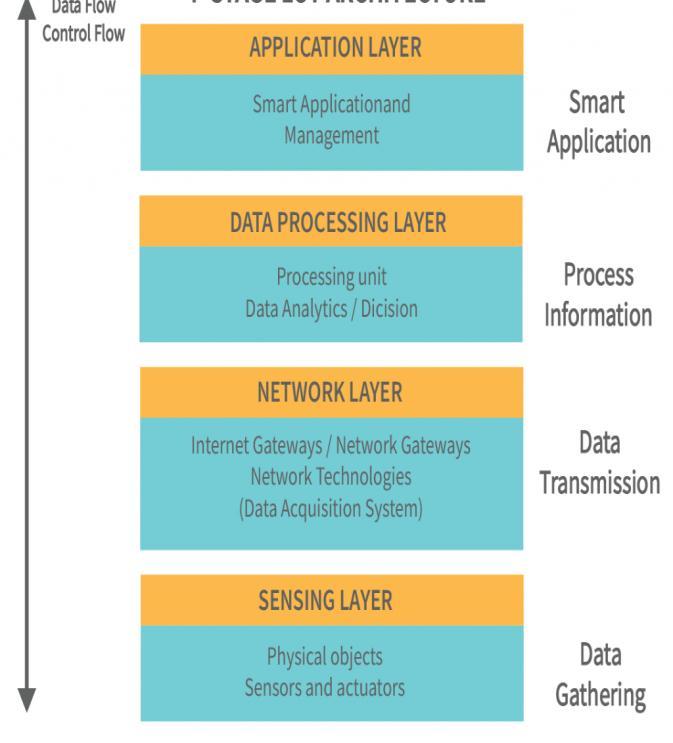
TheapplicationofIoTinthehealthcareindustryenablesthe automation of time-consuming activities that previously allowedhumanmistake.Forinstance,manyhospitalstoday usenetworkedequipmenttoregulatethetemperatureand airflowinoperatingrooms.
1.ReducedErrors–IoTallowsfortheaccuratecollectionof data,automatedworkflowsandminimizedwaste,butmost importantlyitreducestheriskoferror.
2. Decreased costs – With IoT, patient monitoring can be done in real-time, drastically cutting down the need for doctorsgoingoutandmakingvisits.Connectedhomecare facilitieswillhelptoreducehospitalstaysandre-admissions ofthepatients.
3.Betterpatientexperience–Aconnectedhealthcaresystem creates an environment that meets each patient’s needs. Dedicated procedures, enhanced treatment options and improved diagnosis accuracy make for a better patient experience.
4.Quickpropertreatment–Withreal-timedatahealthcare providers can continuously monitor patients. This means thattheycanspotandprovidequicktreatmenttoanyofthe seriouspatientsintime
5.Homecare–Patientscanbemonitoredintheconvenience oftheirownhomesusingM2M.Tothepatient,sensorsare attached to various medical devices, such as heart rate monitors. Data collected is sent to the hospital where a qualifiedmemberofstaffanalysesitforanyabnormalities.
International Research Journal of Engineering and Technology (IRJET) e-ISSN:2395-0056
Volume: 09 Issue: 11 | Nov 2022 www.irjet.net p-ISSN:2395-0072
The Arduino IDE (Integrated Development Environment)isused to writethecomputercode anduploadittothephysicalboard.Itisverysimple anditssimplicityisprobablyoneofthemainreason Arduinobecamesopopular
ThingSpeakisanIoTanalyticsplatformservicethat allows us to aggregate, visualize and analyze live data streams in the cloud. It provides instant visualizationsofdatapostedbyourdevices.
Android Studio is the official integrated development environment for Google's Android operating system, built on JetBrains' IntelliJ IDEA software and is designed specifically for Android development. It is used to develop android applicationwhich showsusallpatientrelateddata inmobilethroughinternet.
NodeMCU is an open-source Lua based firmware thatrunsontheESP8266Wi-FiSoCfromEspressif Systems, and hardware is based on the ESP-12 module.ItcanbepoweredusingMicroUSBjackand VINpin(ExternalSupplyPin)andsupportsUART, SPI,andI2Cinterface.
Asensorsolutionwithanintegratedpulseoximeter andheart-ratemonitoriscalledMAX30100.Itisan opticalsensorthatobtainsitsreadingsfromthered andinfraredlightemittedbytwoLEDs,thenusesa photodetectortomeasuretheabsorbanceofpulsing blood.ThismixofLEDcoloursisidealforreading data with the tip of the finger. It can be entirely customised using software registers, and the device's internal 16-deep FIFO stores the digital outputdata.containsadigitalI2Cinterfaceaswell forcommunicatingwiththehostmicrocontroller.
The DS18B20 is a 1-wire programmable Temperaturesensorwithmaximintegratedandis widely used to measure temperature in hard
environments. The constriction of the sensor is rugged and can be purchased with a waterproof option making the mounting process easy. It measuresawiderangeoftemperaturefrom-55°C to+125°withadecentaccuracyof±5°C
Apopulartemperatureandhumiditysensoristhe DHT22. The sensor includes a dedicated NTC for temperature measurement and an 8-bit microprocessor for serial data output of temperature and humidity information. It is straightforward to integrate with different microcontrollers and is factory calibrated. The sensor records temperature readings between40°Cand80°C.
AD8232 ECG Module integrated with AD8232 IC from Analog Devices, is a single-chip designed to extract,amplify, and filter biopotential signalsfor biopotentialmeasurement.Theycanbeextremely noisy so that the AD8232 Single Lead Heart Rate Monitor acts as an op-amp to help obtain a clear signalfromthePRandQTIntervals.
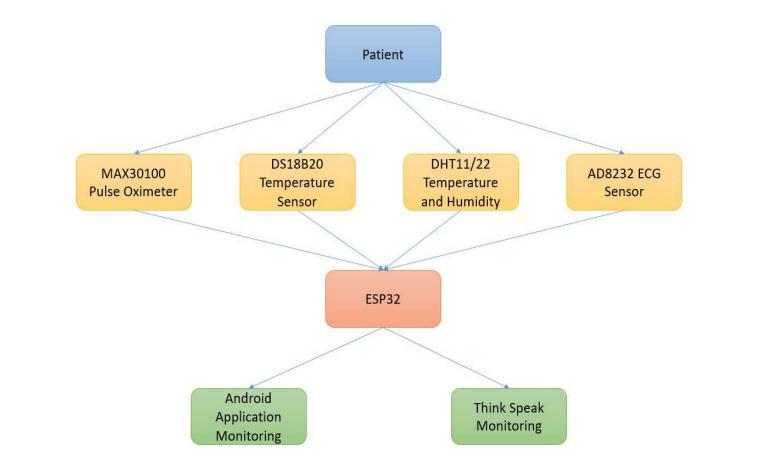
The flow of the system goes like firstly the patient is connectedwithsensorstothebodylikeAd8232ECGsensor has three color cables (red, blue, black). The black color cable is attached left arm , blue color cable is attached to right arm and red color cable is attached to right leg. The DS18B20 Temperature sensor is attached to the body of patient under Left/Right arm. DHT11 is not connected to bodyasitisusedforroomtemperatureandroomhumidity. MAX30100 Pulse oximeter is attached to the finger of the patient.Nowthedataiscollectedfromallthesensors and
International Research Journal of Engineering and Technology (IRJET) e-ISSN:2395-0056
Volume: 09 Issue: 11 | Nov 2022 www.irjet.net p-ISSN:2395-0072
uploaded on the cloud using ESP32 and is used by thingspeakandandroidapp.Allthemonitoringofthesensor is done on ThingSpeak Platform or on the Android Applicationinstalledinthesmartphone.
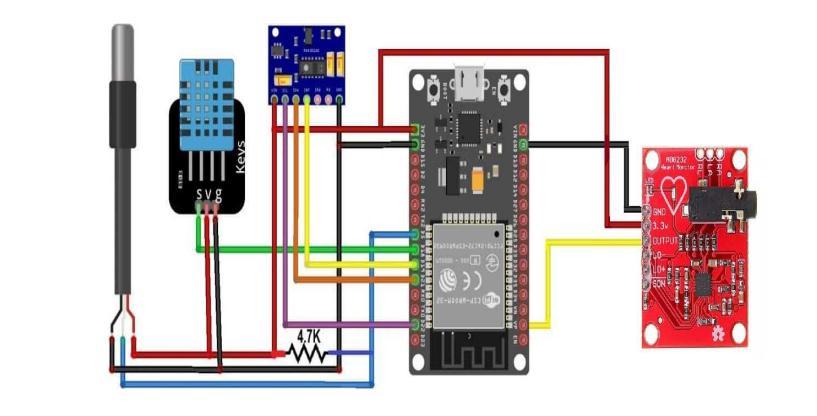
Allthesensordataoutputisprintedonserialmonitorand accuracyofthesensorsareasbelow:
• MAX30100PulseOximeter–Theresultisthatthe accuracyofthetoolreaches99.62
• DHT11TemperatureandHumiditySensor–DHT11 humidity range is from 20 percent to 80 percent with5percentaccuracy.
• DS18B20 Body Temperature Sensor – Measures Temperatures from -55°C to+125°C (-67°F to +257°F)with±0.5°CAccuracyfrom-10°Cto+85°C
• AD8232 ECG Sensor – A performance accuracy of 91.62percentisobtainedfromECGsystem
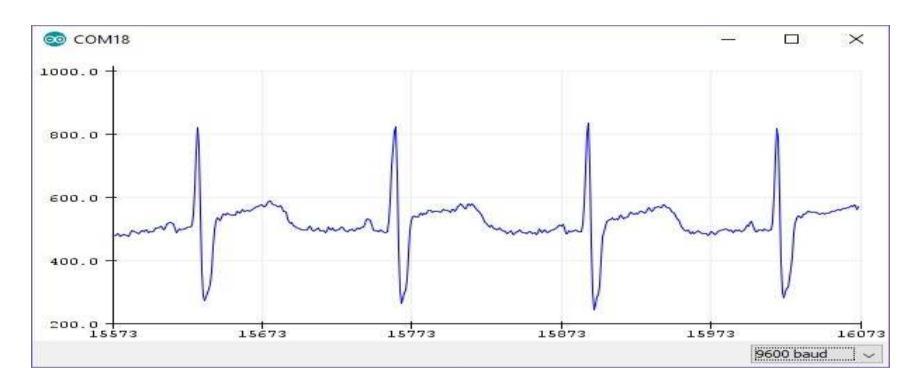
Fig -5: ECHPlotonSerialPlotter
NormalValuesofPatient
1-DHT11RoomHumidity30to50percent
2-DHT11RoomTemperature72F 3-AD8232ECGSensor(Heartbeat)60to100bpm 4-DS18B20BodyTemperature97Fto99F 5-MAX30100PulseOximeterAbove93percent
NormalValuesofECG
1-Heartrate:60-100bpm
2-PRinterval:0.12-0.20s
3-QRSinterval:lessthanequalto0.12s
4 - QT interval : less than half RR interval (males less than0.40s;femaleslessthan0.44s)
5-Pwaveamplitude(inleadII):lessthanequalto3 mV(mm)
6-Pwaveterminalnegativedeflection(inleadV1):less thanequalto1mV(mm)
7-Qwave:lessthan0.04s(1mm)andlessthan1/3of Rwaveamplitudeinthesamelead
5. Results
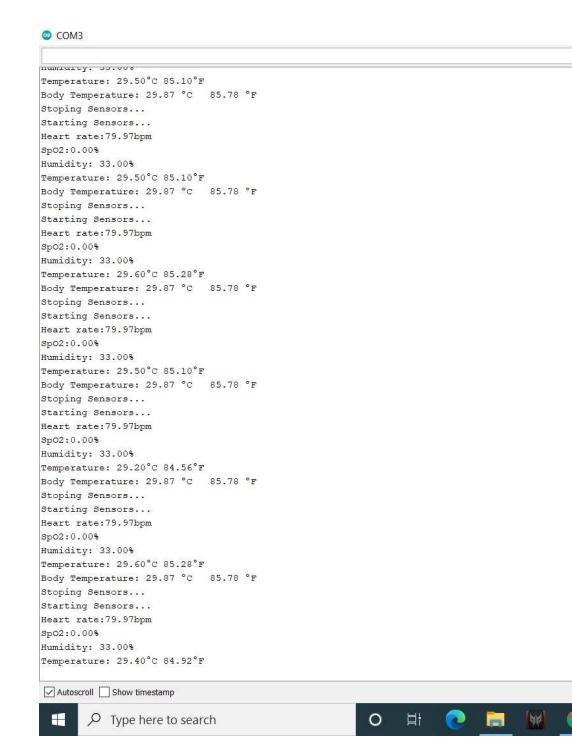
Fig -6: ThinkspeakFieldChart
Factor value: 7.529 | ISO 9001:2008
International Research Journal of Engineering and Technology (IRJET) e-ISSN:2395-0056
Volume: 09 Issue: 11 | Nov 2022 www.irjet.net p-ISSN:2395-0072
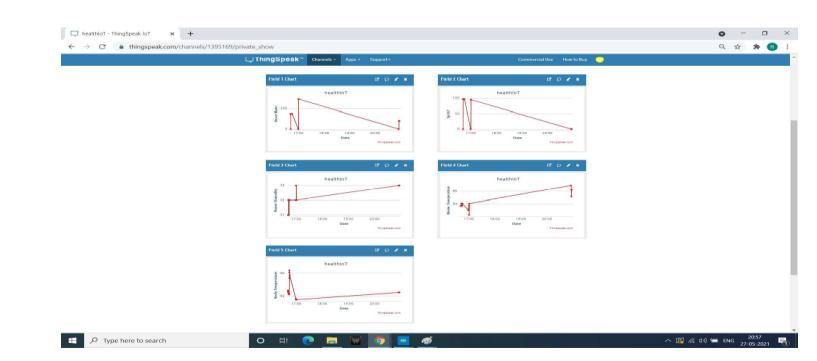
Figure6 showsfivefieldchartonThingSpeakplatformwith pulse oximeter output, body temperature output, room temperature output, room humidity output, heart rate outputwheredataisfetchedeverysecondfromthesensor andupdatedeverysecond
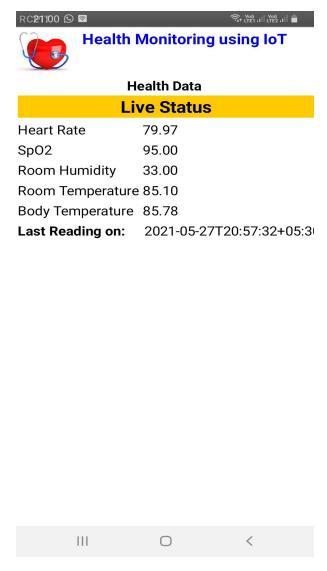
Figure 7 shows android application for live tracking or monitoringofthedatafetchedfromthesensorsandwhich areuploadedtoThingSpeak,Thisappuseshttpgetandhttp response from the ThingSpeak platfrom and same data is sharedintheapplication.
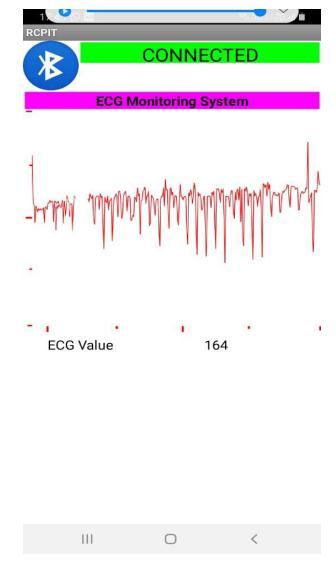
Fig -8: ECGplotonAndroidApplication
Figure 8 shows android application for ECG Plotting from AD8232 ECG sensor and the sensors pads are attached to patientsbody.
TheInternetofThingsisconsideredasoneofthefeasible solutions for any remote value tracking, especially in the field of health monitoring. It facilitates that the individual prosperityparameterdataissecuredinsidethecloud,and staysinthehospitalforconventionalroutineexaminations Mostimportantlythehealthcanbemonitoredanddisease be diagnosed by any doctor across the globe. This system monitorsbodytemperature,pulserateandroomhumidity andtemperatureusingsensors.Thesevaluesarethensent toamedicalserverusingwirelesscommunicationandthe data is then received on an authorized personals smart phone with IoT platform. Further, with these values the doctorthendiagnosesthediseaseandthestateofhealthof thepatient.
There are other health parameters that can be monitored suchascufflessbloodpressure,non-invasivebloodglucose, respiratoryrate.Additionally,machinelearningtechnology can be considered as a vital addition to the healthcare monitoringsystembecauseitwillassistdoctorstodiagnose
International Research Journal of Engineering and Technology (IRJET) e-ISSN:2395-0056
Volume: 09 Issue: 11 | Nov 2022 www.irjet.net p-ISSN:2395-0072
diseasesfasterandmoreaccuratelythantheconventional diagnosingapproaches.Furthermore,incaseofurgent,when there is an abnormal signal produced from the patient’s body, there are some approaches can be added to this project to handle this need. First, mobile calling and SMS messages sending to doctors, patients, relatives, and ambulance centers can be performed by adding SIM800L GSM Module to this project. Emails also can be sent via NodeMCUautomaticallytospecificpeople’semailaccounts to save lives. Second, a wearable DC defibrillator can be attached to the patient body to apply DC shocks automaticallywhensuddenVF(VentricularFibrillation)is happening. Finally, this system can be equipped with an automatic ventilation system to provide the oxygen automaticallyincasetheSPO2.
[1] RolfH.Weber,RomanaWeber,2010InternetofThings, Springer,41-68.M.
[2] Rahaman A, Islam M, Islam M, Sadi M, Nooruddin S. DevelopingIoTbasedsmarthealthmonitoringsystems: areview.RevIntellArtif.2019;33:435–40.
[3] L.A.Dur´an-Vegaetal.,2019Aniotsystemforremote healthmonitoringinelderlyadultsthroughawearable deviceandmobileapplication,Geriatrics,4(2),p.34.
[4] S. Diekmann et al., 2019 Economic evaluation of prolongedandenhancedECGHoltermonitoringinacute ischemicstrokepatients,CurrentMedicalResearchand Opinion,35(11),pp.1859-1866.
[5] Rizwan, K. Suresh. Design and development of low investment smart hospital using Internet of things through innovative approaches, Biomedical Research. 28(11)(2017).
[6] SarfrazFayazKhan,“HealthCareMonitoringSystemin Internet of Things (loT) by Using RFID”. pp 198-204, 2017.
2022, IRJET | Impact Factor value: 7.529 | ISO 9001:2008 Certified Journal