International Research Journal of Engineering and Technology (IRJET) e-ISSN:2395-0056

Volume: 09 Issue: 11 | Nov 2022 www.irjet.net p-ISSN:2395-0072
International Research Journal of Engineering and Technology (IRJET) e-ISSN:2395-0056
Volume: 09 Issue: 11 | Nov 2022 www.irjet.net p-ISSN:2395-0072
1Vanshika Vashisht, M.Plan(Urban Planning), Sushant University, Gurugram, Haryana, India
2Professor Shalini K. School of Art & Architecture, Sushant University, Gurugram, Haryana, India
3Professor Varsha Khetrapal, School of Art & Architecture, Sushant University, Gurugram, Haryana, India ***
Abstract – Complete Streets is a method of designing, managing, operating and maintaining streets that permits safe access for all users, including transit users of all ages and abilities like motorists, cyclists, and pedestrians. The challenging interests of the transit users are significant at intersections as everyone is fighting to save ‘time’ to cross the particular intersection. Driver expectations must change to include sharing the road with other modes in urban and suburban environments where intersection users will suffer delays and conflicts involving cars,pedestrians,andbikes. This review paper makes it clearthataccessmanagementgoals are to maintain street safety and mobilitywhileenablingaccessto land uses by regulating access location, design, spacing, and operation. The paper provides a review of the complete intersection designs as guided by the North Carolina Department of Transportation (NCDOT).
Key Words: Pedestrians, Intersections, Conflicts, Delays, Cyclists,Transit,Street,Urban
Thisstrategyalsoplacesafocusontheneedsofthosewho have suffered from systematic underinvestment or whose needs have not been satisfied by a conventional transportationapproach,includingolderfolks,peoplewith disabilities,thosewithoutaccesstocars,andvariousother communities.
The "Complete Streets" policy has provided a basic framework for including multi modal system for the proposed infrastructure and the brown field projects, strengthening the older areas and taking burden off the streets.[1]
Thisstrategyhasthefollowingadvantages:
•Improvingaccessibilityfortravellers;
• Promoting the use of alternative modes and routes of transportation;
•Creatingmoresustainablecommunitiesandsocieties;
•Increasingconnectivitybetweencommunities,streets,and transitsystems;
• Improving safety for motorists, cyclists and drivers especiallypedestrians
ThereisnoonespecificdesignprescriptionforComplete Streets,evenifitisaprocessandapproachtostreetdesign. Eachoneisdistinctandreactstoitslocalenvironment.One ormoreofthefollowingmaybefoundonacompletestreet: curbextensions,bikelanes(orwidepavedshoulders),special buslanes,comfortableandaccessiblepublictransportation stops, frequent and safe crosswalks, median islands, accessiblepedestriansignals,accessiblepedestriansignals, accessible pedestrian signals, sidewalks, roundabouts, and more.
Even when employing a Complete Streets concept, streets willstilllookdifferentinrural,suburban,andurbanregions becauseofthedifferencesinenvironmentanduserneeds.
Countries all around the world have witnessed an increasing need to make it safer and easier for citizens to walk, cycle, use free public transportation and drive. As, a city’s population grow, more and more people seek urban amenities and better lifestyles. In western countries, healthcarecostsandobesity,alongwiththerisingfuelprices, still remain the number one reason of switching to public transportation.
Accordingto TrafficSafetyFacts [2][3],apedestrianwas killedevery81minutesinatrafficcrash. Table - 1 depicts thePedestrianFatalitiesdatainNorthCarolinaoveraperiod of10years,from2011-2020[4].
Table - 1: TotalFatalitiesandPedestrianFatalitiesin TrafficCrashes,2011–2020
International Research Journal of Engineering and Technology (IRJET) e-ISSN:2395-0056
2017 37,473 6,075 16%
2018 36,835 6,374 17%
2019 36,355 6,272 17%
2020 38,824 6,516 17%
Source : Crash Stats, National Highway Traffic Safety Administration
Theincreasingpedestrianfatalitieshasbeenamajorfactor contributing towards the need of Complete Street Designs andPolicies.
However,establishingaclearpolicyisonlythefirststageofa muchlongerprocessthatwillimpactstreetdesignpractices. The projects that are created and how they are built are determined by these practices, whichare the fundamental elements of establishing a full network that will serve everyone and link more people to destinations safely and effectively.Thesedifferentstagesaredepictedin Figure 1.
• Sinceajunctionisa partofthelargernetwork,the designshouldincludesuitabledesignsandamenities thatarecarriedthroughtheintersectionandoutto thestreetapproaches.
• Whenapproachinganintersection,drivers,bicycles, and pedestrians should be able to see and react to oneanother.Byallowingsufficientsightdistanceat intersections,locationswherevehiclesaremerging, and crosswalks, as well as by putting the proper pavement markings, signs, and signals, you can alwaysmakesurethatpedestriansandbicyclesare asvisibleaspossible.
• At the junctions, channelizing islands to isolate conflictsmightbeakeydesignelement.Islandswith the right design may reduce conflict sites, create a pedestrian refuge space, break up pedestrian crossingmaneuvers,andcutthecrossingdistance.
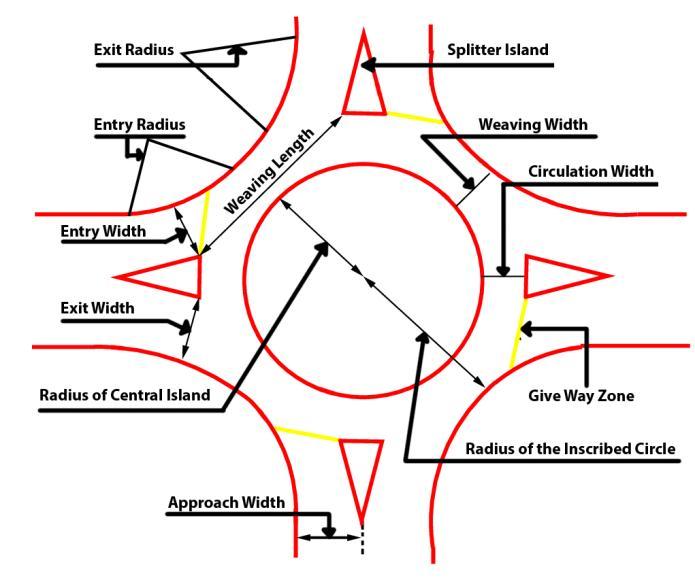
Figure 2 showstheelementsofacompletestreetdesign
Figure 1:
ofDevelopingProjectsw.r.t Policies
Source : Author, 2022
Abasicunderstandingoflanduse,transportationnetwork context is necessary for designers and planners while designing intersections. These are the general principles whichcouldassistindevelopingcompleteintersections:

• Intersectionsgenerallyposetheproblemofincreased conflicts between various modes of transportation and they should prioritize the movement of the cyclistsandpedestrians.Themainmotiveshouldbe toreducethecrossingtimeatjunctionsforvarious modes.
• Thenumberoflanesofthejunctionsdeterminesthe main design parameters Intersections should be logicallybuiltsoastoreducetheareaofthecrossing orsimplythecrossingdistance.
• Thespeedfortheintersectionsshouldbeaccording tothetypeofroadsleadingtothoseintersectionsand accordingtothelandusearound.Drivingataslower speedgivesthedrivermoretimetoseeandrespond toissuesatjunctions.
• Intersectionsshouldbeconstructedsodriverslearn to anticipate pedestriansand bicycles, ascollisions areoftenlesssevereifspeedsareslower.
Figure 2: DesignElementsofaCompleteIntersection
Source : Prof. Tom V. Mathew, Traffic Rotaries, 2019
InthecontextofNorthCarolina,variousstreetpatterns andnetworkswereidentifiedwhichcouldbealignedforthe policyofcompletestreets[2].Thesetypesareasbelow:
MainStreetIntersection
BoulevardIntersection
AvenueIntersection
ParkwayIntersection
OtherIntersections
Volume: 09 Issue: 11 | Nov 2022 www.irjet.net p-ISSN:2395-0072 © 2022, IRJET | Impact Factor value: 7.529 | ISO 9001:2008 Certified Journal | Page740
International Research Journal of Engineering and Technology (IRJET) e-ISSN:2395-0056
Volume: 09 Issue: 11 | Nov 2022 www.irjet.net p-ISSN:2395-0072
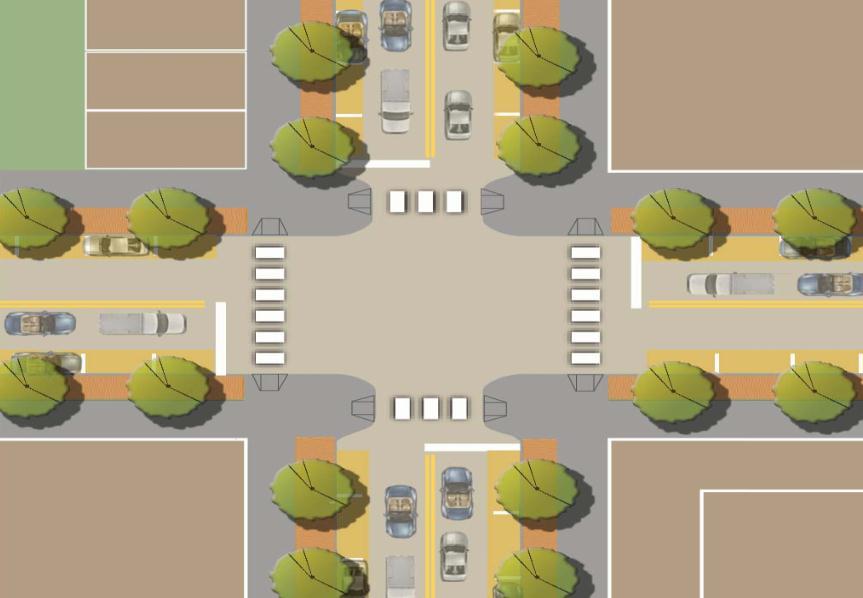
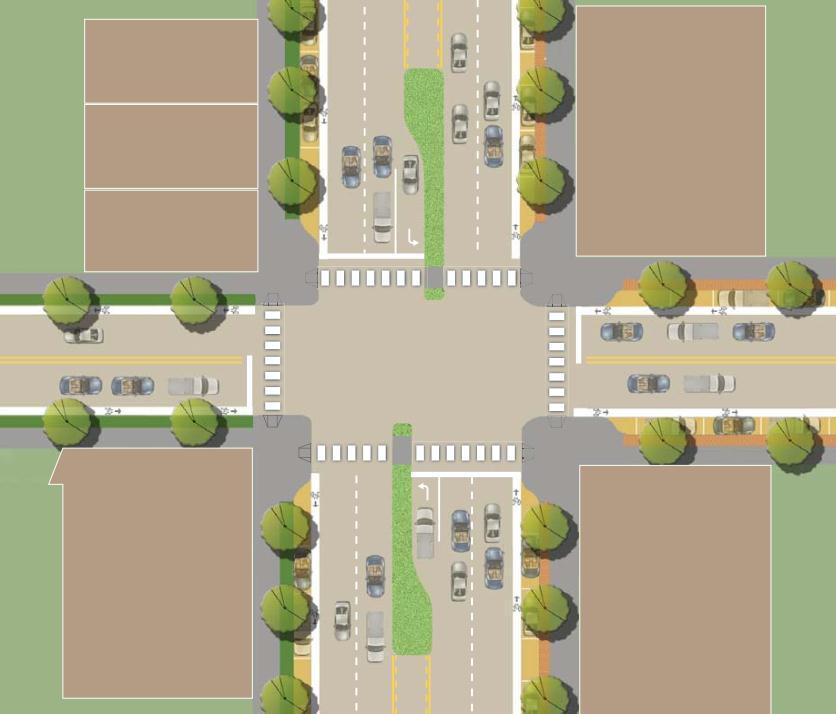
These intersections should prioritize pedestrian travel needs including high visibility crosswalks. [5] They are plannedtocarryvehiclesatamuchlowerspeedrangingfrom 30-35km/hr.On-streetparkingshouldalsobeprovidedfor thevehicles.
Separate bicycle lanes should not be provided duetothevolumeoftrafficandlowerspeedsof vehicles.
Pedestrian signals with countdowns should be provided.
No bus stops should be provided in close proximity of the intersections, along with no separateleftorrightturninglanes.
uncommon.Parking,ifoffered,shouldnormallybelocatedon adistinct,parallelfrontageroadwaythatisdividedbyaside median.
Boulevards have a tendency to attract higher volumesoftrafficatmuchhigherspeedswhich can be dangerous for users like cyclists and pedestrians.
Boulevards typically have left-turn lanes and they permit right turn lanes and right turnislands
Boulevards always have a median and more lanesthanavenues.
Iftheroadwayhasfiveormorelanesoftrafficor the crossing distance is longer than 50 feet, includearefugeislandinthepedestriancrossing.
Numerous refuge islands should be proposed when the number of lanes are seven or more Thegoalistolimitthedistancethatpedestrians mustcrosstofivelanesorfiftyfeet.Thisdistance is without the presence of a refuge island to minimizethedistance
These intersections should carry cycling lanes throughtheintersection
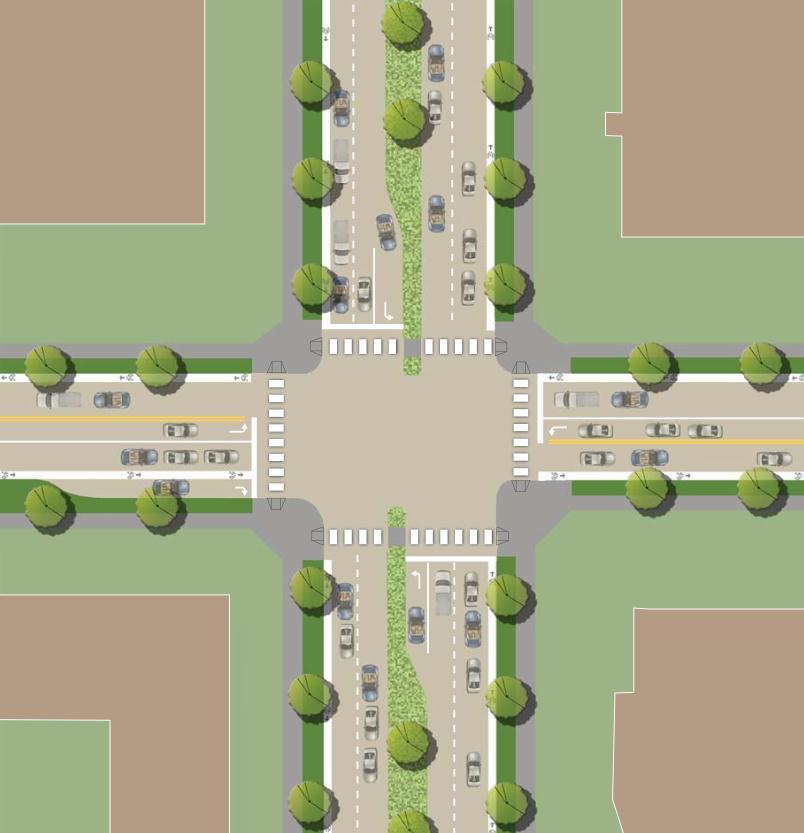
Theseintersectionspermitbusstopsonthefar sideoftheintersectionincludinghighvisibility crossingsandintroducepedestriancountdown signals.
Source : Complete Streets Planning and Design Guidelines
These intersections most frequently serve as arterial roads to transport cars at a moderate pace. They are characterizedasathoroughfarethathasastreetmedianand many lanes. Due to faster speeds and larger amounts of motorvehicletraffic,broadwalkwayswithampleplantation ontheedgesandmediansandseparatelanesforbicyclesare required to support various other users like pedestrians, cyclists,etc.[6]Additionally,buildingsetbackswilloftenbe deeperthanonavenues.Sheltersandtransitstationscould be positioned inside the right-of-way, necessitating connectionstowalkways.
Parkingonthestreetisnotnecessary.Itispermittedwhen appropriate,althoughbecauseofthenatureofthestreet,itis
Source : Complete Streets Planning and Design Guidelines
International Research Journal of Engineering and Technology (IRJET) e-ISSN:2395-0056
Volume: 09 Issue: 11 | Nov 2022 www.irjet.net p-ISSN:2395-0072
Theymayserveasanarterial,collector,orlocalroadina ruralarea,althoughittypicallymovesatslowtomoderate speeds. They act as an urban thoroughfare that carries a variety of traffic between and among different area types. Transitstations,shelters,andotherfacilitiesarepositioned along the route, ideally inside the right of way. Wide walkwaysandon-streetcyclingfacilitiesarepresent.
Theseintersectionsnormallydonothavemedians buttheyshouldbeminimum6feetwide,ifprovided.
Thebasicavenuedesignincludeslavishislandsfor landscaping,pedestriancrossingpossibilities
Theyarelesslikelytohavedistinctright-turnlanes than boulevards or parkways and have tighter intersectionspacing.
Ifthestreetisoffourorlesserlanesthennorefuge islandisneeded.However,ifthepedestriancrossing distanceexceeds50feetorthestreetis5lanesor more,thenarefugeislandismandatory
Theywillincludea"receiving"bicyclelanetheother side of the intersection and carry bicycle lanes throughtheintersection.
Inordertoallowforbusstopsontheoppositeside, zebracrossings,andcountdownpedestriansignals, thebicyclelaneshouldbedeletedshortlybeforethe actualcrossing
Avenuescouldormightnotbeapartofthenetwork ofkeyhighways.
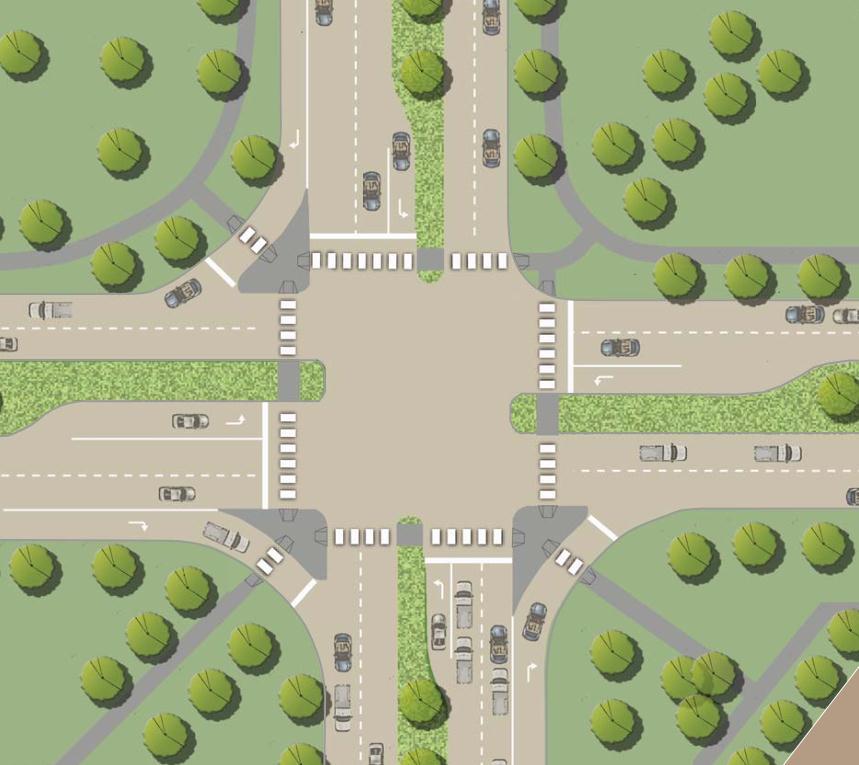
Theyserveasarterialroadsmostlytocatercarsmovingat mediumtohighspeeds.Landscapingoruncultivatedplants alongthesidesoftheroadandinthemediansarefrequent featuresofurbanorruralthoroughfares.Landusesareoften notorientedtowardtheparkwayandaresetbackfromthe street.Parkwayintersectionsprovideeasyaccesstotransit stations,busstops,andparkinglots Pedestrianandbicycle trafficaretypicallyaccommodatedonseparatemulti-use
These intersections generally do not traverse the mainstreets.
Theymighthavemultiplelanesalongwithamedian.
Theywillallowdualrightandleftturninglanes.
Theywillincluderefugeislandsifthestreetiswider than7lanes.
They should provide pedestrian signals with countdownsalongwithhighvisibilitycrossings.
Source : Complete Streets Planning
Source : Complete Streets Planning and Design Guidelines
Other intersection types, apart from the signalizedand unsignalizedintersections,arenecessarytodesigncomplete streets.Theseintersectionsshouldbebuilttorepresentthe contextaswellastobeenhancetheuserexperiences.These include table top crossings and other elements like refuge islands, zebra crossings green strips, medians that are necessaryforsupportingthepedestriansandcyclists.[7]
International Research Journal of Engineering and Technology (IRJET) e-ISSN:2395-0056
Volume: 09 Issue: 11 | Nov 2022 www.irjet.net p-ISSN:2395-0072
Providing roundabouts at other intersections can help increasetheintersectioncrossingtimeforalltheusers.The hugevolumeoftrafficcaneasilyflowthroughtheroundabout withoutanydelayandchaos.
Whilecomparingalltheintersectionsdiscussed,weclearly see that the medians are mandatory while designing BoulevardsandParkways.Mainstreetsmightneverinclude medians while it is not necessary to include continuous medians in the avenues. The purpose of not providing continuous medians on avenues is to avoid long distance intersections and logical route options. If the hierarchy of roads is considered parkway and boulevard intersections mightbelocatedonthehigherhierarchyofroadsi.e,arterial roadsorprimarycollectorroads[5].Thesecondarycollector roads and local roads might include the main streets and avenueswhichcarryvehiclesatlowerspeeds
We concur that by regulating access placement, design, spacing, and operation aims to build a safe street while incorporating different modes of transportation and providing easy access to all kinds of land uses. The focus might be on pedestrians and bicyclists but planning and designingcompleteintersectionsisinclusiveandtakesthe needofallusersintoaccount,includingthepeopleofallages andabilities.[8][9]Theseguidelinestodesigningcomplete intersectionswillsupporttheaimofprovidingconvenient, safeandcomfortabletravelforallusers.
Iwouldliketoexpressmyhonestanddeepestappreciation to Prof. Shalini K. and Prof. Varsha Khetrapal, whohave constantly guided me, helped me structure my paper and witheverydifficultywiththeirutmostprofessionalism.
Iwouldliketothankthemforalwayshavingtheattitudeand thesubstanceofagenius:theycontinuallyandconvincingly conveyed a spirit of adventure regarding this paper and excitementregardingteaching.Withouttheirguidanceand persistenthelp,thispaperwouldnothavebeenpossible.
[1] NorthCarolinaDepartmentofTransportation,"Complete StreetsPlanningandDesignGuidelines,"NorthCarolina DepartmentofTransportation,2012.
[2] (NHTSA), National Highway Traffic Safety Administration,"TrafficSafetyFacts,"U.S.Departmentof Transportation,2022.
[3] N.CDepartmentofTransportation,"NationalPedestrian Safety Facts," May 2021. [Online]. Available: https://oshr.nc.gov/facts-and-figures.
[4] J.E.B.J.J.T.P.H.S.T.RoyCooper,"NorthCarolina2020 Traffic Crash Facts," North Carolina Division of Motor Vehicles,2021.
[5] UTTIPEC,"StreetDesignGuidelines,"UTTIPEC,2009.
[6] C.K.K.C.C.R. HwanNamGung,"ResearchProgressof RoadIntersectionDesignAnalysis," InternationalJournal of Scientific Research in Science, Engineering and Technology, vol.7,no.6,pp.245-256,2020.
[7] M.A.-A.Ma’enMohammadAliAl-Omari,"Evaluationofa New Intersection Design, “Shifting Movements”," Sage Journals, vol.2675,no.10,2021.
[8] R. Rauf, "Complete Streets - A Case Study of Boulder, Colorado, and the Great Streets Initiative," Niehoff Studio,UniversityofCincinnati,Cincinnati,2010.
[9] T.Jagannath,"PedestrianizedStreetsCreateImportant Public Spaces," Interviews and Articles on Art & Public Spaces, 17October2016.
VanshikaVashisht,Architectfrom USAP,GGSIPUniversity,currently pursuing her Masters of Planning (Urban Planning), Sushant University,Gurugram.Herareaof interest is to work for the better streetsandbettercities



Prof. Shalini K., Bachelor’s in Physical PlanningandMaster’sin Urban Planning from School of Planning and Architecture - New Delhi. Research Associate with Centre for Policy Research (CPR) andInstituteofTownandCountry Planning,India(ITPI)
Prof. Varsha Khetrapal, Architect and Environmental Planner from SPA, New Delhi Her area of researchisonstreetplanningand designing and its evaluation. She hasalmost2decadesofexperience in the field of architecture and planning,includingacademicsand industry. She has published articles in various journals and conferences