International Research Journal
of
Engineering and Technology (IRJET) e-ISSN:2395-0056

Volume: 09 Issue: 11 | Nov 2022 www.irjet.net p-ISSN:2395-0072
International Research Journal
Engineering and Technology (IRJET) e-ISSN:2395-0056
Volume: 09 Issue: 11 | Nov 2022 www.irjet.net p-ISSN:2395-0072
Department of civil engineering, Harcourt butler technical university,Nawabganj Kanpur 208002 (UP) India ***
ABSTRACT-The goal of the current study was to assess how well kanpur City's existing sewage treatment facilities (STPs) wereperforming.TwoSTPs,basedonASPeachhavinganoperatingcapacityof130MLDand36MLD,respectively,arenowin operationinKanpur.TheamountofbiogasproducedbytheASPreactorisalsolessthanitsdesignvaluesincethewastewater ismixedwithhousehold effluentasittravelsthroughtheSTPs,resultingina relativelylowBODconcentration. Toascertain the plants' efficiency, by the method of artificial neurons network(ANN) have been applied. Graphical interpretations have beenusedforalltheoutcomes.Thestudy'sfindingsshowthattheASPreactorperformsmoreefficient..
Key words: Sewagetreatment,lifecycleanalysis,pollution,ASP,landcost,influent,effluent,KanpurCity,India
ThevaryingqualityoftherawwateravailableinIndianecessitateschangestothetraditional
Anaerationandchemicalwatertreatmentplanfiltration,sedimentation,flocculation,coagulation,anddisinfection.Sludgeand backwash water production environmental issues arise from water treatment facilities. when it comes to disposal. Consequently, chemical process optimization Dosing and filter runs are crucial to lowering the waste products from water treatmentfacilities.Thereisalsothenecessitytoresearchwatertreatmentfacilitiesfortheiroperatingstateandtoinvestigate the most practical technique to assure optimal production of drinking water with as few rejections as feasible and its administration. Due to this the Central Pollution Control Board as a backdrop (CPCB), analysed water treatment facilities nationwide,forthecurrentlyavailablerawwaterquality.
The release of wastewater into the environment resulted in unfavourable conditions, which prompted the development of extensivesewagetreatmenttechniques.Sedimentationoneoftheinitialprocedureswaschemicalprecipitation.usedtotreat wastewater In 1865 the early The microbiology of sludge digesting experiments were carried out in England. The first experimentsonintermittentwastewaterfilteringwasdone,whileearlystudiesonintermittentsandwereconductedin1870. InEngland,filtrationwereproduced.Firstseptictankbuiltin1876intheUnitedStatesofAmerica.Initially,in1882Aeration experiments were conducted in England. United In 1884, States used bar racks for the first time. in the U.S. The state's first facilityfor treating chemical precipitation was erected in1887.Filtration in contact beds wasinventedin 1889. Septic tanks wereusedbecausetheoffensivenatureofthesludgecreatedbysedimentationmadethesolidstheremoreorlessinoffensive, although challenges of many kinds prompted the widespread adaptation of In 1904, Travis built a two-story septic tank in England.
Germany granted a patent for the Imhoff tank in 1904. The process of disinfecting wastewater via chlorination was Phelps gaveademonstrationofitin1906intheUnitedStates.IntheUnitedStates,atricklingfilterwasinstalledforthefirsttimeina municipalsettingin1908,andregulationsgoverningChickdevelopeddisinfectionintheUnitedStates.ThefirstImhofftanks werebuiltintheUnitedStatesin1911.
1912–1913: Aeration of Slate-filled tanks with wastewater were used at Experiment Station Lawrence. There were experiments in 1914. that produced the study by Arden and Lockett creation of the activated sludge method, which uses a Thereisagreatdegreeofcleansing.Themethodwasutilisedatamunicipalsewagetreatmentfacilityat1916inSanMarces, Texas.Contactaeratorsdebutedin1925developedintheUSbyBuswell.
The numerous changes occurring in the world today are caused by the changing features of wastewater as a result of the release of several toxins treatment of wastewater. Treatment of sewage or waste is one such option, where numerous
e-ISSN:2395-0056
Volume: 09 Issue: 11 | Nov 2022 www.irjet.net p-ISSN:2395-0072
processes created and run to closely resemble the natural procedures to treat pollutants to a certain level the capacity of nature. In this regard, particular focus is required to evaluate how existing practises affect the environment Facilities for treatingwastewater.
Thisproject'sprimarygoalistoassesstheeffectivenessofeachparameterandtheoveralleffeciencyofthesewagetreatment facilityduringthesummerandwintermonths.
Thestudy'sobjectivesareasfollows:
Toresearchthesignificanceofeveryparameterinengineeringofwastewater.

ToassesstheeffectivenessofTSSandBODremovalofasewagetreatmentfacilityinthesummer. ToassesstheeffectivenessofTSSandBODremovalofasewagetreatmentfacilityinthewinter.
Firstofall,comparedtoconventionalaerationwithoutmedium,theBOD5(testingforBODaftertakinganincubationperiod) water quality metric maximises the development of microorganisms in a given volume of aeration tank. The media in FAB technology is kept still and fluidized in the aeration tank. Results for a total capacity of 43 MLD have been published. In this instance, the sludge produced was dried in sludge drying beds before being disposed of as waste or given away for free to nearbyfarmers.Inthisinstance,thetreatedwaterisreleasedintotheHolyGangaRiver.Itisdifficulttodetermine ifitismore efficient to construct a single plant that treats a huge volume or numerous plants that treat different minor flows when designingaplant.Asaresult,it'simportanttoevaluateasewagetreatmentplant'spotentialeffectsontheenvironmentwhile taking its capacity into account. Sewage treatment system evaluation tools include the Artificial neural network (ANN). The ANN'sinputshouldbeadatasetofCOD,BOD,andTSSvariationdatathatwaschosenasaresponseforboththemodellingof STPs and the variation of waste water quality data (factors). Finally, multivariate modelling using ANN necessitates the production of a diverse set of data demonstrating response variation as a function of the components.. pH and operational temperature were kept between 28 and 32 oC and 7 and 0.5, respectively. The analysis of the samples that were taken provided the primary data, while U.P. Jal Nigam's Ganga Pollution Control Unit in Kanpur city provided the secondary data. The sampling process involved composite sampling, and the samples were kept chilled between collection and analysis. The sampleswereanalysedthedaytheywerecollected.
Thisstudyemploysanartificialneuralnetwork(ANN)asitsmodellingmethod.TheCOD,BOD,andTSSvariationdatadataset that was selected as a response for both the modelling of STPs and the fluctuation of waste water quality data serves as the ANN's input (factors). An analytical modelling technique known as an artificial neural network (ANN) may identify and generatecomplicatednon-linearcorrelationsbetweenindependentanddependentvariables.
International Research Journal of Engineering and Technology (IRJET) e-ISSN:2395-0056
Volume: 09 Issue: 11 | Nov 2022 www.irjet.net p-ISSN:2395-0072
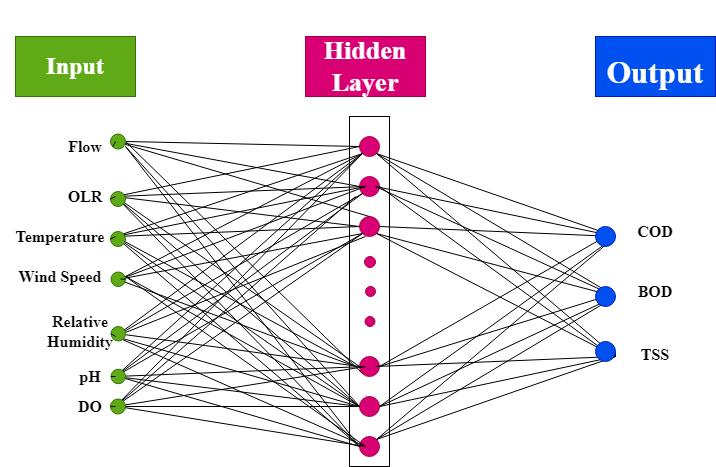
Thenumberofneuronsinthehiddenlayerisoneofthemostcrucial ANN parameters. Whenthereare eitheranexcessively highoranexcessivelylownumberofneurons,thenetworkgetscomplexorunderperforms.Thenetworkmusthaveanideal distributionofneuronsforittofunctioneffectively.ThenumberofneuronsintheANNvariedbetween7and21inSTPJajmau Kanpur.
e-ISSN:2395-0056
Volume: 09 Issue: 11 | Nov 2022 www.irjet.net p-ISSN:2395-0072
ANN architecture with the multilayer feed forward back propagation algorithm for modeling of parameters in STP Jajmau kanpur
S. No. Date
Influent S. No.
Effluent TSS (mg/ l) BOD (mg/l) COD (mg/l) TSS (mg/ l) BOD (mg/l) COD (mg/I)
1. 01/06/2022 296 294 332 2. 160 80 268 3. 02/06/2022 301 300 344 4. 98 60 208 5. 03/06/2022 300 295 332 6. 76 66 160 7. 04/06/2022 301 308 340 8. 64 55 140 9. 05/06/2022 310 306 332 10. 62 46 128 11. 06/06/2022 311 305 348 12. 60 38 96 13. 07/06/2022 307 302 336 14. 58 30 92 15. 08/06/2022 309 302 340 16. 60 29 88 17. 09/06/2022 310 310 352 18. 56 28 76 19. 10/06/2022 302 300 328 20. 53 29 72 21. 11/06/2022 299 300 344 22. 51 30 76 23. 12/06/2022 305 301 336 24. 50 28 64 25. 13/06/2022 299 300 328 26. 52 24 64 27. 14/06/2022 308 302 348 28. 50 29 56 29. 15/06/2022 309 302 344 30. 49 24 50 31. 16/06/2022 300 298 328 32. 48 28 48 33. 17/06/2022 301 299 344 34. 45 26 46 35. 18/06/2022 290 300 336 36. 47 28 42 37. 19/06/2022 292 301 352 38. 43 27 44 39. 20/06/2022 304 310 346 40. 42 25 40 41. 21/06/2022 298 284 368 42. 40 24 36 43. 22/06/2022 310 310 324 44. 42 26 44 45. 23/06/2022 315 304 356 46. 39 28 40 47. 24/06/2022 312 303 340 48. 41 25 48 49. 25/06/2022 303 290 332 50. 39 27 42 51. 26/06/2022 300 310 328 52. 37 25 40 53. 27/06/2022 307 308 344 54. 42 26 46 55. 28/06/2022 304 310 328 56. 46 29 48 57. 29/06/2022 307 307 340 58. 40 30 44 59. 30/06/2022 312 130 336 60. 160 80 268
e-ISSN:2395-0056
Volume: 09 Issue: 11 | Nov 2022 www.irjet.net p-ISSN:2395-0072
S. No. Date
Effluent TSS (mg/ l) BOD (mg/l) COD (mg/l) TSS (mg/ l) BOD (mg/l) COD (mg/l) 61. 1/07/2022 314 132 352 62. 24 35 40 63. 2/07/2022 316 133 340 64. 21 37 44 65. 3/07/2022 318 130 336 66. 20 35 36 67. 4/07/2022 320 136 348 68. 22 36 40 69. 5/07/2022 336 139 344 70. 19 34 36 71. 6/07/2022 229 142 332 72. 18 30 32 73. 7/07/2022 303 146 340 74. 20 33 40 75. 8/07/2022 306 153 352 76. 19 32 36 77. 9/07/2022 313 149 360 78. 21 35 44 79. 10/07/2022 316 146 348 80. 18 33 40 81. 11/07/2022 324 153 360 82. 19 32 36 83. 12/07/2022 328 160 374 84. 17 30 32 85. 13/07/2022 328 156 368 86. 20 35 40 87. 14/07/2022 309 159 376 88. 18 37 44 89. 15/07/2022 332 156 380 90. 19 34 36 91. 16/07/2022 340 149 372 92. 22 36 40 93. 17/07/2022 344 145 368 94. 18 30 32 95. 18/07/2022 335 150 360 96. 16 33 36 97. 19/07/2022 340 153 376 98. 17 35 40 99. 20/07/2022 340 160 360 100. 19 36 44 101. 21/07/2022 336 156 352 102. 22 34 36 103. 22/07/2022 348 159 364 104. 17 33 44 105. 23/07/2022 352 156 380 106. 20 34 40 107. 24/07/2022 316 155 352 108. 22 32 36 109. 25/07/2022 328 160 372 110. 24 30 44 111. 26/07/2022 344 153 356 112. 21 33 40 113. 27/07/2022 336 156 364 114. 23 32 44 115. 28/07/2022 332 159 378 116. 24 34 40 117. 29/07/2022 352 165 360 118. 25 36 44 119. 30/07/2022 328 163 380 120. 26 35 40
International Research Journal of Engineering and Technology (IRJET) e-ISSN:2395-0056
Volume: 09 Issue: 11 | Nov 2022 www.irjet.net p-ISSN:2395-0072
ANALYSIS
e-ISSN:2395-0056
Volume: 09 Issue: 11 | Nov 2022 www.irjet.net p-ISSN:2395-0072
T SS (%)
85.5 86 86.5 87 87.5 88 88.5 89 89.5 0 5 10 15 20 25
Number of observations
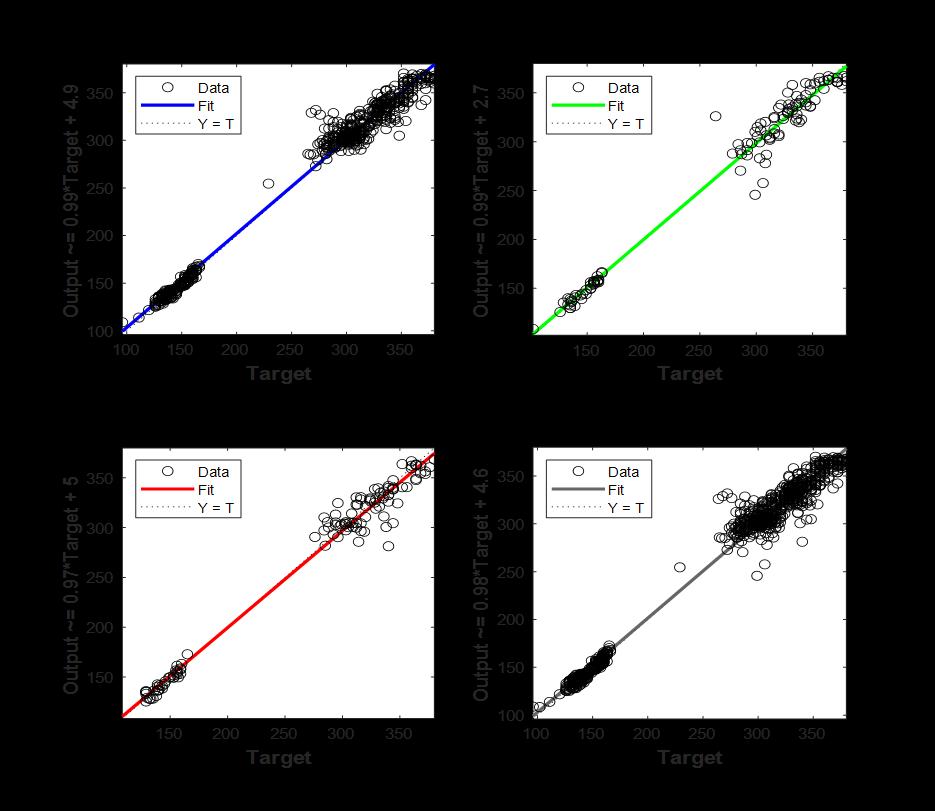
Performance evaluation has been given consideration for a waste water treatment facility that uses the biological treatment technology known as the Activated Sludge Process. Overall effectiveness of the current was acceptable. According to UP JAL NIGAMData,BODhadaremovaleffectivenessof94.84%andTSShadaremovalefficiencyof90.75%.Accordingtolaboratory testsonsamples,theremovaleffectivenessofBODwas94.04%andthatofTSSwas92.68%inwinterseason.
The calculated values for BOD and TSS for the summer were 93.08% and 88.68%, respectively. Additionally, the individual unitsareoperatingeffectively,andtheirremovalefficienciesareacceptable.Theprimaryclarifier'sremovalefficiencyforBOD andTSSare57.38%and53.42%,respectively.
The activated sludge plant's (Aeration tank + Secondary clarifier) BOD and TSS removal efficiency are 87.90% and 86.50%, respectively. According to the laboratory test sample, the elimination effectiveness of TSS was 90.61% and 93.42% for BOD, respectively.Thus,theplantanditsvariousunitsareoperatingsatisfactorilywhenthedatafromAuthorityandthelaboratory samplearecompared.
• Rai, R. K., & Nagaraj, K. (2018). Prediction of STP Operational Parameters Using ANN. InUrbanization Challenges in Emerging Economies: Energy and Water Infrastructure; Transportation Infrastructure; and Planning and Financing(pp.267-277).Reston,VA:AmericanSocietyofCivilEngineers.
• Tripathi, M., & Singal, S. (2013). Performance evaluation of sewage treatment plants in Lucknow City.Hydro Nepal: JournalofWater,EnergyandEnvironment,12,80-86.
• Singh,K.P.,Mohan,D.,Sinha,S.,&Dalwani,R.(2004).Impactassessmentoftreated/untreatedwastewatertoxicants dischargedbysewagetreatmentplantsonhealth,agricultural,andenvironmentalqualityinthewastewaterdisposal area.Chemosphere,55(2),227-255.
• Wakode, P. N., & Sayyad, S. U. (2014). Performance evaluation of 25MLD sewage treatment plant (STP) at Kalyan.AmericanJournalofEngineeringResearch,3(03),310-316.
International Research Journal of Engineering and Technology (IRJET) e-ISSN:2395-0056
Volume: 09 Issue: 11 | Nov 2022 www.irjet.net p-ISSN:2395-0072
• MW,B.A.,&Wanjule,R.V.StudyonSewageQualityfromSewageTreatmentPlantatSalimAliLake,Aurangabad(MS).
• Florence, K. R., Rollakanti, C. R., Prasad, C. V. S. R., & Nagendra, C. V. S. Performance Evaluation of Waste Water Treatment:ACaseStudyonSewageTreatmentPlant(STP).
• Kawale, E. M., Dohare, E. D., & Tupe, E. P. Performance evaluation of existing ASP & SBR (30 MLD capacity) STP’s at PCMC,Pune(MH)–Acasestudy.
• Choksi, K. N., Sheth, M. A., & Mehta, D. (2015). To evaluate the performance of Sewage Treatment Plant: A Case study.InternationalResearchJournalofEngineeringandTechnology(IRJET)e-ISSN,1076-1080.
• Gedekar,A.R.,Bhorkar,M.P.,Thergaonkar,V.P.,&Baitule,P.K.(2016).PerformanceEvaluationofSewageTreatment Plant(STP)–AReview.Int.J.Sci.Technol.Eng,2(07),2011-2013.
• Khalil, N., Sinha, R., Raghav, A. K., & Mittal, A. K. (2008, March). UASB technology for sewage treatment in India: experience, economic evaluation and its potential in other developing countries. InTwelfth International Water TechnologyConference(Vol.12,pp.1411-1427).
• Singh,K.P.,Mohan,D.,Sinha,S.,&Dalwani,R.(2004).Impactassessmentoftreated/untreatedwastewatertoxicants dischargedbysewagetreatmentplantsonhealth,agricultural,andenvironmentalqualityinthewastewaterdisposal area.Chemosphere,55(2),227-255.
• Gueymard, C. (1995).SMARTS2: a simple model of the atmospheric radiative transfer of sunshine: algorithms and performanceassessment(pp.1-78).Cocoa,FL:FloridaSolarEnergyCenter.
• KhAlIl, N., & AhMAd, T. (2016). Quality Assessment of Full-Scale Municipal Wastewater Treatment Plant consisting UASBReactorsandPolishingPondsduringitsStart-upPhaseinIndia.CurrentWorldEnvironment,11(1),47.
• Pathe, P. P., Kaul, S. N., & Nandy, T. (1995). Performance evaluation of a full scale common effluent treatment plant (cetp)foraclusterofsmallscalecottontextileunits.Internationaljournalofenvironmentalstudies,48(2),149-167