Digital Certificate Verification using Blockchain

Page 1

International Research Journal of Engineering and Technology (IRJET)

e-ISSN: 2395-0056

Volume: 09 Issue: 11 | Nov 2022

p-ISSN: 2395-0072

www.irjet.net

Digital Certificate Verification using Blockchain Prof. Priyanka Abhale1, Anjali Chikate2, Shubhada Jadhav3, Irshad Shaikh4, Rutuja Bhole5 ALARD COLLEGE OF ENGINEERING & MANAGEMENT (ALARD Knowledge Park, Survey No. 50, Marunji, Near Rajiv Gandhi IT Park, Hinjewadi, Pune-411057) Approved by AICTE. Recognized by DTE. NAAC Accredited. Affiliated to SPPU (Pune University). ----------------------------------------------------------------------***-------------------------------------------------------------------1.2 Model Architecture Abstract -This article describes a blockchain technology algorithm for validating digital certificates. As the number of university and higher education students and graduates continues to grow each year, there is a need to easily validate graduation certificates. In this paper, we project two financial models in which the price of services is balanced between graduates and employers as the main actors of services. Students demand cheap and easily verifiable certificates, and employers demand fast and reliable proof of their degrees. The issue of fake credentials is a big one. Getting a fake education certificate in India is not that difficult. Companies that hire thousands of freshmen spend a lot of money verifying applicants' educational credentials and qualifications. A blockchain is a distributed digital ledger collectively managed by a network of computers called nodes. Data on the blockchain cannot be changed by one person without the consent of everyone else holding the record. This keeps your data safe.

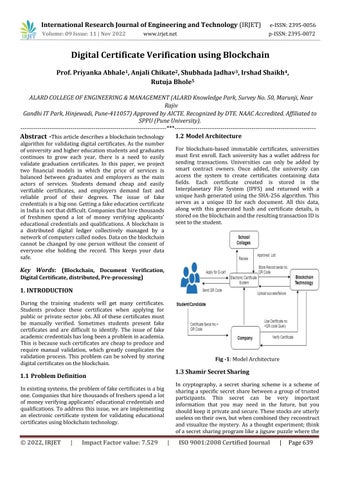
For blockchain-based immutable certificates, universities must first enroll. Each university has a wallet address for sending transactions. Universities can only be added by smart contract owners. Once added, the university can access the system to create certificates containing data fields. Each certificate created is stored in the Interplanetary File System (IPFS) and returned with a unique hash generated using the SHA-256 algorithm. This serves as a unique ID for each document. All this data, along with this generated hash and certificate details, is stored on the blockchain and the resulting transaction ID is sent to the student.

Key Words: (Blockchain, Document Verification, Digital Certificate, distributed, Pre-processing) 1. INTRODUCTION During the training students will get many certificates. Students produce these certificates when applying for public or private sector jobs. All of these certificates must be manually verified. Sometimes students present fake certificates and are difficult to identify. The issue of fake academic credentials has long been a problem in academia. This is because such certificates are cheap to produce and require manual validation, which greatly complicates the validation process. This problem can be solved by storing digital certificates on the blockchain.

Fig -1: Model Architecture

1.3 Shamir Secret Sharing

1.1 Problem Definition

In cryptography, a secret sharing scheme is a scheme of sharing a specific secret share between a group of trusted participants. This secret can be very important information that you may need in the future, but you should keep it private and secure. These stocks are utterly useless on their own, but when combined they reconstruct and visualize the mystery. As a thought experiment; think of a secret sharing program like a jigsaw puzzle where the

In existing systems, the problem of fake certificates is a big one. Companies that hire thousands of freshers spend a lot of money verifying applicants' educational credentials and qualifications. To address this issue, we are implementing an electronic certificate system for validating educational certificates using blockchain technology.

© 2022, IRJET

|

Impact Factor value: 7.529

|

ISO 9001:2008 Certified Journal

|

Page 639


Turn static files into dynamic content formats.
Create a flipbook