International Research Journal of Engineering and Technology (IRJET) e-ISSN: 2395-0056

Volume: 09 Issue: 11 | Nov 2022 www.irjet.net p-ISSN: 2395-0072
International Research Journal of Engineering and Technology (IRJET) e-ISSN: 2395-0056
Volume: 09 Issue: 11 | Nov 2022 www.irjet.net p-ISSN: 2395-0072
1,2,3Student, SENSE, VIT Vellore, Tamil Nadu, India ***
Abstract - Student Attendance mainframe structure is defined for managing the student's class attendance data files using the concept of face detection and recognition through open computer vision.This approach is proposed primarily to improve the existing university attendance practices and prevent the waste of resources and time. The concept of moving from the traditional attendance system to the digital one using face detection and recognition techniques has been driven by the automation world's pointing sides.Byaddingthe dataset of an individual, the Student Attendance structure is constructed in this way. In addition to lowering the long-term time burden work, and disposables required, the main goal of constructing this system was to increase the adaptability and performance of the attendance system procedure.TheStudent Attendance markup structure's primary functionistoaddand modify a student's attendance notes, make an automatic computation of the number of presentees and absentees depending on the subject and affability of the class, and then produce an automated document or spreadsheet.The concept of open computer vision is used in this approach, which is entirely based on the general-purpose language Python.For face detection system we used haarcascade and for face recognition, we used LBPH model;After training each individual student, the system generated a spreadsheet that included the number of students present in the classroom along with a picture or video that was captured live.
Key Words: PrincipalComponentAnalysis,SVM,Dlib,LBP Feature,API,TensorflowMaintaining attendance is crucial at any institute for monitoringthequalityofeducation.Students'attendanceis routinelyrecordedbyestablishingattendancefilesornotes provided by the departmental arch in the depths of the institutions. The teacher manually takes attendance by callingouteachstudent'snameandconfirmingwhetheror nottheyarepresentintheclass.Thisprocessisdull,timeconsuming, and unreliable because students frequently makethewrongcallsfortheirabsentfriends.Additionally, this procedure makes it more difficult to alter every student's attendance in a large classroom. In order to automatically identify the students in a class and record theirattendancebycollectingtheirframes,wedesignedthis applicationandusedarangeoftechniques,includingfacial exposureandanunderstandingsystem.Whilesomebiotech assimilationmetricscanbeincreasedproperly,inthepast, studentstypicallyhadtowaitlongerwhentheyenteredthe
room for attendance. Face recognition is the best option becauseofitsnon-intrusivenessandfamiliarity,aspeople generally know other people by their facial features. This facialbiometricstructureprimarilyconsistsofanenrolled approachin which, followingthe processof detectingand understanding,thekeydistinguishingcharacteristicsofeach individualfacewillbesavedinthedataset.Thetraditional methods for analyzingstudent engagement in particular subjectsinvolvephysicallysigningtheattendancelogsina PC framework for analysis. This approach is ineffective becausestudentswouldsignupfortheirabsentclassmates, whichisboring,unpleasant,andpronetoerrors.Theuseof thefaceidentificationandacknowledgmentframework in placeoftheconventionalmethodswillprovideaquickerand more effective method for accurately capturing student participation while also providing secure, reliable, and strong restrictions on the framework records. After these restrictionshavebeenapproved,onecanaccesstherecords foranypurpose,includingfororganization,guardianship,or evenforthestudent'sownstudies.
Earlyfacerecognitionresearchcenteredontechniquesthat matchedbasicfeaturesusingimageprocessingalgorithms de-tracingthefaces'geometricalshapes.Nevertheless,these techniques only functioned in incredibly restricted circumstances,theydemonstrated.Computersarecapableof recognizingfacesautomatically.Then,statisticalsubspaces techniques like principal component linear discriminant analysiswithprincipal componentanalysis(LDA)grew in acceptance.Thesetechniquesareknownasholisticbecause theyincorporatedatafromthefull-faceregion.Duringthis time,advancementsinothercomputervisionfieldsledtothe creationofcapablelocalfeatureextractorsthatelucidatethe textureofanimageinseveralareas.Feature-basedmethods for facial recognition involve comparing these regional specifics over pictures of faces. Hybrid methods were created by further developing and combining holistic and feature-basedapproaches.Facerecognitionsoftwareusinga combinationoftechniquesUpuntilrecently,state-of-the-art technologywasdeeplearningthemosteffectivestrategyfor most computer vision applications, such as facial identification.Theremainderofthistextsummarizessome of the most notable reviews Each of the aforementioned kindsofstrategiesissupportedbyasearch.
International Research Journal of Engineering and Technology (IRJET) e-ISSN: 2395-0056
Volume: 09 Issue: 11 | Nov 2022 www.irjet.net p-ISSN: 2395-0072
The outcome in Viola and Jones depends on the data and unreliableclassifiers.Theuniformityofthetrainingsethasa significantimpactonthefinaldetection'squality.Important considerationsincludethesizeofthesetsandtheinterclass variability.Whennumerouspeoplewithdifferentsequences areconsidered,theanalysisyieldsverypoorresults.Viola andJonesalgorithmistheemployedalgorithminthispaper. Thedata'strainingprocessshouldbecarriedoutproperlyin sucha waythatthequalityofthefinal detectionincrease. Thesystemoverviewoughttoincludetheoverallbuilding designthatwilltheconciseandthoroughdetailsaboutthe project.
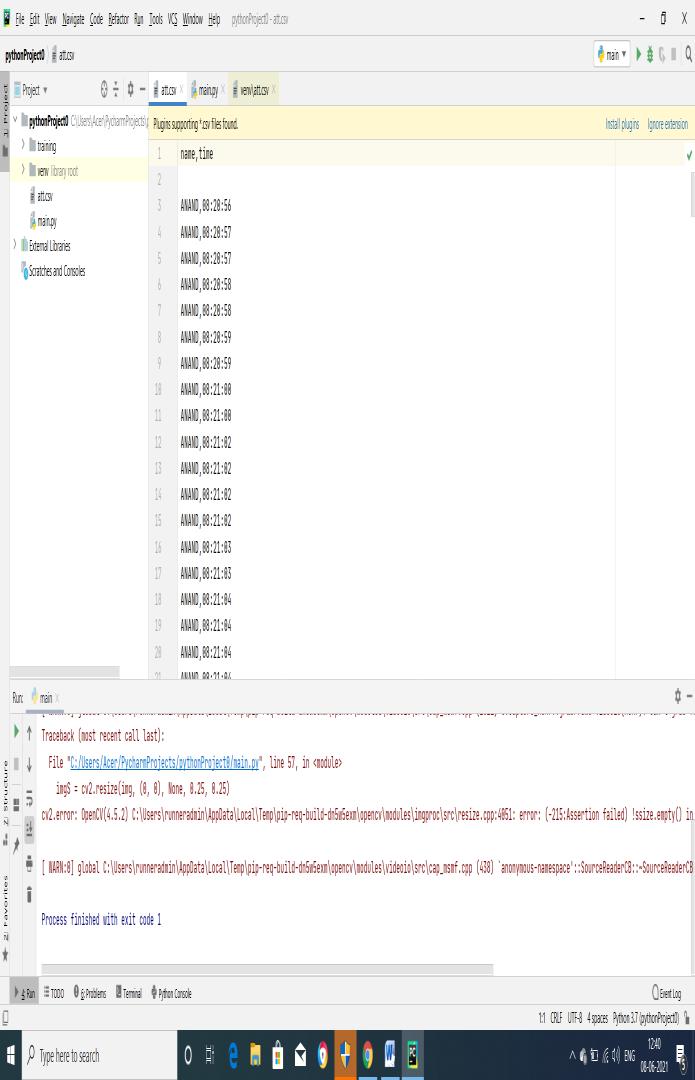
The system is put into practice under the basic and fundamentaltenetofadigitalcameraintheclassroom.Ina lecturethatlasted50minutes,thedigitalcamerawouldtake 2 pictures every 25 minutes. The system will now get the imageandextractallofthefacesfromit.Now,theexistence of the face would be determined by comparison with the trainedmodeloffacesalreadyinuse.Ifastudent'sfaceisin thecurrentdatabase,thesystemwillsavetheiruniqueIDin theattendancedatabaseordiscardsthemifthestudentisn't inthedatabase.StudentdatabaseWehavetackledanumber of issues in this study, including real-time face detection, multiplefacedetection,andintegrationwiththecomputer learningalgorithm.Theactualchallengeinputtinganidea intopracticewasreal-timefaceextractionfromanimage.In ordertoresolvethisproblem,weemployedusingtheDeep Neural Network (DNN) of the Tensorflow estimator API, which is also trained from the instantaneously extracted photos.However,findingface-likepatternsisonlyasmall portion of the issue. You must use face recognition technology using an algorithm to successfully identify a studentfromadatabaseofpupils.WeusedGoogle'sfacenet, amodel thathasbeenpre-trainedon150000photosand wasinspiredbytheGooglePixel,todealwiththisproblem.
The computation is slow and the detecting method is complicated. Performance compared to the Viola-Jones algorithm is typically worse. The algorithm is neural network-based.Thisstrategyisonlyeffectiveifthelargesize oftheimagewastaught.
In the last few years, face recognition technology has embracedawiderangeofmethodologies,buttheclassical methodology still predominates. Component analysis,
discriminating analysis, discrete transformation, and component analysis are categories for prestigious face recognition. It is considered to be the most important element in facial recognition technology. Numerous researchers in the field of facial recognition technologies employtheeigenfacestechnique.Themainelementofthis techniqueiseigenfaces.Basically,itdividedavarietyofinput variables into several classes (Li & Hua, 2015). The PCA (Principal Component Analysis) algorithm can be used to extract the image data in its original form. One of the fundamental principles that PCA adheres to is that it can recreate the image's original form from the original collection by using eigenfaces. In face recognition technology,Eigenfacesareregardedasthekeycomponent. Eigenfacestypicallydepicttheprimaryfacialcharacteristics, whichtheoriginalimagemaynothavehad.
An attempt is made to develop the automated facial attendancesystemutilizingSVMontheLBPfeaturetaking intoaccountthedrawbacksofsomeofthesystemslistedin the previous works, as the LBP method provides good accuracy in comparison to other systems. The suggested method introduces an automated attendance system that incorporatesafacialrecognitionalgorithmandanAndroid app.Anydevicewithacameraiscapableoftakingapicture oravideo,whichitmaythenuploadusingawebapplication. The received file is put through face detection and recognition processes, so the detected faces are extracted fromtheimage.
Afewdrawbacksoffacialrecognitionareimagequality,size, angle of facing, and processing time. performance of the facialrecognitionalgorithmisfirstfundamentallyinfluenced bytheimagequality.Whencomparedtoadigitalcamera,the videoscanningofanimagehasinferiorquality.Themethod of facial detection as a whole was impacted by the image quality. Face recognition poses considerable challenges in terms of storage and processing. To recognize a person's trueappearance,acertainangleischosen(Minaee&Wang, 2015). The process of detecting faces will be severely hamperedbytheseveralanglesthatmustbeusedinorder to obtain an adequate face while employing recognition software.Inessence,theyadoptedthe2Dfacialtype'sphoto structure.Thisformatpreventsfacialrecognitionsoftware from currently detecting numerous faces. The facial recognitiontechnologywillexperienceissuesbecauseofthe person's movements, which resulted in erroneous photographsbeingcaptured.Itisnecessarytousecurrent software,whichishighlyexpensiveonthemarket,formore accuracy. The detection method can occasionally run into trouble when the photos are blurry. The effectiveness of facial recognition technology is also influenced by the camera'sperspective.
International Research Journal of Engineering and Technology (IRJET) e-ISSN: 2395-0056
Volume: 09 Issue: 11 | Nov 2022 www.irjet.net p-ISSN: 2395-0072
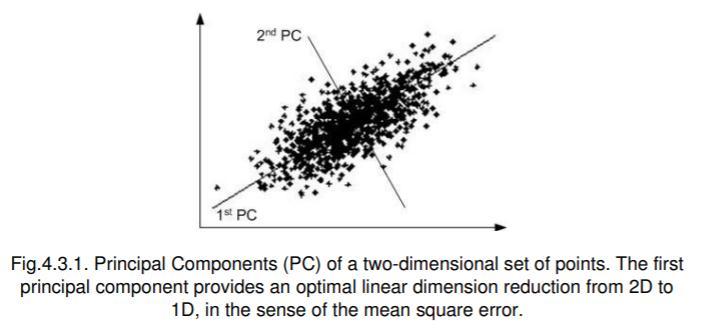
It is derived from the transition of Karhunen-Loeve. Principal Component Analysis (PCA) often locates a tdimensionalsubspacewhosebasisvectorscorrespondtothe largestvariancedirectionintheoriginalimagespacegivinga dimensionalvectorrepresentationofeachfaceinatraining set of photos. Typically, this new subspace has a lower dimension (ts). The PCA basis vectors are defined as eigenvectorsofthescattermatrixiftheimageelementsare thought of as randomvariables. For dimensionality reduction,theEigenfacetechniqueusePCAtoidentifythe vectors that best capture the distribution of face pictures throughout the whole image space. The subspace of face imagesisdefinedbythesevectors,anditisknownasface space. To determine a set of weights that accurately representsthecontributionofeachvectorinthefacespace, all of the faces in the training set are projected ontothefacespace. To generate the appropriate set of weightsforidentifyingatestpicture,thetestimagemustbe projectedintothefacespace.Thefaceinthetestimagecan be recognized bycomparing theweights ofthetest image withthesetofweightsofthefacesinthetrainingset.The foundationofPCA'sprimarymethodistheKarhumen-Loeve transformation.Theimagemightbeviewedasasampleofa stochastic process if the image's constituent parts are assumedtorepresentrandomvariables.Theeigenvectorsof thescattermatrixST,ST=ΣNi=1(xi-μ)(xi-μ)T,arewhat areknownasthePCAbasisvectors.
hasdeducedfromadatabaseofwell-knownpeople,whereas inissueswithverification:thesystemmustacceptorreject theclaimoftheinput'sidentity.
Theultimateobjectiveofafacerecognitionsystemisimage understanding, or the ability to recognize an image's meaninginadditiontoitsstructure.Ageneraldefinitionof automaticfacerecognitionisasfollows:givenstillormoving photographs of a scene, identify or confirm one or more people in the scene using a database of faces that have as been previouslyrecorded.Thechallengecan be solved by segmenting faces (facial detection) from cluttered scenes, extracting features from the face regions, and then identifyingorverifyingthefaces.Theinputforidentification isanunidentifiedface,andthesystemreturnstheidentityit
1.Obtaintheclass'sstudentroster.
2. Look through each image folder associated with each student.
3.Theparentfoldernameappearsastheclasslabelforeach image.
4. Determine whether a face is there by applying a face detectionalgorithmtotheface.
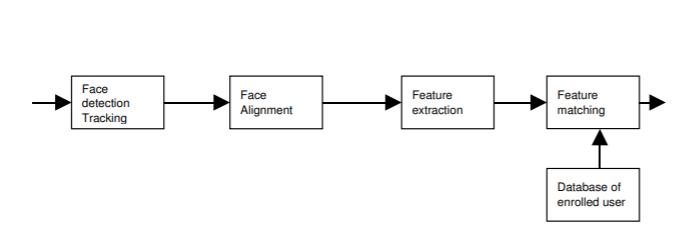
5.Gettheboundingboxcoordinatesifafaceisfound.
6. Crop the image so that it only contains a face using the boundingboxcoordinates.
7.UseDlibtodeterminethedirectionoftheface,thenapply transformstoaligntheeyes,mouth,andotherfacialfeatures at a specific angle. This guarantees the neural network's inputisofhighquality.
8. Feed the neural network with the aligned image. The networkproduces128measurements ofeachface.
9.Atthispoint,theimage'sdatahavebeenextracted.Traina classifierusingthisembeddingvector.
10.Theclassifierisfinishedoffandsavedasanobject,which can later be imported from the database and used to makepredictions.
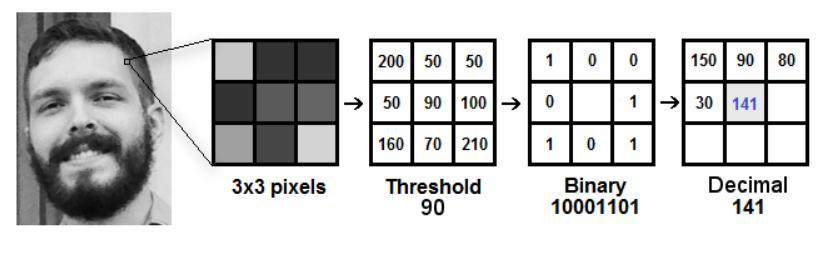
TheinitialcomputationalstageoftheLBPHistoproducean intermediateimagethat,byemphasizingthefacefeaturesof the original image, more accurately describes the original image.Themethoddoesthisbyutilizingaslidingwindow ideadependingonradiusandneighbour.Theprocedureis shownintheimage.
International Research Journal of Engineering and Technology (IRJET) e-ISSN: 2395-0056
Volume: 09 Issue: 11 | Nov 2022 www.irjet.net p-ISSN: 2395-0072
Thismethodhasbeensuggestedtokeepupattendance.The paperworkandstationeryarereplacedwithanautomated system that is quick, effective, cost-effective, and timesaving. The proposed system, however, is anticipated to producetheintendedoutcomes.Integratingothereffective methodscouldalsoincreaseefficiency.Here,we'vecovered avarietyoffaceidentificationtechniquesthattheresearcher utilized.Thesetechniquesmightbeappliedbyeducational or business institutions to track students' attendance at lecturesbyidentifyingtheirfaces.Inordertoclassifyfaces, we are attempting to develop a system using Improved Support Vector Machines (IVSM) on LBP features in the followingphase.
In the future, we'll connect the system with the email addressandmobilenumbersothatifanybodydoesn'tshow up,anautomaticSMSorMAILwillbesenttothem.
[1] P.Mehta,“AnEfficientAttendanceManagementSystem basedonFaceRecognitionusingMatlabandRaspberry Pi2,”Int.J.Eng.Technol.Sci.Res.IJETSR,vol.3,no.5,pp. 71–78,2016..
[2] Yang Zhong Josephine Sullivan Haibo L KTH Royal Institute of Technology, 100 44 Stockholm, Sweden "FaceAttributePrediction
[3] Max Ehrlich, Timothy J. Shields, TimurAlmaev, and Mohamed R. Amer, "Facial Attributes Classification usingMulti-TaskRepresentationLearning",2016IEEE ConferenceonComputerVisionandPatternRecognition Workshops.
[4] Yun-Fu Liu, Member, IEEE, Jing-Ming Guo, Senior Member,IEEE,Po-HsienLiu,Jiann-DerLee,andChenChieh Yao, "Panoramic Face Recognition", IEEE, Transactions on Circuits and Systems for Video Technology.
[5] HamdiDibeklio˘glu, Member, IEEE, Fares Alnajar, StudentMember,IEEE,AlbertAliSalah,Member,IEEE, and Theo Gevers, Member, IEEE, "Combining Facial DynamicsWithAppearance for Age Estimation", IEEE TRANSACTIONSONIMAGEPROCESSING,VOL.24,NO.6, JUNE2015.
[6] W.Haider,H.Bashir,A.Sharif,I.Sharif,andA.Wahab,“A SurveyonFaceDetectionandRecognitionTechniques,” Res.J.RecentSci.,2014.
[7] I.Dagher,“IncrementalPCA-LDAalgorithm,”inCIMSA 2010-IEEEInternationalConferenceonComputational
International Research Journal of Engineering and Technology (IRJET) e-ISSN: 2395-0056
Volume: 09 Issue: 11 | Nov 2022 www.irjet.net p-ISSN: 2395-0072
IntelligenceforMeasurementSystemsandApplications, Proceedings,2010.
[8] N.Kar,M.K.Debbarma,A.Saha,andD.R.Pal,“Studyof ImplementingAutomatedAttendanceSystemUsingFace RecognitionTechnique,”Int.J.Comput.Commun.Eng., vol.1,no.2,pp.100–103,2012.
© 2022, IRJET | Impact Factor value: 7.529 | ISO 9001:2008 Certified Journal | Page576