International Research Journal of Engineering and Technology (IRJET) e-ISSN: 2395-0056

Volume: 09 Issue: 11 | Nov 2022 www.irjet.net p-ISSN: 2395-0072
International Research Journal of Engineering and Technology (IRJET) e-ISSN: 2395-0056
Volume: 09 Issue: 11 | Nov 2022 www.irjet.net p-ISSN: 2395-0072
Abstract – This paper proposes the application of the Analytic Hierarchy Process (AHP) in determining the relative weights of important maintenance decision-makingfactors in retaining wall management. Based on a pairwise comparison of the criteria (age, operating & maintenancecondition,safety consequence & mobility consequence), weights aregenerated, which are used in computing a priority index for ranking the maintenance importance of the walls. These weighted factors are applied to 29 retaining wall structures in Tennessee, with maintenance priority ranking as output.Thismethodprovides transportation agencies with a simple but effective method of selecting the retaining wall for maintenance, given a limited budget. Sensitivity analyses are conducted to identify the factors that most significantly affect a chosen outcome variable of estimated repair cost – in a bid to validate the AHP model. Overall, the case study clearly demonstrates the applicability and practicality of the AHP-based method for maintenance prioritization of retaining wall structures.
Key Words: Retaining Wall, Asset Management, AHP, MulticriteriaDecision-Making,Operations&Maintenance.
In the United States, most transportation agencies do not observe specific maintenance or rehabilitation regime for their retaining wall structures (Anderson et al., 2009; Kimmerling & Thompson, 2015). While other “primary” transportationinfrastructuresuchaspavementandbridges havescheduledproactiveinspectiontimeframes,thisasset class is mostly ignored (Lawal, 2021). Without these inspection cycles, there is no way asset managers could identifydistressesatanearlystagetoavertfailure(Pettway &Sinkey,1980).Withthisbackground,afewDepartmentsof Transportationhavestartedextendingtheirrisk-basedasset management programs to include retaining walls (Tappenden&Skirrow,2020;Thompsonetal.,2016;Vessely etal.,2015).
However,withmoreassetclassestomanagecomesatthe competingcostofmaintenanceprioritization(Frangopol& Liu, 2019). The limited annual maintenance budget most transportationagencieshaveisbarelyenoughtocoverthe legacy assets in need of maintenance (Kulkarni & Miller, 2003).Yet,theseagenciesarecompelledtosimultaneously maintain other assets such as retaining walls which have beenfoundtobeequalcontributorstosafetyandmobility along transportation highways (NCHRP Report 903).
Therefore,itisanimportantissuefortheseagenciestofind the best possible waytheycanallocatetheirmaintenance budget,whilehavingthemostimpact.
Duetothelackofhistoricaldata,therehasnotbeenalotof researchonretainingwallmanagementasatransportation orgeotechnicalasset.Regardless,assetmanagersroutinely have to make maintenance decision-making on pavement and bridges at the network level, considering the performanceandothercharacteristicsoftheroadsections (O’Reily&Perry,2009;Wangetal.,2022).Theperformance of these assets and subsequent maintenance decisionmakingispremisedonseveralfactorsandcriteria(Niekamp et al., 2015; Lawal et al., 2017). Similarly, retaining walls alonghighwaycorridorscanbemodelledasamulti-factor and multi-criteria decision-making problem. Based on available literature, the factors worthy of consideration include structure age, condition rating, mobility consequence,etc.Thegoalsofmaintenancearetorestoreas manystructurestothebestpossibleconditions,andalsoto minimizeoverallagencymaintenancecostswhiledoingthis (Lawal, 2022). These two important, yet seemingly contradictory goals could be achieved using a scientific processthatcanrationallyrankthemaintenancepriorityof theassetsbasedonsetcriteria(Saaty,1988).
Considering the qualitative nature of the relationship between each factor, determining the weight of each criterion and sub-criteria then becomes difficult. Analytic HierarchyProcess(AHP)comesinhandyindemystifyingthe problems based on hierarchies and pairwise comparison (Saaty, 2008). This method has been widely adopted in several multicriteria decision-making problems with complicatedstructure,duetoitsrelativesimplicity(Ziaraet al., 2002). Its application has been found in several infrastructureclassfrombridges(Dabous&Alkass,2010) (Wakchaure et al., 2012) to pavements (Ramadhan et al., 1999)(Ahmedetal.,2017;Lietal.,2018),andhasbeenused inthisstudytodeterminetheweightofeachfactor,inabid to arrive at a comprehensive ranking index for the prioritizationofretainingwallmaintenance.
The goal of this study is to develop an AHP-based maintenanceprioritizationrankingindexforretainingwalls. AcasestudyofretainingwalldatacollectedintheStateof Tennesseewasusedtodemonstratetheapplicabilityofthe
International Research Journal of Engineering and Technology (IRJET) e-ISSN: 2395-0056
Volume: 09 Issue: 11 | Nov 2022 www.irjet.net p-ISSN: 2395-0072
AHP-theory.Certainpre-determinedimportantfactorswere used as decision-making factors. These factors include retaining wall age, operations & maintenance (O&M) condition, mobility consequence, safety consequence. Hierarchiesarethenconstructedbasedonthesefactorsto determinetheweightofeachofthedecision-makingfactors–cumulatively lending towards the prioritization ranking index. Sensitivity analysis is subsequently carried out in order to verify the accuracy and effectiveness of the weightingprocess.
Thedecisionofwhichwalltomaintainataparticularpointin timeisbasedontheprioritizationrankingindexofthewall. Thisindexshouldreflecttherelativeimportanceofthewall, and why if required should be selected ahead of another. Therefore,thefactorsthathavegoneintothecomputationof this ranking should represent those that individually hold majorimportance.Whilethereareseveralprobablefactors thatcontributeinvaryingdegrees,itisimpracticaltoinclude all of it in the hierarchical process. Thus, key criteria that werefoundthroughliteraturereviewhavebeenshortlisted. TheNCHRPReport903whichprovidesanimplementation guidance for transportation agencies implementing geotechnical asset management (GAM) developed a GAM planner tool. These factors which were retaining wall age, O&M condition, mobility consequence, and safety consequence correlated with the variables in the asset inventoryoftheGAMplannertool.
Structure age represents one of the most significant influencingfactorsforretainingwallmaintenancedecisionmaking,justliketheother“primary”assets.Despitethelack of retaining wall historical data (construction and maintenance) in Tennessee, google earth pro historical imageryfunctionwasusedinestimatingtheapproximateage ofallofthewallssurveyed–whichrevealedthatmostofthe wallswerebuiltover20yearsago.Asastand-alonefactor,it followsthatbarringanymaintenance,theolderstructures wouldbeclosertotheirdesignlifeandwouldneedthemost urgent attention. However, since age is not the only contributingfactortodeterioration,thisapproachwouldnot hold.
BasedontheGAMplannertool,operatingandmaintenance condition, which in simple terms can be referred to as the condition rating of the structure is an important factor in maintenanceprioritization.AsdefinedinthetoolandNCHRP report 903, the conditions are categorized into “1-New or Good”, “2-Minor Loss”, “3-Fair”, “4-Poor”, “5-Critical to Failed”.Consideringthewallssurveyed,the1-4ratingscale hasbeenusedinstead.
Table 1:O&Mconditionleveldefinitions(NCHRPReport 903)
O&MCondition Definition 1 NeworGood 2 MinorLoss 3 Fair 4 Poor 5 CriticaltoFailed
Failureconsequencethatcouldaffectmobilityonadjourning highway is a very important factor to consider in maintenance decision-making. Those walls whose failure would seriously impact mobility would naturally be given priorityoverthosewithless.TheGAMplannertoolstipulates thedifferentcategoriesof“NoImpactpossible”,“Impactto shoulder possible”, “Impact to travel lane possible”, “Road closurepossible:1dayorless”,“Roadclosurepossible:>1 day”.
Table 2:Mobilityconsequencedefinitions(NCHRPReport 903)
Mobility consequence Definition
1 Noimpactpossible 2 Impacttoshoulderpossible 3 Impacttotravellanepossible 4 Roadclosurepossible,1day orless 5 Roadclosurepossible,>1 day
Failure consequences of retaining walls that have safety implicationstowardsthetravelingpublicisaverysignificant metric that contributes to the maintenance prioritization decision-makingoftheassets.Thecategoriesofthisfactoras includedintheGAMplannertoolare:“Noimpactpossible”, “Impacttoshoulderpossible”,“Impacttotravellanepossible butavoidable”,“Vehicledamagepossible”,“Fatalityorinjury possible”
International Research Journal of Engineering and Technology (IRJET) e-ISSN: 2395-0056
Volume: 09 Issue: 11 | Nov 2022 www.irjet.net p-ISSN: 2395-0072
AHPwasfirstdevelopedandexploredbySaaty(1980)asan objective mathematical and psychological weighting technique. Over the years, the technique has found its application in different transportation infrastructure multicriteria decision-making. However, specifically for retainingwallmaintenance,ithasnotbeenreallyexplored TherangeofproblemsthatcouldbesolvedusingAHPspans across both objective and subjective evaluations. This is achieved through a systematic process including: a) developmentofahierarchicalstructure;b)methodologyfor establishment of priorities, and c) ranking and overall consistencyassessment.
ThefirststageintheAnalyticHierarchyProcessisthedesign of the hierarchies itself. This involves breaking down the wholeproblemstructureintoindividualclusters–thatforms a hierarchy. Each hierarchical level comprises of elements thatinturnfeedoffintoothersub-elementsuntiltheentire structure is decomposed completely. The goal of this approachwouldbetopresentthelogicalandmathematical interactionofthefunctionalcomponentsthatmakeupthe problem.Theflexibilityandreliabilityofferedbyhierarchies make it difficult for the entire system to be affected by outsideinfluence(Saaty,1977).Inthehierarchymodel,the goal of the AHP is placed on the uppermost layer. This is followed by the criteria layer. In the case where there are sub-criteria,thisrepresentsthethirdlayer.Thealternatives arethenplacedatthebottomlayer.AtypicalAHPhierarchy structureisshowninFig.1
ThesecondstageintheAnalyticHierarchyProcessinvolves theestablishmentofanacceptablebasisforprioritysettings. Through a pairwise comparison of each criterion, relative importanceisdetermined.Thisisachievedusinga1-9scale showninTable1.
1
Equalimportance 3
Weakormoderate importanceofoneoverthe other 5
Essentialorstrong importance 7
VerystrongorDemonstrated importance 9
AbsoluteorExtreme importance 2,4,6,8
Intermediatevaluesbetween twoadjacentjudgement values
Theassignmentsandcomparisonsaredonebasedonexpert judgementandexperience.

4.3
Based on the hierarchical structure and pairwise comparison,theimportanceofeachcriterionrelativetothe otherisobtained.Consideringthedifferentindicesused,the judgementmatrixisnormalizedinordertogivetherelative importance.Duetotheprocessofthepairwisecomparison, itispossibleforinconsistenciestobeintroduced,i.e.,inthe caseof3criteriaA,B,C,criterionAismoreimportantthan B,criterionBismoreimportantthanC,ifcriterionCismore importantthanA,thisismathematicallyimpossibleandthus aninconsistencyarises.
Therefore,itisnecessarytocarryoutaconsistencycheck attheendofthepairwisecomparisonprocessinorderto avoidcontradictoryresults.Whileitisunlikelytoobtaina perfectconsistency,thesmallertheconsistencyratio(CR) is to 10%, the better. In order to obtain the consistency ratio(CR),aconsistencyindex(CI)iscalculatedusingEq. 1basedonthemaximumeigenvalue
CI= ,n=1,2,….,9 (1)
Consistencyratioisobtainedbydividingtheconsistency index(CI)bytherandomconsistencyindex(RI).RIis showninTable2.
CR= (2)

International Research Journal of Engineering and Technology (IRJET) e-ISSN: 2395-0056
Table 4:TheRIvalues
Elements 1 2 3 4 5 6 7 8 9 RI 0 0 0.58 0.9 1.12 1.26 1.36 1.41 1.45
Twenty-nineretainingwallstructuresacrossthethreemaincities(Chattanooga,Knoxville,andNashville)inTennesseewere selected from the Tennessee DOT report on rating and inventory of retaining walls. The four important factors earlier establishedwereusedincollectingandsynthesizingthedata,andaggregatedasshown.
Table 6: Retainingwalldataforcasestudy
Wall Retainingwall locations Age
1
Weighted Overall Rating
O&M condition level Safety Consequence Mobility consequence
7244-7544E Brainerd Chattanooga,TN 14 3.74 1 3 3
2
308Ashland Terrace, Chattanooga,TN 22 2.45 2 2 2
TN-153,OffBonny OaksDr., Chattanooga,TN 21 2.1 3 3 2 3
4
Northpoint Boulevard, Chattanooga,TN 13 2.91 2 3 2
5 RiversideDr, Chattanooga,TN 27 2.21 3 3 3
6
SignalMountain Rd,Chattanooga, TN 18 3.49 1 5 5
7 1727DaytonBlvd, Chattanooga,TN 16 2.95 2 3 3 8 222BakerStreet, Chattanooga,TN 24 2.95 2 4 5 9
918-998Cherokee Blvd,Chattanooga, TN 22 2.84 2 4 5
10 I-75N, Chattanooga,TN 35 2.66 2 4 3
11
1201-1261Dayton Blvd,Chattanooga, TN 27 2.97 2 4 4
12 I-75S, Chattanooga,TN 36 2.43 2 4 3
13
US-11,Birmingham HwyCrossRailway, Chattanooga,TN 38 1.85 3 2 2
14 6401LeeHwy 47 2.41 2 2 2 15 4177WillardDr 48 2.77 2 5 5
Volume: 09 Issue: 11 | Nov 2022 www.irjet.net p-ISSN: 2395-0072 © 2022, IRJET | Impact Factor value: 7.529 | ISO 9001:2008 Certified Journal | Page725
International Research Journal of Engineering and Technology (IRJET) e-ISSN: 2395-0056
Volume: 09 Issue: 11 | Nov 2022 www.irjet.net p-ISSN: 2395-0072
16 6828NorthsideDr 17 3.74 1 4 4
17
US-27N/Exitto SignalMountain, Chattanooga,TN 6 3.9 1 4 4
18
19
US-27S/Dayton BlvdEntrance, Chattanooga,TN 6 3.78 1 4 4
US-27S/Near Manufacturers RoadExit, Chattanooga,TN 6 3.93 1 4 5
20 9303EBrainerdRd 15 3.75 1 3 3
21 6312FiskAve, ChattanoogaTN 16 3.32 1 4 3
22 1701-1899 MeharryDr 45 2.4 2 2 2 23
US-27N/Between RedBankExitand R.R.OlgiatiBridge, Chattanooga,TN 6 3.88 1 3 3 24
1301Washington Avenue,Knoxville, TN 21 3.62 1 3 2
25 HallofFameDr, Knoxville,TN 19 3.1 2 4 3 26 JamesWhitePkwy, Knoxville,TN 31 2.59 2 4 5
27
NBroadwayRamp toI40,Knoxville, TN 15 2.16 3 4 5
BrileyPkwy, Nashville,TN 35 2.03 3 3 2 29 ElmHillPike, Nashville,TN 24 3.01 2 3 2
28
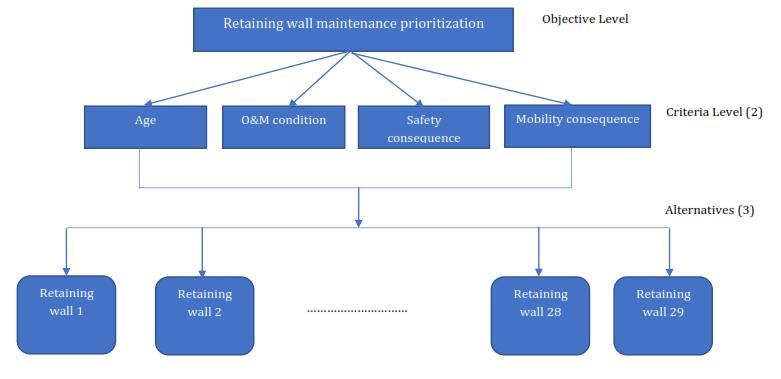
In the hierarchical structure, the ultimate goal at the objectivelevelistocomputeapriorityrankingindexthat would guide in retaining wall maintenance decisionmaking. The four important factors that are believed to affectthisdecision-makingprocess,i.e.,age,operatingand maintenancecondition,safetyconsequence,andmobility consequence form the criteria level. While the different retaining wall options available to be considered for maintenancearethealternatives.Thehierarchicalstructure modelisshowninFig.
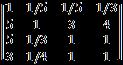
Basedonexpertjudgementonretainingwallmanagement, a comparison matrix of the criteria was formed. The pairwisecomparisonmatrix,CisshowninEq.3
C= (3)
Wethecomputethenormalizedpairwisematrix, as showninEq. = (4)
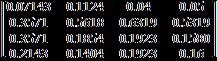
Theaverageofthenormalizedpairwisematrixthen givesthefactorweightsrepresentedbythevector, W W = (5)
2022, IRJET | Impact Factor value: 7.529 | ISO 9001:2008 Certified Journal | Page726
International Research Journal of Engineering and Technology (IRJET) e-ISSN: 2395-0056
Volume: 09 Issue: 11 | Nov 2022 www.irjet.net p-ISSN: 2395-0072
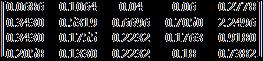
Thisistheweightsofthefactorsage,O&Mconditionlevel, safety consequence, and mobility consequence, respectively. The maximum principal eigenvalue, isobtainedasanaverageoftheratiooftheweighted sumvalueandcriteriaweight.Theweightedsumvalueis showninequationbelow.
isobtainedas4.1449.Consistencyindex,CIisgivenby Eq.1.Therefore,usingTable2ofRIvalues,withn=4,and given , CIis0.0483.ConsistencyRatio,CR,fromEq.2 isthenobtainedas0.0537.i.e.,0.0483/0.9.
Since 0.0537 < 0.1, the overall ranking is consistent and passesthislogicaltest.
Based on the weights of the four factors, and the synthesizeddata,apriorityrankingindexisgeneratedfor allthetwenty-nineretainingwalls.Usingtheprinciplesof normalization on the synthesized data, older retaining walls,retainingwallswiththeworstO&Mcondition,
retaining walls with worst safety consequence, and retainingwallswithworstmobilityconsequencearegiven highest preference. In Table, the summary of weighting together with the other factors computed in assessing consistencyareshown.Overall,Tableoutputsthepriority ranking index based on normalized data values from all fourconsideredfactors.
Table 7:Factorweightsandconsistencycheck
International Research Journal of Engineering and Technology (IRJET) e-ISSN: 2395-0056
Volume: 09 Issue: 11 | Nov 2022 www.irjet.net p-ISSN: 2395-0072
Theweightsofeachfactormultipliedbytheassignedvalue(normalized)isthensummedforeachretainingwall,andthisgives arelativeindex(0-1)ofthemaintenanceneedsoftheretainingwalls,andwhichshouldbeprioritized.Thehigherthepriority index,thegreatertheneedformaintenancerelativetotheotherstructures,andvice-versa.Finally,ranksareassignedtogivea numericalimportancetothepriorityofthewallsformaintenance.ThisisfurtherpresentedinTable.
Table 8: Priorityindexandrankingbasedonnormalizationofdata
Wall Age O&M condition level
Safety consequence Mobility consequence Priority index Priority Ranking
1 0.291667 0.333333333 0.6 0.6 0.436998012 27 2 0.4375 1 0.6 0.4 0.766379702 5 3 0.458333 0.666666667 0.4 0.4 0.545853091 20 4 0.270833 0.666666667 0.6 0.4 0.577632502 19 5 0.5625 1 0.6 0.6 0.810205187 3 6 0.375 0.333333333 1 1 0.602498553 15 7 0.333333 0.666666667 0.6 0.6 0.617170763 14 8 0.5 0.666666667 0.8 1 0.743746519 8 9 0.458333 0.666666667 0.8 1 0.740888369 9 10 0.729167 0.666666667 0.8 0.6 0.688964269 12 11 0.5625 0.666666667 0.8 0.8 0.712782707 10 12 0.75 0.666666667 0.8 0.6 0.690393343 11 13 0.791667 1 0.4 0.4 0.746032889 7 14 0.979167 0.666666667 0.4 0.4 0.581579961 17 15 1 0.666666667 1 1 0.822685398 2 16 0.354167 0.333333333 0.8 0.8 0.521177357 22 17 0.125 0.333333333 0.8 0.8 0.505457534 23 18 0.125 0.333333333 0.8 0.8 0.505457534 23 19 0.125 0.333333333 0.8 1 0.540708571 21 20 0.3125 0.333333333 0.6 0.6 0.438427086 26 21 0.333333 0.333333333 0.8 0.6 0.484497246 25 22 0.9375 0.666666667 0.4 0.4 0.578721811 18 23 0.125 0.333333333 0.6 0.6 0.425565413 28 24 0.4375 0.333333333 0.6 0.4 0.411750499 29 25 0.395833 0.666666667 0.8 0.6 0.666099072 13 26 0.645833 0.666666667 0.8 1 0.753750042 6 27 0.3125 1 0.8 1 0.908199447 1 28 0.729167 1 0.6 0.4 0.786386749 4 29 0.5 0.666666667 0.6 0.4 0.593352325 16
value:
International Research Journal of Engineering and Technology (IRJET) e-ISSN: 2395-0056
Volume: 09 Issue: 11 | Nov 2022 www.irjet.net p-ISSN: 2395-0072
MaintenancebudgetforDepartmentofTransportationis greatlylimited,despitethedifferenttransportationassets undertheirmanagementjurisdiction.Theattendanteffect ofthisissomeimportantassetsnotmaintainedatthemost optimal time, leading to increased life-cycle cost. In recognitionofthisconstraint,thisAHP-basedmaintenance prioritizationmethodforretainingwallsoffermanagersa data-driven, yet, simple approach of timely prioritizing theirmaintenanceandrehabilitation.Withthissystemin place,availablebudgetcanbeallocatedtothestructures basedonpriorityindexandoverallrelativerank.
AHP operates on a subjective evaluation and pairwise comparison of criteria. Despite that this is mitigated through expert judgements and assessment, it’s still an imperfectsystembasedonthesubjectivity.Two experts alsoarenotlikelytohavethesameexactassessment.This is a great limitation for the method. Nevertheless, it is greatly encouraged in future studies to incorporate multiple expert judgements in the process and compare the final outcomes. If the individual comparisons are consistent(whichconfirms thelogicofthecomparison), thefinalpriorityindexandrankingshouldnotbesuchthat awallranked1st throughoneexpert’scomparisonisthen ranked15th throughanother’s.
Inthissection,theresultsoftheAHP-basedmaintenance prioritizationarevalidatedusingsensitivityanalysis.The goalofsensitivityanalysisistoidentifywhichcontributing factor(s) has significant effect on the decision-making pertaining to retaining wall maintenance. This is tested againstatargetvariableofestimatedrepaircost,whichis providedintheTennesseeDOTreport.
For the analysis, retaining wall age was set to 10 years, O&Mconditionto3,safetyconsequenceto3andmobility consequenceto3.Theinfluenceofeachofthefactorsare testedontheestimatedrepaircostandisillustratedbythe changingvalueofthecost.Thetimevalueofmoneyisused inestimatingthepresentvalueofthewallsaftertyears
Original cost of wall * , where y is the 30 years averageinflationrate.The y valueadoptedfortheproject is3.5%(Zarenski,2021) TheO&Mconditionlevelchange had the most significant impact on the estimated repair cost. The O&M condition level were substituted with residualpercentageandusedinestimatingtherepaircost. Similarly,thesafetyandmobilityconsequencewerevaried toseetheirimpactontheestimatedcostofrepair.Overall, theO&Mconditionlevelresultedinthemostvariationin the repair cost which validates the outcome of the weightingfromtheAnalyticHierarchyProcessmodel.
Table 9:AssumptionofResidualPercentageBasedon RatingScore(NCMA,2004)
CurrentRatingScore ResidualPercentage
This method has been widely applied to different multicriteria decision-making problems across different fields,includingtransportationinfrastructuremanagement like pavement and bridges. Given that retaining wall management is relatively new to most Transportation agencies, they typically do not have to plan for their maintenance, and thus there had not been a need for prioritization. As more highway agencies are moving to improved proactive management techniques, this approachforprioritizingretainingwallmaintenancecould notbetimelier
TheAHP-basedtechniqueincorporatedcertainimportant potentialmaintenancerelatedfactorsthatcouldhelpgivea quantitativerelativeimportanceofthewalls–througha priorityindexandrankingforalloftheconsideredwalls. With the case-study validation using a total of four maintenance decision-making factors including age, operatingandmaintenancecondition,safetyconsequence, and mobility consequence considered. A hierarchical structure model consisting of the goal, criteria, and retaining wall alternatives was developed followed by pairwise comparison and weighting of the important factors.Withthefactorweights,andthedatanormalized, the result is a retaining wall maintenance priority index andpriorityranking.
Theauthor(s) would liketo acknowledgethe Tennessee DepartmentofTransportationforfundingtheprojecton Rating and Inventory of TDOT retaining walls, which providedinpart,thedatausedforthispaper.
[1] Anderson,S.A.,Alzamora,D.,&DeMarco,M.J.(2009). Assetmanagementsystemsforretainingwalls.In GeoVelopment: The Role of Geological and Geotechnical Engineering in New and Redevelopment Projects (pp. 162-177).
[2] Kimmerling, R. E., & Thompson, P. D. (2015). Assessment of Retaining Wall Inventories for
International Research Journal of Engineering and Technology (IRJET) e-ISSN: 2395-0056
Geotechnical Asset Management. Transportation Research Record, 2510(1),1-6.
[3] Pettway,R.H.,&Sinkey,J.F.(1980).Establishingonsite bank examination priorities: An early-warning systemusingaccountingandmarketinformation. The Journal of Finance, 35(1),137-150.
[4] Vessely,M.,Widmann,B.,Walters,B.,Collins,M.,Funk, N.,Ortiz,T.,&Laipply,J.(2015).WallandGeotechnical Asset Management Implementation at the Colorado Department of Transportation. Transportation Research Record, 2529(1),27-36.
[5] Thompson,P.D.,Beckstrand,D.,Mines,A.,Vessely,M., Stanley, D., & Benko, B. (2016). Geotechnical asset management plan: analysis of life-cycle cost and risk. Transportation Research Record, 2596(1),36-43.
[6] Tappenden,K.M.,&Skirrow,R.K.(2020).Visionfor Geotechnical Asset Management at Alberta Transportation.In Canadian Geotechnical Conference, GeoVirtual
[7] Lawal,A.(2022).WhiteTopping:AReviewofDesign andConstructionProcedures.
[8] Frangopol,D.M.,& Liu,M.(2019).Maintenanceand managementofcivilinfrastructurebasedoncondition, safety,optimization,andlife-cyclecost. Structuresand Infrastructure Systems,96-108.
[9] Lawal, A. (2021). An analytic hierarchy process and Markovchainbasedapproachforconditionratingand dynamicservicelifepredictionofretainingwalls.
[10] Lawal,A.,Jimoh,M.,&Jimoh,A.(2017).Assessmentof types and significant causes of building defects in University of Ilorin, Ilorin, Nigeria. USEP: Journal of Research Information in Civil Engineering, 14, 18241839.
[11] Wang,E.,Lawal,A.,Wu,W.,Onyango,M.A.,Wu,D.,& Zhang, B. (2022). An Integrated Analytic Hierarchy Process: Markov Model for Rating Condition and Predicting Service Life of Retaining Walls (No.TRBAM22-00943).
[12] Wu,W.,Wang,E.,Onyango,M.,&Wu,D.(2021). Rating and Inventory of TDOT Retaining Walls (No.RES201908).Tennessee.DepartmentofTransportation.
[13] Kulkarni, R. B., & Miller, R. W. (2003). Pavement management systems: Past, present, and future. Transportation Research Record, 1853(1), 6571.
[14] E. R. Zarenski, "Construction Inflation Analysis for Natonal Data," in "Construction Analytics 2021 ConstructionEconomicForecast,"2021.
[15] O'Reilly,M.P., & Perry, J.(2009). Drystone Retaining Walls and Their Modifications: Condition Appraisaland Remedial Treatment.CIRIA.
[16] Niekamp, S., Bharadwaj, U. R., Sadhukhan, J., & Chryssanthopoulos, M. K. (2015). A multi-criteria decision support framework for sustainable asset managementandchallengesinitsapplication. Journal of Industrial and Production Engineering, 32(1),23-36.
[17] Saaty, T. L. (1988). What is the analytic hierarchy process? In Mathematical models for decision support (pp.109-121).Springer,Berlin,Heidelberg.
[18] Saaty,T.L.(2008).Decisionmakingwiththeanalytic hierarchy process. International journal of services sciences, 1(1),83-98.
[19] Ziara,M.,Nigim,K.,Enshassi,A.,&Ayyub,B.M.(2002). Strategic implementation of infrastructure priority projects: case study in Palestine. Journal of infrastructure systems, 8(1),2-11.
[20] Ramadhan,R.H.,Wahhab,H.I.A.A.,&Duffuaa,S.O. (1999).Theuseofananalyticalhierarchyprocessin pavement maintenance priority ranking. Journal of Quality in Maintenance Engineering
[21] Ahmed, S., Vedagiri, P., & Rao, K. K. (2017). Prioritizationofpavementmaintenancesectionsusing objective based Analytic Hierarchy Process. International Journal of Pavement Research and Technology, 10(2),158-170.
[22] Dabous, S. A., & Alkass, S. (2010). A multi‐attribute rankingmethodforbridgemanagement. Engineering, Construction and Architectural Management
[23] Wakchaure,S.S.,&Jha,K.N.(2012).Determinationof bridge health index using analytical hierarchy process. Construction Management and Economics, 30(2),133-149.
[24] Li,H.,Ni,F.,Dong,Q.,&Zhu,Y.(2018).Applicationof analytichierarchyprocessinnetworklevelpavement maintenancedecision-making. InternationalJournalof Pavement Research and Technology, 11(4),345-354.
[25] N. NCMA, "Maintenance of Concrete Masonry Walls, TEK08-01A,"ed,2004.
Volume: 09 Issue: 11 | Nov 2022 www.irjet.net p-ISSN: 2395-0072 © 2022, IRJET | Impact Factor value: 7.529 | ISO 9001:2008 Certified Journal | Page730