International Research Journal of Engineering and Technology (IRJET) e-ISSN:2395-0056

Volume: 09 Issue: 11 | Nov 2022 www.irjet.net p-ISSN:2395-0072
International Research Journal of Engineering and Technology (IRJET) e-ISSN:2395-0056
Volume: 09 Issue: 11 | Nov 2022 www.irjet.net p-ISSN:2395-0072
1Principal, Anugrah Memorial College, Gaya (A constituent unit of Magadh university, Bodh Gaya), Bihar, India 2B. Tech student, Computer Science & Engineering, IIIT, Hyderabad, Telangana, India. ***
Abstract: In this paper, the voltage noise (Sv) in Y1Ba2Cu3O7 (YBCO) thin films prepared by dc magnetron sputtering technique on SrTiO3 substrate and its dependence on various parameters such as temperature, bias current and frequency are discussed. The voltage noise characteristics shows an enhanced peak near transition temperature (Tc) except for best quality samples with better surface morphology, lesser number of grain boundaries and having high critical current density (Jc). The calculated value of Hooge’s parameter using the carrier density Nc=1021/ cm3 for the thin film was 0.004 at 300K. To understand the effect of sample quality on voltage noise, measurements were performed on Y1Ba2Cu3O7 thin films of different characteristics
Keywords: Hooge’s parameter, percolation noise, spectral noise density, YBCO thin film.
Voltage noise in high-Tc superconductors determines the ultimate sensitivity of superconducting devices and it depend on the temperature, current and frequency. The voltage noise is found in metals, semiconductors, superconductorsandevenindeviceslikeSQUIDs. Thelow frequencynoiseinsuperconductingmaterials isrelatedto the critical current density, grain boundary weak links, phase. orientation and dynamics of vortices in an applied magnetic field [1-5]. The excess noise in YBCO is approachingzeroinsuperconductingstateandstartrising sharply in the transition region [4]. The Tc-inhomogeneity mayalsoleadtothermodynamicnoiseinsuperconductors [6]. For YBCO single crystal the 1/f noise power spectral densities are five orders of magnitude larger than clean metallic samples [7,8]. The strong 1/f noise in YBCO has been attributed to conduction along the one-dimensional Cu-O chains [9] For low-Tc conventional superconductor, the 1/f noise is related to the dynamics of vortex and flux bundle pinning just below the superconducting transition [10-12]. For granular YBCO superconducting samples, the noise is associated with grain boundaries and percolation effects near superconducting transition The highly anisotropic YBCO [13] superconducting thin films having
differentcriticalcurrentdensity,phaseandorientationhas beenchosenforthepresentstudy.
2.1.
The normalized voltage noise for thermal fluctuation modelisgivenby
2
S V k T C l l f v B v
2 2 1 2 3 2 [ ln ]
Where =(dR/dT)/R is the temperature coefficient of resistance. Cv is the heat capacity, KB is the Boltzmann constant and 3+2 ln(l1/l2) is a geometrical parameter with length l1 and width l2 of the thin film sample respectively [14-17]. Low frequency conduction noise behavior in conventional superconductors is explained by thermal fluctuation model. The defects due to oxygen vacancies which may lead to fluctuations in local carrier density in the copper oxygen planes for Y1Ba2Cu3O7 can affect many of the superconducting parameters may leads tosinglesharpnoisepeaknearthetransitiontemperature [10]. This peak is usually analyzed in terms of the temperaturefluctuationmodel[18].
Hooge’s expression for voltage noise spectral density (Sv) foranohmicsampleisgivenby[19]
S v N f v c 2
where v is the dc voltage applied across the sample, is Hooge’sparameterandisdimensionlessconstant. isalso a constant equal to unity and Nc is the total number of charge carriers in the sample which is proportional to the sample volume. value is about 10-1 to 10-3 for metals dependingonthestrengthoflatticedisorder. Thespectral
e-ISSN:2395-0056
Volume: 09 Issue: 11 | Nov 2022 www.irjet.net p-ISSN:2395-0072
densityofvoltagenoiseisindependentoftemperatureand isapowerlawatallfrequencies.
This model [3,12,18] describes the temperature dependence of the resistance noise near superconducting transition showing a sharp rise In the absence of applied magnetic field, the normalized noise is proportional to Rk’/s,whereRrepresentsthemacroscopicsampleresistance and k’ and s are critical exponents .and the ratio k’/s can be regarded as an index of the rise of normalized noise [25].Here,asuperconductorisrepresentedasaresistance network whose element was grain boundary junctions. Theresistanceofthenetworkasawholeisdeterminedby a fraction of superconducting junction p, and resistance fluctuations by random switching of these junctions (pnoise).Thenumberofswitchingjunctionsisassumedtobe independent of temperature. The origin of noise may be the percolation process between grains in the film. The amplitude of the temperature dependence of p-noise dependsonthedegreeofstructuraldisorderinthesample [26]
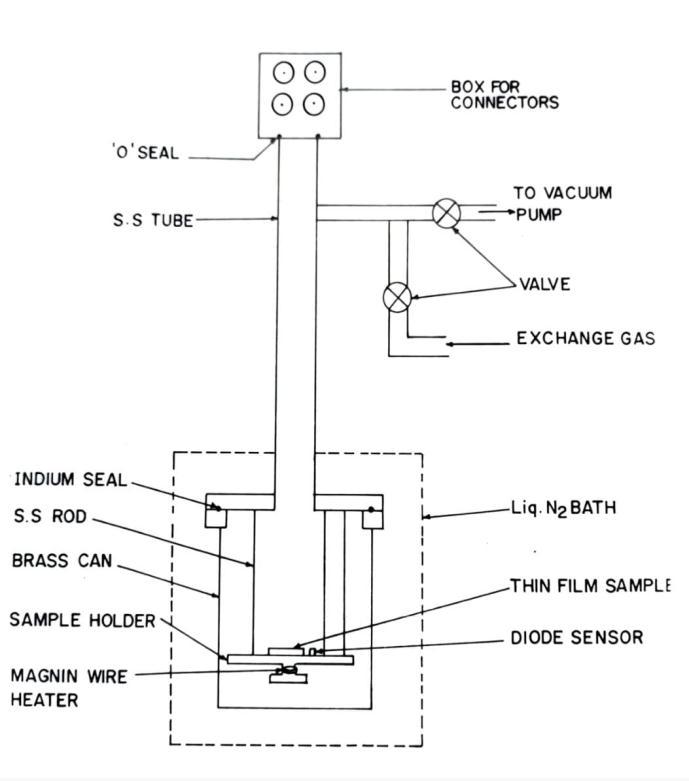
Figure1showsschematicoftheexperimental set-upused voltage-noise measurement in a high-Tc superconducting film [5]. For the measurement of low frequency voltage noise,thesamplewasmountedonacoppersampleholder. Temperature of the sample was monitored with a silicon diode thermometer (D-T 470, Lakeshore USA), mounted on the sample holder close to thin film sample. A noninductively wound manganin heater wire of 20 resistance was fixed at the center of the sample holder which was mounted inside a vacuum can was made of brass. The sample holder was connected to the liquid nitrogen bath with a weak thermal link made of stainless steel. The temperature of the sample could be varied by changingthecurrentintheheater.Thetemperatureofthe sample was monitored and controlled with a cryogenic temperature controller (Lakeshore, USA, DTC-93C) within the accuracy of 0.05 K. Voltage noise was measured by standardfourprobetechniqueinthespectralrange0.5to 100Hz.
Figure 1. Schematic of the experimental set-up used voltage-noise measurement in a high-Tc superconducting film
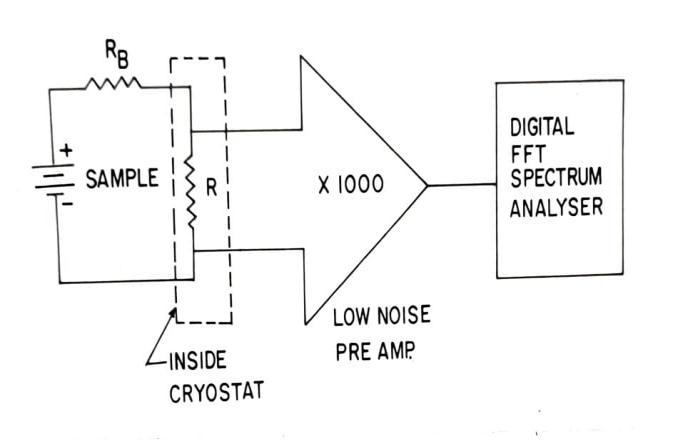
A battery-generated dc-current was passed through the sample with a large ballast resistance Rb, in series to minimize the noise due to contacts. The voltage signal developedacrossthesamplewasac-coupledtoalownoise pre-amplifier(Stanford-USA,SR-560)whichhada tunable bandpassfilterfromdcto1MHz. Amplifiedvoltagesignal was then applied to a dynamic signal analyzer (Hewlett Packard, USA-35660) or to a lock in amplifier (SR-530) which measures the spectral density of noise (in 1 Hz bandwidth) of the input signal in the desired frequency range or at a fixed frequency respectively. Figure 2 shows the experimental set-up for low frequency noise measurement in a high-Tc superconducting thin film. The observed voltage noise is the sum of preamplifier noise and noise from the sample. The background noise of the system is measured without passing any current through the sample. By subtracting background noise from the measured noise, we can observe the excess noise corresponding to the sample. To avoid interference of signals from nearby sources the sample holder was surrounded with three layers of metal and the measurements were performed inside the rf-shielded room[23]
e-ISSN:2395-0056
Volume: 09 Issue: 11 | Nov 2022 www.irjet.net p-ISSN:2395-0072
2 Experimental set-up for low frequency noise measurement in a high-Tc superconducting thin film
The high-Tc YBa2Cu3O7-x thin films studied in the experiment were deposited onto (100) SrTiO3 (10 x 10 mm2) substrate by dc magnetron sputtering technique [20].TargetwasstoichiometricYBa2Cu3O7-x.Substratewas gluedwithsilverpainttoaheaterblockandheatedto7007500C during deposition. The sputtering gas pressure was maintained at 800mTorr during deposition. Immediately after deposition pure dry oxygen was introduced in the chamber up to 300 Torr. The substrate temperature was slowly decreased up to 4750C and was kept at this temperature for one hour before removing the sample from the chamber. Thickness of samples was around 300 nm. The sample was patterned into a micro-bridge of dimension 50x50 m2 using standard photolithography followedbyetchinginsaturatedEDTAsolution.Inorderto investigate the influence of orientation on the low frequency voltage noise behavior of the YBCO thin films, voltagenoisewasmeasuredintwoYBCOthinfilmsamples of different phase and orientation. The samples were patternedintoamicro-bridgeof 50x50m2 dimension and low resistivity contacts were made on them. Prior to noise measurements, the electrical resistance and critical current density was measured using standard dc fourprobe technique [21]. Figure 1 shows the temperature dependenceofresistancemeasuredfortwoYBCOthinfilm samples. The resistance was found to decrease with decreasing temperature until superconducting transition is approached. Sample 1 has Tc (R=0) values of 83K whereas the sample 2 was having a higher Tc (R=0) value of 90.5K. The Jc in ambient field at 77K for sample 1 and sample 2 were 5x10⁴ and 1.5x10⁶A/cm2, respectively. The observed differences in the Tc and Jc values are attributed tothebettercrystallinequalityofsample2.
Figure 3. R-T curves for YBCO thin film micro-bridge sample 1 and sample 2
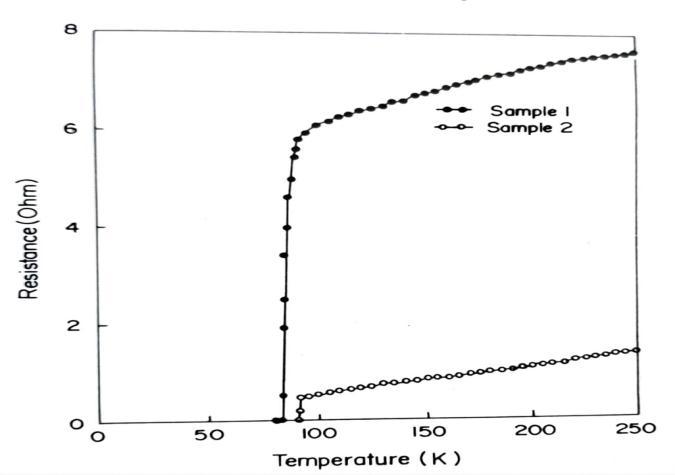
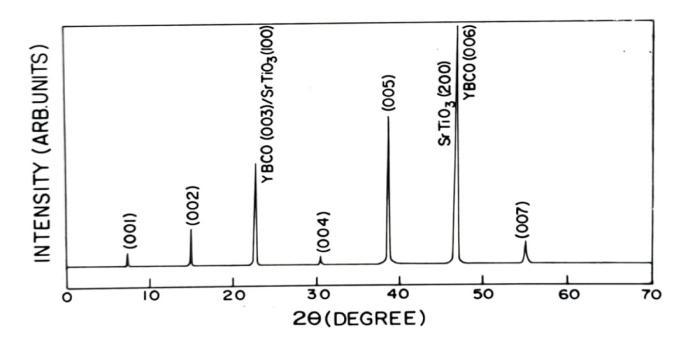
Figure 4. (a) X-ray Diffraction pattern of YBCO thin film sample 1
Figure 4. (b) X-ray Diffraction pattern of YBCO thin film sample 2.
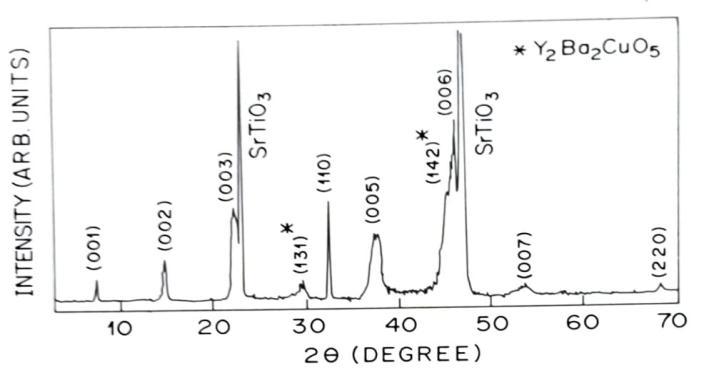
Figure 4. (a) and (b) shows the XRD pattern of sample 1 and 2. -2 scan shows reflection from (00l) YBa2Cu3O7-x crystallographic planes indicating the alignment of the YBCO c-axis perpendicular to the (100) plane of the substrate. We have seen some evidence of (131), (142)
(IRJET) e-ISSN:2395-0056
Volume: 09 Issue: 11 | Nov 2022 www.irjet.net p-ISSN:2395-0072
peaksofY2BaCuO5 andpeakofYBa2Cu3O7-x(110)planesin sample 1, while for sample 2 no evidence of extraneous phases was found and the film was highly c-axis oriented. Table1.showstheelectricalpropertiesofYBCOthinfilms.
Table 1. Superconducting properties of YBCO thin films.
Sample No.
R100K (Ohm) R300K (Ohm) Tc (R=0) (K)
Phase& Orientati on
Jc (A/cm2) (77K)
1 112.66 477 83 Mixed 5x10⁴
2 7.95 23.62 90.5 Single 1.5x10⁶
The voltage noise properties of the two YBCO thin film sampleswereinvestigatedinthetemperaturerangeof77300K in the low frequency region (0.5-100Hz). Table 2 showsthenoisepropertiesoftwoYBCOthinfilmsamples.
Table 2. The noise properties of two YBCO thin film samples
SampleNo. Sv nVHz(100K) Sv nVHz(300K)
1 370 1200
2 17.7 39.5
4.1 As a function of biasing current
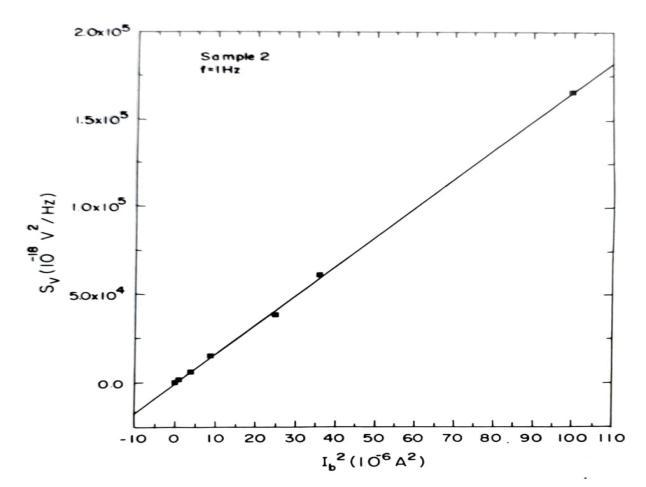
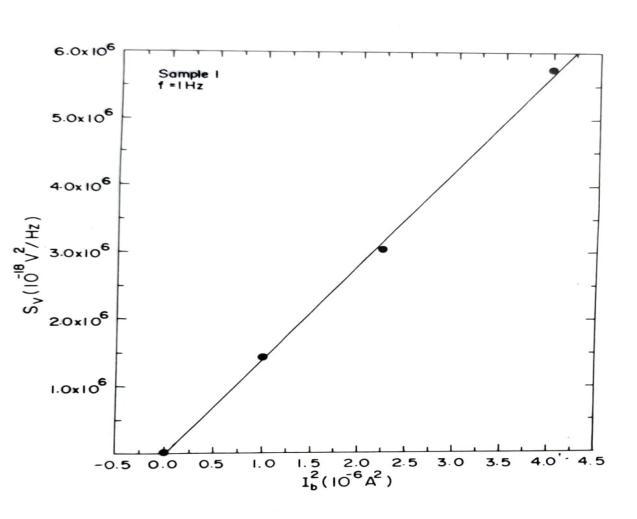
Figure 5 (a) and (b) shows the variation of spectral densityofvoltagenoise(Sv)measuredat1Hzforsample1 and 2 as a function of biasing current Ib, at 300K. The spectral densityof voltage noise(Sv)wasfound tohave I2 dependencei.e.,V2 dependence[18]
Figure 5 (a) Variation of spectral density of voltage noise Sv (1Hz, 300K) as a function of biasing current Ib for sample 1
This confirms that the noise arises due to resistance fluctuations [2]. This result excludes the possibility that thenoisegenerateatcontactpadsisdominant,ifitwasso, thenSv wouldhaveotherthanI2 dependence[23]
Figure 5 (b)
noise Sv (1Hz, 300K) as a function of biasing current Ib for sample 2
e-ISSN:2395-0056
Volume: 09 Issue: 11 | Nov 2022 www.irjet.net p-ISSN:2395-0072
contacts were negligible [23]. Moreover, I-V characteristic of the contacts was found to be linear for the strength of currentemployedduringmeasurements.
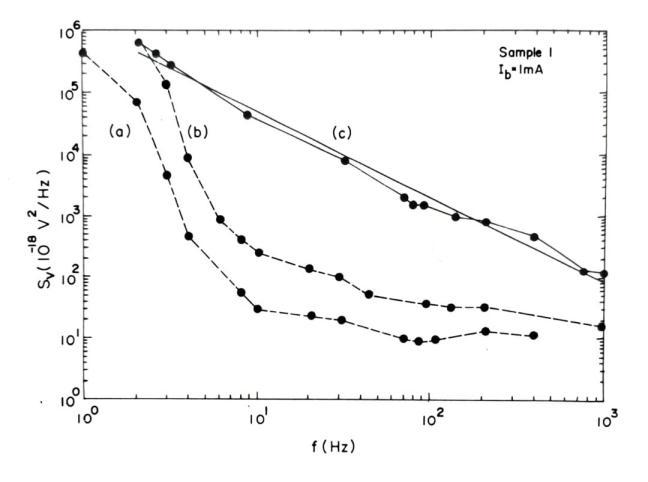
Figure 6 shows the voltage noise spectrum (Sv –f) of sample1measuredatthree differenttemperatures86.6K, 100K and 300K. From the figure it is clearly evident that Sv(f) has 1/f dependence at low frequencies (<10Hz) for all the temperatures with close to 1. Above this frequency the spectra are dominated by frequency independent noise (white noise) at low temperatures (86.6K and 100K) which are in the superconducting transition region. At higher temperature i.e. in the normal statethenoisespectrashows1/f dependencethroughout themeasurementrangeoffrequency[18,25].
Thelowermagnitudeofnoisepeakintransitionregionfor sample 2 is due to the fact that this YBCO thin film is of very good quality; highly c-axis oriented and has higher Jc value ascompared with sample 1. The oriented nature of sample 2 is expected to give lower magnitude of noise, as there exists a large conduction anisotropy in the YBCO material. Also, in sample 2 the conduction is in the a-b planewhichreducesthescatteringofchargecarriers. The largernoisepeakobservedforsample1ispossiblydueto the enhanced scattering caused due to crystal imperfections as well as randomly aligned grains. The noise near the Tc onset appears to be associated with the thermalfluctuationandwiththefluctuationinthenumber ofcooperpairsduetoitsshortcoherencelength[2].Inthe lower part of the transition region superconductor grains are at random locations results in random distribution of currentdensitywhichnaturallyleadstopercolationeffects in this regime. The neighboring grains form superconducting islands via Josephson coupling and at lower temperature the percolation length of these islands is becoming larger. When the percolation length reaches thethicknessofthefilm,a3-D/2-Ddimensionalcrossover occurs[25].
Figure 6. Voltage noise spectrum (Sv –f) of sample 1 measured at three different temperature (a) 86.6K, (b) 100K and (c) 300K.
Figure 7 (a) & (b) shows the temperature variation of Sv (1Hz) for samples 1 and 2, respectively, measured with a bias current of 1mA. It has been observed that the magnitude of Sv in the normal state for both samples shows a gradual decrease with the decrease in temperature.Asthesuperconductingtransitionisreached the magnitude of Sv rises sharply and shows a noise peak. Below this temperature the magnitude of noise falls sharply [5]. Although, both samples showed a presence of noisepeakinthetransitionregionbutforthesample1we have observed two peaks one near Tc (onset) and other oneclosetoTc (0)(ieat83K).Magnitudeof Sv innormal stateforsample2issmallerbythreeordersofmagnitude thanthatofsample1.
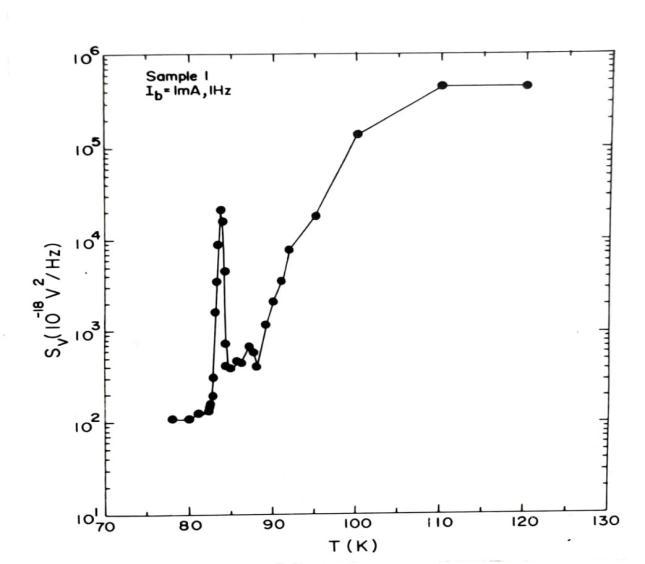
Figure 7(a) Temperature variation of Sv at 1Hz for sample 1 measured with a bias current of 1mA.
e-ISSN:2395-0056
Volume: 09 Issue: 11 | Nov 2022 www.irjet.net p-ISSN:2395-0072
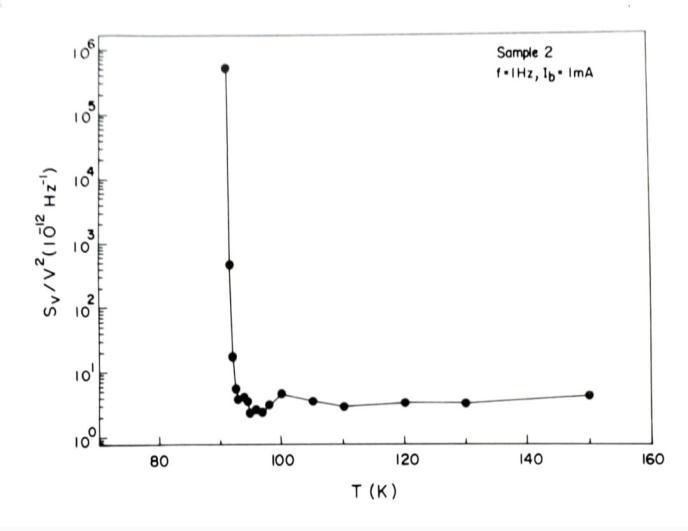
normal state and shows a sharp rise by several orders of magnitude as the transition temperature is reached. The enhancement of Sv/V2 in the superconducting transition regionisclosetofiveordersofmagnitude[24].
Figure 7(b) Temperature variation of Sv at 1Hz for sample 2 measured with a bias current of 1mA.
Near superconducting transition, the conductivity fluctuationsariseduetothefluctuationinthemobilityand density of the carriers [10]. At temperature < Tc (R=0), at lowbiascurrents,acontinuoussuperconductingpathexist which suggests that vortex motion is the source for noise inthisregion[22].Itisduetothermallyactivateddiffusive vortex motion and is enhanced by a strong Lorentz force due to the applied current [2,15,18]. The excess noise has been observed in granular and mixed orientation YBCO superconducting films as compared to high quality epitaxial c-axis oriented film [23]. The magnitude of spectralnoisedensityinc-axisorientedfilmsisabouttwo orders less than mixed oriented films. In c-axis oriented films, transport occurs through a set of parallel layers consisting of CuO2 planes (in a-b directions) and CuO chains (along the b direction). Oxygen depletion is known to create vacancies within the chains [9] The onedimensional chain leads to significant resistance fluctuations in the planes. Noise peak near transition temperature is more for sample 1, which has mixed orientation. Sample 1 has a larger electrical noise magnitude than sample 2, which is c-axis-oriented film. The improved noise performance of samples with large size grains is related to the presence of a smaller number of grain boundaries [23]. These grain boundary acts as Josephsonweaklinksandcontributetotheobservednoise
Thenormalizednoisevoltagespectral densitywasplotted for both samples Figure 8. shows the temperature dependence of normalized noise Sv/V2 for YBCO thin film sample 2. Magnitude of Sv/V2 remains constant in the
Figure 8. showsthetemperaturedependenceof normalizednoiseSv/V2 forYBCOthinfilmsample2.
The Hooge's parameter for two thin film samples are calculated using the carrier density Nc=1021/ cm3 at room temperature and experimentally observed value of Sv/V2 ThenumericalvalueofHooge’sparameter forthefilmsis comparable to that of metals [5]. The lowest value of measured at 300K was 0.004 in YBCO thin film deposited on SrTiO3 by dc magnetron sputtering technique (sample 1). It was found that the value of for sample 1 is lower than the single crystal value by a factor of 100. Table 3 shows the Hooge’s parameters for two YBCO thin film samples
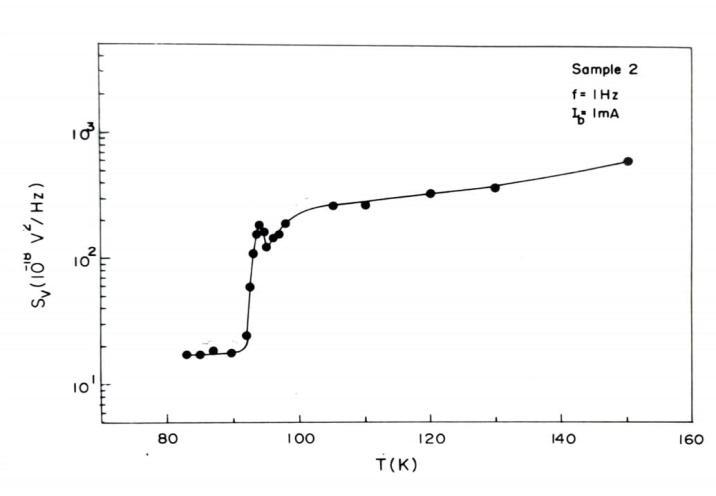
Table 3. The Hooge’s parameters for the two YBCO thin film samples
SampleNo. (100K) (120K) (300K)
1 2.35x10⁻² 2.34x10⁻¹ 4.21x10⁻³
2 2.2x10⁻¹ 1.5x10⁻¹ 5.6x10⁻²
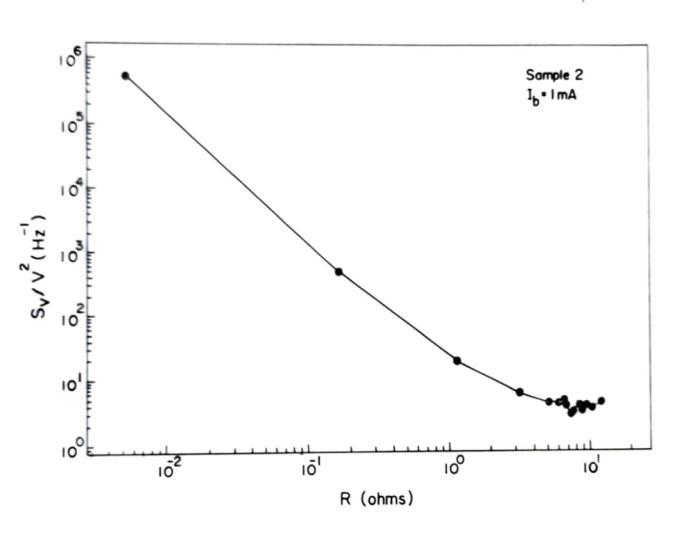
Figure 9 showsnormalizednoise(Sv/V2)versusresistance (R)onalog-logscaleatbiasingcurrent1mAforYBCOthin
e-ISSN:2395-0056
Volume: 09 Issue: 11 | Nov 2022 www.irjet.net p-ISSN:2395-0072
filmsample2.Thehighvalueofslope(k= 3)forsample2, is probably the result of superconducting islands whose thicknessisjustalittlelessthanthatofthefilmsothatitis approaching the 3-D model for the p noise [3,4,18]. This resultshowsthatthefilmisofhighquality.
[1] B.W. Ricketts, R. Driver and H. K. Welsh, “Low frequency excess noise in bulk Y1Ba2Cu3O7 samples” SolidStateCommun. 67 (1988)133
[2] M.Fardmanesh,A.RothwarfandK.J.Scoles.“Noise characteristics and detectivity of Y1Ba2Cu3O7 superconducting bolometers: Bias current, frequency and temperature”. J. Appl. Phys. 79(4) (1996)2006-2011
[3] L.B. Kiss, P. Svedlindh. “Noise in high-Tc superconductors. IEEE Transactions on Electron Devices” 41(11)(1994)2112-2122.
[4] J.H. Lee, S.C. Lee, Z.G. Khim. “Noise measurement near the transition region in thin film superconductor”. Physical Review B, 40(10) (1989)6806
[5] S.K.Arora.“1/fnoisepropertiesofswiftheavyion irradiatedepitaxialthinfilmsofYBCO”.Bulletinof MaterialScience, 22 (1999)251-255
We have studied the voltage noise both in normal and superconductingstateofYBCOthinfilms.Thedependence of low frequency excess noise power (Sv) on current confirmsthatthenoisearisesduetoresistancefluctuation. Atsuperconductingtransitiontemperature,themagnitude of spectral density of voltage noise Sv, rises sharply and showa noisepeak.Belowthistemperaturethemagnitude of noise fall sharply. Amplitude of the noise peak near superconducting transition temperature also found to decrease gradually as sample quality improves and disappears for best quality samples. The low noise level wasduetothebestlatticematchingbetweenthesubstrate and lesser number of grain boundaries The in-situ annealed c-axis oriented films has values ~ 0.004 at T=300K.ThemagnitudeofnormalizednoiseSv/V2 remains constant in the normal state and shows a sharp rise by several order of magnitude as transition temperature is reached.Thevariationofnormalizednoisewithresistance shows that the normal conductor superconductor percolationnetworkfitwellwiththetheoretical3-Dmodel for the p-noise. The larger k slope attributed to a 3-D model.Improveddepositionconditiondecreasesthenoise in c-axis oriented thin films by several orders of magnitude.Thec-axisorientedfilmwithhigh-Jc issuitable forfabricationofsuperconductordevices.
[6] N.V. Fomin, and D.V. Shantsev Pis’ma Zh Tekl. Fiz 20 (1994)9
[7] Y.Song,A.Misra,P.O.CrookerandJ.R.Gaines,“1/f noise and morphology of Y1Ba2Cu3O7 single crystal”.Phys.Rev.Lett. 66,(1991)825
[8] Y. Song, A. Misra, P.O. Crooker and J.R. Gaines, “Anisotropic 1/f noise and motion of magnetic vortices in Y1Ba2Cu3O7.”. Phys. Rev.B. 45, (1992) 7574
[9] D. Stanffer and A.Aharony. “Introduction to percolation theory”. Taylor & Francis, London,1992
[10] E.R. Nowak, “Flux-flow voltage noise and normal state resistance fluctuations in epitaxial (Dy, Y) Ba2Cu3O7 thinfilms”,PhysicaC, 421(2005)15-34
[11] M. J. Ferrari, M. Johnson, F.C. Wellstood, J. Clarke, P.A. Rosenthal, R.H. Hammond and M. R. Beasley, “Magnetic flux noise in thin film rings of Y1Ba2Cu3O7 ”.Appl.Phys.Lett 53 (1988)695
[12] L.B. Kiss, T. Larsson, P. Svedlindh, L. Lundgren, H. Ohlsen, M. Ottoson, J. Hudner and L. Stolt, “ConductancenoiseandpercolationinY1Ba2Cu3O7 thinfilms”.PhysicaC 207,(1993)318-332
Figure 9. Sv/V2 versus resistance R on a log-log scale at biasing current 1 mA for sample 2.International Research Journal of Engineering and Technology (IRJET) e-ISSN:2395-0056
Volume: 09 Issue: 11 | Nov 2022 www.irjet.net p-ISSN:2395-0072
[13] Shailaj Kumar Shrivastava, “Crystal structures of cuprate based superconducting materials” , International Journal of Engineering, Science and Mathematics(IJESM), 7(5)(2018)151-159
[14] R. F. Voss and John Clarke, “Flicker(1/f) noise: Equilibrium temperature and resistance fluctuations”Phys.Rev.B, 13 (1976)556
[15] R.D.Black,L.G.Turner,A.MognoCampero,T.C.Mc Gee and A.L. Robinson. “Thermal fluctuation and 1/f noise in oriented and unoriented Y1Ba2Cu3O7 films”.Appl.Phys.Lett. 21 (1989)2233
[16] M. B. Ketchen and J. Clarke, “Temperature fluctuations in freely suspended thin films at the superconducting transition”. Phys Rev. B, 17 (1978)114
[17] Z. Celik Butler, W. Yang and D.P. Butler. “Measurements of noise and temperature coefficient of resistance on Y1Ba2Cu3O7 thin films inmagneticfield”.Appl.Phys.Lett. 60 (1992)246
[18] J. Hall, PhD dissertation Univ. South Florida, Tampa, FL,1992; J.J. Hall, Tsong-Ming Chen. “ElectricalnoiseinYBaCuOsuperconductingthinfilms with differing axes of orientation”. IEEE TransactionsonElectronDevices. 41(1994)21282132
[19] F. N. Hooge, T. G. M. Kleinpenning, and L. K. J. Vandamme. “Experimental studies of 1/f noise” Rep.Prog.Phys. 44 (1981)479
[20] ShailajKumarShrivastava,“Depositiontechniques for high-Tc superconducting YBCO thin films” . InternationalJournalofEngineeringandScientific Research(IJESR) 5(6)(2017)33-43.
[21] Shailaj Kumar Shrivastava, “Measurement methods for determination of transition temperature of high-Tc superconductors” International Journal of Emerging Technologies and Innovative Research (JETIR), 5(10) 2018, 473-478


[22] M. J. Ferrari, M. Johnson, F.C. Wellstood, J.J. Kingston, T.J.Shaw and J. Clarke.”Magnetic flux noiseincopperoxidesuperconductors”.Journalof lowtemperaturePhysics, 94(1/2),1994,15-47.
[23] S.K.Arora,A.K.Gupta.”Effectofsamplequalityon 1/f noise in Y-Ba-Cu-O ceramics”. Solid State Comm. 90(7)(1994)417-420
[24] B.W. Ricketts, R. Driver and H. K. Welsh. “Low frequency excess noise in bulk Y1Ba2Cu3O7 samples”.SolidstateComm. 67(1988)133
[25] A.Jahanzeb,Z. Celik-Butler. “Low-frequency nose and hall effect measurements on Y1Ba2Cu3O7thin films” IEEE Transactions on Applied Superconductivity. 5(2)(1995)1416-1419
[26] A.V. Bobyl, M.E. Gaevski, I,A. Khvebtov, S.G. Konnikov, D.V. Shanteev, V.A. Solov’ev, R.A. Swiss A.D. Tkachenko ,”Resistance flicker noise and current percolation in c-oriented Y1Ba2Cu3O7films inthevicinityofTc ”.PhysicaC, 247 (1995)7-33
Shailaj Kumar Shrivastava worked as Research fellow at National Physical Laboratory, New Delhi and obtained hisPh.D.degreeinPhysicsfromDelhi University. His research work is related to superconducting thin film preparation, characterizations and study of harmonic generation in superconducting films. Presently,heis workingas PrincipalatAnugrahMemorial College, Gaya, Bihar (A Constituent Unit of Magadh University, Bodh Gaya). He has 26 years of teaching, administrative and research experience with more than seventy research papers publications in various Journals and conferences. He is member of several academic/professional bodies/associations/committees.
He got several awards including ‘Young Research Award’ atIUMRS-ICA-98heldatIIScBangalore.
Mr. Chandan Shrivastava is doing B. Tech from computer science engineering department at International Institute of Information Technology (IIIT), Hyderabad. He is interestedinsoftwaredevelopmentand technologyinnovations