International Research Journal of Engineering and Technology (IRJET) e-ISSN:2395-0056

Volume: 09 Issue: 11 | Nov 2022 www.irjet.net p-ISSN:2395-0072
International Research Journal of Engineering and Technology (IRJET) e-ISSN:2395-0056
Volume: 09 Issue: 11 | Nov 2022 www.irjet.net p-ISSN:2395-0072
¹Final Year Students, Department of Mechanical Engineering, Sathyabama Institute of Science and Technology, Chennai - 600119.
²Professors, Department of Mechanical Engineering, Sathyabama Institute of Science and Technology, Chennai –600119. ***
ABSTRACT - The objective of the research is to find the Brake Thermal Efficiency (BTE), Specific Fuel Consumption (SFC) of the Variable Compression Ratio (VCR) Engine and to reduce emissions by operating the VCR Engine using PRUNUS DOMESTICA METHYL ESTER as a biodiesel. Extraction and Transesterification process is done with PRUNUS DOMESTICA to get Methyl Ester and the Methyl Ester is mixed with diesel in proper composition. 100% of biodiesel cannot be used in the engine, since the investment on the biofuel will be higher. So, the biofuel is mixed with a pure diesel to get a biodiesel blend. Therefore, four samples are prepared with a proper ratio i.e., 90% of diesel and 10% of biofuel, 80% of diesel and 20% of biofuel, 70% of diesel and 30% of biofuel & 60% of diesel and 40% of biofuel. All the samples are tested in the Variable Compression Ratio Engine. The Specific Fuel Consumption (SFC), Brake Thermal Efficiency (BTE) and the emission characteristics from the Variable Compression Ratio Engine is noted. The graph is plotted and compared to get a better result of the engine’s performance using PRUNUS DOMESTICA METHYL ESTER as a biodiesel.
Key Words: VariableCompressionRatioEngine,Prunus Domestica Methyl Ester, Biodiesel, Specific Fuel Consumption,BrakeThermalEfficiency,Emission,Brake Power.
Today’sworldismostlydependentuponnon-renewable fuel sources for power generation. The research work focus on the enhancement of the efficiency of the Variable Compression Ratio Engine using Prunus Domestica Methyl Ester as a biofuel. The main goal is to improve combustion and fuel economy, to increase Brake Thermal Efficiency (BTE), to reduce Specific Fuel Consumption (SFC) and to reduce emissions like carbon monoxide(CO),carbondioxide(CO2),hydrocarbon(HC) and unburnt oxides of nitrogen (NOX). Biofuel plays a vital role in decreasing the limitation of the diesel. The experiment is operated on single cylinder, four stroke, variable compression ratio engine. The experiment is
done in various ratio of the biodiesel blend to get a betterefficiency.
WehavestudiedabouttheextractionofoilfromPrunus Domestica and Transesterification process of Prunus Domestica oil to get Prunus Domestica Methyl Ester [17].Efficiencyoftheengineperformance,mainlyvariable compression ratio engine’s performance with different typeofbiodieselsanddifferentcompressionratio[8-30]. The composition of the fuel blend is mixed in different ratiostogetmoreefficiencyhasbeenstudied.
Many Researchers conducted test on Variable Compression Ratio Diesel Engine fuelled with different types of biodiesels to evaluate the efficiency of engine characteristics [8-19].Inrecentyears,theinvestigations were done in single fuel method [8-18] and dual fuel method [19-29]. From the experiments the Specific BrakeThermalEfficiencyisincreased,slightlowerinthe Specific Fuel Consumption and reduction in emission characteristicsarecomparedwithpurediesel.
Biodiesel is prepared by using Prunus Domestica oil. TheoilfromP.DomesticaisconvertedintoMethylEster by Transesterification Process [2] and mixed with a diesel in proper ratio to obtain a proper biodiesel blend [19].
The biodiesel samples are to be tested in Variable Compression Ratio Engine to find Brake Thermal Efficiency (BTE), Specific Fuel Consumption (SFC) and Emissioncharacteristics.
The main objectives are
To reduce the emission from the variable compressionratiodieselengine.
Toincreasethequalityofthebiodiesel(↑BTE,↓ SFC).
To enhance the performance of the variable compressionratiodieselengine.
International Research Journal of Engineering and Technology (IRJET) e-ISSN:2395-0056
Volume: 09 Issue: 11 | Nov 2022 www.irjet.net p-ISSN:2395-0072
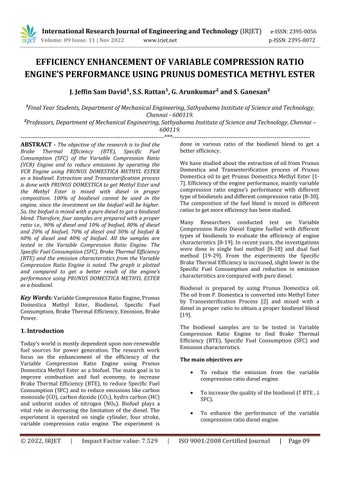
The European plum, Prunus Domestica as shown in Fig. 1.,isaspeciesoffloweringplantfromRosaceaefamily.It is a deciduous tree that encompasses a wide range of fruit trees that are commonly referred as plums in English, not all the plum varieties are members of this species. The Prunus Domestica subspecies also includes damsonsandgreengages.
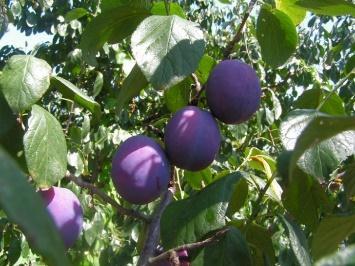
Diesel engine is a type of internal combustion engine where the ignition of fuel occurs without a spark as a result of compression of the input air and subsequently injection of fuel, diesel fuel is especially made to use in compressionengine.DieselfuelasshowninFig.2.hence requiresgoodcompressionignitionproperties.
Fig. 2. Diesel Fuel









International Research Journal of Engineering and Technology (IRJET) e-ISSN:2395-0056
Volume: 09 Issue: 11 | Nov 2022 www.irjet.net p-ISSN:2395-0072
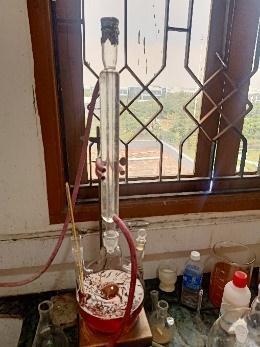
The process of transesterification involves in the reaction of a oil with an alcohol to produce esters and glycerol. The reaction rate and yield are enhanced with theapplicationofacatalyst(5gramofNaOH).Alcoholin excess is used to move the equilibrium to product side becausethereactionisreversible.
The process of allowance of non-edible oil to chemically react with alcohol is known as transesterification as shown in Fig. 3. They are readily available and inexpensive, ethanol and methanol are the most often employedalcoholsinthisprocess.Thisprocesshasbeen widelyusedtoturntriglyceridesintoesterandtolessen theviscosityofnon-edibleoil.
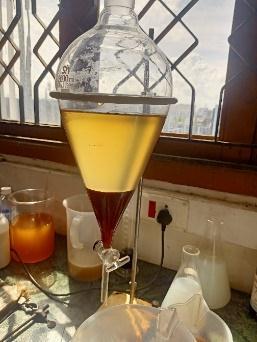
A separatory funnel as shown in Fig. 4. is used to separate the immiscible liquids. Two layers are visible when two immiscible liquids are put into a separatory funnel. The top layer will contain the biodiesel and the lowerlayerwillcontainthecrudeglycerin.
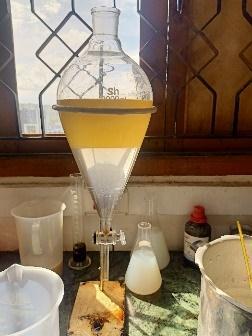
A biodiesel washing is a process of neutralizing the biodieseltoneutral(PHvalueto7).Thisprocessisdone bymixinghotwater(105°C)andbiodieselinseparating funnel as shown in Fig. 5. Water and biodiesel are two immiscible liquids that are separated into two distinct layersinaseparatingfunnel.
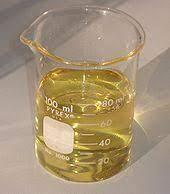
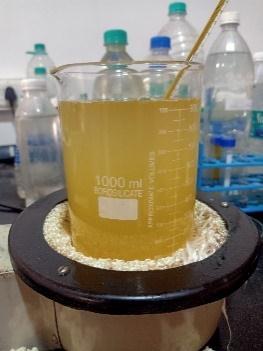
Prunus Domestic oil is trans-esterified into neat Prunus DomesticaMethylEster(PDME)asshowninFig.6
Domestica
Fig.3.TransesterificationCrudeFig. 4.SeparationofGlycerin
Fig.6.Biodiesel(PDME) Fig.5.BiodieselWashing
4. Properties of Prunus Domestica Methyl Ester
4.1. Free Fatty Acid
Oils and fats are hydrolyzed to make free fatty acids (FFA). As a result of the oils and fats being subjected to different environments, such as storage, processing, heating, or frying. The level of FFA is dependent on temperature,timeandmoisturecontent.
FFA= % =
FFA of Prunus Domestica oil = 0.846 %
4.2. Density
Densityisthemassofamaterialperunitvolume.Grams per cubic centimeter is the unit of measurement for
International Research Journal of Engineering and Technology (IRJET) e-ISSN:2395-0056
Volume: 09 Issue: 11 | Nov 2022 www.irjet.net p-ISSN:2395-0072
density. A liquid's density is a gauge of how heavy it is relativetotheamountisbeingmeasured.Theliquidthat weighs heavy is more denser if you weigh two liquids with similar volume or amount. A substance that is less densethan water that will floatifit isgentlyintroduced tothewatersurface.
Density = g/cm³ = Density for PDME = 0.884 g/cm³
The physical quality of kinematic viscosity is very important for biodiesel. It directs the whole combustion ofthefuelinthedieselengine.Temperature,theamount of double bonds, and the number of carbon atoms all affectthekinematicviscosityofthebiodiesel.
Viscosity=Timeinseconds×0.014(diameter) =312×0.014
Viscosity for PDME = 4.368 cSt
Theterm"moisturecontent"(MC)referredtohowmuch moisture is present in a given sample. This value is expressed as a percentage of the mass of the substance. There are numerous ways to measure how much moistureispresentinanobject,suchasmoisturemetres oroven-drytests.
WeightofSamplewithCrusible=WeightofEmpty Crusible+WeightofSample
WeightofEmptyCrusible=22.60g
WeightofSample=5.02g
WeightofSamplewithCrusible=22.60+5.02=27.62g
MoistureContent= ×100% = ×100
Moisture Content for PDME = 0.254 %
To determine how corrosive sulphur compounds are in biodiesel, scientists use the copper strip corrosion test (CSCT). When performing the CSCT, a strip of clean, polished copper is submerged in a biodiesel for a predeterminedamountoftimeataspecific temperature before being "rated" against a standard as shown in Fig. 7.
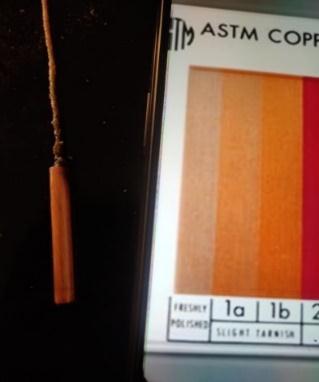
Corrosion Test for PDME = 1b
Calorific value, which is calculated by the complete burning of a predetermined quantity under constant pressureandundersometypicalcircumstances Itisthe amount of heat energy present in fuel. It isadditionally knownascalorificpower.
CalorificValue= –(En+Ec)cal/g where,
Mw=Massofwater,g
Cw =Specificheatcapacityofwater,cal/g°C
W =Waterequivalent,cal/°C
Tr =Temperaturerise,°C
Ms=Massoffuelsample,g
En =Energyequivalentcalculatedwithrespectto nichromewire,cal/g
Ec =Energyequivalentcalculatedwithrespecttocotton thread,cal/g
= –(2.3+3600)
International Research Journal of Engineering and Technology (IRJET) e-ISSN:2395-0056
Volume: 09 Issue: 11 | Nov 2022 www.irjet.net p-ISSN:2395-0072
Calorific Value for PDME = 7663.9 cal/g
The cloud point is a temperature at which a clear solution either experiences a liquid to liquid phase separation to create an emulsion or a liquid to solid phase transition to produce a stable sol or a suspension that precipitates. The cloud point is comparable to the "dew point," which is the temperature at which water vapour (humid air) undergoes a gas to liquid phase transition known as condensation to generate a liquid water(deworclouds).Thedewpointbecomesthefrost point when the temperature drops below 0 °C, when water vapour transitions from a gas to a solid state knownasdeposition,solidification,orfreezing.
Cloud Point of PDME = -9 °C
The temperature below which a liquid substance loses its ability to flow is known as the pour point. It is described as the lowest temperature at which oil can pourdownfromabeaker.
Pour Point of PDME = -21 °C
Flash point is the lowest temperature at which a liquid (oftenapetroleumproduct)willproduceavapourinthe atmosphere at its surface that will "flash," or momentarily ignite when in contact with a flame. The flash point is a indicator of a liquid's combustibility or flammability.
Flash Point of PDME = 176 °C
A volatile combustible substance's fire point is the lowest temperature at which its vapour continues to burn in the atmosphere as when heating after the flash pointhasbeenfound
Fire Point of PDME = 184 °C
Prunus Domestica Oil is produced from Prunus Domestica seed. The Methyl Ester is extracted from the Prunus Domestica Oil. By transesterification process the oilisconvertedintobiodiesel.
For this experiment, four samples of biodiesel are preparedwithdifferentratio.
SAMPLE
S1 90% 10%
S2 80% 20%
S3 70% 30%
S4 60% 40%
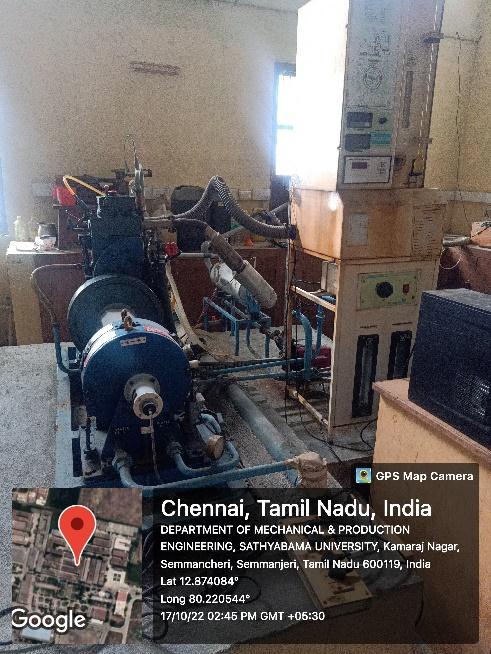
An electric start, single-cylinder, four-stroke diesel enginewithavariablecompressionratioiscoupledtoan eddy current dynamometer for loading. By using a specifically created tilting cylinder block arrangement, the compression ratio can be altered without stopping the engine and without changing the geometry of the combustion chamber. The setup comes with the tools required to measure crank angle and combustion pressure. ForPPVdiagrams, these signalsare interfaced to the computer via the engine indicator. Additionally, there is room for the interface of load monitoring, temperature, fuel flow, and airflow. A stand-alone panel box with an air box, two fuel tanks for a blend test, a manometer, a fuel measuring unit, transmitters for measuring the flow of both air and fuel, a process indicator, and an engine indication are all part of the setup Rotameters are provided for cooling water and calorimeterwaterflowmeasurement.
International Research Journal of Engineering and Technology (IRJET) e-ISSN:2395-0056
Volume: 09 Issue: 11 | Nov 2022 www.irjet.net p-ISSN:2395-0072
The configuration allows for the investigation of the brakingpower,indicatedpower,frictionalpower,BMEP, IMEP, mechanical efficiency, volumetric efficiency, specificfuelconsumption,A/Fratio,andheatbalancefor VCR engines as shown in Fig. 8. with EGR. For online performance assessment, the Labview-based Engine Performance Analysis software package "Enginesoft" is offered.
A computerized Diesel injection pressure measurement isoptionallyprovided
Features
Compression Ratio could be changed without stoppingtheengine
NoalterationinCombustionchambergeometry
WatercooledEGR
Electricstartwithbatteryandcharger
Arrangementforblendtest
PΘ-PV plots, performance plots and tabulated results Data logging, editing, printing and export,Configurablegraphs
IP,IMEP,FPindication,combustionanalysis
Range of Experiments
StudyofVCRengineperformance(Computerizedmode)
StudyofemissionswithEGRvariation
Studyofcombustionwithdifferentfuelblends
Study of pressure volume plot and indicated powerHighCRLowCR
Utilities Required
Electric supply
230+/-10VAC,50Hz,1phase
Computer
IBMcompatiblewithstandardconfiguration
Water supply
Continuous,cleanandsoftwatersupply@1000 LPH, at 10m.head.Providetapwith1”BSPsizeconnection
Apex Innovations Pvt. Ltd. created the Labview-based software package EngineSoft for engine performance monitoringsystems.
Most engine testing application demands, such as monitoring, reporting, data entering, and data logging, can be met by EngineSoft. The computer programme assesses power, efficiency, fuel use, and heat release. It canbealtereddependingontheenginesetup.
Different graphs are produced under various operating conditions.Therequiredsignalsarescanned,saved,and showninagraphwhiletheengineisbeingtestedonline in the RUN mode. In order to examine the data in graphical and tabular modes, a stored data file is accessed. Printing the results and graphs is an option. You can utilise the data in excel format for additional analysis.
International Research Journal of Engineering and Technology (IRJET) e-ISSN:2395-0056
Volume: 09 Issue: 11 | Nov 2022 www.irjet.net p-ISSN:2395-0072
Product VCR Engine test setup 1 cylinder, 4 stroke, Diesel with EGR (Comp.)
Product Code 234
Make Kirloskar, Type 1 cyl., 4 stroke Diesel, water cooled, power 3.5kW at 1500rpm, stroke 110mm, bore 87.5mm. 661cc, CR17.5, Modified to VCR engine CR 12 to 18. With electricstartarrangement,batteryandcharger
Dynamometer Typeeddycurrent,watercooled, Propeller shaft Withuniversaljoints
Air box MSfabricatedwithorificemeterandmanometer
Fuel tank Capacity15litwithglassfuelmeteringcolumn
Calorimeter TypePipeinpipe
EGR Watercooled,SS,Range0-15%
Piezo sensor Range5000PSI,withlownoisecable
Crank angle sensor Resolution1Deg,Speed5500RPMwithTDCpulse.
Data acquisition device NIUSB-6210,16-bit,250kS/s. Piezo powering unit ModelAX-409.
Temperature sensor TypeRTD,PT100andThermocouple,TypeK
Temperature transmitter RTDPT100,Range0–100oC,3Nos;Thermocouple,Range0-1200oC,2Nos
Load indicator Digital,Range0-50Kg,Supply230VAC
Load sensor Loadcell,typestraingauge,range0-50Kg
Fuel flow transmitter DPtransmitter,Range0-500mmWC
Air flow transmitter Pressuretransmitter,Range(-)250mmWC
Software “EngineSoft”Engineperformanceanalysissoftware
Rotameter Enginecooling40-400LPH;Calorimeter25-250LPH Pump TypeMonoblock Overall dimensions W2000xD2500xH1500mm
Optional Computerized Diesel injection pressure measurement with injection variation 0-25 deg BTDC
The Transesterification Process for Prunus Domestica OilisdonesuccessfullyandconvertedintoMethylEster Four Biodiesel samples has been prepared with proper ratios. The Biodiesel samples are yet to get tested in Variable Compression Ratio Engine to check the Efficiency of the Engine’s Performance and Emission Standards.
[1] Górnaś, P., Rudzińska, M., & Soliven, A. (2017). Industrialby-productsofplumPrunusdomestica L. and Prunus cerasifera Ehrh. as potential biodiesel feedstock: Impact of variety. Industrial Crops and Products, 100,77–84.
[2] González-García, E., Marina, M. L., & García, M. C. (2014). Plum (Prunus Domestica L.) by-product asa newandcheapsource ofbioactivepeptides:
International Research Journal of Engineering and Technology (IRJET) e-ISSN:2395-0056
Volume: 09 Issue: 11 | Nov 2022 www.irjet.net p-ISSN:2395-0072
Extractionmethodandpeptidescharacterization.
Journal of Functional Foods, 11,428–437.
[3] Mahmood, A., Ahmed, R., & Kosar, S. (2009). Phytochemical screeningandbiological activities of the oil components of Prunus domestica Linn. Journal of Saudi Chemical Society, 13(3),273–277.
[4] Niimi, J., Guixer, B., & Splivallo, R. (2020). Odour active compounds determined in the headspace of yellow and black plum wines (Prunus domesticaL.). LWT, 130,109702.
[5] Popov, S. v, Ovodova, R. G., Golovchenko, V. v, Khramova, D. S., Markov, P. A., Smirnov, V. v, Shashkov, A. S., & Ovodov, Y. S. (2014). Pectic polysaccharides of the fresh plum Prunus domestica L. isolated with a simulated gastric fluidandtheiranti-inflammatoryandantioxidant activities. Food Chemistry, 143,106–113.
[6] Kostić, M. D., Veličković, A. v, Joković, N. M., Stamenković, O. S., & Veljković, V. B. (2016). Optimization and kinetic modeling of esterificationoftheoilobtainedfromwasteplum stones as a pretreatment step in biodiesel production. Waste Management, 48,619–629.
[7] Reidel, R. V. B., Cioni, P. L., & Pistelli, L. (2017). Volatileemissionofdifferentplantpartsandfruit development from Italian cherry plums (Prunus cerasifera and P. cerasifera ‘Pissardii’). Biochemical Systematics and Ecology, 75,10–17.
[8] Banoth, B. N., & Kadavakollu, K. R. (2016). PerformanceandemissionofVCR-CIenginewith palm kernel and eucalyptus blends. Perspectives in Science, 8,195–197.
[9] Bapu, B. R. R., Ganesan, S., Mahalingam, S., Abinash, J., & Bharathwaj, R. R. (2021). Analysis of emission reduction in VCR diesel engine using urea based catalytic convertor. Materials Today: Proceedings.
[10] Channapattana, S. v, Kantharaj, C., Shinde, V. S., Pawar, A. A., & Kamble, P. G. (2015). Emissions and performance evaluation of DI CI-VCR engine fuelledwithhonneoilmethylester/dieselblends. Energy Procedia, 74,281–288.
[11] Chebattina, K. R. R., Vadapalli, S., Pathem, U. C., Sirasapalli, A., Lodagala, C. C., Billakurthi, S. M. S. R., Annamdevara, N. C. S., & Mohammad, A. R. (2021). H2O2 as fuel additive in bio-diesel for emission reduction and performance
enhancement of variable compression ratio (VCR) diesel engine. Materials Today: Proceedings, 47,5697–5700.
[12] Ganesan, S., Mohanraj, M., Kiranpradeep, N., & Saran,R.S.G.(2021).ImpactofDiisopropylEther on VCR diesel engine performance and emission with cashew shell oil using GRA approach. Materials Today: Proceedings
[13] Ganesan, S., Mohanraj, M., Hemanandh, J., & Sankar,S.L.(2021).ExperimentalstudiesonVCR diesel engine characteristics using camelina and lemongrass oil biodiesel with butylated hydroxytoluene as a nano additive. Materials Today: Proceedings
[14] Ganesan, S., Hemanandh, J., Venkatesan, S. P., Mahalingam, S., SenthilKumar, J., Padmanabhan, S.,&Raj,M.M.(2021).Studyofperformanceand emissions on VCR diesel engine fuelled with camphor oil and N-octanol as a nano additive. Materials Today: Proceedings
[15] Ganesan,S.,Mohanraj,M.,Khushal,S.,&Lokesh, S. (2021). Effect of tertiary butyl hydroquinone ondieselengineperformancefuelledwithlemon grassoil. Materials Today: Proceedings
[16] Kumar, T. A., Chandramouli, R., & Mohanraj, T. (2015).Astudyontheperformanceandemission characteristics of esterified pinnai oil tested in VCR engine. Ecotoxicology and Environmental Safety, 121,51–56.
[17] Nishanth, S., Gunasekar, N., Nanthakumar, S., Prakash, R., & Kumar, T. S. (2021). Experimental investigation on performance and emission characteristics of VCR engine working with biodiesel and Diethyl Ether. Materials Today: Proceedings, 45,836–840.
[18] Prabakaran, S., Manimaran, R., Mohanraj, T., & Ravikumar, M. (2021). Performance analysis and emission characteristics of VCR diesel engine fuelled with algae biodiesel blends. Materials Today: Proceedings, 45,2784–2788.
[19] Sanjeevarao, K., Pavani, P. N. L., Suresh, C., & Kumar, P. A. (2021). Experimental investigation on VCR diesel engine fuelled with Al2O3 nanoparticles blended cottonseed biodieseldiesel blends. Materials Today: Proceedings, 46, 301–306.
International Research Journal of Engineering and Technology (IRJET) e-ISSN:2395-0056
Volume: 09 Issue: 11 | Nov 2022 www.irjet.net p-ISSN:2395-0072
[20] Prabhahar,M.,Prakash,S.,George,I.,&Amith,K. K. (2020). Optimization of performance and emissioncharacteristicsof biodieselfuelledVCR engine using Taguchi approach. Materials Today: Proceedings, 33,859–867.
[21] Hoeltgebaum, T., Simoni, R., & Martins, D. (2016).Reconfigurabilityofengines:Akinematic approach to variable compression ratio engines. Mechanism and Machine Theory, 96,308–322.
[22] Ganesan, S., Mohanraj, M., Guruprakaash, R., & Logeshwar, S. (2021). Impact of bamboo and castor composite catalytic converter on VCR diesel engine emission using Wheat germ oil. Materials Today: Proceedings
[23] Ganesan, S., Mohanraj, M., Karthick, K., & Karthikeyan, M. (2021). Effects of Di Tertiary Butyl Ether fuel additives on diesel engine performance and emission characteristics using biodiesel. Materials Today: Proceedings
[24] Karaman,V.,Yildizhan,S.,Ozcanli,M.,&Serin,H. (2016). Calculation and optimizing of brake thermal efficiency of diesel engines based on theoretical diesel cycle parameters. International Journal of Engineering Technologies IJET, 2(3), 100–104.
[25] Rai, R. K., & Sahoo, R. R. (2020). Taguchi-Grey methodoptimizationofVCR engineperformance andheatlossesbyusingShorearobustabiodiesel fuel. Fuel, 281,118399.
[26] Sharma, M., & Kaushal, R. (2021). Performance and exhaust emission analysis of a variable compression ratio (VCR) dual fuel CI engine fuelled with producer gas generated from pistachioshells. Fuel, 283,118924.
[27] Mahesh,R.,Muthurajan,K.G.,&Senthilkumar,A. (2020).ExperimentalinvestigationofJujubeseed oil in VCR for different nozzles. Materials Today: Proceedings, 33,1198–1205.
[28] Parida,M.K.,Joardar,H.,Rout,A.K.,Routaray,I., & Mishra, B. P. (2019). Multiple response optimizations to improve performance and reduce emissions of Argemone Mexicana biodiesel-diesel blends in a VCR engine. Applied Thermal Engineering, 148,1454–1466.
[29] Singh, D., Sharma, D., Soni, S. L., Sharma, S., & Kumari, D. (2019). Chemical compositions, properties, and standards for different generationbiodiesels:Areview. Fuel, 253,60–71.
[30] Suresh,M.,Jawahar,C.P.,&Richard,A.(2018).A review on biodiesel production, combustion, performance, and emission characteristics of non-edible oils in variable compression ratio diesel engine using biodiesel and its blends. Renewable and Sustainable Energy Reviews, 92, 38–49.